In June, AMD overtook the predictive memory engine known as MEXT, which claims to offer upwards of 99% of the performance of a system with full DRAM capacity while running with as little as 25% of the physical DIMMs. The technology offloads cold memory pages to flash storage and uses an AI model to serve pages before they’re needed, and AMD says it plans to extend the tech across a wide swath of its IT infrastructure next year.
The pitch behind MEXT seems too good to be true. According to AMD and MEXT founder Gary Smerdon, the technology can cut the physical DRAM required in a server by 20% to 75% depending on the application and performance target. That missing memory still registers as installed DRAM to the OS. Instead of DRAM, however, MEXT uses relatively inexpensive flash storage to offload cold pages, flying them back in as they’re needed with an AI model. In some of AMD’s internal workloads, such as Synopsys PrimeTime, the company says it’s able to achieve 95% of the performance of a full server while running at 50% DRAM capacity with MEXT.
AMD has deployed MEXT internally on 145 servers, which it says will expand to 2,000 servers next year. In addition, the company has announced a partnership with HPE to bring MEXT to customers. Currently, we’re in phase 1 of the rollout, with some EPYC Venice servers carrying a “MEXT Ready” badge and a dedicated NVMe drive or bay for the offload. Phase 2 brings MEXT licenses out to these servers, as well as the RAM View application. AMD hasn’t said when Phase 2 will begin.
The AI-driven DRAM pricing surge impacts more than just gaming PCs, with enterprises also feeling the brunt of price increases, even if they aren’t running AI workloads. If MEXT is able to achieve what AMD claims, it could be transformative given the current market. Because of that, it’s worth understanding what exactly MEXT is, as well as what AMD claims it can do.
Although MEXT is exciting in concept, it’s obvious that AMD is taking a conservative approach to the rollout. Extraordinary claims require extraordinary evidence, after all. The applications of MEXT are currently narrow, though AMD says it’s expanding the workloads it’s using MEXT on with promising early results.
DRAM, Flash and an LLM
(Image credit: AMD)
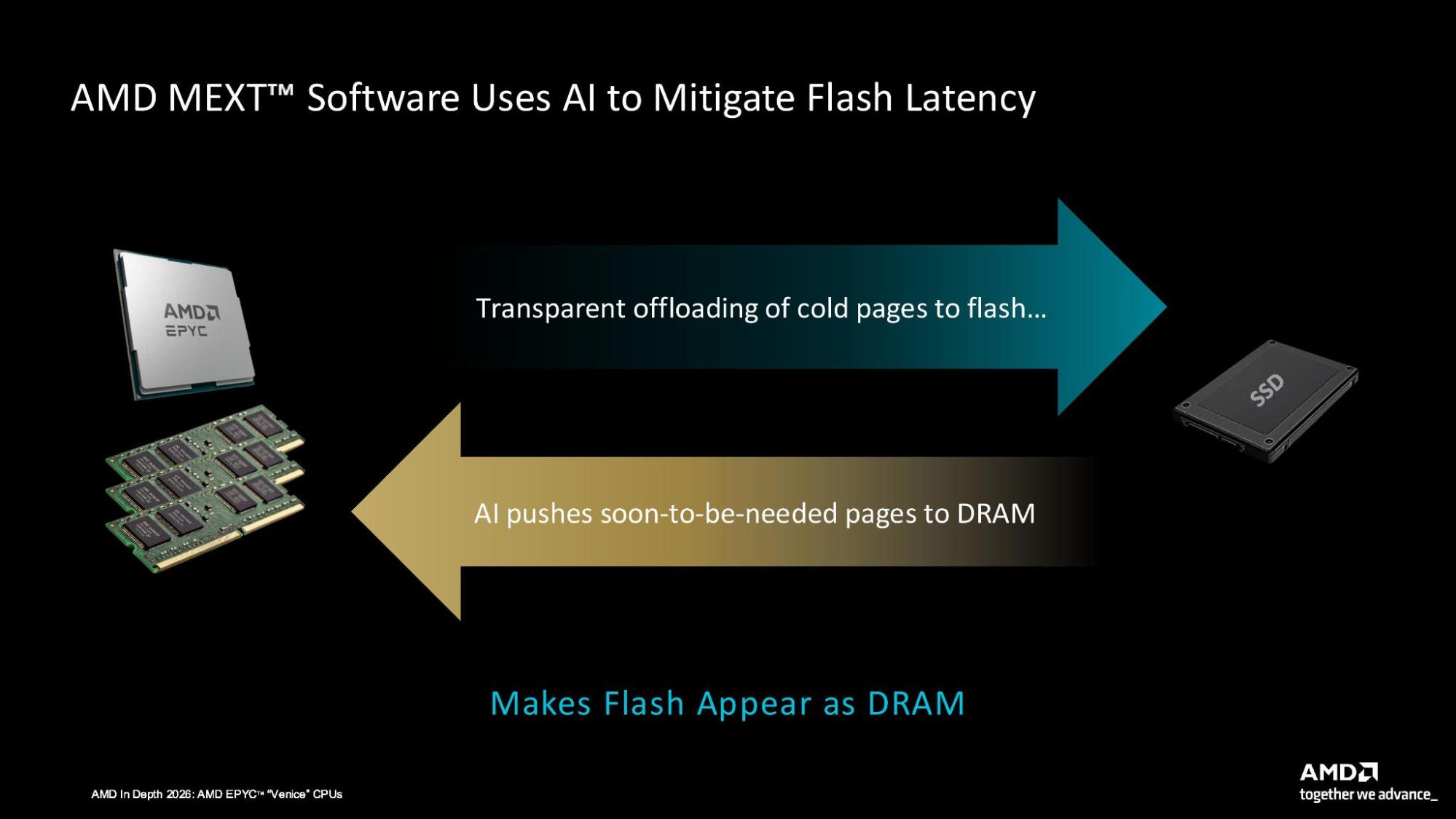
The basic setup of MEXT is simple in concept: cold pages go to flash, AI brings those pages back as needed, and it’s as if the memory was never missing in the first place. The main problem should be obvious. Flash is orders of magnitude slower than DRAM, so streaming pages back into memory from flash as they’re needed isn’t feasible. MEXT’s trick is using an AI model to predict the pages you’ll need. And, as long as the model is able to stay ahead by at least the transfer latency from the SSD, it’s as if the physical DRAM was installed the whole time.
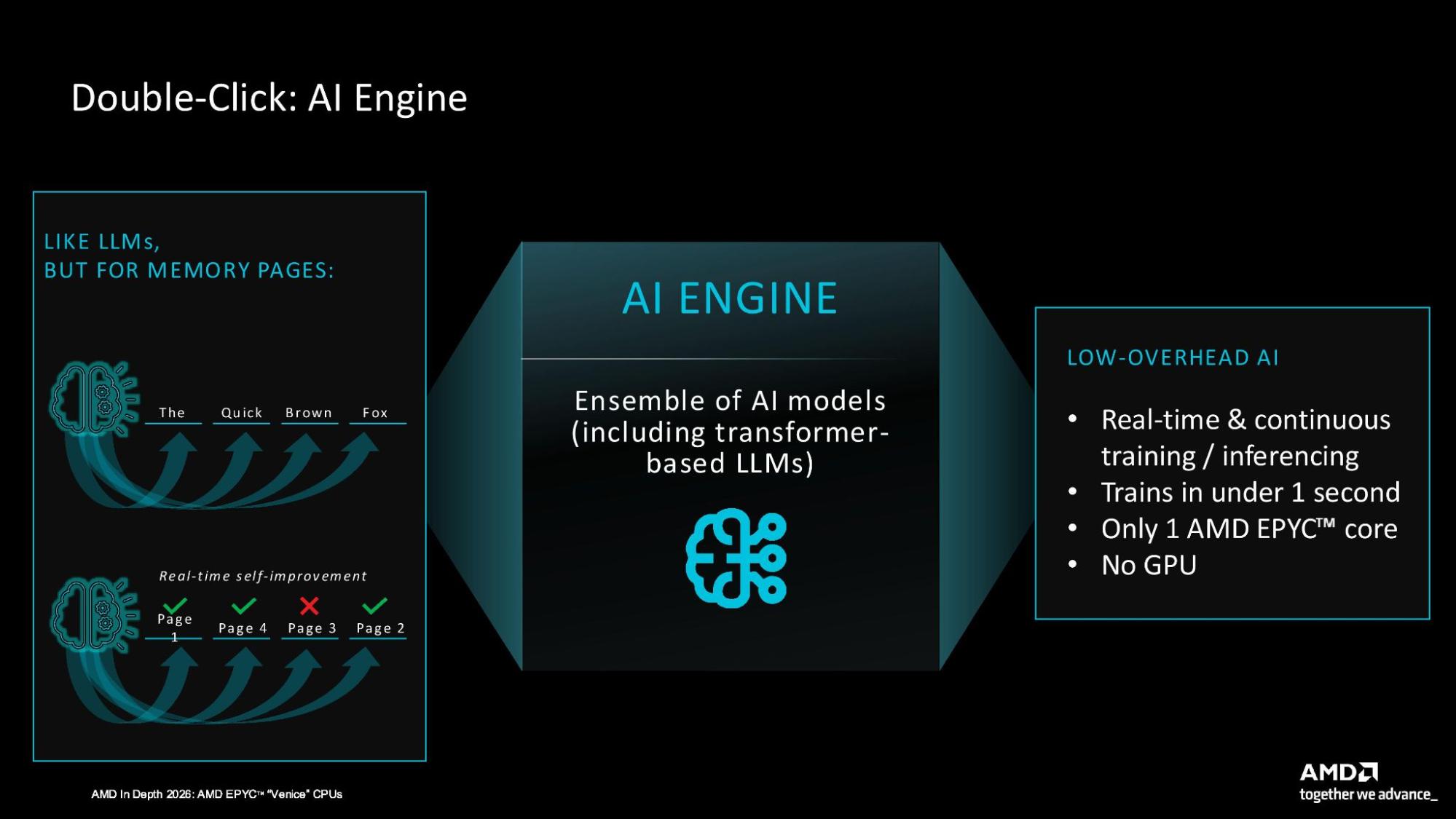
This isn’t a crazy concept considering how a transformer-based LLM, which MEXT uses, operates. If you’re unfamiliar with the inner workings, this open-source visualization breaks down the concept of a transformer AI model cleanly. The foundational concept is next token prediction, which underpins the design of modern LLMs. Given a set of tokens, the LLM determines which token (word, portion of a word, etc.) is most likely to come next. It makes a prediction. In the case of MEXT, it’s predicting what page is needed next, not what word comes next.
(Image credit: AMD)
Memory offloading to flash isn’t a new concept, but MEXT founder Gary Smerdon says that AI is the critical difference in this technology. MEXT itself is deployed as a Linux kernel module that works with any Linux distro. It uses an “ensemble of AI models,” with the primary transformer-based LLM driving the technology. And critically, it doesn’t come pre-trained.
Instead, AMD says that MEXT trains in under a second when first deployed, operates on one EPYC core without a GPU, and continually trains as the workload progresses. This approach makes sense given the varied workloads that MEXT may apply to. The idea is that it would learn the access patterns of the application in order to drive that prediction engine.
MEXT isn’t perfect, but it doesn’t need to be perfect in every situation. For instance, the order of stored pages isn’t important. With text, an LLM needs to predict the correct text in the correct order, but with MEXT, the order doesn’t matter. As long as the page is in DRAM when it’s needed, that’s fine.
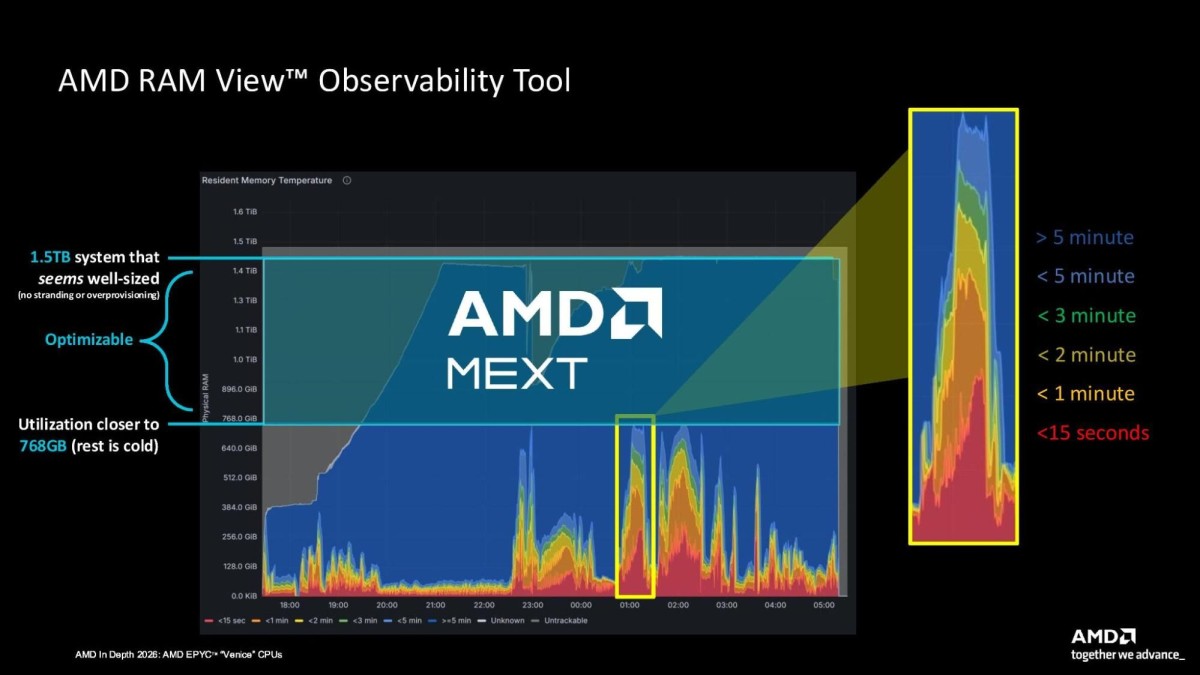
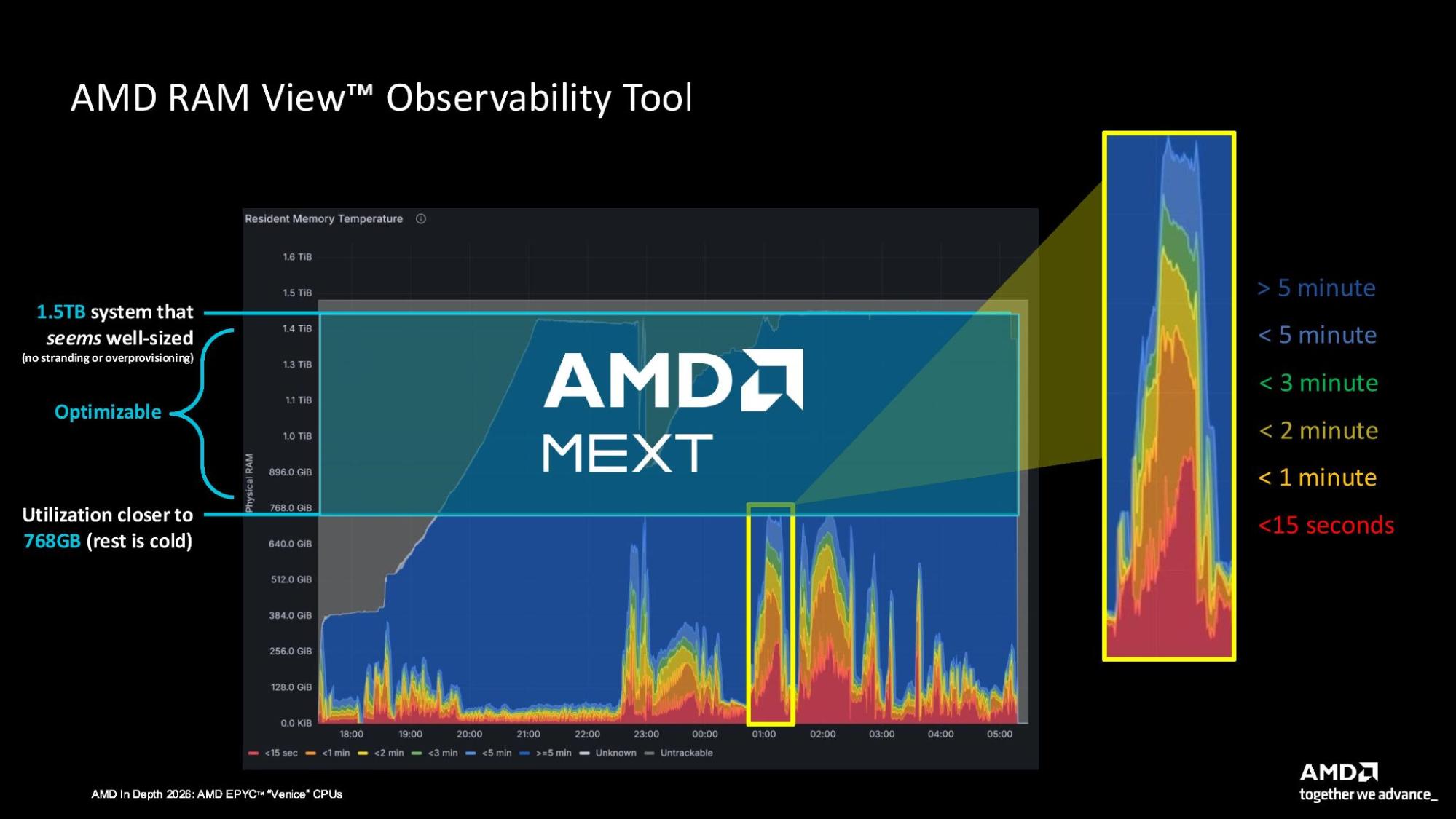
In order to understand the application of MEXT to different workloads, AMD has developed RAM View to go alongside the tech. It’s a memory utilization tool that shows which pages are hot and which have gone cold. As you can see from the example above, a system with 1.5 TB of memory shows near-full utilization across the full workload, but around half of the pages stored in memory haven’t been touched in five minutes or more at any given time.
AMD provided this generalized example and didn’t clarify what workload it was testing. That’s very important, as the utilization breakdown will look vastly different depending on the application(s) running on the server. Initially, AMD is applying MEXT to critical EDA applications it uses internally, such as Synopsys PrimeTime, but the company says it has focused on optimizing agentic AI, database, and media and entertainment workloads as well.
(Image credit: AMD)
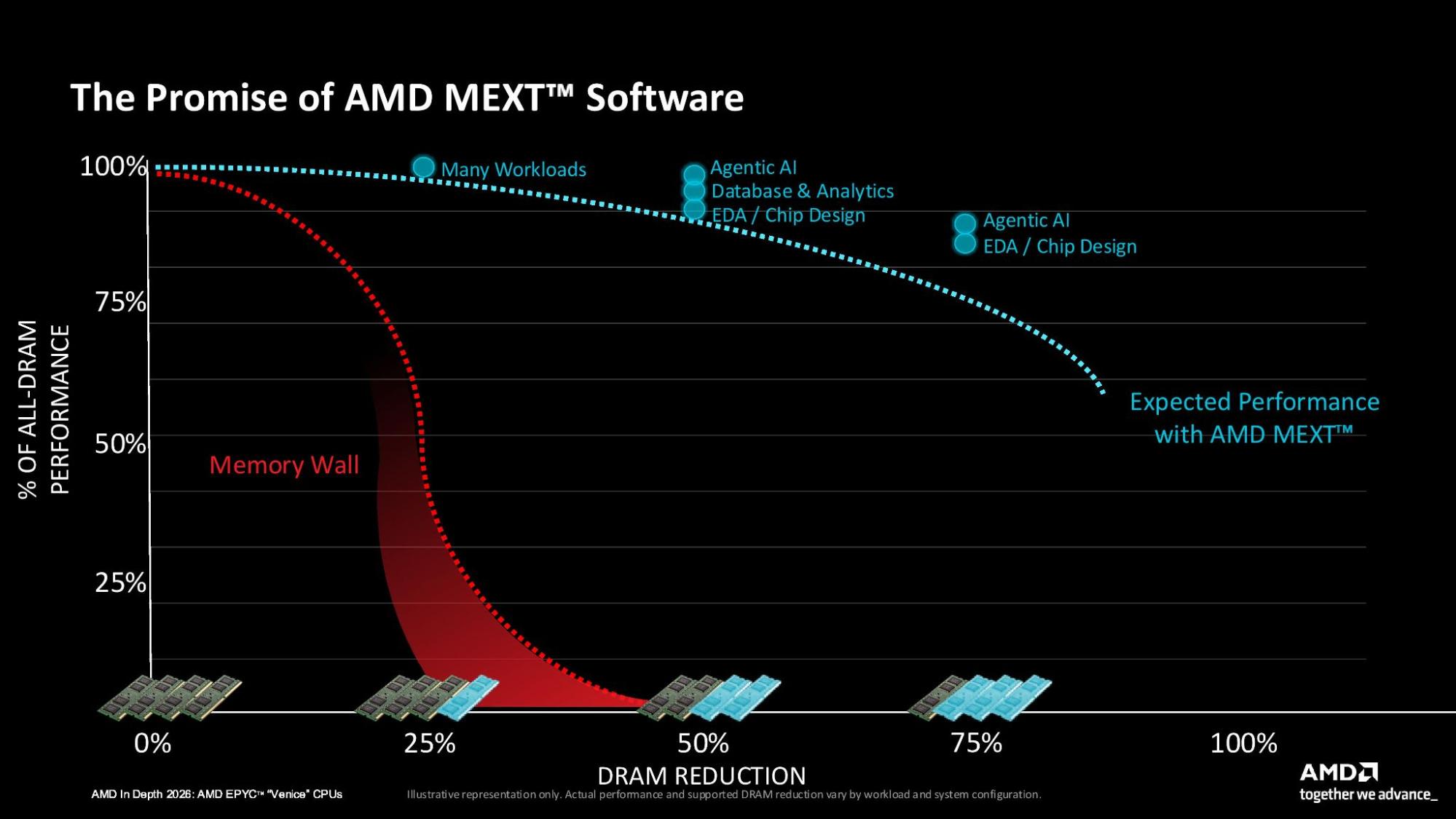
This is important not only because memory access patterns change between applications, but also because performance in those applications reacts differently when a system doesn’t have enough memory. The “memory wall,” as AMD calls it, should be a familiar concept regardless of whether you’ve ever touched a server. With MEXT, AMD says it’s trying to extend this memory wall, which may look different for different applications.
For instance, the company is confident that many workloads can reduce capacity by around 20% to 25%. As the reduction increases, however, the applications become more specialized, and the performance delta becomes greater.
AMD’s internal MEXT results
(Image credit: AMD)
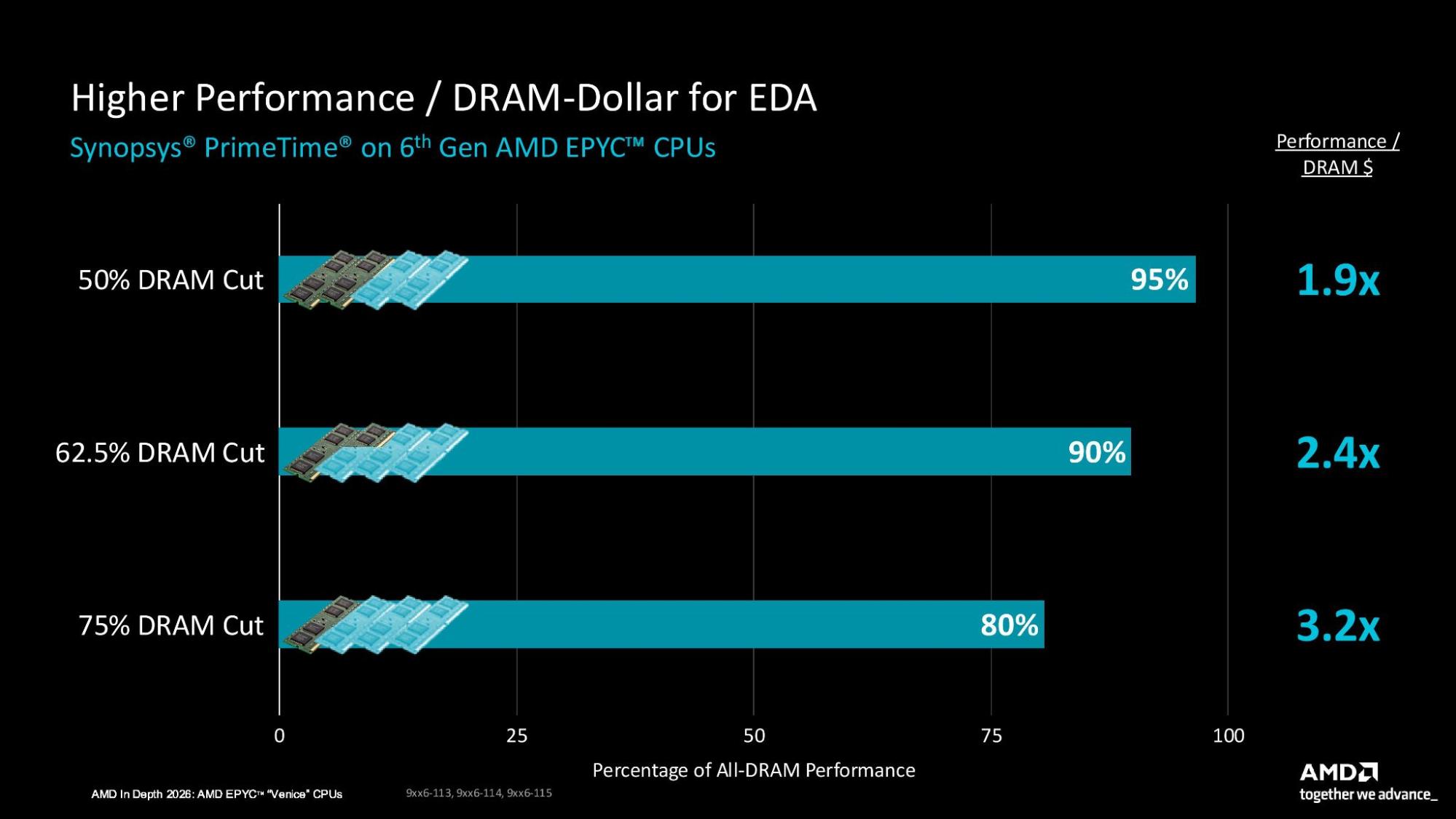
AMD has shared some internal MEXT results, which look impressive, though as usual, it’s always smart to handle first-party benchmarks like this with skepticism. Starting with PrimeTime, where AMD has focused much of its attention on MEXT up to this point, it says servers running at 50% capacity retain 95% of the performance of a full server, and going down to as little as 25% capacity still maintains 80% of the application’s performance.
(Image credit: AMD)
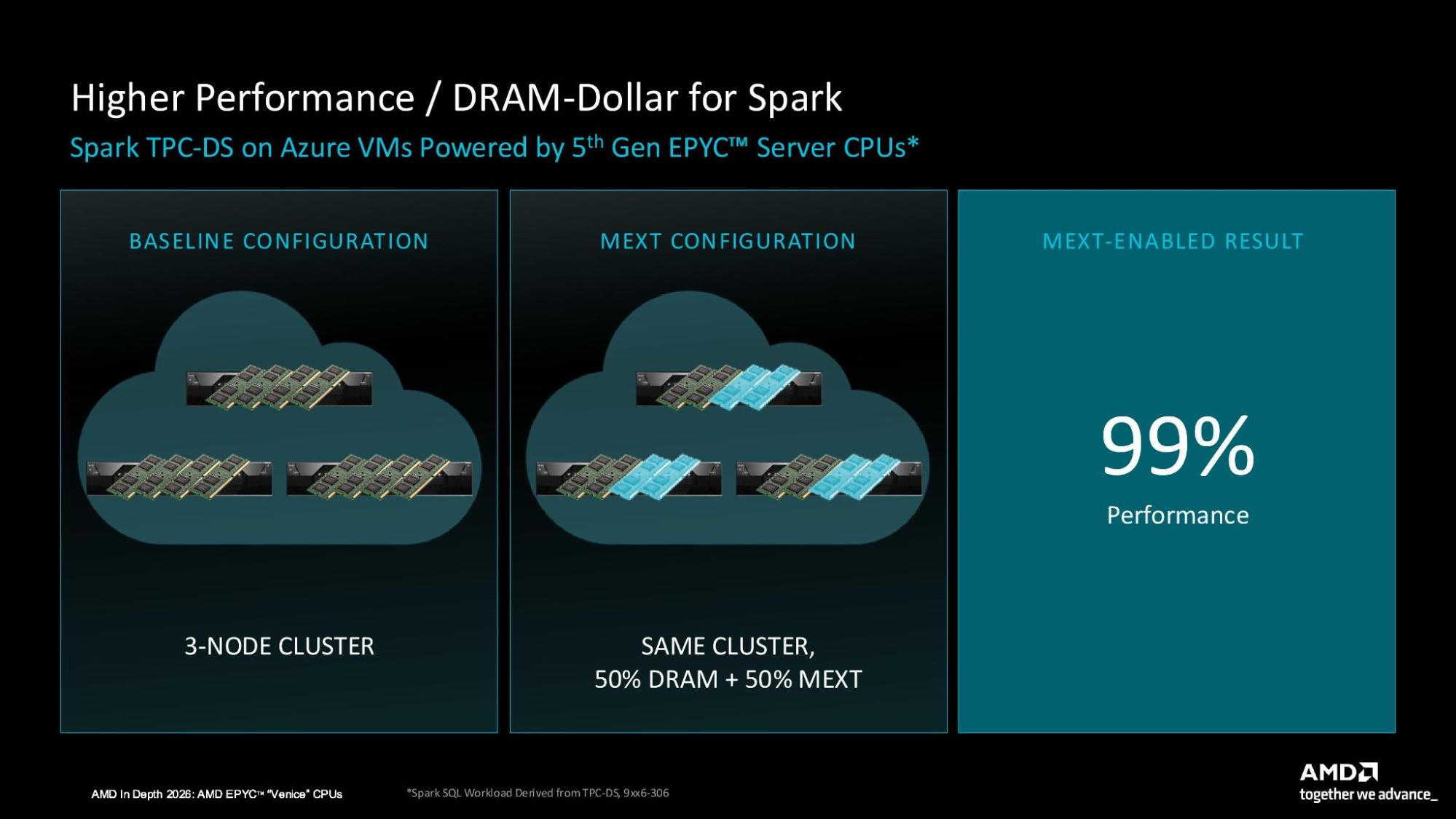
PrimeTime demands a lot of memory for large designs. There are some applications where performance is nearly identical, according to AMD. In a 3-node cluster running in Azure with 5th-gen EPYC CPUs, AMD says MEXT offers 99% of the performance of the full cluster while running at 50% DRAM capacity with the Spark SQL workload from the TPC-DS benchmark. SQL databases try to cache as much data as possible in memory to prevent I/O bottlenecks, creating a golden opportunity for tech like MEXT that wants to free cold pages.
(Image credit: AMD)
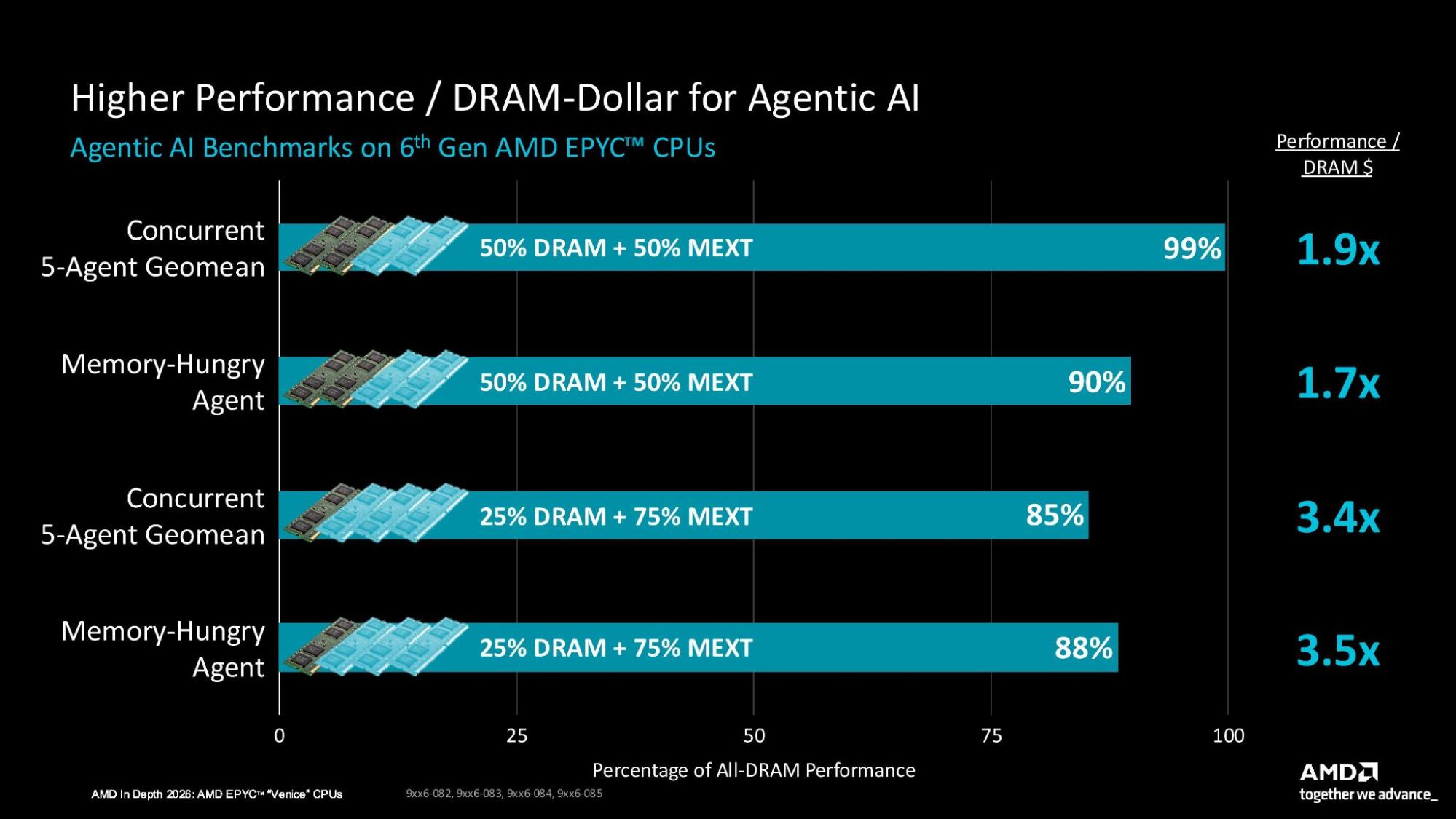
Perhaps the most applicable workload at the current moment, however, is agentic AI, and AMD says MEXT has similar applications there. Across a five-agent concurrent geomean, AMD claims 99% of the performance of a full server with 50% memory capacity, and 85% of the performance with 25% capacity. With a “memory-hungry” agent, AMD claims 90% and 88% performance for 50% and 25% capacity, respectively.
The slide you can see above has footnote tags. However, AMD has not shared the footnotes with us yet, so we don’t have a view into how these tests were run. Naturally, we assume AMD has, at minimum, represented the performance of MEXT in the best light possible. We can’t do a full analysis without knowing how the tests were run, however.
What is interesting is AMD’s cautious approach to rolling out MEXT. It’s an EPYC-exclusive feature right now, though AMD left the door open for support on future products (consumer devices, such as Strix Halo) far down the road. It will be sold as a license, bundled with the RAM View software, but we don’t have a timeline on when that will happen. And, despite a partnership with HPE to push out “MEXT Ready” servers, we still don’t know when MEXT itself will be ready for deployment beyond AMD’s walls.
Given that conservative approach, there are likely pitfalls to MEXT that we’re not seeing yet, and it’s hard to imagine it will be broadly applicable to every server, at least at the 50% and 25% DRAM capacity levels that AMD showed off with its benchmarks.
However, even being able to trim 25% of a server’s DRAM capacity represents a massive cost savings in the current supply-constrained environment. If some workloads can push that to 50% capacity, that’s even better. Of course, we’ll need to see how MEXT holds up once it’s available broadly, but if AMD’s claims hold water, it could become a defining technology in data centers that can’t seem to get enough memory.
Jake Roach is the Senior CPU Analyst at Tom’s Hardware, writing reviews, news, and features about the latest consumer and workstation processors.


 (Image credit: AMD)
 Like
0
 Dislike
0
 Love
0
 Funny
0
 Wow
0
 Sad
0
 Angry
0









Comments (0)