

Another World review: a stunning animated movie with an incredibly ugly story

Published Jun 7, 2026, 8:31 AM EDT
The Golden Horse winner is Hong Kong's highest grossing animated film of all time
 Image: GKIDS
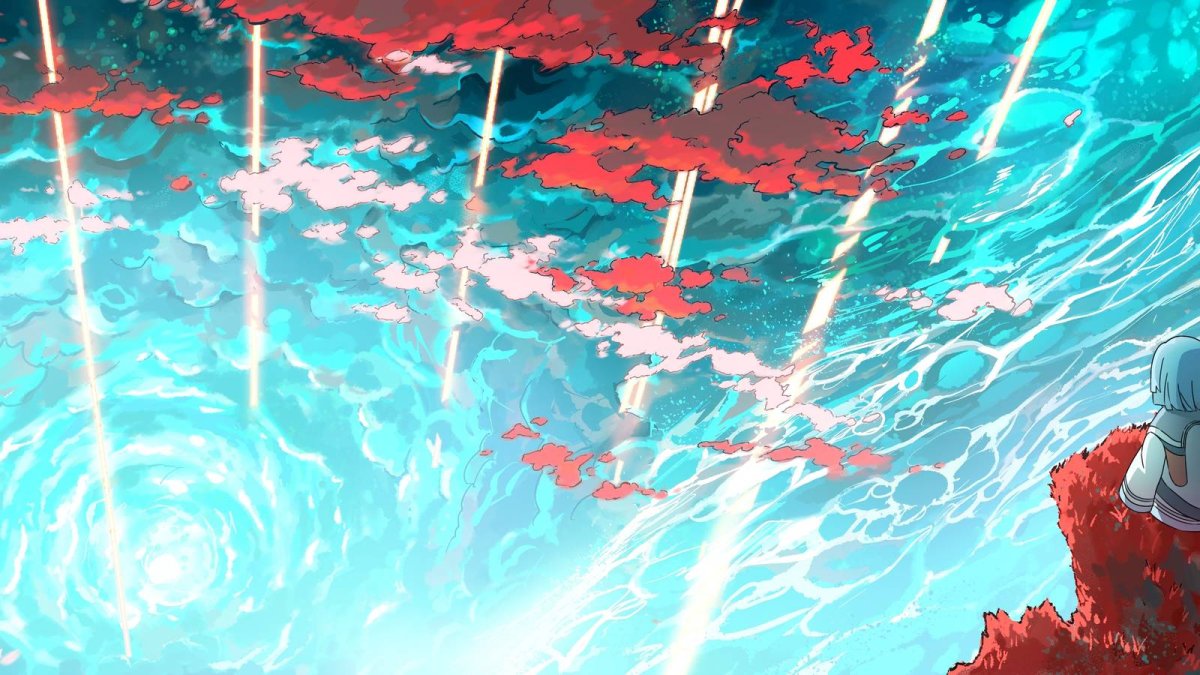
The Golden Horse-winning animated Hong Kong movie Another World is going to be glorious in theatrical release. A significant part of the film takes place in an afterlife realm called simply Another World, which seems to be composed solely of elaborate, poster-worthy fantasy biomes. Giant ice islands embedded with purple crystals and linked by bands of orange light hang in the sky above a glacier-covered mountain. Glowing rivers of light run like veins through a jewel-toned pink-and-blue cavern full of what might be stone trees reaching from floor to ceiling. A time-stopped nighttime ocean terminates in a massive curling wave that links with itself to create a perfect circle the size of a mountain. It’s unclear why any of these things exist in Another World, except to provide spectacle — but the spectacle is magnificent.
Another World is also a much-needed break from Another World’s heavy themes and endlessly grim reveals. Tommy Ng and Polly Yeung’s adaptation of Naka Saijō’s novel Thousand Year Ghost (sometimes translated as Millennium Ghost) jumps between stories that show people at their darkest moments, and humanity at its cruelest. At times, it feels like a condemnation of human history, to the point where its small messages of hope and forgiveness seem misguided and naïve. The focus on positivity in the wake of incredible horrors is a life-affirming message, but the film around it is exhaustingly sad at times.
Another World initially presents two stories in parallel. In one, a diminutive, masked, childlike figure named Gudo operates as a “soulkeeper” in Another World, tasked with guiding the spirits of the recent dead to give up their memories of life and embrace reincarnation. His latest assignment is a perky young girl named Yuri who refuses to release her memories until she finds her missing brother Kenji. That story interleaves with another narrative about a recently orphaned princess named Goran whose kingdom, Flower City, is on the verge of being overrun by the violent country of Nyer. Her people have lost faith in her, and her uncle seems to be conspiring to seize control of the nation. When Gudo appears to Goran, he doesn’t initially seem to know how to help with either problem.
A third storyline soon pushes in, from later in Gudo’s history, when Flower City has fallen, and a young farmer named Keung is watching his village starve under Nyer’s oppression. In a desperate bid to save his people, Keung travels to a forbidden shrine and offers himself as a sacrifice, asking the shrine’s powers to make him into a monster called a Wrath so he can kill the invaders.
One link running through these three stories is that Yuri, Goran, and Keung all have a “Seed of Evil,” the result of unresolved resentments human souls bring into their next reincarnation. When a soul with a Seed of Evil experiences extreme rage and frustration, it can blossom, turning them into a Wrath — a mindless, destructive monster that kills everyone around it, producing more souls with unresolved resentments, and potentially threatening Another World. All three of these characters face tremendous suffering, and Gudo tries to intercede with all three of them, pushing them toward conscious, constructive choices instead of inchoate fury. There’s another link between the stories as well, but doesn’t become clear until late in the film, as the full narrative comes into focus.
All three of their stories are relentlessly grim, with a focus on mutilation and murder, war, starvation, torture, slavery, child death, suicide, and even more horrific topics. The details of each case make Another World a difficult watch, along the lines of watching the child protagonists of Isao Takahata’s Grave of the Fireflies suffer, starve, and die during World War II.
 Image: GKIDS
Gudo’s well-meant bravery in trying to stand between his clients and their own ragged emotions is difficult to watch as well. He’s an impassioned little hero, but not a particularly eloquent one. Gudo starts the movie by explaining that he’s never been human and doesn’t understand any of their experiences. Most of his attempts to intervene whenever a new Seed of Evil opens turn into reminders of how limited his comprehension is. He understands the results — a new Wrath being born — but not the causes. So his attempts to console his weeping, disintegrating clients mostly consist of either wailing a character’s name over and over or yelling variants of “No!” and “Stop!” at his bodyguard Dark Sky, a smoke-headed, four-armed dervish who keeps trying to kill Gudo’s clients.
Dark Sky represents an extreme of judgment and distrust. He wants to slaughter any human with a Seed of Evil, to ensure no Wrath is ever born. Gudo, meanwhile, represents an equally extreme pole of love and optimism, frequently putting his own wee body between his disintegrating clients and Dark Sky’s blades. These poles give Another World their central tension, but also make a lot of the story’s supernatural side feel redundant, as the two representatives of Another World scream the same things at each other over and over.
What their battles for human souls lose in verbal nuance, director Tommy Ng (founder of animation house Point Five Creations) makes up for in kinetic action. Another World features some breathtaking battles, where characters whisk through the sky, clashing and colliding, as the camera swirls dramatically around them. Yeung’s script uses story-within-story mechanics to make sure the audience sees exactly what horrors a Wrath is capable of, and to add extra scenes of high-flying, dramatic combat. The action scenes are creatively staged, energetic, and exciting, and the fully sprouted Wraths are strikingly creepy.
 Image: GKIDS
But there is a sense that there’s something missing in all this — a more cogent, lyrical defense of surrendering anger in the wake of so much suffering, perhaps or a clearer explanation of Seeds of Evil, which work much better as a broad, abstract metaphor than a plot-driving magical item. Or perhaps the movie could just use a slightly kinder balance between atrocity and uplift. “Don’t give in to anger, it turns you into an unreasoning monster” is a worthwhile message for any age.
But Another World gives short shrift to any response to suffering other than, “Die, be reborn, and forget what you just went through.” The film is a visual extravaganza worthy of the biggest screens, and it comes with a lot of breathless thrills. But wild, mind-boggling landscapes and white-knuckle fight sequences don’t quite counteract the sense that the movie’s big-swing message about hope is dwarfed by the agony it inflicts on its characters.
Another World opens in American theaters on June 5.
What's Your Reaction?
 Like
0
Like
0
 Dislike
0
Dislike
0
 Love
0
Love
0
 Funny
0
Funny
0
 Wow
0
Wow
0
 Sad
0
Sad
0
 Angry
0
Angry
0







Comments (0)