

Apple’s new Child Safety features ‘don't get to where the harm is happening,’ online safety expert says — pushing responsibility to iPhone app developers poses a ‘huge risk’ to kids despite ‘genuine progress’
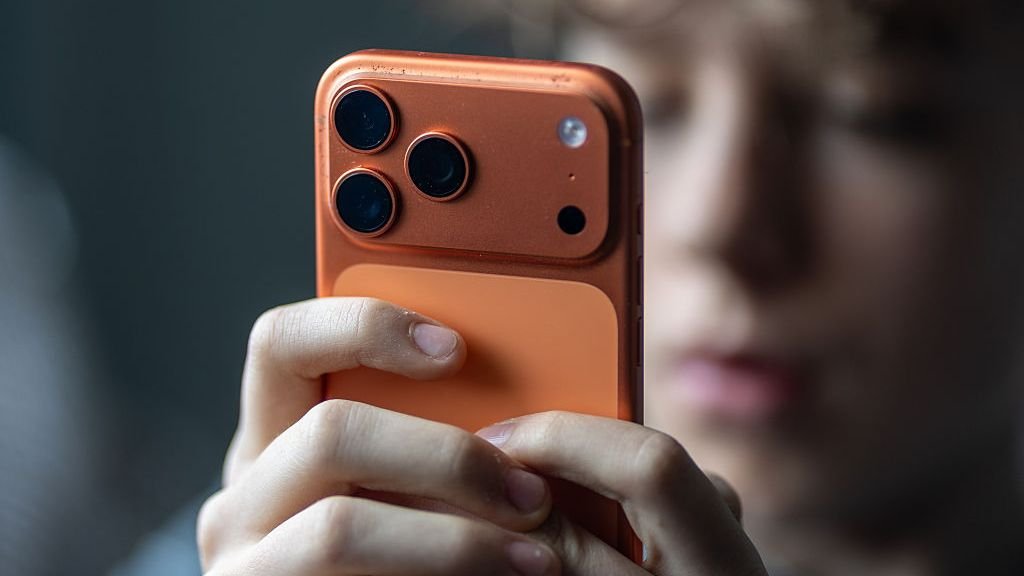
 iPhones are overwhelmingly the most popular phones among teenagers
(Image credit: Getty Images / Anna Barclay)
iPhones are overwhelmingly the most popular phones among teenagers
(Image credit: Getty Images / Anna Barclay)
Online safety — and in particular, the online safety of children — has emerged as a hot topic of debate in recent months.
The UK is following Australia’s lead in banning social media for under-16s, while Big Tech companies including Apple and Google have committed to giving parents more safety tools to better protect their children from smartphone-related harm.
Apple, for its part, dedicated a sizeable portion of its WWDC 2026 presentation to the new Child Account features it’s introducing in iOS 27, but are these changes — which include more granular parental control and app-specific screen time limits — enough to satisfy increasingly safety-concerned governments? The answer, at least for now, appears to be ‘no’.
On the same day as Apple’s WWDC 2026 keynote, the UK government gave major tech firms a three-month ultimatum to “implement technical solutions on smartphones and tablets to detect and block nude images for children,” lest they face fines and legislative action forcing them to do so.

UK Prime Minister Keir Starmer referenced Apple and Google by name as the biggest bearers of responsibility on this “horrific issue”, adding that “nothing is off the table” in terms of sanctions: “As a last resort, we are exploring criminal liability for tech bosses who fail to comply.” Yikes.
Starmer also cited British AI company SafeToNet — whose HarmBlock software blocks all nude content on supported smartphones at the operating system (OS) level — as proof that the government’s demands are possible to implement at a technological level.
TechRadar spoke exclusively to Richard Pursey, founder and CEO of SafeToNet, to understand where Big Tech companies like Apple are still falling short when it comes to child safety — and how they can address the vulnerabilities in their respective approaches to this complex issue.
Sign up for breaking news, reviews, opinion, top tech deals, and more.
The questions in this interview have been edited for clarity.
TechRadar (TR): Apple dedicated a sizeable portion of its WWDC 2026 keynote to demonstrating its new child safety features. Does this suggest Big Tech companies are waking up to the dangers of smartphone use among children?
Richard Pursey (RP): All advancements from Big Tech in online child safety are welcome. At SafeToNet, we've never believed in one silver bullet, because protecting children online requires a collaborative approach where the online safety ecosystem must work together. This includes legislators, big tech, and cyber safety specialists like SafeToNet.
What Apple announced at WWDC 2026 was genuine progress: mandatory child accounts, parental approval before new app downloads or website [visits], and an expansion of its Communication Safety detection to cover violent and graphic content alongside nudity. All of that matters, and parents should switch it on.
But the protection still lives where Apple chooses to build it — inside its own apps, like iMessage and FaceTime — and depends on individual app developers like Meta, TikTok, etc. choosing to build similar protections into theirs. And there’s the rub. The tech platforms have been given years to sort this issue out, and they’ve failed. I don’t see why they will start now. As welcome as Apple’s announcements are, they don’t get to where the harm is happening — on platforms where users can see, film and share harmful content.
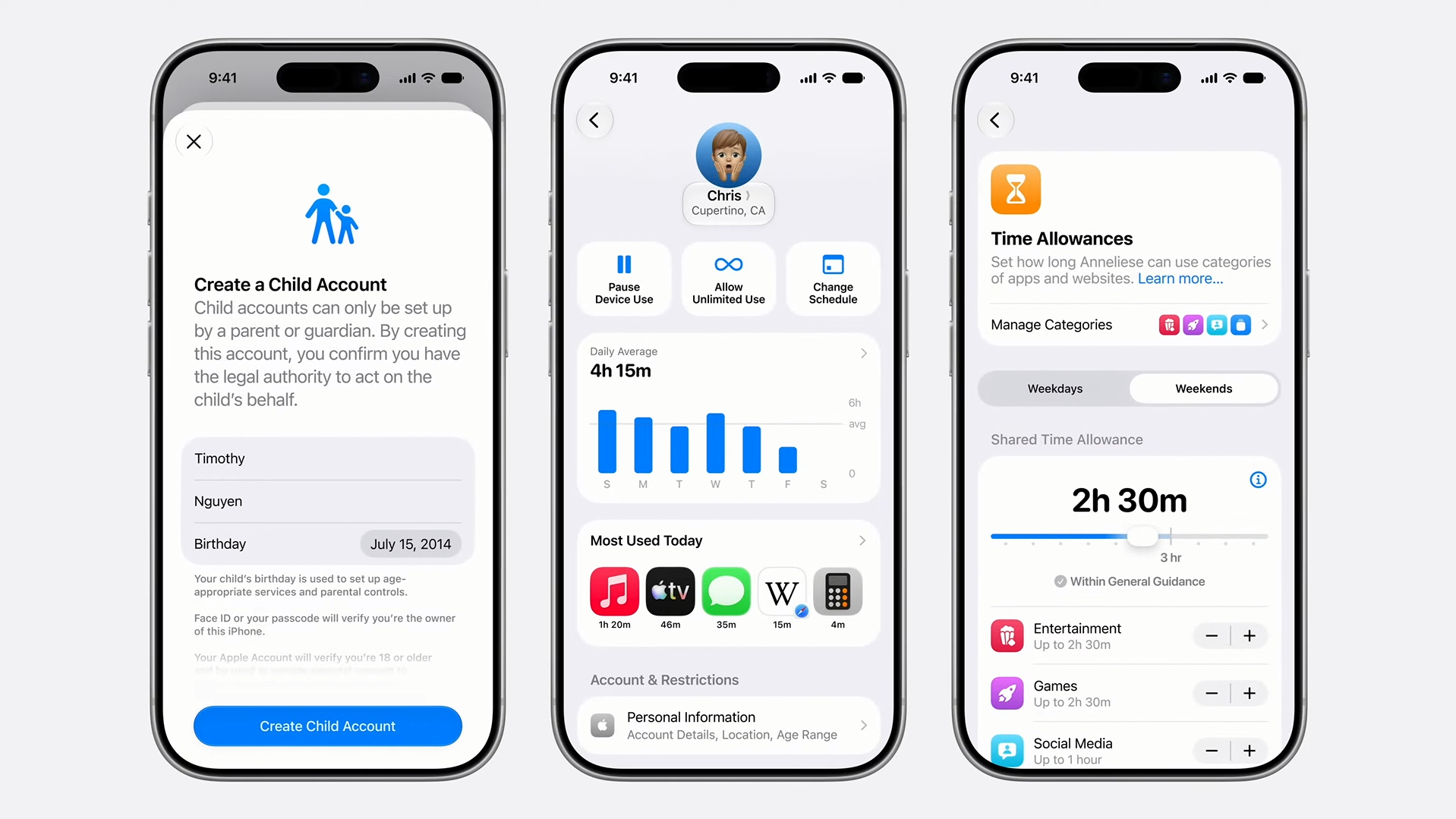
Ann Thai, Apple’s Senior Director of Marketplace Platforms and Technologies, said at WWDC 2026, “It’s developers who play an important role in assuring kids get age-appropriate experiences in apps”. She further continues, “…we believe every app has the same responsibility.” And [she] cited Apple’s resources to help developers build this functionality into their apps. The reliance on every app platform, every messaging app, every chat room, [and] every gaming platform to build solutions themselves is a huge risk to every child's safety. We can’t afford to leave any gaps, as we all know that the bad actors will find them and exploit them.
The tech platforms have been given years to sort this issue out, and they’ve failed.
Richard Pursey, CEO of SafeToNetThat's precisely the gap that the UK government called out on June 8, giving every device manufacturer three months to define how they will close it.
It's also the gap HarmBlock was built to close: one safeguarding layer that runs across the entire device. One that is application agnostic and which even works on E2EE environments. HarmBlock is designed to prevent the seeing, filming, and sharing of sexual content across the entire device, including livestream and the camera. The government further stated that all of this must be delivered without threatening users’ privacy, which is where HarmBlock is so powerful. It runs on the device, in real-time, without collecting or transmitting any user data.
TR: Is it too late — or even possible — for Big Tech companies to implement these changes?
RP: It's not too late, but we can’t be timid in our approach. The UK Government has been bold, and it must not soften or concede. HarmBlock is absolute proof that it is possible to make every smartphone and tablet (laptops too — even though they are out of the initial UK Government scope) safe out of the box.
Technology like ours is tamper-proof; it cannot be deleted or circumvented. This must become the standard. We used to drive cars without seat belts. Nobody in their right mind would do that now. So, we need to push ahead with confidence and make every device in the hands of a child safe to use. We can do that, and we can do it now.
TR: Apple's Communication Safety feature uses on-device AI to determine if a photo or video appears to contain nudity and blocks that content accordingly. As you noted, Apple announced that it's expanding this functionality to include gore and violent content. Could you clarify how HarmBlock still differs from Apple's approach?
RP: HarmBlock is universal. It runs across every device and across the entirety of that device. It isn’t selective like Apple. It is agnostic and protects across the entire ecosystem — not just the apps a manufacturer happens to control. HarmBlock stops problems like sextortion in its tracks because it works in the camera of any application — not just the Apple native camera. I don’t know of a single parent who doesn’t want that.
We can’t afford to leave any gaps, as we all know that the bad actors will find them and exploit them.
Richard Pursey, CEO of SafeToNetTR: Regarding the UK government’s new demands surrounding the detection of sexually explicit images, how does Apple’s current approach fall short of those demands?
RP: There's still a clear gap. Apple has confirmed it can block explicit content within its own messaging ecosystem, but it puts the responsibility on every other app to build that same protection into its own environment, and there's currently no way for a parent to check whether any given app has actually done that. The camera also remains unprotected, meaning content can be created.
With a HarmBlock-enabled device, you don't have to check. It just works the moment the device is switched on. You'll see our sapling symbol in the status bar, and that's confirmation that nude-based protection is active across the entire device, not buried somewhere inside one app's settings. Children cannot circumvent or disable it. Parents shouldn't have to dig through every app their child has installed just to know their child is safe. SafeToNet makes the entire device safe out of the box. No onboarding, no confusing user flows. It just works.
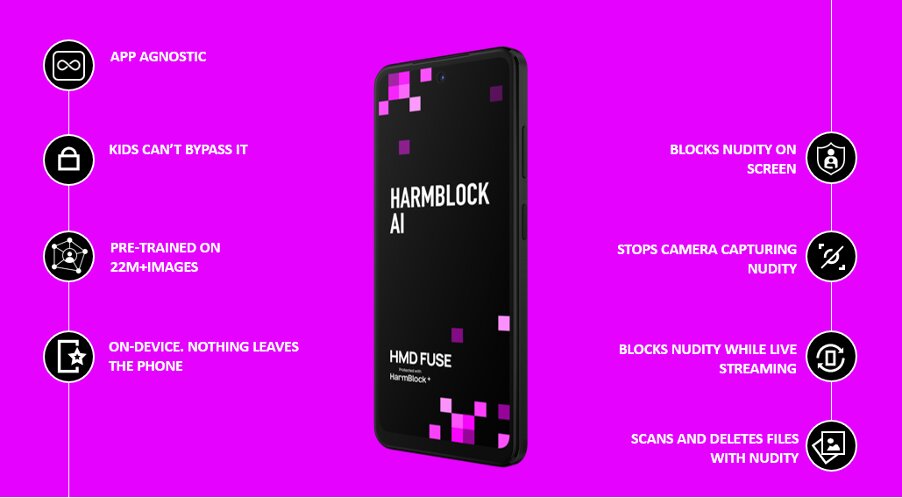
TR: Are there plans to make HarmBlock AI available on additional devices, beyond the HMD Fuse?
RP: Yes, and that is happening as we speak. More OEMs are turning to SafeToNet, including chipset manufacturers, and we plan to make some major announcements in that area very soon.
We believe we are setting the gold standard for on-device safety. If it isn’t HarmBlock-enabled, then it isn’t safe. We are being chosen due to the speed, accuracy, and efficiency of our software, and, crucially, because we are independent. We are specialists in this area and have been safeguarding children for over 14 years. This is our area of expertise
HarmBlock detects harm faster than the blink of an eye, which is how it works in livestream. Manufacturers like that we don’t intrude on the user’s experience of their device or their apps. We are chosen because we balance safety with privacy. We don’t know of anyone else who does that.

If SafeToNet is in talks with chipset manufacturers, it figures that HarmBlock will become a key selling point of more phones soon — and hopefully on models available outside the UK, too.
Might the company also be in direct communication with Big Tech firms like Apple and Google over the issue of child safety? “I can't deny or confirm,” SafeToNet’s Co-Founder, Sharon Pursey, told TechRadar for a separate article, which suggests Richard's vision for a true a “collaborative approach” might soon be realized.
In any case, if you’re mulling over which smartphone to buy your child right now, we recently researched the best phones for kids so you don’t have to. Our comprehensive guide explains the difference between smartphones, dumbphones, and hybrid devices, and features recommendations for different parental needs.
We've reached out to Apple for its response to the UK government's demands and will update this article if we hear back.

Follow TechRadar on Google News and add us as a preferred source to get our expert news, reviews, and opinion in your feeds. Make sure to click the Follow button!
And of course you can also follow TechRadar on TikTok for news, reviews, unboxings in video form, and get regular updates from us on WhatsApp too.
Axel is TechRadar's Phones Editor, reporting on everything from the latest Apple developments to newest AI breakthroughs as part of the site's Mobile Computing vertical. Having previously written for publications including Esquire and FourFourTwo, Axel is well-versed in the applications of technology beyond the desktop, and his coverage extends from general reporting and analysis to in-depth interviews and opinion.
Axel studied for a degree in English Literature at the University of Warwick before joining TechRadar in 2020, where he earned an NCTJ qualification as part of the company’s inaugural digital training scheme.
What's Your Reaction?
 Like
0
Like
0
 Dislike
0
Dislike
0
 Love
0
Love
0
 Funny
0
Funny
0
 Wow
0
Wow
0
 Sad
0
Sad
0
 Angry
0
Angry
0










Comments (0)