

Beverley Callard, 69, says she's 'feeling dreadful' as she shares candid health update after completing radiotherapy treatment amid breast cancer battle
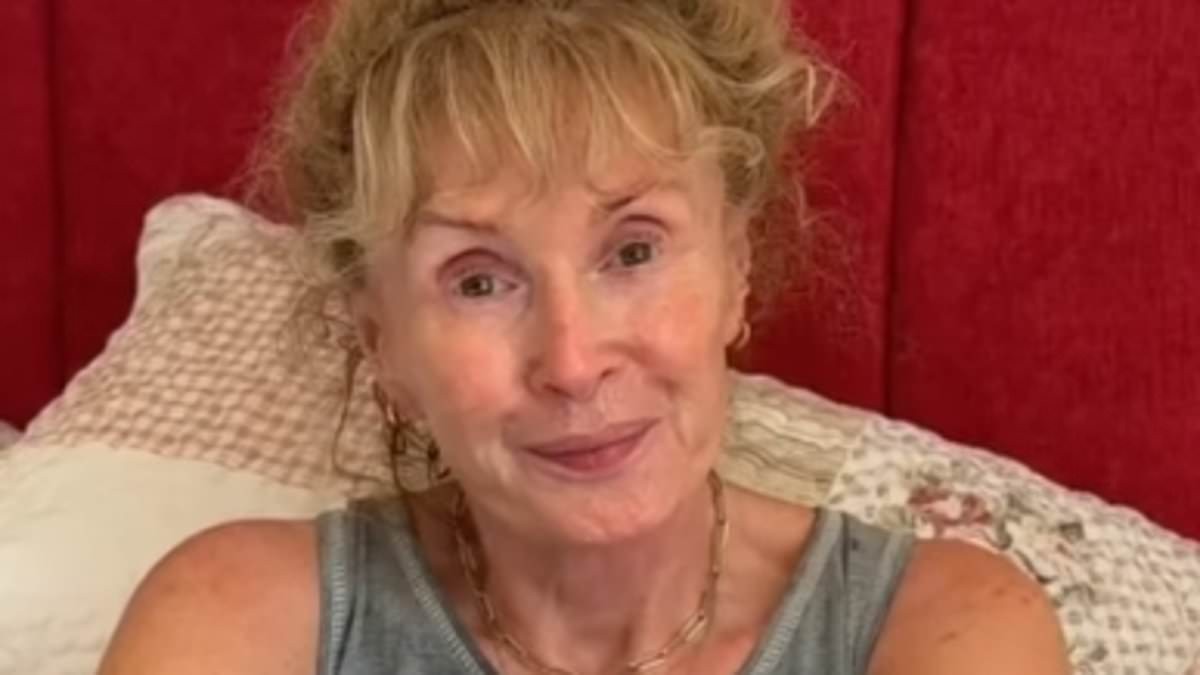
Beverley Callard has shared a candid health update after completing radiotherapy treatment amid her breast cancer diagnosis.
The Coronation Street star, 69, was diagnosed with breast cancer earlier this year and has constantly updated followers during her treatment and hospital appointments.
Last week, the actress shared the fantastic news that she had completed all 10 of her radiotherapy sessions.
And on Monday, Beverley took to Instagram and gave her followers an update on how she's doing, admitting she's 'felt dreadful.'
Sharing a clip of her sitting on the bed, she said: 'Well, what a weekend. I've finished radiotherapy for now, last Thursday. And in my naivety I thought, "well that's great."
'More often than not, I've done really well. Sometimes feeling a bit poorly and etcetera, but not too bad at all.
Beverley Callard has shared a candid health update after completing radiotherapy treatment amid her breast cancer diagnosis
Addressing her fans, she said: 'This weekend, oh my god, I've felt dreadful. My skin on my chest and everywhere is now is so sore'
'This weekend, oh my god, I've felt dreadful. My skin on my chest and everywhere is now so sore.
'I'm putting all sorts of things on. Aloe vera, loads of lotions and potions, and I've been so nauseous, and almost like morning sickness.
'I've only been sick a couple of times, but I feel dizzy, I feel worn out.
'To be honest, I'm in shock.
'It's funny because a nurse did say to me, "It's not actually over," she said. "Really, it's the beginning when you sort of finish your treatment."
'So I understand what she meant now, and another lady said to me, "Beverley, you're still cooking," and I understand that now as well.
'My skin is so hot, and it feels hot inside as well. So I'm coping, and I'm trying hard, but I do have to rest a lot, so I'm going to research vitamins and health foods.
'I am eating healthily, although my appetite is gone.
'But yeah, I'm going to do lots of research. So anybody else going through it, just remember, don't expect too much of yourself.'
Last week, the actress shared the fantastic news that she had completed all 10 of her radiotherapy sessions
Alongside the post, Beverley penned: 'Apparently I’m still “cooking” and trust me… it feels like it.'
Last week, Beverley shared the incredible news that she has finished her radiotherapy treatment.
Addressing her fans she said: 'I've done it. I've just finished my last radiotherapy session. Fingers crossed.
'Yep, that was number 10 for me and lots of people have to have lots more I know that, but for now that's finished. So hopefully, I don't know for sure, but hopefully I won't need any more.'
Her husband Jon McEwan interjected: 'Positive thinking, darling,' as she replied: 'That's it. I know positive thinking. Yes definitely.'
She continued: 'To be honest, I feel a bit numb because yesterday I really struggled, but today I've been fine and now I've got to see the professor again in two months, and then I'll know a lot more, and mammograms and oncologists and all that.
'But radiotherapy is finished for now, so I'm really thrilled. I'm not going to celebrate tonight. We're too tired. We can't be bothered.
'I'm going to put scruffy clothes on and just sit and watch TV with a cup of tea.'
Last month Beverley gave an update on her radiotherapy treatment plan as she revealed she would be having '10 days of radiotherapy, five consecutive days, then a weekend off, then five more days.'
She said: 'I'm not sure when it starts yet. They'll let me know. They will send me an appointment to have a body scan and do the mapping, that's the first thing, and they'll let me know soon when that begins, so really that's all I know at the moment.'
She confirmed that she is still able to work while she awaits treatment starting.
Beverley also said how medics were worried she should have started radiotherapy earlier following her breast cancer diagnosis.
The star admitted it 'wasn't what she wanted to hear' after attending the hospital to discuss a treatment plan with doctors.
Beverley has moved to Ireland from England and revealed it had taken a while for her medical records to be transferred between the countries.
She also marked a huge milestone last month after she returned to work, admitting she felt 'nervous and on edge' as she arrived ready to film scenes for Fair City, after four months away while she had surgery.
Beverley joined the cast of Ireland's RTÉ’s soap opera Fair City in February as Lily, the quirky and unpredictable long-lost mother of Carrigstown resident Gwen.
That same month, while she was just about to go on set, the soap star got a call from her doctor that she had breast cancer and so returned to the UK to have surgery and treatment.
In an Instagram video, Beverley revealed her husband Jon had driven her to work. She said: 'I have to tell you, it's like the first day back at term at school.
'I'm really nervous and on edge but nicely so. So wish me luck, I'll let you know how it goes.'
After a day of filming Beverley updated her followers and seemed delighted with how it all went.
She said: 'Home from my first day at work and do you know what? It was fantastic. As I said before, it was a bit nerve wracking. You think first day of term, "this is scary".
'But as soon as I was in there, you just feel like you've never been away. It was really good. Everybody was so pleased to see me and I was really pleased to see them.
'We laughed a lot and got the giggles. It was just fantastic, I have a very early start tomorrow which I'm not looking forward to but there we go.'
Breast cancer is one of the most common cancers in the world and affects more than two MILLION women a year
Breast cancer is one of the most common cancers in the world. Each year in the UK there are more than 55,000 new cases, and the disease claims the lives of 11,500 women. In the US, it strikes 266,000 each year and kills 40,000. But what causes it and how can it be treated?
What is breast cancer?
It comes from a cancerous cell which develops in the lining of a duct or lobule in one of the breasts.
When the breast cancer has spread into surrounding tissue it is called 'invasive'. Some people are diagnosed with 'carcinoma in situ', where no cancer cells have grown beyond the duct or lobule.
Most cases develop in those over the age of 50 but younger women are sometimes affected. Breast cancer can develop in men, though this is rare.
Staging indicates how big the cancer is and whether it has spread. Stage 1 is the earliest stage and stage 4 means the cancer has spread to another part of the body.
The cancerous cells are graded from low, which means a slow growth, to high, which is fast-growing. High-grade cancers are more likely to come back after they have first been treated.
What causes breast cancer?
A cancerous tumour starts from one abnormal cell. The exact reason why a cell becomes cancerous is unclear. It is thought that something damages or alters certain genes in the cell. This makes the cell abnormal and multiply 'out of control'.
Although breast cancer can develop for no apparent reason, there are some risk factors that can increase the chance, such as genetics.
What are the symptoms of breast cancer?
The usual first symptom is a painless lump in the breast, although most are not cancerous and are fluid-filled cysts, which are benign.
The first place that breast cancer usually spreads to is the lymph nodes in the armpit. If this occurs you will develop a swelling or lump in an armpit.
How is breast cancer diagnosed?
- Initial assessment: A doctor examines the breasts and armpits. They may do tests such as a mammogram, a special X-ray of the breast tissue which can indicate the possibility of tumours.
- Biopsy: A biopsy is when a small sample of tissue is removed from a part of the body. The sample is then examined under a microscope to look for abnormal cells. The sample can confirm or rule out cancer.
If you are confirmed to have breast cancer, further tests may be needed to assess if it has spread. For example, blood tests, an ultrasound scan of the liver or a chest X-ray.
How is breast cancer treated?
Treatment options which may be considered include surgery, chemotherapy, radiotherapy and hormone treatment. Often a combination of two or more of these treatments are used.
- Surgery: Breast-conserving surgery or the removal of the affected breast depending on the size of the tumour.
- Radiotherapy: A treatment which uses high energy beams of radiation focused on cancerous tissue. This kills cancer cells, or stops them from multiplying. It is mainly used in addition to surgery.
- Chemotherapy: A treatment of cancer by using anti-cancer drugs which kill cancer cells, or stop them from multiplying.
- Hormone treatments: Some types of breast cancer are affected by the 'female' hormone oestrogen, which can stimulate the cancer cells to divide and multiply. Treatments which reduce the level of these hormones, or prevent them from working, are commonly used in people with breast cancer.
How successful is treatment?
The outlook is best in those who are diagnosed when the cancer is still small, and has not spread. Surgical removal of a tumour in an early stage may then give a good chance of cure.
The routine mammography offered to women between the ages of 50 and 71 means more breast cancers are being diagnosed and treated at an early stage.
For more information visit breastcancernow.org or call its free helpline on 0808 800 6000
What's Your Reaction?
 Like
0
Like
0
 Dislike
0
Dislike
0
 Love
0
Love
0
 Funny
0
Funny
0
 Wow
0
Wow
0
 Sad
0
Sad
0
 Angry
0
Angry
0







Comments (0)