

‘Can we accept what we have done or not done?’: harrowing film follows doctors in Gaza
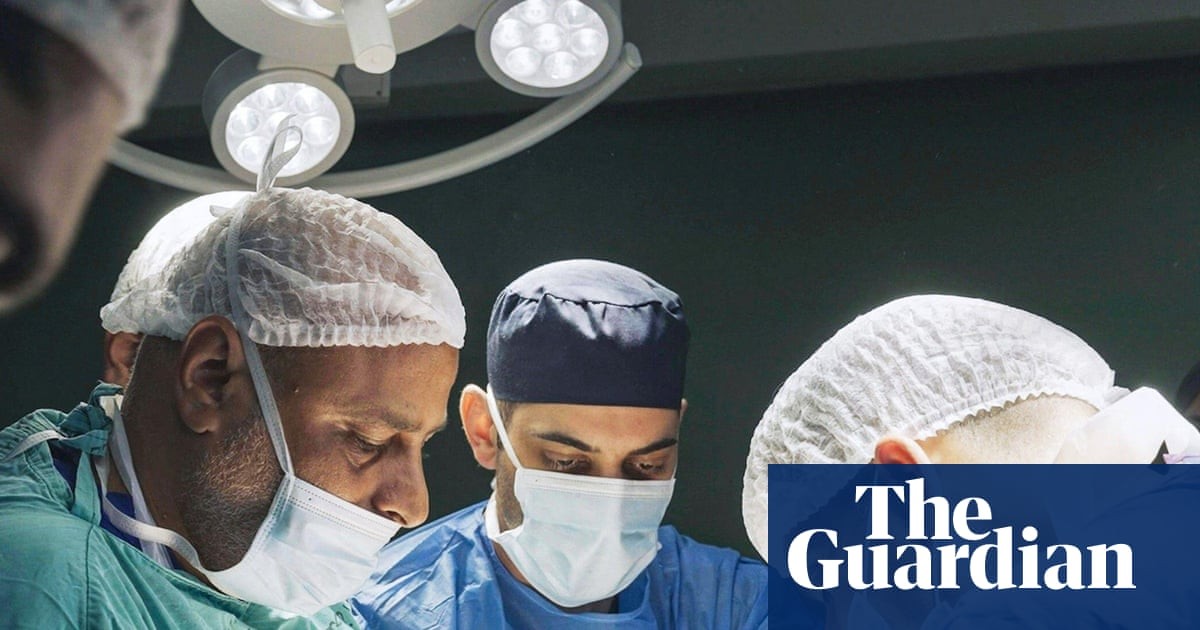
When she wanted to confront Americans about the consequences of their actions – or inactions – in Gaza, Poh Si Teng reached for a genre with mass popular appeal: the medical drama.
“Whether it’s The Pitt, Grey’s Anatomy, House, ER, even a comedy like Scrubs, you name it,” the documentary film-maker says via Zoom from her New York apartment. “I thought to myself, there’s something about medical dramas and doctors and human mortality in this space so let’s make The Pitt. The difference is it’s real and it’s set in Gaza and maybe this is the way to bring Palestine back to the United States.”
The result is American Doctor, a 93-minute film directed by Teng and co-produced with Kirstine Barfod and Reem Haddad, which premiered at the Sundance film festival and is out now in US cinemas.
The documentary follows three doctors from different cultural and religious backgrounds – Thaer Ahmad, a Palestinian-American emergency doctor; Mark Perlmutter, a Jewish orthopedic surgeon from North Carolina; and Feroze Sidhwa, a Zoroastrian trauma surgeon based in California – as they volunteer on the frontlines of Gaza’s collapsing hospital system.
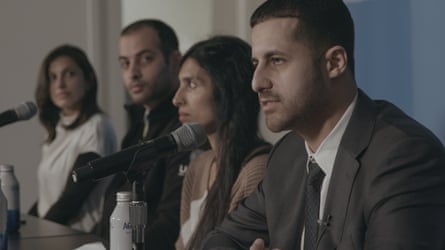
They return to the US as advocates in the halls of Congress, which continues to send military aid to Israel. The film highlights the unique position of American doctors as witnesses whose professional standing makes their testimony difficult for politicians and even rightwing media to dismiss as propaganda.
The journey of Teng to making the film began in the fall of 2024, a year into the military campaign in Gaza. The Malaysian-American had spent years as a producer, documentary commissioning editor for Al Jazeera English and creative director at ABC/Disney but felt suffocated by the professional and political silence surrounding what she does not hesitate to call a genocide.
“I was so frustrated and it felt like nothing was changing,” the 41-year-old explains. “In our journalism circles, even though we were seeing so many Gazan journalists being targeted and executed, it felt like in the western part of the world – specifically where I was situated in New York – that people were still whispering about Palestine and what was going on in Gaza. That’s when I decided I need to quit my job if I’m going to do this, and I’m going to make a film.”
The path became clear when Teng saw Perlmutter being interviewed on television in late 2024. A reporter had asked him why he believed there was no ceasefire, expecting a rehearsed, diplomatic response. Instead, Perlmutter looked directly into the camera and said bluntly that there was no ceasefire because western politicians were entirely beholden to powerful lobby groups.
“I was like, oh my, who is this man?” Teng recalls. A few days later, she attended a fundraiser at Sony Hall in Manhattan where Perlmutter was the keynote speaker. “Big hall, mostly Palestinians, Arabs, Muslims and when he spoke, one thing I realised immediately: incredible storyteller. Secondly, I looked around and the room was so quiet because people were weeping silently. When his speech ended, the host of the evening said, my brother, we will not forget what you have done for us.”
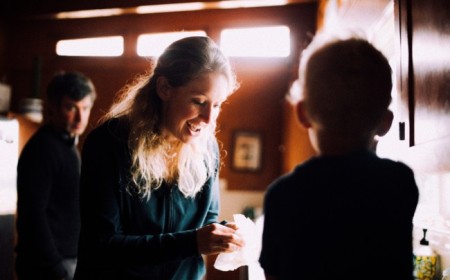
Early in the film, Teng is seen standing in the home of Perlmutter, questioning whether they should display the most graphic, shattering footage of children shredded by US-made bombs in Gaza. Perlmutter turns to her, his face taut with moral outrage, demands to know why she is there if she refuses to show the unvarnished truth.
Teng reflects: “He’s told me this before: ‘If you weren’t gonna film it, I was ready to kick you out of my house.’ I said, yeah, I probably deserved it. As a film-maker, as a former journalist, where there’s discomfort it is very important for us to run towards it because that’s where the biggest realisation and growth is going to be and, if we learn something from it, maybe others can too.”
While Perlmutter is the blunt, emotional firebrand and Ahmad is the measured, politically strategic voice who walked out of a meeting with President Joe Biden during Ramadan, Sidhwa is the cool, analytical anchor of the trio. When Teng first approached him about being filmed, his reaction was sceptical.
Sidhwa, 44, says via Zoom: “I told Poh she’s welcome to follow me around with a camera if she wants to but I told her it would be a waste of her time. I told her, do you know how many documentaries there are about the Gaza Strip? Nobody cares. It was a very defeatist sense but I’m very glad that she didn’t listen to me because it turns out this movie does resonate with people quite a bit.”
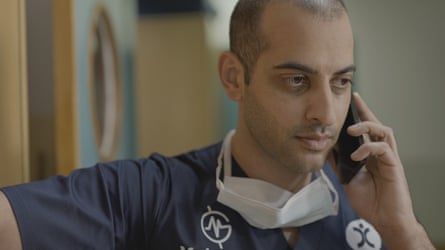
Sidhwa has volunteered in Gaza twice: first in March and April 2024, and again in March and April 2025. When he tried to return for a third time in November 2025, the Israeli authorities blocked his entry. He is now part of a legal petition to the Israeli high court of justice challenging the systematic blocking of healthcare workers.
American Doctor captures the unfathomable destruction in Gaza, the fear and grief of its people and the steely determination of medical professionals working at the front line of hospitals that are constantly overwhelmed. To understand the scale of what he and the other doctors witnessed, Sidhwa argues you must first dismantle the abstract language used by military spokespeople and politicians.
The entire Gaza strip is smaller than the Ukrainian capital Kyiv and has a smaller population. “When you unleash the entire might of the American and Israeli military on a place that size, it’s going to be destroyed and that’s exactly what happened.”
Almost every house, mosque and government building has been destroyed, Sidhwa continues, along with half of hospitals, and those that remain are starved of supplies and barely functioning. “Something like 10% of the healthcare workforce is dead or has fled Gaza. The largest killing of humanitarian aid workers that’s ever happened has happened in the Gaza Strip over the past three years. The same with the killing of physicians, nurses and children.”
There is also a catastrophic breakdown of infrastructure. “Everybody lives in a tent. The rodents are attacking children and literally gnawing on the faces of babies at night. You can imagine their panicked mother wakes up in a completely dark tent with no ability to turn the light on to her baby screaming and she has no ability to even figure out what’s going on.
“When it rains, everything is flooded. This is a laboratory for death and disease, and again in a place that’s 70% refugees and half children. There’s nothing like this that’s being done anywhere else in the world.”
But the moral weight of American Doctor lies not just in its depiction of Gaza but its unflinching examination of the political and media machinery that enables it. Teng chimes in: “There are lots of films that are, ‘Oh, this is what’s happening,’ which is very important. There’s enough on social media too, depending on your feed, to see sheer horror.
“But at the end of the day, it’s very important for those in the west, especially Americans, to take a good look at themselves. Are they OK with rats gnawing at children’s faces? Who’s responsible for that? We are responsible for that and so it was very important to bring the message of what was happening there back home to the American psyche.”
This may be why American Doctor has had a profound impact on audiences on the festival circuit. Teng continues: “There are war movies and American Doctor is nowhere near that. I don’t think it’s actually the graphic nature of it; I think it’s the guilt.
“I’ve watched documentaries across the board, just so that I am aware and know what kind of art that is being made on conflicts and wars and genocide. American Doctor doesn’t even come close. But I think the challenge here is people sometimes having to reckon with what they’re part of and that does something to you.”
Sidhwa agrees. “This idea of ‘righteous’ or ‘clean’ violence. People don’t think of our bombs doing the same thing that Russian bombs do, which is very weird: they’re both bombs. They work exactly the same way but they just don’t think of it. I don’t know why. But I think when they see it then it’s the guilt of saying, ‘I knew we were responsible for what was going on but I didn’t realise this is what’s going on.’
The film elicits different reactions in different countries, Teng adds. “Here’s a film that can maybe help tell people about what’s going on and help people to look at themselves in the mirror. Next year, five years from now, 20 years from now, can we see ourselves? Can we accept what we have done or have not done? If, as individuals, we live in a democracy then we really need to be part of it and fight for the living.”
-
American Doctor is out in US cinemas now and in the UK on 20 November
What's Your Reaction?
 Like
0
Like
0
 Dislike
0
Dislike
0
 Love
0
Love
0
 Funny
0
Funny
0
 Wow
0
Wow
0
 Sad
0
Sad
0
 Angry
0
Angry
0









Comments (0)