

Cinematographer Michael Bauman Looked to His Own Roots for ‘Monster: The Ed Gein Story’
When cinematographer Michael Bauman was growing up in Wisconsin, his neighbors and relatives told stories of local legend Ed Gein, the serial killer whose horrific acts in the 1950s inspired “Psycho,” “The Texas Chainsaw Massacre,” and “The Silence of the Lambs.” Bauman was more than ready, therefore, when his frequent collaborator Max Winkler told him he’d be directing an Ed Gein streaming series and asked if Bauman would be interested in shooting it.
“I was pretty familiar with the mystique of the Ed Gein story,” Bauman told IndieWire. “One of the things that was fascinating to me was the fact that this one incident affected so many things in American culture, even up to ‘Silence of the Lambs.'” Bauman came on board Winkler’s project, “Monster: The Ed Gein Story,” and immediately got down to work creating one of the most ambitiously photographed films or series of 2026 — a beautiful, horrifying, and meticulous portrait that lives up to and even exceeds the expectations Bauman set when he photographed the VistaVision epic “One Battle After Another” last year.


“Monster: The Ed Gein Story” is the third incarnation of Ryan Murphy and Ian Brennan’s Netflix series, and like “Dahmer” and “The Lyle and Erik Menendez Story” it’s as precise in its period detail as it is audacious in its narrative provocations — the scripts don’t just acknowledge Ed Gein’s influence on pop culture auteurs like Alfred Hitchcock and “Texas Chainsaw Massacre” director Tobe Hooper, the incorporate Hitchcock and Hooper as characters. For Bauman, the work began with a deep dive into the historical record.
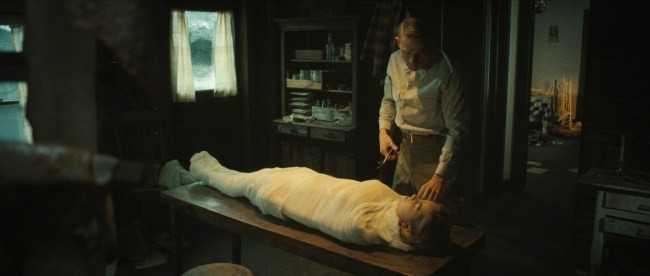
“There’s a lot of documentation of Ed’s home and the case,” Bauman said, noting that Gein’s notoriety foretold the tabloid culture that would become prevalent in later decades. “It was the start of post-World War II sensationalism.” Bauman’s research, and that of production designer Matthew Flood Ferguson, ended up determining how Bauman would approach lighting sets like Gein’s home. “Where Ed grew up, they were a little late to the game in terms of electricity. He didn’t live in the city. So we knew a lot of our light sources were going to be kerosene lamps and things like that.”
The old-fashioned interior light sources provided a nice contrast with the sunlight from outside, and one of the show’s greatest strengths is its ability to flawlessly replicate the Midwestern sense of a sunny day that’s simultaneously ice cold. Bauman drew on his own memories of growing up during brutal Wisconsin winters to visually represent the feeling, a task made more challenging by the fact that all of the interiors were shot on a stage in California and the exteriors were on location in Illinois.
“In a perfect world, you would shoot the locations first and then match them on the stage,” Bauman said. “We were doing it in reverse for a variety of reasons.” That meant Bauman, Ferguson, and the rest of the crew had to create a Midwestern winter on stage in California without knowing exactly what they’d be getting into when they began shooting months later in Illinois. Luckily for the project — though not for the cast and crew’s comfort — when the production moved to Illinois, they found a harsh winter waiting for them.
 ‘Monster: The Ed Gein Story’©Netflix/Courtesy Everett Collection
“We had gambled that it was going to be snowing with all the backdrops and things like that,” Bauman said. “When we arrived in Illinois, it was insanely cold, and there had just been a snowstorm. So we got all that right out of the gate, which was great because later in the shoot it got warmer and we had to create the snow. The special effects department had to bring in 80 tons of ice that they could shred to create snow that would only last for an hour.”
While the wintry exteriors give a real sense of Midwestern scale to “Monster,” the haunting interiors of Gein’s house are where the show finds most of its terror. Bauman and Ferguson worked closely to find ways of remaining faithful to the actual house’s architecture while using it as a storytelling tool to evoke a sense of dread and claustrophobia. “Max and I talked a lot about frames within frames,” Bauman said, noting that although the series is shot in a widescreen aspect ratio, the frame is often narrowed by windows and doorways to create negative space that both focuses the viewer’s attention and generates a real sense of mystery about what’s hidden in the darkness.
Production design, lighting, and performance come together to unsettle the audience with particular effectiveness in the “Buxom Bird” episode, for which Bauman is deservedly nominated for an Emmy. The central set piece of the episode, in which a pair of cops enter Gein’s home and discover the carnage within, is expertly choreographed so that each camera move subtly reveals one horror while teasing what’s to come, with Bauman’s lighting perfectly calibrated to keep the audience leaning forward to discern the meaning behind every detail.
The use of mirrors and other reflective surfaces, along with the frames within frames, was key, and Bauman attributes the impact of the sequence to a close collaboration between departments. “We’re really trying to build the tension as the two police officers come in,” Bauman said. “One of them is savvy, the other more uninitiated, and he’s the one who wanders through the space the most. So it became about isolating and separating them and teasing out those moments.”
 ‘Monster: The Ed Gein Story’©Netflix/Courtesy Everett Collection
Though “Monster” is filled with impressive set pieces ranging from the “Buxom Bird” reveal to an all-out musical number later in the series, but some of its most memorable moments are simple close-ups of Ed in all his tormenting and tormented complexity. Bauman knew early on what he had in Charlie Hunnam’s performance, and was intent on capturing all of its nuances. “The work he had done became really obvious in our first tests. And Max and I talked a lot about portraiture as we looked at hundreds and hundreds of visual references.”
To convey the range and subtlety of Hunnam’s performance in a way that focused the eye on its details, Bauman worked with Panavision to use vintage lenses that would isolate Hunnam in the frame and let the depth of field grow shallower and shallower around him. “We also worked with a 58mm Petzval lens, which has a swirly bokeh pattern that happens as you shoot at certain stops,” Bauman said. With both Ed and the supporting characters, there was a desire to emphasize their individual reactions in distinctive ways.
“Max and I talked a lot about how to isolate people from the environments and create separation as everyone goes on their own journey of discovering the horrors of what’s happening,” Bauman said, adding that as he worked on the show he realized how the impact of Gein’s crimes was still being felt among his family and their neighbors. “We had a researcher who interviewed many of my folks’ friends, two of whom were teenagers in the 1950s and could describe specific things about Ed, like the way he walked and the kinds of environments he was in. It was an interesting reminder that this was not that long ago. This all happened very recently — it’s not ancient history.”
“Monster: The Ed Gein Story” is currently streaming on Netflix.
What's Your Reaction?
 Like
0
Like
0
 Dislike
0
Dislike
0
 Love
0
Love
0
 Funny
0
Funny
0
 Wow
0
Wow
0
 Sad
0
Sad
0
 Angry
0
Angry
0







Comments (0)