

El Niño is now stronger than at any point in the last 1,000 years, study finds
“One more warning sign here of what we’re facing in a warmer world.”
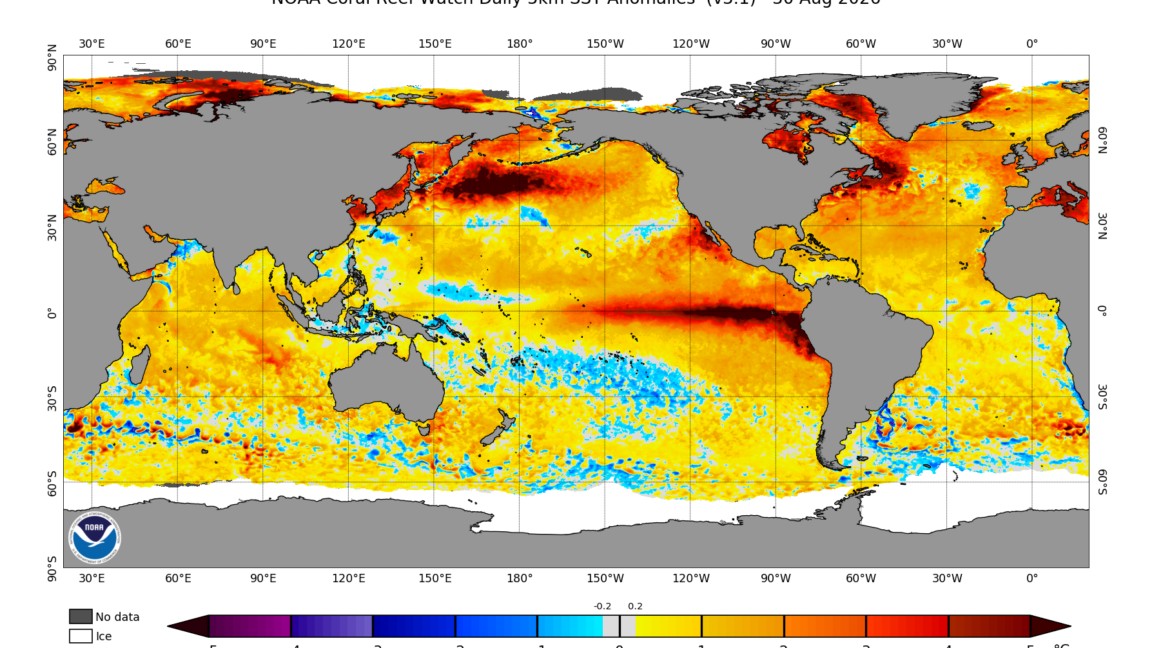
Every few years, El Niño or its cool counterpart, La Niña, shifts rainfall across the tropics, dries out Australia, floods parts of Peru, and rearranges the weather on most of the planet. The two are the warm and cold swings of a single system, the El Niño–Southern Oscillation, or ENSO, and that system is the largest source of year-to-year climate variation on Earth. Its swings sit atop the steadily rising temperatures driven by global warming.
But we didn’t know whether global warming was making it stronger. It’s possible that the added energy in the atmosphere and oceans was causing its swings to be more dramatic.
“We’ve been seeing some very strong El Niño events in the late 20th and early 21st century, and what we didn’t know was how unusual those are,” said Julie Cole, an environmental scientist at the University of Michigan. Because models disagree with one another and the instrumental data are too short to separate a trend, Cole’s team reconstructed a thousand-year-long ocean surface temperature record by analyzing fossilized Galápagos corals.
It turns out that El Niño in the eastern Pacific has never been as violent as it is now. “The events don’t look anything like what we see in the pre-industrial era,” Cole said. “That was exciting. And a little surprising, actually.”
Limestone thermometer
The Galápagos sit in the bullseye of the eastern Pacific ENSO pattern, where the biggest events have their strongest impact. It is also one of the few options to look for fossilized corals in the region. “The Galápagos are located at 90 degrees west, and you have to go all the way to 160 degrees west to find another island in that near-equatorial zone,” Cole said.
Corals there grow one to two centimeters a year, laying down a calcium carbonate skeleton with a chemistry that depends on the water it formed in. In these skeletons, Cole and her colleagues looked at the strontium-to-calcium ratio and at different isotopes of oxygen because both track temperature. “As temperatures get warmer, we get less strontium in the coral,” Cole said. Sampling the extracted cores of fossilized corals millimeter by millimeter yields more than a dozen measurements per year—a monthly temperature log for the life of the coral colony.
Living colonies cover recent decades and can be checked against instrument data. The deeper history comes from dead coral heads, which can be dated using uranium-thorium methods to within a few years, even as far back as 500 years. “We were also able to find corals that are dead and washed up on the beach,” Cole said. “They may be 100 years old, 200 years old, or 900 years old, or even older.”
The result of sampling corals was a patchy but long temperature log—28 time-separated series from five islands, covering scattered years back to around 1100 CE. Set against that baseline, the last four decades look rather strange.
Modernized ENSO
Temperature variability since 1984 runs 36.5 percent higher than it was during the preindustrial stretch from 1000 to 1850 CE and is still 16.2 percent higher than during the period from 1851 to 1982. All three intervals are statistically distinct, and the trend only goes up. Those figures, Cole explained, mean that events that once ran a degree or two above normal in the Galápagos now run three or four.
The corals also record a shift in skewness—whether the swings were lopsided in the warm or cold direction. “The skewness turned positive,” Cole said, “and the positive skewness indicates that it’s the warmer events that got stronger.”
The extra variability in our times is due to El Niño specifically. What’s more, nothing comparable shows up elsewhere in the record. Neither the Little Ice Age nor the Medieval warm period left such a distinct fingerprint on ENSO variability.
However, Cole and her colleagues did not yet have evidence clearly indicating that human activity was to blame. That came when scientists fed coral records into multiple climate models.
Beating the models at their own noise
ENSO fluctuates on its own; quiet decades are followed by wild ones, with no external push required. To understand whether the recent decades were really special or we just happened to catch the cycle in a more energetic period, the team had to find some point of reference for their findings. This proved tricky.
“We don’t have a direct source of observational data to compare our records to in the eastern Pacific,” Cole said. “If we had another long record, we wouldn’t be publishing this in Science.”
As a workaround, Cole and her colleagues used simulations in several climate models running through the conditions of the last millennium but incorporating only natural factors like volcanoes or solar variability—changes in greenhouse gas concentrations were left out. This allowed them to ask how often a climate untouched by any human impact produces a swing this large on its own.
“We tried to see if there was some evidence for this in climate models, and we found none,” Cole said. The actual increase retrieved from coral records sits outside the models’ internal variability at a confidence level approaching 99 percent. The team interpreted this as evidence that what’s currently happening with ENSO would not be happening without us.
The picture in the central Pacific, though, is murkier. Line Islands corals show a similar mean increase but far wider scatter, which the researchers partly attribute to these records’ reliance on oxygen isotopes alone. Heavy El Niño rainfall there can account for half or more of the signal by changing the oxygen levels in water.
But an ambiguous central Pacific coral record is also what climate models predict. A forced, human-caused increase should appear first in the east. “The faster emergence in the eastern Pacific is exactly consistent with the models,” Cole said.
Crystal ball
Global warming is already expected to intensify ENSO’s hydrological consequences, creating wetter wet phases and drier dry ones, regardless of ENSO-driven temperature swings. Even if El Niño’s temperature swings stayed exactly the same magnitude, its floods and droughts would still get worse in a warmer world because the hotter atmosphere holds more water vapor.
But if ENSO temperature swings are strengthening too, the effects compound. What these compound effects are going to look like, however, is something corals can’t say. “We don’t predict the future. We kind of have a crystal ball to look into the past—it’s a little murky, but that’s our corals,” Cole said.
The future, though, has already started happening since Cole’s study concluded. Two more strong El Niño events have arrived since the end of the team’s coral temperature logs, with another developing now that Cole (and most other experts) expects to break records. “It suggests that what we see is not a fluke,” she said, “but rather a new type of situation for El Niño, a new style of El Niño.”
While the nature of the change remains uncertain, Cole and her colleagues have little doubt about its root cause. “We are attributing that to warming, and we know what causes the warming, and it’s our use of fossil fuels,” Cole said. “One more warning sign here of what we’re facing in a warmer world.”
Science, 2026. DOI: 10.1126/science.ady2660

Jacek Krywko is a freelance science and technology writer who covers space exploration, artificial intelligence research, computer science, and all sorts of engineering wizardry.
What's Your Reaction?
 Like
0
Like
0
 Dislike
0
Dislike
0
 Love
0
Love
0
 Funny
0
Funny
0
 Wow
0
Wow
0
 Sad
0
Sad
0
 Angry
0
Angry
0










Comments (0)