

Fablehaven author Brandon Mull teases books, movies, and the future

Published Aug 16, 2026, 8:00 AM EDT
Twenty years after the book that changed his life, Mull reflects on faith, fandom, the series’ long-awaited movie
 Image: Shadow Mountain Publishing
A particular kind of gratitude between writers and readers travels through fourth-dimensional space. Fablehaven author Brandon Mull knows this well. Long before he wrote about a secret preserve filled with fairies, demons, satyrs, and rock golems, he was a kid who never picked up a book. Then he found C.S. Lewis’s The Lion, the Witch and the Wardrobe. Suddenly, reading was everything. A passion for dreaming folded into the foundation of his career.
“It would mean a lot to me,” he tells me, a little choked up, “to be able to thank C.S. Lewis for what he gave to me.”
Over 20 years, Brandon Mull has also seen Fablehaven travel. We’re talking in late July because of a lush new illustrated edition of that first book, but from the sound of it, there’s never a bad reason to talk Fablehaven with Mull. That’s because he hears from children who tell him the first novel and its sequels made them readers. He has paid his debt to C.S. Lewis forward — and he can’t imagine ever moving on from its world.
Mull has plenty more going on, including the 2027 movie version of Fablehaven (more on that later) and publishing what he considers to be his magnum opus in a different series all together, but he also has more Fablehaven ideas. He always will.
 Image: Shadow Mountain Publishing
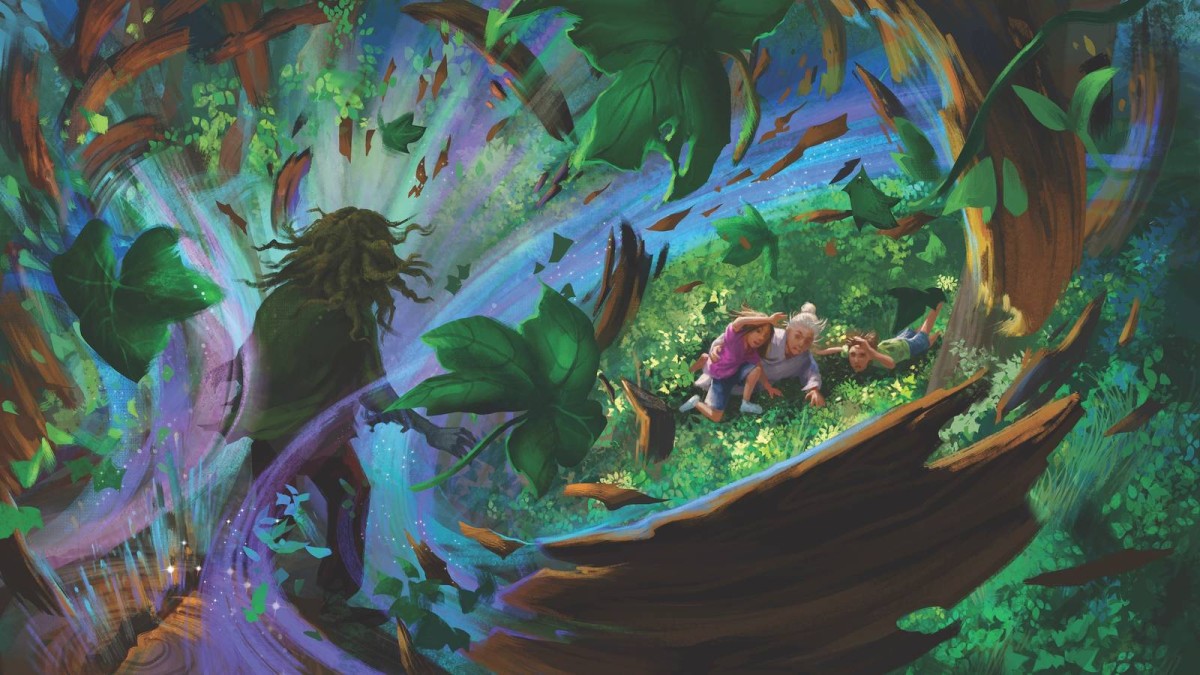
The new edition of Fablehaven, illustrated by Brandon Dorman, is itself a kind of culmination. Dorman drew the cover for Fabelhaven in 2006, which was also Mull’s first published book, and has since created hundreds of covers. Their collaboration has continued for two decades, long enough that Dorman’s interpretation of the preserve has become inseparable from Mull’s own mental picture of his young heroes, Kendra and Seth. “The way he sees it is not the same as I see it — everyone's got their own way they picture stuff.” But that difference has become productive. “The visual brand for Fablehaven, in my mind, is Brandon Dorman's style because it's so consistent through the years.”
Mull now credits Dorman as an influence, and says the art has changed how he sees his own creations (and how he hopes they appear in the movie version). The writer even believes Dorman’s full-color illustrations provide new information about his own world, particularly in an image of Seth seeing the fairies for the first time.
“The wonder in the expression was so good,” Mull says. “It helped me see it a little better, just seeing the wonder on that face.”
Mull has always described himself as having a fairly short attention span, but the vistas of his fictional farmland — and the world beyond the grounds of Fablehaven the saga has gone to — have always enchanted him, locked him in. He thinks part of the appeal, both for him and his readers, is the idea that magic can be discovered somewhere close enough to home that it might plausibly have been overlooked. Kendra and Seth aren’t “chosen ones,” but they do have the capacity for awe that allows them to stumble into their grandparents’ secret magical careers as “caretakers.”
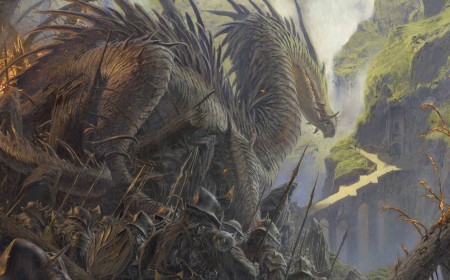
Though the demonic entity Bahamut rises up in Fabelhaven #1, Seth and Kendra remain children in over their heads from start to finish — completely relatable 20 years later. This has left many adult readers frustrated and furious over Seth’s recklessness. Meanwhile, children recognize themselves in the blur of confusion.
“That it bothers some adults and makes them want to punish him, and also makes kids kind of cheer for him means something's working there,” Mull says.
And it has: Families read it together, grown kids return to each new installment. In one case, the Make-A-Wish Foundation contacted Mull about a child on his deathbed whose wish was to learn what happened in the fifth book because he was afraid he would die before it came out. “The fact that I hear that sometimes makes my life feel worthwhile,” he says.
 Image: Shadow Mountain Publishing
Despite the outpouring of joy, Mull has also spent years navigating the expectations of the religious community he grew up in. A member of the LDS church and a graduate of Brigham Young University, he belongs to a tradition that has produced an unusual number of prominent fantasy and science-fiction writers, including Orson Scott Card, Brandon Sanderson and Stephenie Meyer. Mull has his own theory about the connection: Mormonism, he says, asks believers to accept the possibility of angels, revelation, and miracles — to make room for things that cannot be explained by ordinary senses.
“TI think there's some space to believe things that are unbelievable,” he says. There may also be practical reasons. “If you're doing the Mormon thing and you're really doing it, you don't drink, you don't smoke, you don't have premarital sex… you gotta do something. So we're reading fantasy books, man!”
SBut sift through enough comment threads and you can find LDS readers who object to the Fablehaven books’ embrace of monsters and demons, as well as the behavior of its young protagonists. Mull anticipated that possibility. He wanted to write something genuinely family-friendly, but not something sanitized of danger. His childhood self, he says, did not want “cuddly.” He wanted to be scared. He wanted the consequence of death on the table. He wanted to write a book that respected children enough to let them encounter frightening things without abandoning the boundaries that made it appropriate for them.
His understanding of faith itself is similarly resistant to certainty. Early on in Fablehaven, Lena, a former naiad turned housekeeper, admits to Kendra and Seth that the existence of fairies and other creatures only complicates the line between realities and faith. “No mythology or religion that I know of holds all the answers,” she says. “Most religions are based on truths, but they are also polluted by the philosophies and imaginations of men.”
Mull says the sentiment is absolutely his own belief, and an invitation to remain curious. “I love any message that says we know some things, not all things,” he says. “Because I think if you think some other way, then you're not gonna keep learning.” His faith, as he describes it, is valuable precisely because it does not require him to believe he has exhausted the mystery of existence.
Milk plays a major role in the world of Fablehaven, granting those who consume it the power to behold supernatural sights. So I had to ask on behalf of my 8-year-old and myself: Why milk? For Mull, the answer is partly personal, partly accidental, and exactly the sort of strange logic that seems to power Fablehaven itself.
“I’m a milk addict ever since I was a little kid,” Mull says. “I am by far the tallest in my family, and I feel sure it’s because I drank milk like crazy, and they were pumping hormones in the cows. And some mix of lots of milk, plus the hormones in the milk, made me the tallest in my family by like four inches. I still like milk. If you said, ‘What’s your favorite drink?’ Milk, chocolate milk. My favorite drink by far. Like, by miles. I don’t drink soda. I don’t drink. So I really like milk.”
But then he went to a Utah farm with his children, walked into an enormous barn and wondered why it needed to be so large. “What if that were the size of the cow?” he thought. A giant cow became a natural fit for Fablehaven. And once Mull had a giant cow, he needed a reason for it. “Well, if we have a giant cow in the barn, there’s gotta be a reason. Ah, maybe its milk is special.”
Perhaps that is why the boundaries around Fablehaven have remained so porous. Mull was invited into middle-grade fantasy after an earlier, more adult-oriented novel, The Other End of the Hippo, failed to find a publisher. The rejection that finally came from Shadow Mountain Publishing suggested his protagonist should be younger, placing the story closer to the emerging category shaped by Harry Potter. Mull accepted the invitation, discovered that the pacing suited his natural instincts, and effectively settled into the form. “I'm glad Sanderson's Sanderson, and I'm glad Mull's Mull,” he says. “I like the lane I found. It really is a good fit.”
This freedom has allowed him to keep expanding without necessarily leaving the audience that first found him. His current Guardians series, he says, is the closest to breaching a more adult lane. Brandon Sanderson read it and told him, “Mull, you wrote an epic fantasy.” Mull’s response was essentially: Yes, but it is also middle grade. “It's both,” he says, and believes the trilogy may be everything he’s been working toward through 20 years of writing. “Those three books together will probably be my masterpiece.”
Yet he keeps coming home to Fablehaven. Even after completing the original arc, then following it with the five-book Dragonwatch sequel series, Mull says he’s already feeling drawn back in. “My brain won't quit on that one,” he admits. “It just keeps seeing opportunities there.”
The next possibility? He teases a prequel centered on Patton Burgess, the ancestor of Kendra and Seth, set roughly a century before the original series. Mull imagines it as a way of entering the familiar world through an unfamiliar door. Patton, he thinks, may also provide an answer to the anxiety some readers have about Seth growing up: In Mull’s mind, Seth is essentially a young Patton, a carefree child whose curiosity can eventually become courage.
The Fabelhaven movie, which launched with a $1.1 million crowdfunding effort in advance of a proposed 2027 release, is another kind of return. Mull says the screenplay is “like a dream come true” and believes it understands the book’s humor and heart. He's realistic about the limitations of a smaller-budget fantasy production — especially one that has to make a secret magical preserve feel convincing without the resources of a major studio franchise — but he also sees an advantage in the modest scale of the first story and how Angel Studios, the production company and distributor, can do it right.
Fablehaven begins in a backyard. There are only a handful of major effects sequences that absolutely have to work: the first encounter with the fairies, Midsummer’s Eve, Seth’s transformation, Hugo and the climactic battle. The ambition is not to make a movie that can rival The Lord of the Rings — it just needs to capture the wonder of that first book. Mull has waited two decades for someone to make the movie on terms he could accept, and he has no interest in watching Fablehaven become something it was never meant to be.
Whatever happens, there’s no losing Fablehaven or what made that first book special. You only need to speak to Mull to know he’ll always find the door in his imagination, walk through it, and keep discovering that there is more on the other side.
“I'm excited about the world. I'm excited about the books. I'm excited about the movie. I'm excited about seeing what other people do with it.” And then, fittingly, he returns to the original reason for making the journey at all: “I get to do for somebody else what C.S. Lewis did for me.”
What's Your Reaction?
 Like
0
Like
0
 Dislike
0
Dislike
0
 Love
0
Love
0
 Funny
0
Funny
0
 Wow
0
Wow
0
 Sad
0
Sad
0
 Angry
0
Angry
0






Comments (0)