

Frank Sinatra’s Last Great Performance Served as the Bridge Between ‘Dirty Harry’ and ‘Se7en,’ but Was Bleaker Than Either
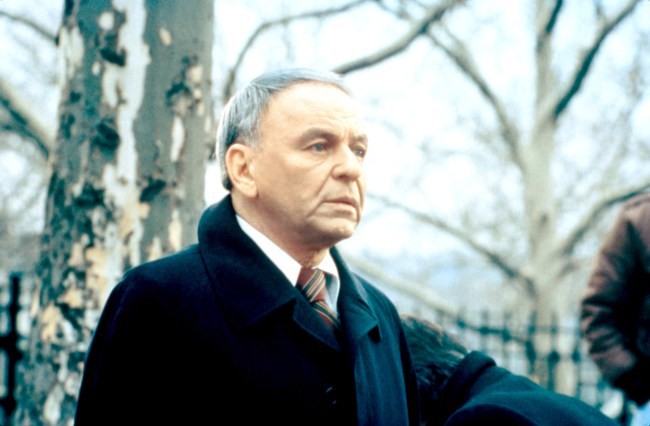
In 1980, Frank Sinatra returned to the big screen for the first time in 10 years in “The First Deadly Sin,” and the result was not only Ol’ Blue Eyes’ best performance, but a fascinating curiosity that ended one cycle of films and looked forward to another.
A grim meditation on aging and mortality masquerading as a serial killer thriller, it’s one of the bleakest and most idiosyncratic movies of Sinatra’s career — which is really saying something when you’re talking about the guy who starred in “Some Came Running,” “The Man with the Golden Arm,” and “The Manchurian Candidate.”
In “The First Deadly Sin,” which was adapted by ace screenwriter Mann Rubin (“The Best of Everything”) from a popular crime novel by Lawrence Sanders, Sinatra plays world-weary NYPD detective Edward Delaney, a cop just a few weeks from retirement whose wife (Faye Dunaway) lies dying in the hospital. When Delaney begins investigating the murder of a man killed in the street with a hammer, he quickly realizes the homicide is the work of a serial killer. But the murders have taken place in different boroughs, and breakdowns in interdepartmental communications have kept any from seeing obvious connections.


Unable to convince anyone to see what he sees — or, worse, to care about it — Delaney goes rogue and pursues the killer without going through proper channels or procuring the necessary warrants, culminating in an act of vigilante justice that wouldn’t seem out of place in a movie starring Clint Eastwood or Charles Bronson. Yet if the story of “First Deadly Sin” sounds like something out of “Dirty Harry” or “10 to Midnight,” the execution — both in terms of Brian G. Hutton’s leisurely direction and Sinatra’s beleaguered performance — makes it singular, less an example of the post-“Dirty Harry” and “Death Wish” wave of vigilante thrillers than a last gasp of commentary on them before the genre would shift into a different register.
The key to the film is Sinatra’s sense of excruciating resignation. Although he’s battling both criminals and a failed system in the same way as Dirty Harry Callahan or Bronson’s Paul Kersey in “Death Wish,” there’s no fire in his pursuit; until the film’s climax, the closest he comes to rage or violence is threatening to throttle his wife’s incompetent doctor. Delaney follows leads with as much passion as one would check items off a grocery list, and there’s a curious lack of propulsion to Rubin’s screenplay.
 ‘The First Deadly Sin’©Warner Bros/Courtesy Everett Collection
Scenes don’t seem to lead into each other as much as they exist independently as studies in stasis — no one in this movie ever seems to really be going anywhere or moving forward with their lives (Faye Dunaway spends the entire movie in a bed that she never leaves). This is not a criticism; what makes “The First Deadly Sin” compelling is the palpable sense of loss it conveys.
When Clint Eastwood tosses his badge to the ground at the end of “Dirty Harry,” it’s an empty gesture — we know he doesn’t really mean it, and that he’ll be back for the sequels. Sinatra’s sense of hopelessness is relentless — there’s no meaning in his pursuit of the killer. No one really seems to care if Delaney catches the psycho or not, and if he doesn’t it won’t make that big a difference on the world outside of the handful of victims the killer takes his hammer to.
The only meaning to be found in Delaney’s mission comes in its contrast to what’s happening in the hospital with his wife. Structurally, “The First Deadly Sin” is rigorous in its parallel attentions to the murder investigations and Delaney’s visits to his dying spouse, and the effect is to connect the two stories on a subliminal level. Delaney can’t save his wife, but maybe he can save someone else by catching the killer; in the end, however, achieving the latter does nothing to alleviate the anguish of the former, and Delaney ends the movie alone and purposeless.
It’s a depressing finale that the movie more than prepares us for, with scene after sad scene in which Delaney barely seems to have the energy to walk from one side of the room to the other, let alone hunt down a killer. In one extended sequence, Delaney just wanders his lonely apartment, the ghost of his wife already haunting the place. She’s not dead yet, but she might as well be, as Delaney ponders what his life looks like without her and realizes his own life is just as finished as hers.
None of this is explicitly stated; it’s conveyed by Rubin and Hutton’s carefully constructed parallel structure and by Sinatra’s body language and gestures. It would be an astonishing performance for any actor, but coming from Sinatra it’s positively mind-blowing. Sinatra had gone dark before, but he rarely fully lost his Rat Pack swagger; there was usually a confidence to his performances, even in downers like “Some Came Running.”
In “The First Deadly Sin” there’s no ego and no mask — Sinatra lets us see every wrinkle and walks around like he’s lugging bowling balls in his pockets, with the wounds of age all the more apparent given the contrast between the actor’s appearance here and when he had last appeared in a movie 10 years earlier.
The conceit of a cop working a big case on the eve of his retirement would become a genre movie cliché in later films like “Falling Down” and “Se7en,” but in those movies there’s usually some sense that the final job is reminding the lead detective of why they do what they do — often, they end up deciding not to retire after all. In “The First Deadly Sin,” it’s unthinkable that Delaney would go back to work after the final scene; really, it’s unthinkable that he will ever even leave his apartment.
 ‘The First Deadly Sin’Filmways/courtesy Everett Collection
The film’s power derives from the fact that it belongs to a genre so at odds with its effects; it marks, in its way the end of the cycle of 1970s vigilante thrillers that began with “Dirty Harry,” “Walking Tall,” and “Death Wish.” There would be vigilante movies after “The First Deadly Sin,” of course, but the genre morphed into something different with the likes of “Ms. 45” and “10 to Midnight,” something more lurid and expressionistic. (If you want to track the increasing stylization of the genre, you can do it simply by comparing the relatively “realistic” “Death Wish” with its heightened sequels.)
“The First Deadly Sin” is a kind of pivot point between the two eras, but it belongs to neither. It’s too restrained to fit in with later vigilante movies and particularly later serial killer films; as opposed to something like “Se7en,” with which it shares many superficial similarities, “The First Deadly Sin” spends almost zero time on the actual serial killer’s motivations or even his crimes — there’s almost zero onscreen violence in the movie. And it lacks the righteous rage of a 1970s vigilante film; Delaney isn’t mad, he’s just tired and indifferent. The only wisdom age has brought him is that there’s nothing he can really do to stave off the infinite string of losses life hands you.
It’s a downer of a message for a mainstream movie, and “The First Deadly Sin,” unsurprisingly, was not a hit in its time. In spite of deservedly positive reviews for Sinatra’s performance (if not the movie as a whole), it also didn’t really find an audience on home video or television. Now, however, the boutique physical media label Vinegar Syndrome has given “The First Deadly Sin” the treatment it always deserved, via a Blu-ray featuring a new restoration and filled with terrific extra features.
The two audio commentaries, by film scholars Travis Woods and Amanda Reyes, are particularly noteworthy — they’re both packed with insight and information that add enormously to one’s appreciation of the film. (They also point out blink-and-you’ll-miss-them key moments like the one where a young Bruce Willis passes by onscreen as an extra, a fascinating fact given that “Die Hard” is technically a sequel to the 1968 Sinatra vehicle “The Detective.”) Vinegar Syndrome has always been one of the best labels out there when it comes to unearthing hidden gems; this is one of their best releases to date.
The special edition Blu-ray of “The First Deadly Sin” is now available from Vinegar Syndrome.
What's Your Reaction?
 Like
0
Like
0
 Dislike
0
Dislike
0
 Love
0
Love
0
 Funny
0
Funny
0
 Wow
0
Wow
0
 Sad
0
Sad
0
 Angry
0
Angry
0











Comments (0)