

From Tri-X to Nikon Z9: Inside a lifelong sports photographer’s camera bag
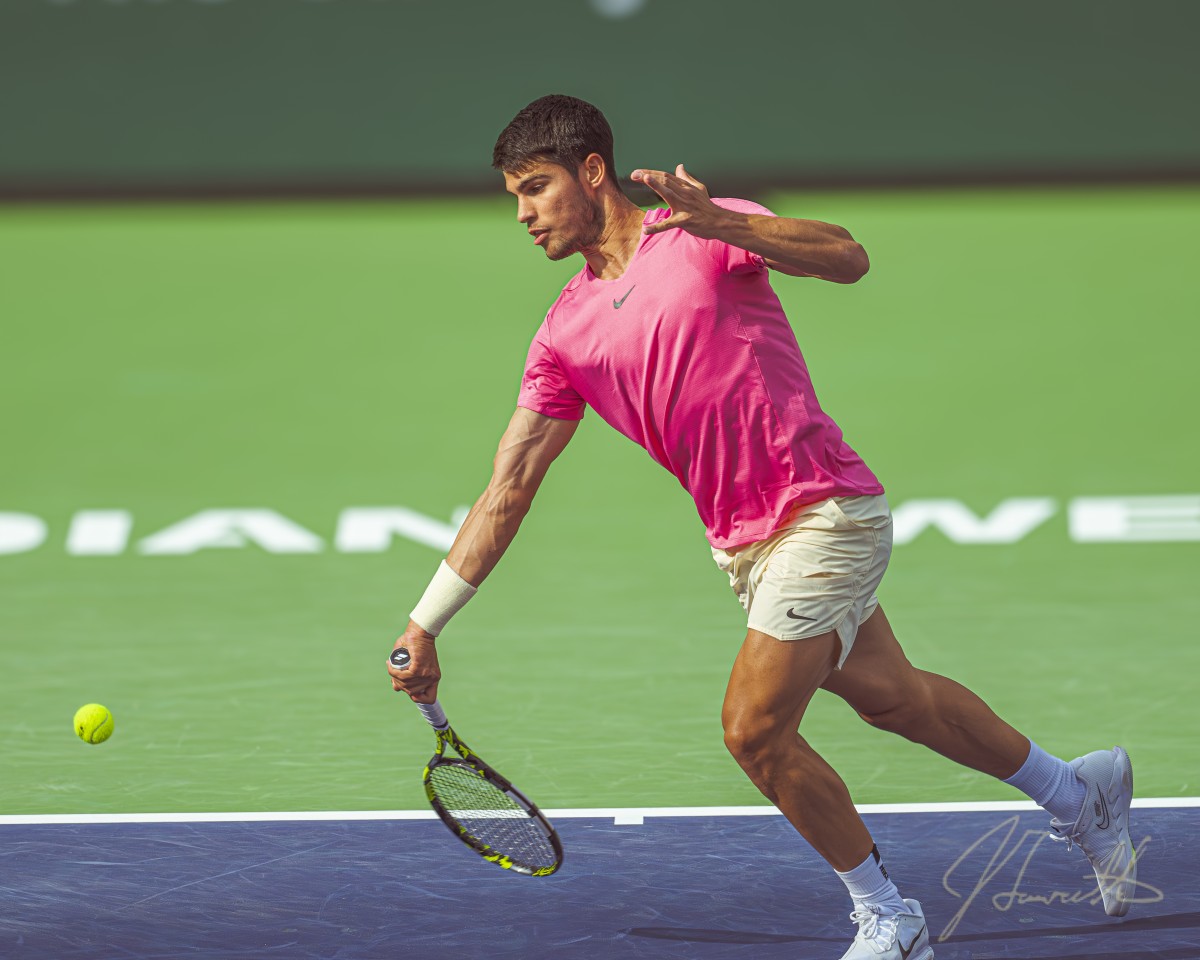
James Fawcette has photographed sports since his junior high school days, evolving from Kodak Tri-X to Nikon Z9 cameras while capturing professional tennis and creating distinctive photo-illustrations.
 James Fawcette
Meet James Fawcette
Home base: Los Altos Hills, CA USA
For this spotlight series, we sometimes get a variety of photos from an individual to share with you, and then there are also specialist photographers like James Fawcette, known as JimLosAltos in the forums. James has spent decades since junior high school covering sports games. He started with the NBA (basketball) using a Kodak Tri-X camera, and is now aiming a Nikon Z9 at professional tennis events.
“When camera companies use the term ‘prosumer’, I suppose that’s what I am. I’m an amateur photographer who extends my enjoyment of tennis by capturing photos of pro tennis players. And I’ve been able to sell enough of these to more than pay for generations of my camera equipment.”
Our ‘What’s in your bag?’ community spotlight series features readers sharing their favorite gear and photography, including from past DPReview collaborators. See below for what James has to share.
What got you into photographing sports?
 Roger Federer’s athleticism was on full display, leaping diagonally to somehow hit an overhead smash at a right angle into a corner of the court while staring into the sun. Since the cluttered background was distracting, I used motion blur to put the focus where it belonged: on Fed. An artist friend told me painters call this “The Adamski Effect”. Who knew?
 Nikon Z7 | AF-S Nikkor 300mm F2.8G IF-ED VR II | F2.8 | 1/6400 sec | ISO 500James Fawcette
“Since the 1960s, as a junior high school student, I sold my first photos of the Boston Celtics and Killington, Vermont ski resort to the local newspaper, the Rutland Daily Herald. I first worked in the Herald’s darkroom, where I learned to develop negatives “by observation.” I had to learn how to “push” the Tri-X from 400 to – who knows. There were no numbers to guide us, so we had to do it by eye. We had pushed the boundaries of that era’s film to its limits.
I managed to get more time behind the camera after the Herald published an on-court shot I took of Wilt Chamberlain. Then I got assignments, first to shoot Killington when it was sub-zero and the NYC tourists were getting frostbite, when my lens literally froze. I couldn’t turn the focus ring. Then I turned an assignment on a new shopping mall into something publishable by getting a private plane ride. I asked the pilot to help me “shoot straight down”. So, he did a wingover, and I was looking literally straight down. Nearly threw up right then and there.”
What’s in James’s bag
 James Fawcette’s camera bag.James Fawcette
Favorite cameras(s): Nikon Z9 & Nikon Z7
Favorite lens(s):
- Nikkor Z 14-24mm F2.8 S
- Nikkor 24-140mm F4 S
- Nikkor Z 400mm F4.5 VR S
- Nikkor 105mm F1.4 F1.4E ED
- Sony FE 70-200mm F2.8 GII
- Viltrox AF 85mm F2.0 Evo
“When I first started, I used what I’m pretty sure were Herald’s Honeywell Pentax reflex cameras that had a long lens of 100m or 135mm, I think. When I had more time for photography years later, I started using lower-end Nikon film equipment, then progressed from the D810 to the D850, and finally to the Z7 and Z9.
Most of my pro tennis shots have been taken by rentals from the likes of old Borrow Lenses to Lensrental, because I do events sporadically, and the physical location varies so widely. My go-to lens for many of my most successful shots after moving to the Z-mount was still an F-mount lens: the 500mm PF on an FTZ converter with a Nikon Z7, then my Z9. It’s remarkably sharp, compact enough to fit in a transparent NFL bag and quick focusing.”
What’s your favorite bag and accessories?
Must-have accessories: “Tile trackers (for theft prevention and tracking) and rubber lens hoods from Kurvd. And of course, the more expected items like backup storage, batteries and a MagSafe Tripod for the phone.”
Favorite bag(s): “I’m totally not satisfied here. This is an endless quest. Frankly, I have a Peak bag I ‘bought’ from that company’s first Kickstarter program. Loved it at first, then the knife-edge shoulder strap, combined with having to spend so much time reconfiguring it every time I changed lenses, turned me off.
Being plenty frustrated with specific camera bags, I now use a regular Tumi or Oakley, which is just a bag with no dividers. I place foam dividers around whatever combination of equipment I put in there.
What’s probably my most unique setup? That’s tough to decide, but freezing on a Killington chairlift in sub-zero temperatures or on my nose looking down from an airplane, I think, qualifies.”
What do you like to shoot?
 The sun setting over the edge of the stadium in Indian Wells casts shadows from his tennis racket’s strings on world number one Jannik Sinner’s freckles. Shot during a semifinal vs Carlos Alcaraz.
Nikon Z9 | AF-S Nikkor 500mm F5.6E PF ED VR | F5.6 | 1/5000 sec | ISO 4000James Fawcette
“My main focus is professional tennis. I’ve captured images of players from Roger Federer to Jannik Sinner and from Serena Williams to Coco Gauff, which have appeared in all sorts of media. Since I like tennis, my focus is more on playing tennis than on reaction shots, which bore me (sorry). I attempt to capture the energy, the technique, the athleticism of these great players. That passion evolved into photo-illustration.
Sometimes I have media credentials and shoot from the edge of the court. Other times, I shoot as a ticket-buying fan (something that is becoming near impossible, as another subject of your spotlight series stated in his article. I find that very sad and short-sighted.)”
How do you photograph constantly moving objects, such as sports players?
 Coco’s Flamboyant Forehand. America’s top women’s player, Coco Gauff, was a teenager playing in San Jose, CA. Z9’s dynamic range was a huge help in capturing her dark skin tones in the deep shadows.
 Nikon Z9 | Nikkor Z 100-400mm F4.5-5.6 VR S @ 350mm | F5.3 | 1/2000 sec | ISO 2500James Fawcette
“It’s kind of impossible to keep up with the quick movements of professional athletes, so knowing the sport well enough to anticipate action helps. Also, I’ve learned a few tennis-specific tricks, but I imagine they have parallels in other sports.
One such example is trying to time the ball’s impact with the racket’s strings. Pros are so precise, and their skills make them so consistent, you can often watch for the ball to get in the right position with confidence that’s where they’ll make contact. I suppose another example would be that of a high cross in soccer (a pass kicked through the air from one side of the field to the other), which will lead to a header (when a player uses their head to play the ball).”
What would you say to other photographers about building a lasting career?
 Sinner Hydra. This photo illustration conveys TV analyst Brad Gilbert saying of world number 1 Jannik Sinner: “He gives you nowhere to go. Everywhere you look, Sinner has a weapon.” This was NOT done with generative AI, but by taking my original photo and blending four copies together in Photoshop using one of its lesser-known tools: parametric filters.
 Nikon Z9 | AF-S Nikkor 500mm F5.6E PF ED VR | F5.6 | 1/1250 sec | ISO 800James Fawcette
“As photography gets commoditized, being able to add value to the photo has helped me. The photo-illustrations differentiate my work. In some cases, I’ve created cover images for a set of photos using typography on the names or headlines that graphically overlap the image. But if I’m trying to get an image published, rather than simply for fun, the illustration or abstraction has to serve a purpose.
For example, a photo-illustration I called “Sinner Hydra” was inspired by a tennis analyst, the excellent Brad Gilbert, saying “He gives you nowhere to go. Everywhere you look, Sinner has a weapon”. So, I created an image of Sinner with four arms holding a racket. Point made.
Differentiating your product is key.
Another tactic that has worked for me is to understand the publication’s or site’s mission and create packages that fit that. A more pragmatic example is a set of images where I overlaid pop-up windows showing close-ups of how tennis players grip their rackets for a website that caters to teaching tennis pros. That’s added value. Differentiating your product is key.”
James really enjoyed participating in this spotlight article and would love to hear what you think of his photography and to answer any of your questions in the comments below.
You can check out James’s other work at jfawcette.myportfolio.com/work.
Editor’s note: This article continues a series, ‘What’s in your bag?’, highlighting DPReview community members, their photography and the gear they depend on. Would you like your photography to be featured in a future installment? Tell us a bit about yourself by filling out this form.
Want to stay up to date on the latest product news and releases? Add DPReview as a preferred source to ensure our independent journalism makes it to the top of your Google search results.

What's Your Reaction?
 Like
0
Like
0
 Dislike
0
Dislike
0
 Love
0
Love
0
 Funny
0
Funny
0
 Wow
0
Wow
0
 Sad
0
Sad
0
 Angry
0
Angry
0






Comments (0)