Gigabyte X870 Aorus Infinity Motherboard Review: limited-edition, designed for extreme overclocking, but pricey for X870
Oct 16, 2026 - 19:11
01
Gigabyte’s X870 Aorus Infinity blends extreme overclocking ability and tools with good all-around features and aesthetics. But you’ll have to pay up for this limited-edition board’s flexibility.
Reasons to buy
+
Dedicated overclocking buttons
+
External BCLK generator
+
Fast USB connectivity (USB4)
+
Magnetically attaching Wi-Fi antenna
+
Two PCIe 5.0 M.2
+
Dual 64MB BIOS
Reasons to avoid
-
Pricey for X870
-
M.2 socket shares lanes with the sole USB4 port
Why you can trust Tom's Hardware
Our expert reviewers spend hours testing and comparing products and services so you can choose the best for you. Find out more about how we test.
motherboard using that incredible-looking space-age material for VRM cooling, along with something more practical: the X870 Aorus Infinity, a production board, not a concept. The Infinity is made for overclockers. Just look at the right edge: All those buttons and voltage read points make pushing the limits even easier. It sports a two-DIMM design, with the DRAM slots above the socket, prioritizing speed over capacity. Priced at an eye-opening
, it's far from cheap (it is a 40th-anniversary limited-edition board), even for the enthusiast X870E platform, but it offers a wide range of features that work for nearly everyone.
As far as specifications go, the Aorus Infinity is well-equipped for an X870 board. You get eight total USB ports on the rear IO (one USB4), three M.2 sockets (one PCIe 5.0), and four SATA ports for storage, fast networking with 5 GbE and Wi-Fi 7 (320 MHz), and a quality last-gen flagship-class audio codec. And of course, there are all of the features designed for overclocking, including robust power delivery and the Overclocking kit, with several buttons and voltage read points, to take some of the complications of extreme overclocking down a notch. Gigabyte also lists support for a staggering DDR5-11400(OC), but it needs manual tweaking, specialized BIOS fine-tuning, and the right hardware (likely an APU with an excellent IMC).
On the performance front, the X870 Aorus Infinity delivered average-to-above-average results across most tests, using our primary Kingston DDR5-6000 kit, which is what we like to see. It proved competent not only in daily office tasks and other productivity functions, but also as a solid gaming platform. Overall, this board is a well-rounded performer.
Below, we’ll examine the Aorus Infinity’s performance and other features, and decide if it has a chance to make our list of the best motherboards. But before we share test results and discuss details, here are the specifications from the Gigabyte website.
Specifications of the Aorus Infinity
Swipe to scroll horizontally
Socket
AM5 (LGA 1718)
Chipset
X870
Form Factor
ATX
Voltage Regulator
22 Phase (18x 110A SPS MOSFETs for Vcore)
Video Ports
(1) USB4 (1) HDMI (v2.1) (1) HDMI (v1.4) Front
USB Ports
(1) USB 4 (40 Gbps) Type-C (2) USB 3.2 Gen 2 (10 Gbps) (5) USB 3.2 Gen 1 (5 Gbps)
Gigabyte includes the typical accessories, including two SATA cables and two 2-pin thermistors, a front panel connector, a Wi-Fi EZ Mag connector for the Wi-Fi Antenna, a manual, and an Aorus sticker. It also includes the CPU Thermal Matrix, two plates (a backplate and one that mounts on top) designed to mount around the socket to reduce VRM and RAM temperatures by up to 8.5 degrees Celsius, which can benefit both the average user and the extreme overclocker.
Latest Videos FromTom's Hardware
Design and Features of the Gigabyte X870 Aorus Infinity
Image 1 of 7
(Image credit: Future)
(Image credit: Future)
(Image credit: Future)
(Image credit: Future)
(Image credit: Future)
(Image credit: Future)
(Image credit: Future)
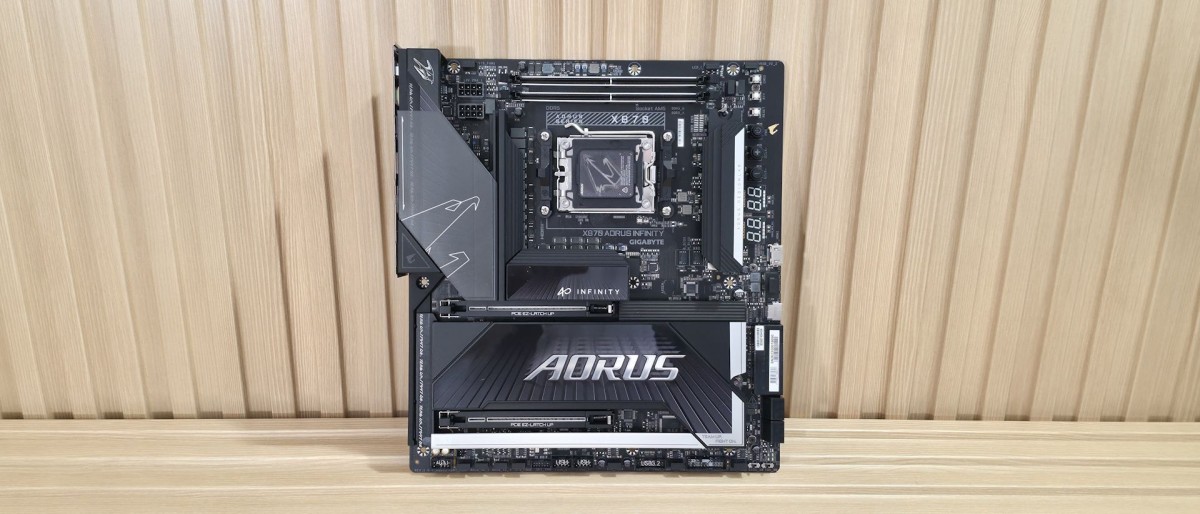
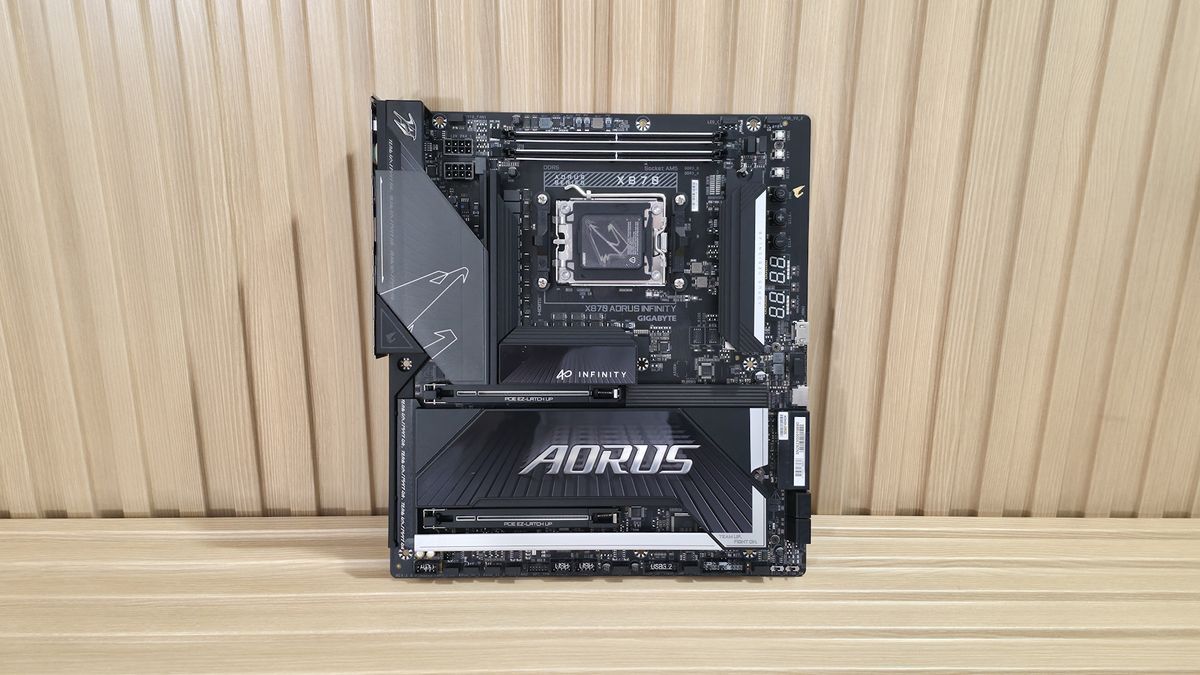
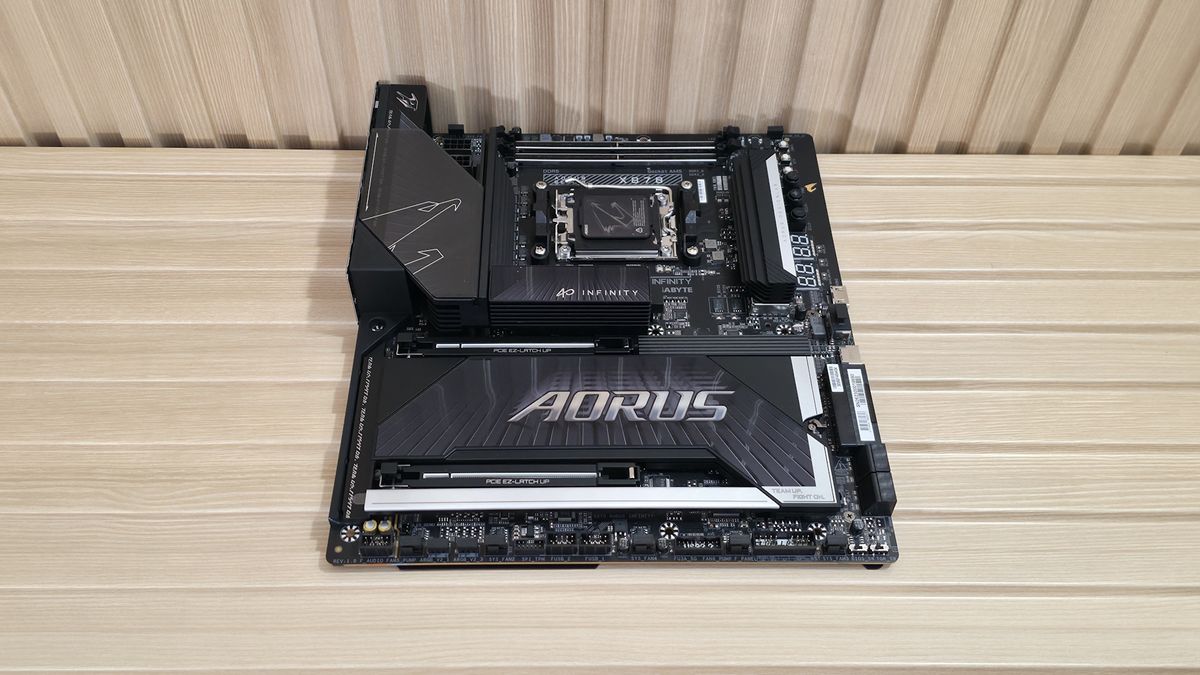
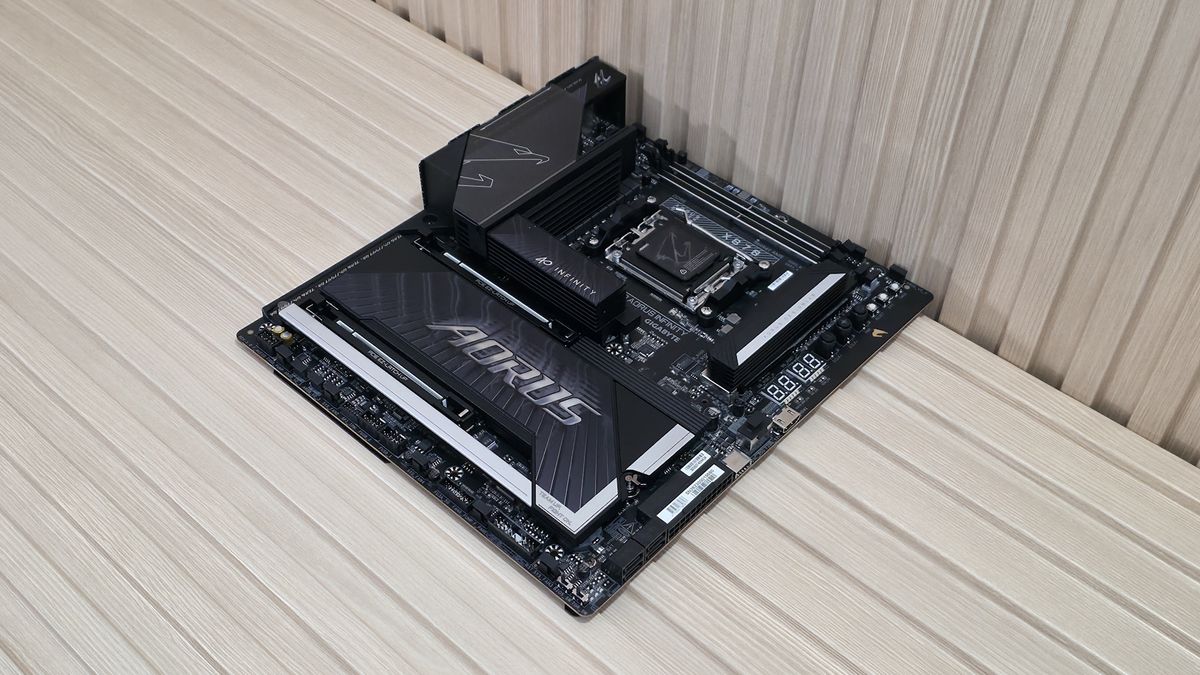
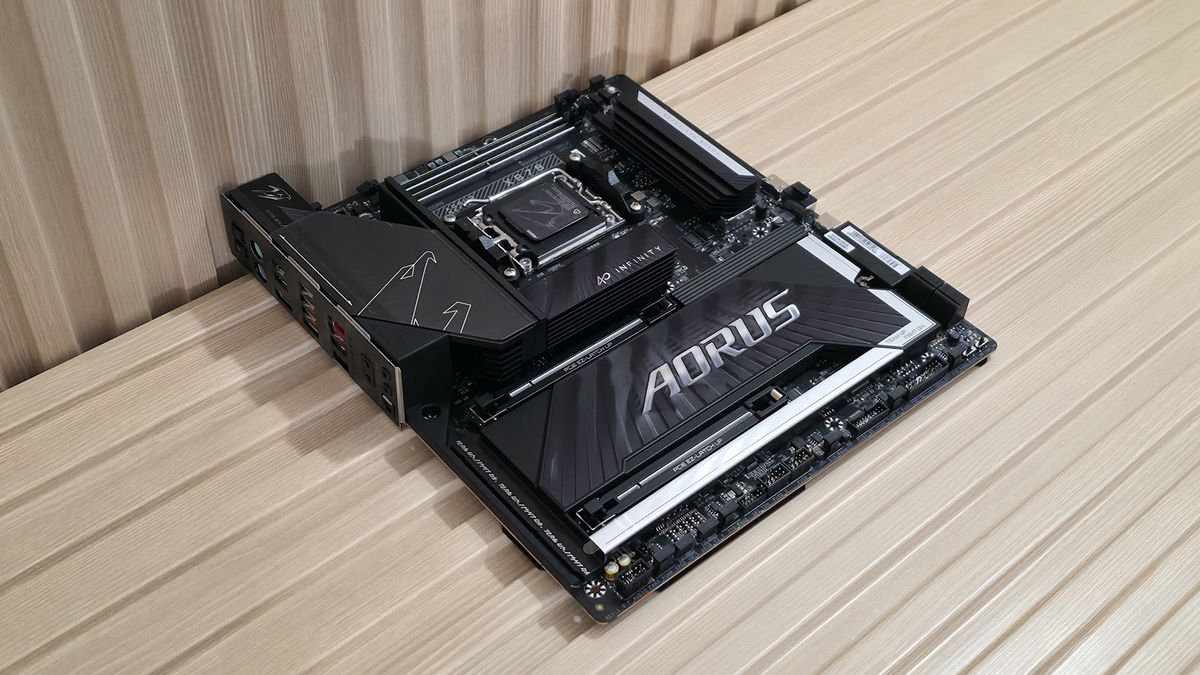
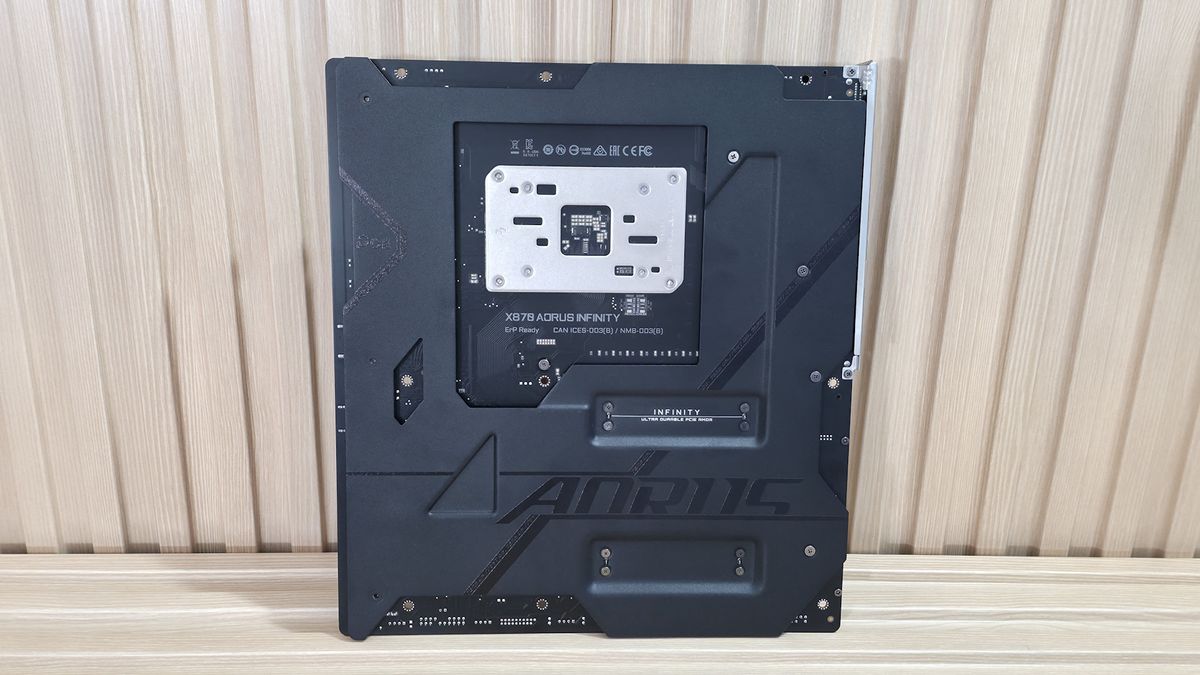
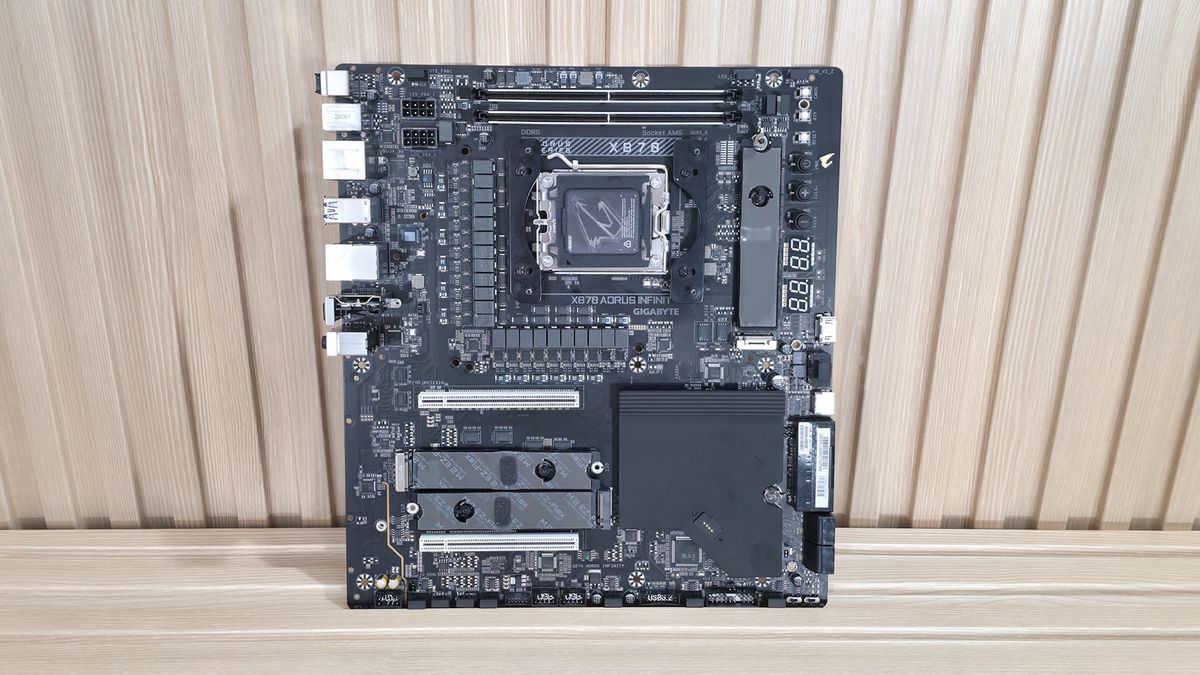
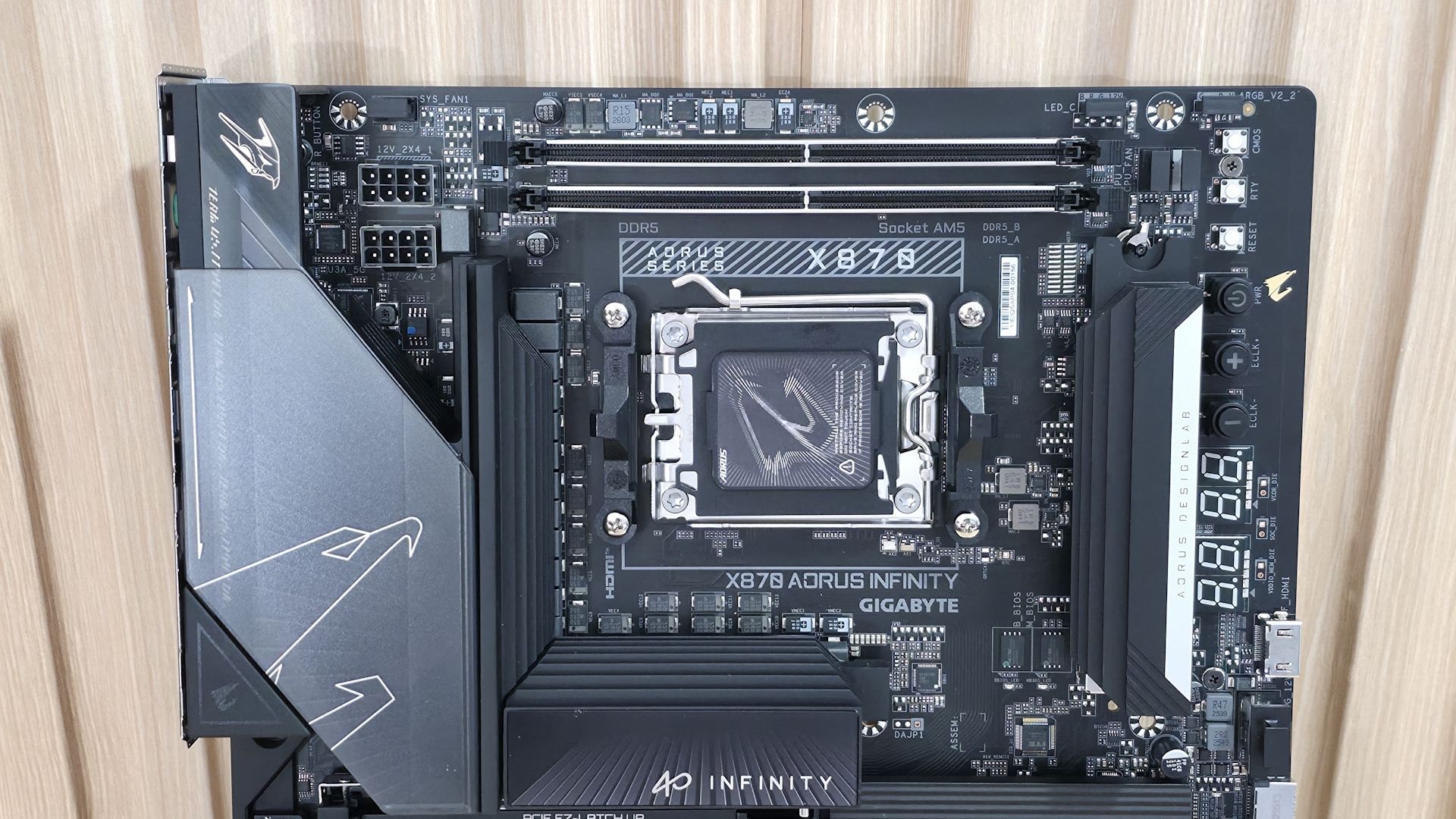
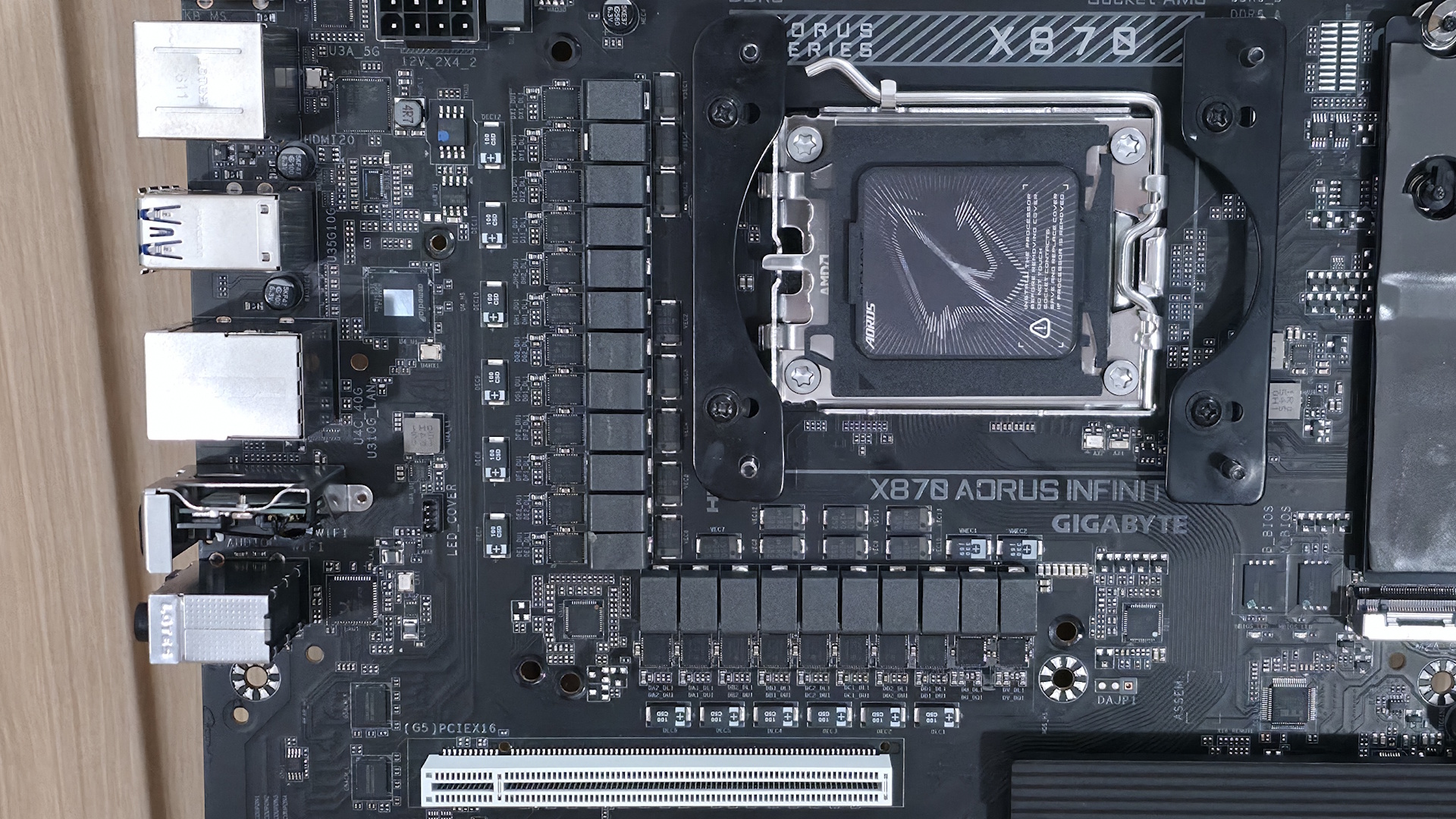
The Aorus Infinity's design stands out primarily for its rotated socket area and top DRAM slots. The left VRM area features a unique heatsink with a plastic cover that slides open to install 8-pin EPS connectors, and slides closed to cover them. On top is the Aorus Falcon, representing the brand, and it's backlit by RGB lighting from below. Where you’d normally find the top M.2 socket (below the CPU socket) is now populated with VRMs, and the M.2 is to the right, running vertically where the DRAM slots normally are. In essence, the entire socket area primary M.2 socket and DRAM slots are rotated 90 degrees counterclockwise.
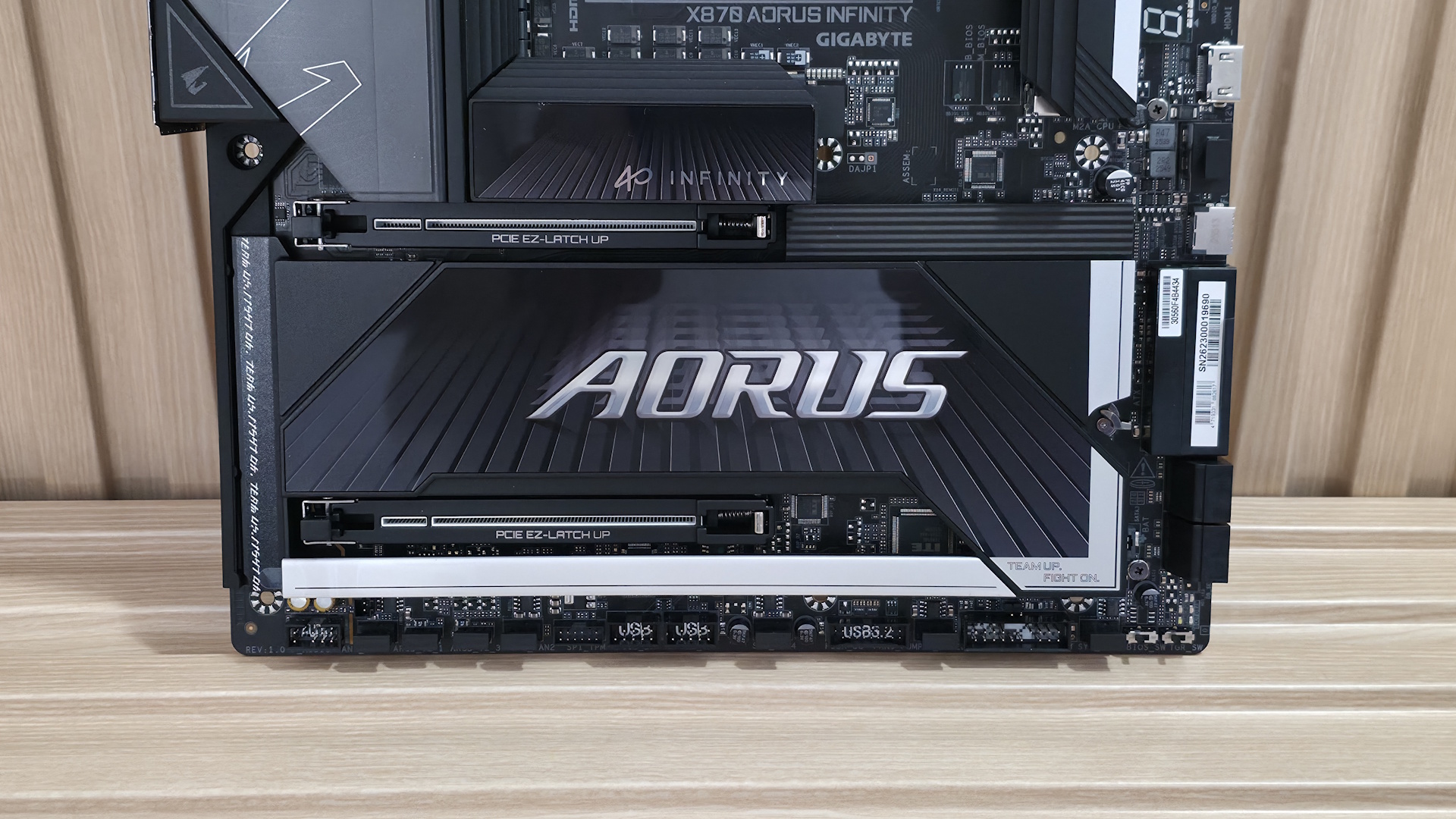
The bottom portion of the board uses reinforced PCIe slots and plate-style heatsinks with DIY-friendly features like PCIe EZ Latch Up (which works similarly to Asus’ method they had to change) and EZ Latch Plus/Click for screwless M.2 mounting. Overall, it’s a good-looking board that looks good inside any dark chassis.
(Image credit: Future)
Starting our tour in the top left, we get a better look at the sliding cover on the large, heatpipe-connected (big 8mm heatpipes) heatsinks. The smoked plastic piece on top slides down to allow access to the two 8-pin EPS connectors (one required). Connect the leads from the power supply, then slide the piece up to hide the unsightly wires. The only RGB element on the board is the Aorus Falcon flying high on the VRM heatsink, with RGB lighting radiating a frosted glow from below.
The two DRAM slots on top of the board have locking mechanisms on both sides. Gigabyte lists support up to an incredible 9600 MT/s and has/had a record on this board reaching an insane 11,400 MT/s (surely that’s achieved with cherry-picked processors and RAM kits) with heavy manual tweaking. Still, it is possible. In a nod to how well this dual-DIMM-slot board handles RAM, it’s one of the rare motherboards that lets our Ryzen 9 9900X run our Klevv DDR5-8000 kit. Normally, that’s only reserved for the APU and its superior IMC or other (but not all) two-DIMM boards.
Moving past the socket, we hit our first M.2 slot, running vertically where you would normally see RAM slots. It’s also one of two CPU-connected M.2 sockets, both supporting PCIe 5.0 x4 (128 Gbps) speeds and 110mm drives. Above that are two (of eight) 4-pin fan headers, each supporting PWM or DC-controlled devices. The BIOS or Gigabyte Control Center (GCC) controls these headers. Above that are two RGB headers, a 3-pin ARGB (one of three) and a 4-pin RGB header. The RGB Fusion app in GCC controls the integrated RGB feature and anything attached through the headers.
Last but not least, on the top half of the board is the Overclocking Kit and EZ-Debug area. This is what makes the board unique compared to ‘normal’ motherboards (ones that aren’t focused on overclocking). Here we see three simple white buttons: a CMOS clear button, a cold reset button for cold boot, and a reset button.
(Image credit: Future)
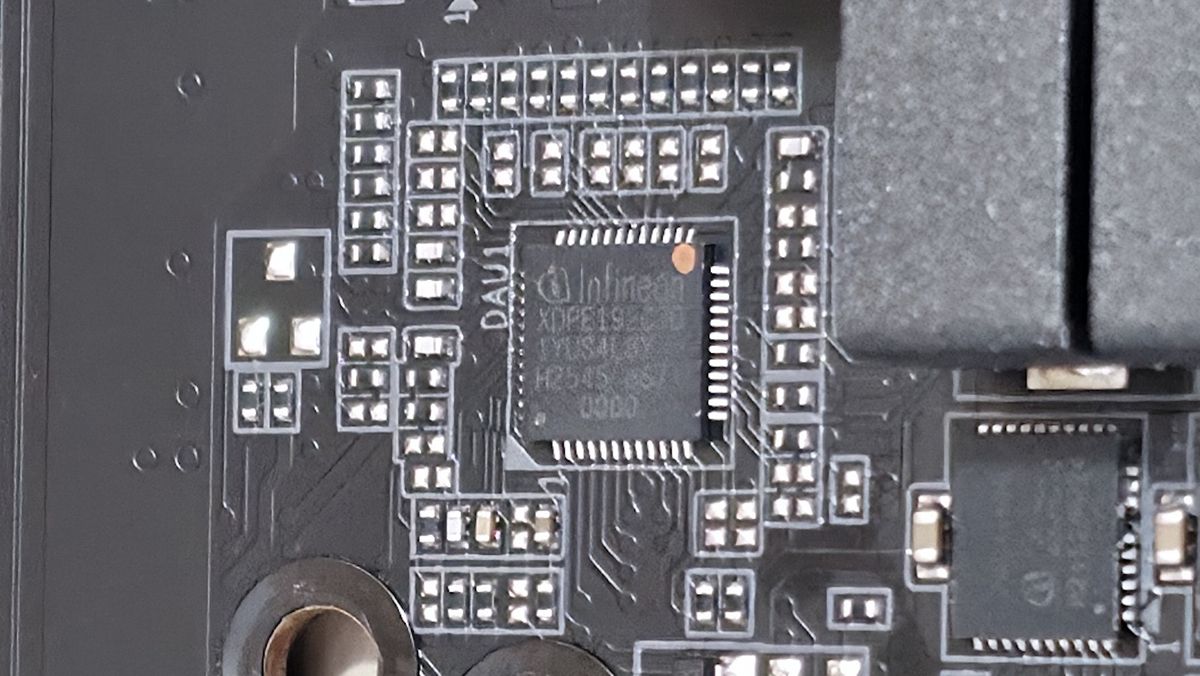
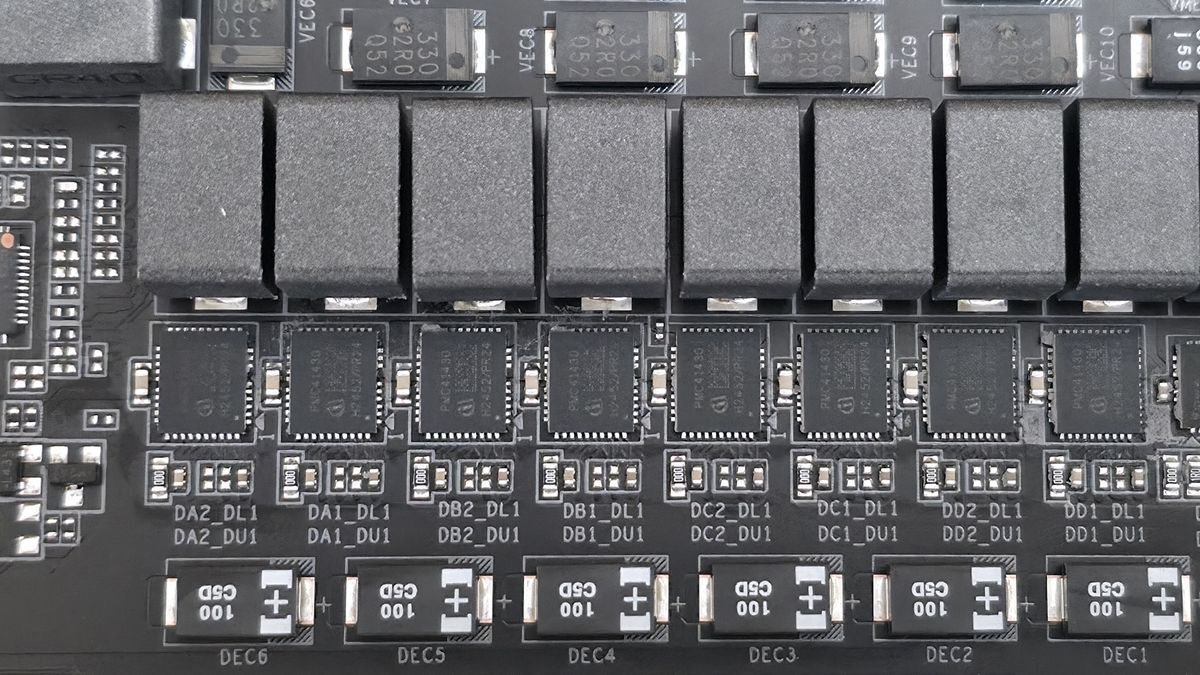
On power delivery, we see a high-end solution with 22 phases, 18 dedicated to Vcore. Power comes from the 8-pin EPS connector(s) and goes to the Infineon XDPE192C3D 12-phase PWM controller using a teamed configuration. From there, it moves to the powerful Infineon PMC41430 110A Smart Power Stage (SPS) MOSFET/gate driver. The 2,200A available will easily handle anything you throw at it, including flagship-class processors like Ryzen 9 9950X or Ryzen 9 9950X3D2, even with extreme cooling methods
Stay On the Cutting Edge: Get the Tom's Hardware Newsletter
Get Tom's Hardware's best news and in-depth reviews, straight to your inbox.
(Image credit: Future)
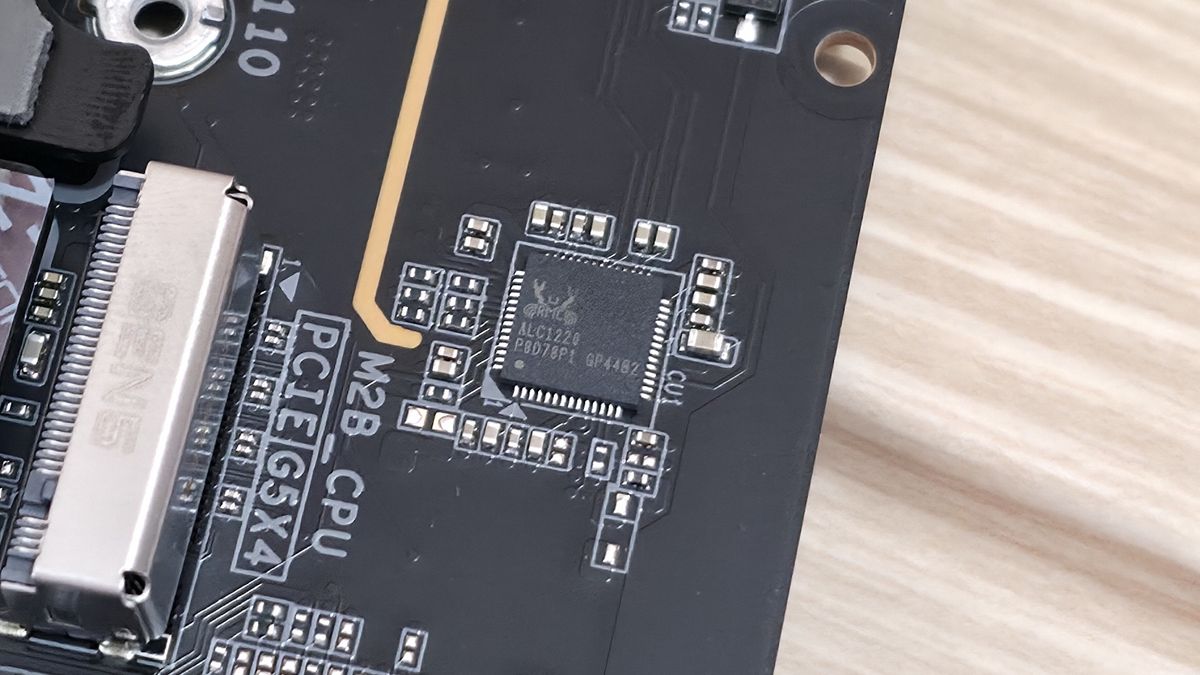
On the bottom half of the board, starting on the left, the audio section is hidden under heatsinks and shrouds. Here, we spy the last-gen flagship Realtek ALC1220 codec and a couple of dedicated audio capacitors. You won’t find a DAC or integrated amplifier, but this board targets overclockers, and we shouldn’t expect that from this type of board. That said, you’ll be perfectly happy with this solution.
In the middle of the board are two full-length PCIe slots, both reinforced and using Gigabyte’s PCIe EZ-Latch Up, which brings back bad memories of Asus’ implementation that got skewered for scratching video-card PCIe connectors. Here’s hoping Gigabyte learned from Asus. The top slot is your primary for graphics and runs up to PCIe 5.0 x16. The bottom slot, also CPU-connected, runs up to PCIe 5.0 x8. When you populate the bottom slot, the top slot drops to x8 speeds (and also supports bifurcation in the BIOS).
Under the large plate-style heatsink with the Aorus branding are two other M.2 sockets (M2B_CPU and M2D_SB). The top socket, M2B_CPU, as the name implies, connects through the CPU and runs at PCIe 5.0 x4 (128 Gbps). Note that this socket shares bandwidth with the USB4 port. You can run it at PCIe 5.0 x2 (64 Gbps, like PCIe 4.0 x4) or disable the USB4 port altogether for full M.2 bandwidth. This isn't ideal for those who need two PCIe 5.0 x4 drives and USB4, but this split is common across vendors. All M.2 sockets also use Gigabyte’s M.2 EZ-Latch Plus and EZ-Latch Click for easy M.2 installation. For anyone who may want to RAID their M.2s, the board supports RAID01/5/10 modes for NVMe (but RAID5 is only available with Ryzen 9000 series).
Along the right edge, we spot a vertical 8-pin PCIe connector that, when used, supports up to QC-USB 65W charging on the front panel (Type-C port). Below that are the front-panel USB 3.2 Gen 2x2 (20 Gbps) Type-C connector and the board's ATX power connector. Just behind the ATX connector are two 2-pin temperature headers for the two included thermistors. Below the ATX connector are the four SATA ports (supports RAID0/1/10).
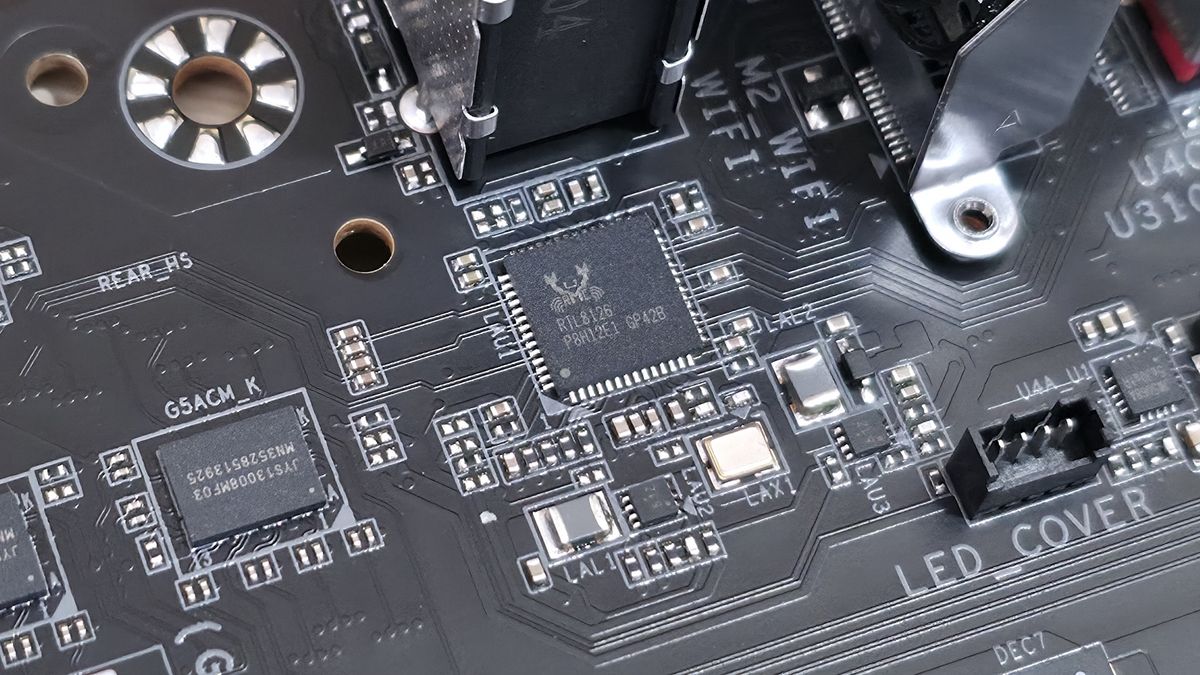
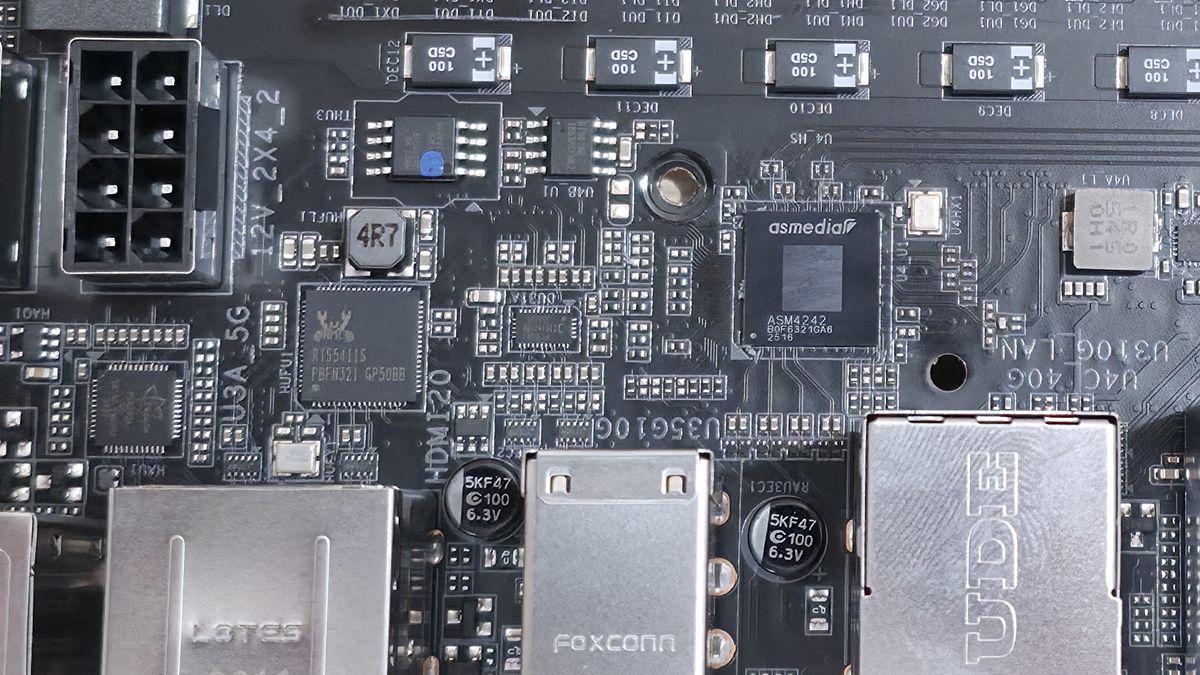
Below that are five LEDs: four used for debugging during POST (CPU, VGA, DRAM, Boot), and an additional LED (orange) is for storage activity. We’ve also included several images of the board’s active IC’s. Gigabyte uses a mix of Infineon (PWM controller and MOSFETs) and Realtek (audio, USB, USB4, LAN, etc.).
Image 1 of 5
(Image credit: Future)
(Image credit: Future)
(Image credit: Future)
(Image credit: Future)
(Image credit: Future)
At the bottom, several headers run the full width of the board, including front-panel audio and USB ports. A complete list of connectivity is listed below (from L to R):
Front panel audio
4-pin fan header
3-pin ARGB
4-pin RGB
4-pin fan header
TPM header
(2) USB 2.0 headers
4-pin fan header
19-pin USB 3.2 Gen 1 header
4-pin fan header
Front panel
4-pin fan header
BIOS switch
OC Trigger Switch
(Image credit: Future)
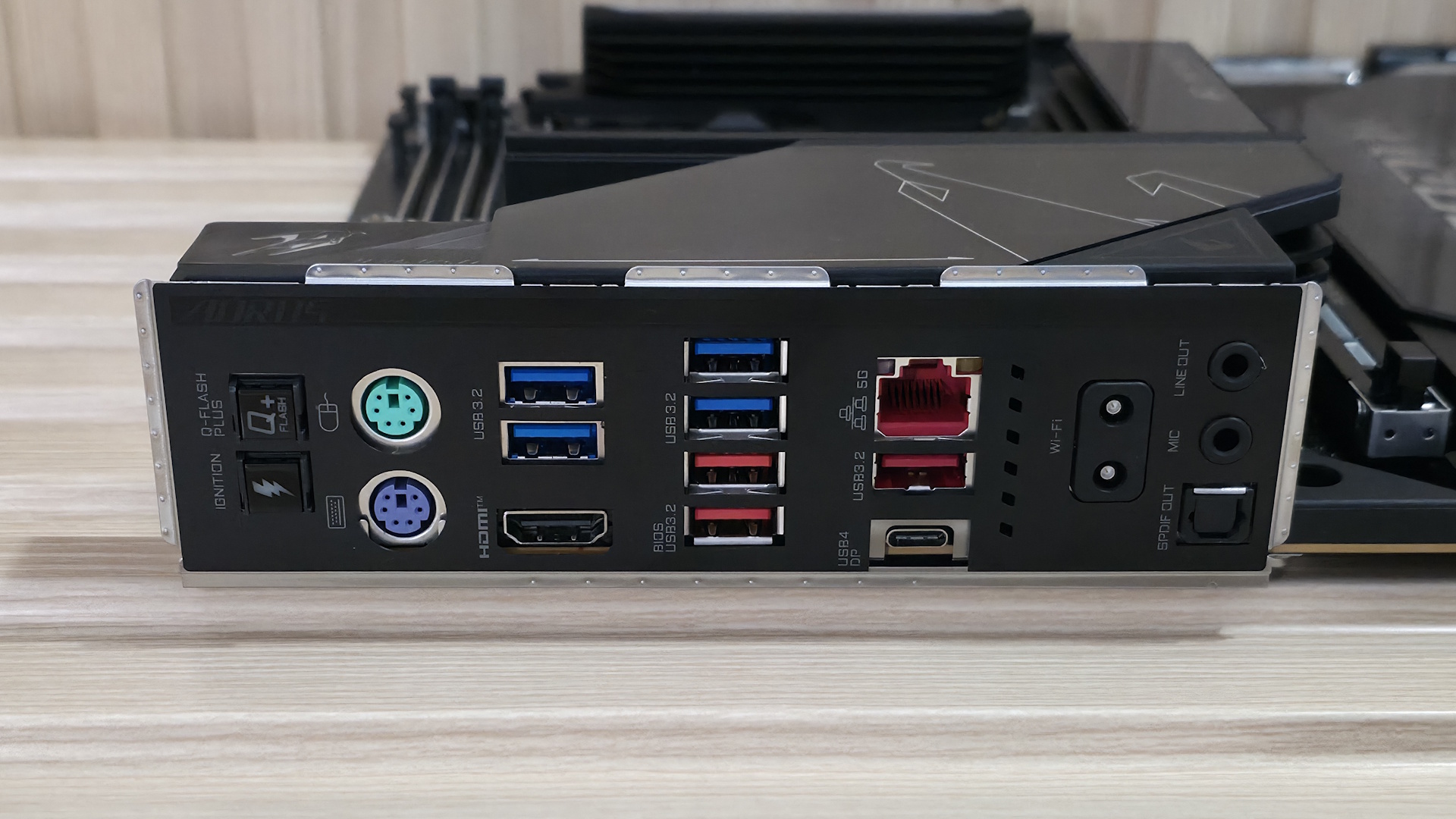
Working our way to the rear I/O, we can see it’s packed with ports (even legacy PS/2) and buttons. On the left is the Q-Flash Plus button, along with the OC Ignition button, which lets users pre-test water-cooling setups when building the PC without booting. Next are two legacy PS/2 ports for a keyboard and mouse, best used for extreme overclocking and pushing the limits (PS/2 is less stressful on the system than USB). After that, we run into the HDMI port and two USB 3.2 Gen 1 (5 Gbps) ports.
Further right, we see another USB 3.2 Gen 1 port and two USB 3.2 Gen 2 (10 Gbps) ports (red; the bottom one is used for Q-Flash). The next stack holds the Realtek 5 GbE, another USB 3.2 Gen 2 port, and below that, the sole USB4 (40 Gbps) port. The Wi-Fi antenna connector is next and connects magnetically — just get it close and let the magnet connect it. Last but not least is the audio stack, which includes two 3.5mm jacks (line out/front speaker out, mic in/rear speaker out) and an optical S/PDIF connector.
It should have plenty of ports, and fast ones at that, for the average user.
Joe Shields is a staff writer at Tom’s Hardware. He reviews motherboards and PC components.
COLGeek
I get the desire for an over-engineered rock solid mobo that should last beyond its normal lifespan given the costs of other components these days.
I don't get the overclocking marketing hype when it is not really something that modern CPUs/GPUs/memory need to provide stellar performance. When considering cost/risk/heat/power vs. a couple FPS, is the juice worth the squeeze? Especially for a $800 motherboard?
Seems an unfortunate anniversary release vice current absurd pricing conditions scenario for something that no one actually needs (but may want) for a very high price-tag.
I get the desire for an over-engineered rock solid mobo that should last beyond its normal lifespan given the costs of other components these days.
I don't get the overclocking marketing hype when it is not really something that modern CPUs/GPUs/memory need to provide stellar performance. When considering cost/risk/heat/power vs. a couple FPS, is the juice worth the squeeze? Especially for a $800 motherboard?
Seems an unfortunate anniversary release vice current absurd pricing conditions scenario for something that no one actually needs (but may want) for a very high price-tag.
You are right. To release such a motherboard in these conditions with almost no reason to OC nowadays may seem completely foolish. I see this selling because certain people want to buy the option to OC in the future with no intention of doing so now just because they want to buy that as an option to do. Some people do also competitively OC or want to tinker. The common persons' desire to purchase things that are over specced also tends to come from a want to not be limited, even if they never use such features.



 Like
0
Like
0
 Dislike
0
Dislike
0
 Love
0
Love
0
 Funny
0
Funny
0
 Wow
0
Wow
0
 Sad
0
Sad
0
 Angry
0
Angry
0








Comments (0)