

Hot Chips 2026: Nvidia touts benefits of its DSX MaxLPS site power management approach — tech allows for more compute from fixed data center power budgets
 (Image credit: Nvidia)
This Tom's Hardware Premium article is free to read with a Tom's Hardware account; no payment necessary. We're offering free access from August 23 to 26 so you can read all of our reporting from Hot Chips.
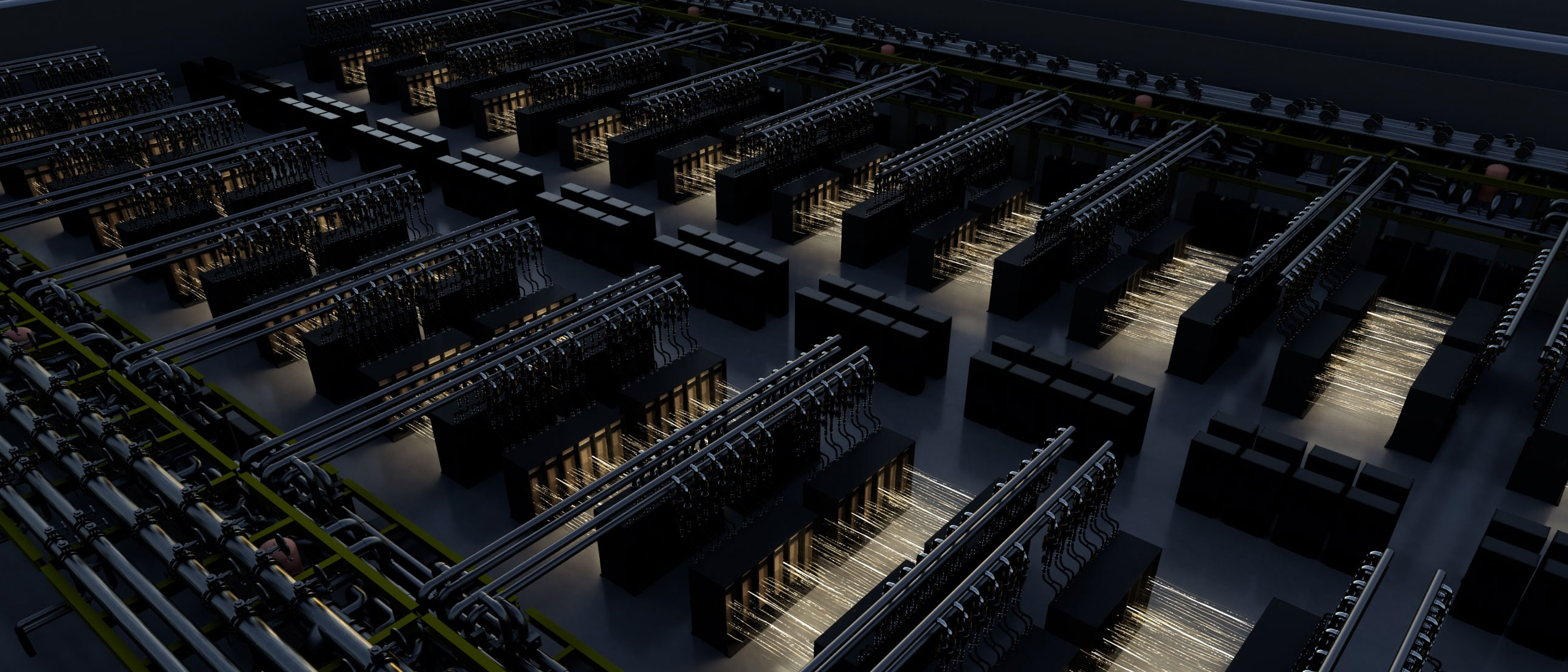
For as much as we might discuss the performance of an individual CPU, GPU, or other chip in a rack-scale AI system, the ultimate constraint on the performance of those chips is the amount of power one can get to the building and into each of the racks that contain them. The management and allocation of that power is a major concern for maximum productivity from a data center installation going forward.
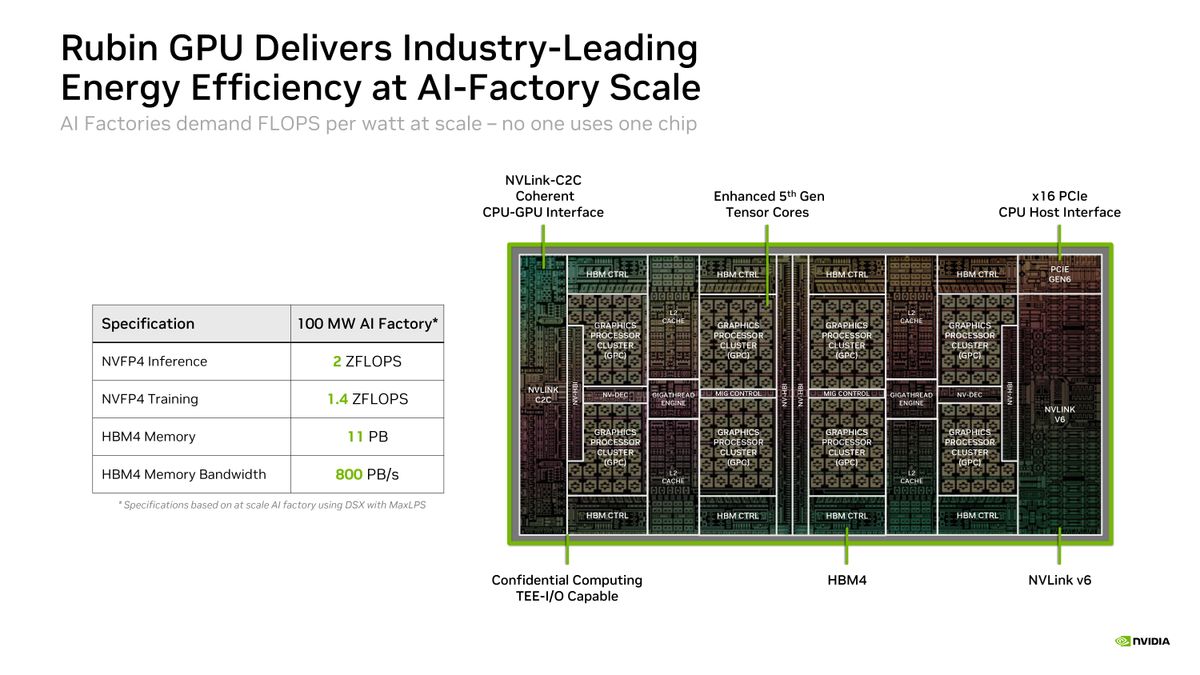
During Nvidia's Hot Chips presentation on the Rubin GPU, the company emphasized this hard limit on data center capacity and touted the amount of compute that Vera Rubin NVL72 systems can deliver within an example fixed facility power budget of 100MW.
Nvidia says that the use of all of Vera Rubin’s power management technologies, in tandem with its DSX MaxLPS (Land, Power, Shell) suite of design and site-level dynamic power management resources, will allow operators to provision installations of 40,000 of those next-gen chips GPUs (or about 40 Rubin DGX SuperPODs) within that 100MW budget, and expects that hardware to deliver up to 2 zettaFLOPS (ZFLOPS) for NVFP4 inference and up to 1.4 ZFLOPS for NVFP4 training.
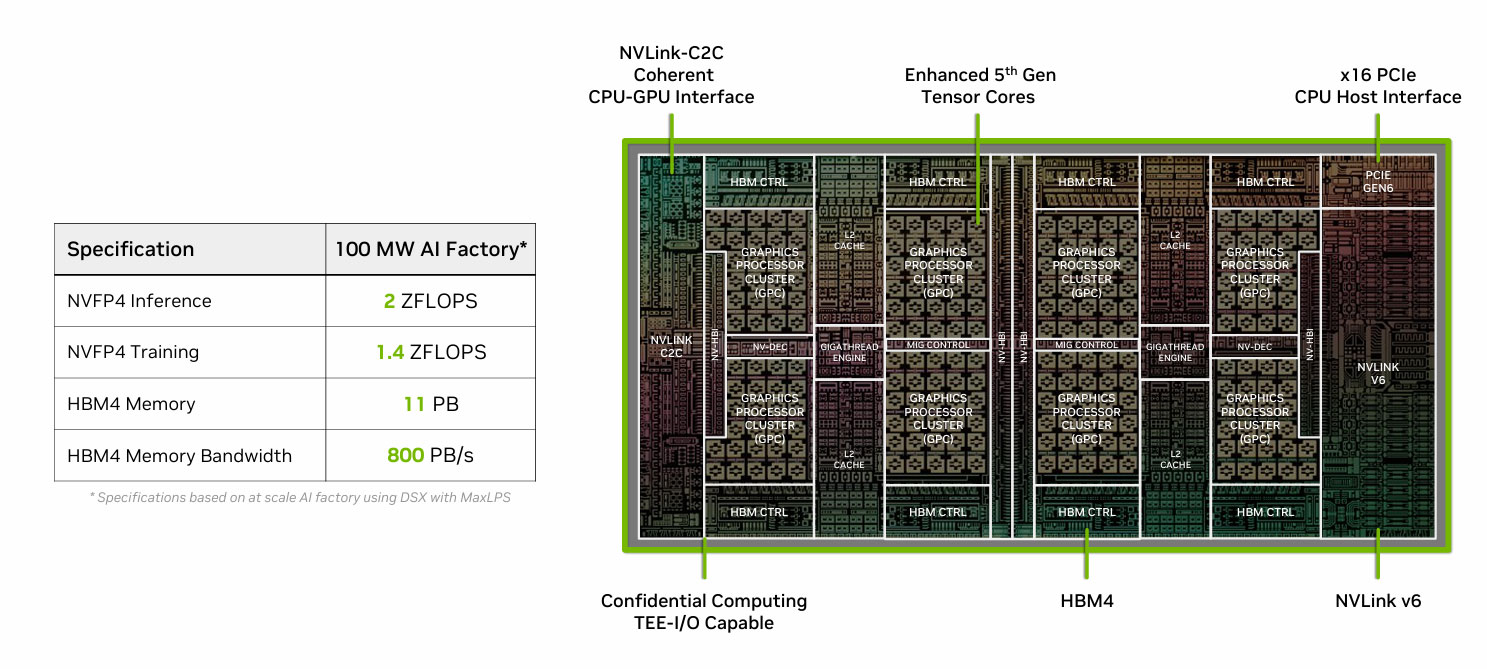
Doing some back-of-the-napkin math for ourselves from publicly available Rubin specs, we feel safe in assuming that those performance figures are estimated, not measured. The maximum number of achievable FLOPS from real-life workloads is likely to be significantly lower for a host of reasons.
But the overall point still stands: getting the most compute out of precious power budgets when planning the AI data centers of the future is going to require more refined planning, monitoring, and facility management than simply applying the coarse measure of estimated peak power draw for every electrical component in the facility. And Nvidia has those building blocks ready for data center constructors in the form of its DSX toolkit.
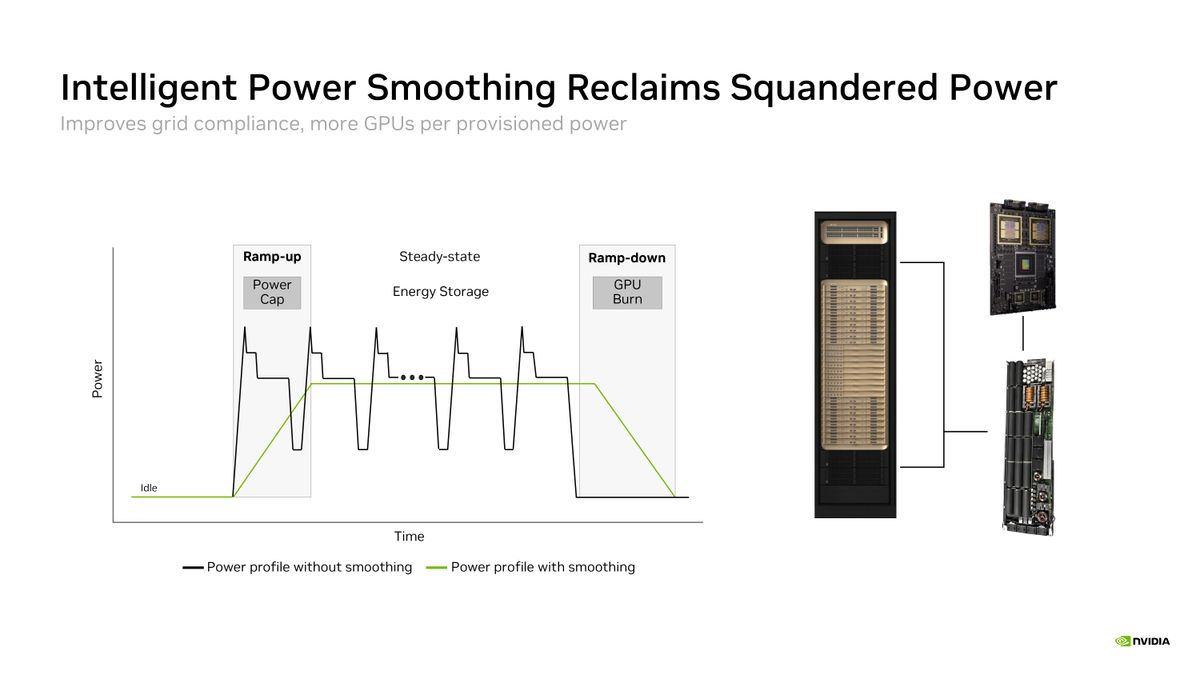
According to a companion blog post that Nvidia shared, as data center operators provisioned their facilities in the past, many of the assumptions they made around power usage focused on those fixed, worst-case power peaks per rack, potentially leading to inflated power budgets that end up stranding power allocation in racks that will rarely, if ever, use all of it.
In just one example, if there was an application load differential between racks in a cluster such that one system would benefit from having more power sent its way in that moment, it couldn’t be re-routed under a static provisioning scheme. The less-utilized rack would use less of its allocated power budget, and the more heavily loaded one might still run into the limits of an overly conservative guard band.
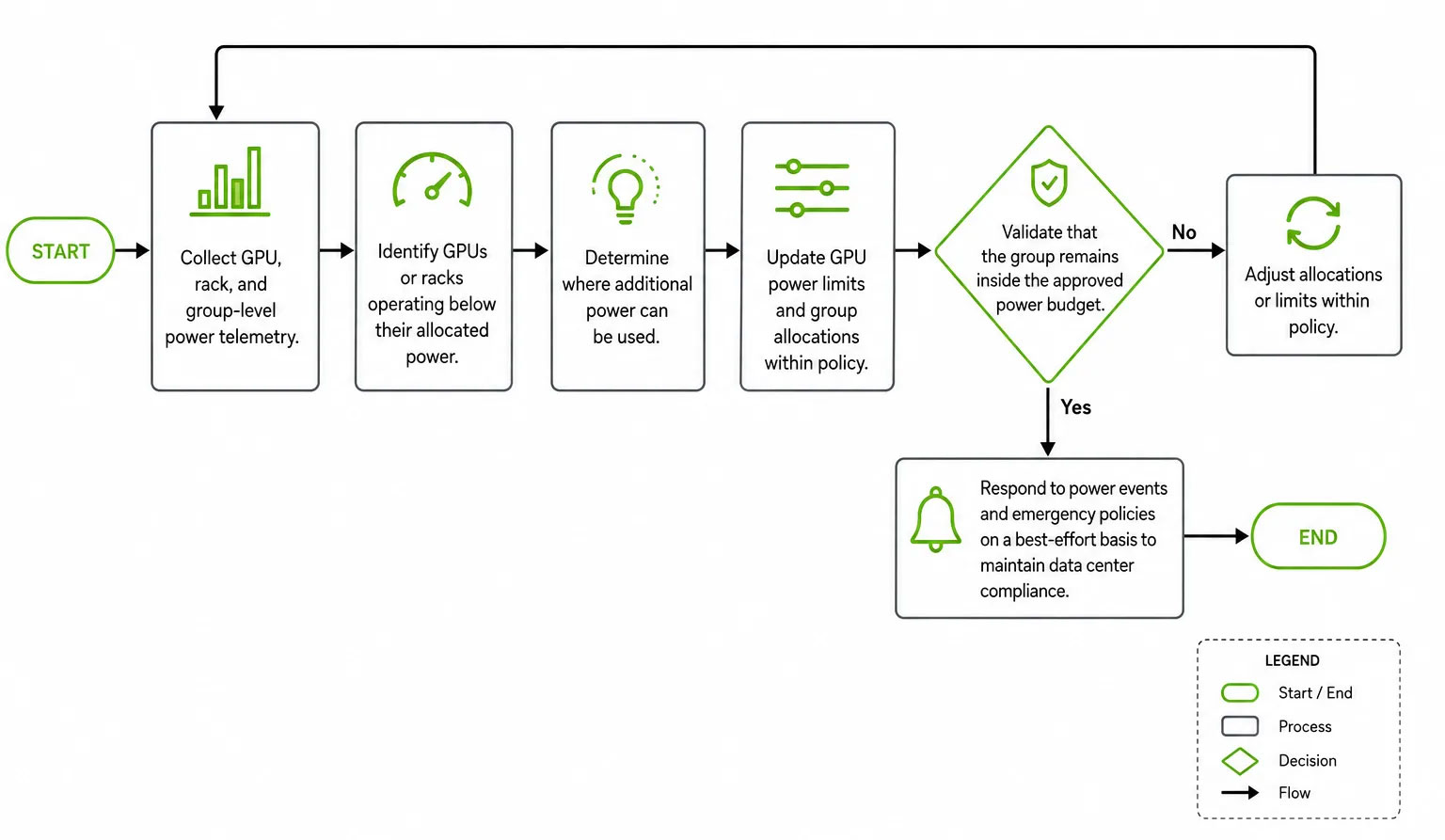
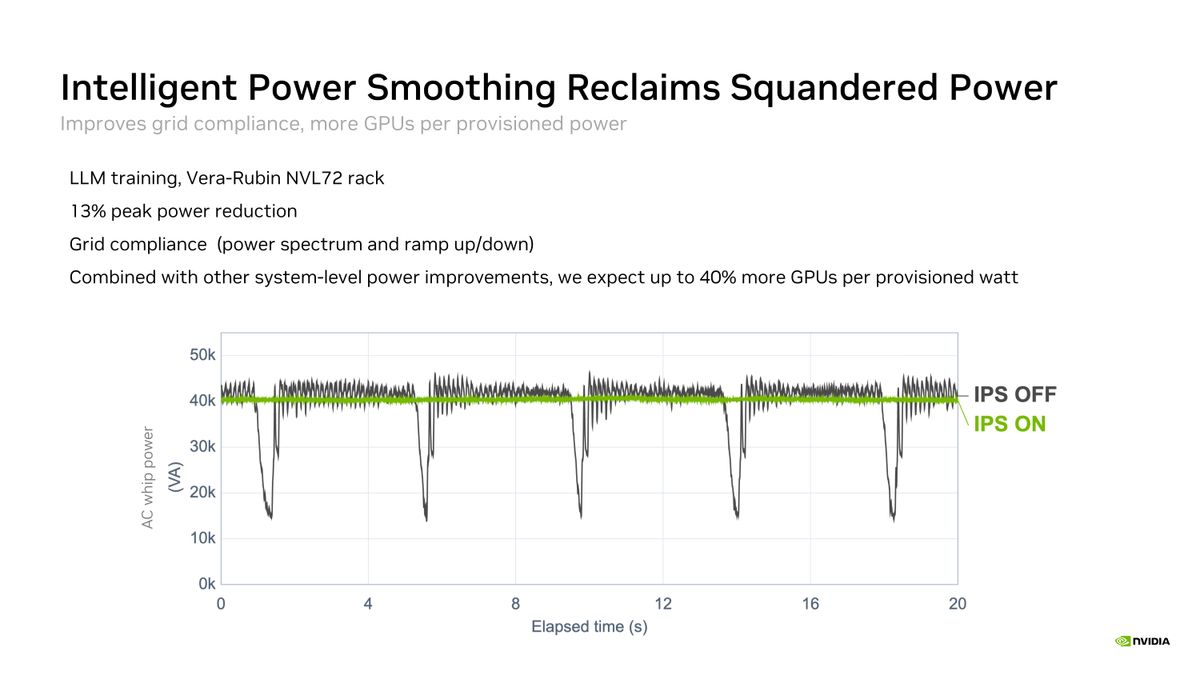
The DSX MaxLPS approach is meant to overcome the limitations of static power provisioning by instead applying an intelligent, dynamic scheme that is continuously aware of power usage at the chip level, rack level, and groups-of-racks level. Where unused power is available due to workload characteristics or idle capacity, Nvidia's Dynamic Power Software control loop can find and redistribute that energy to systems where it's most needed in the moment, maximizing the number of systems that can be installed and performance per watt from the facility over time.
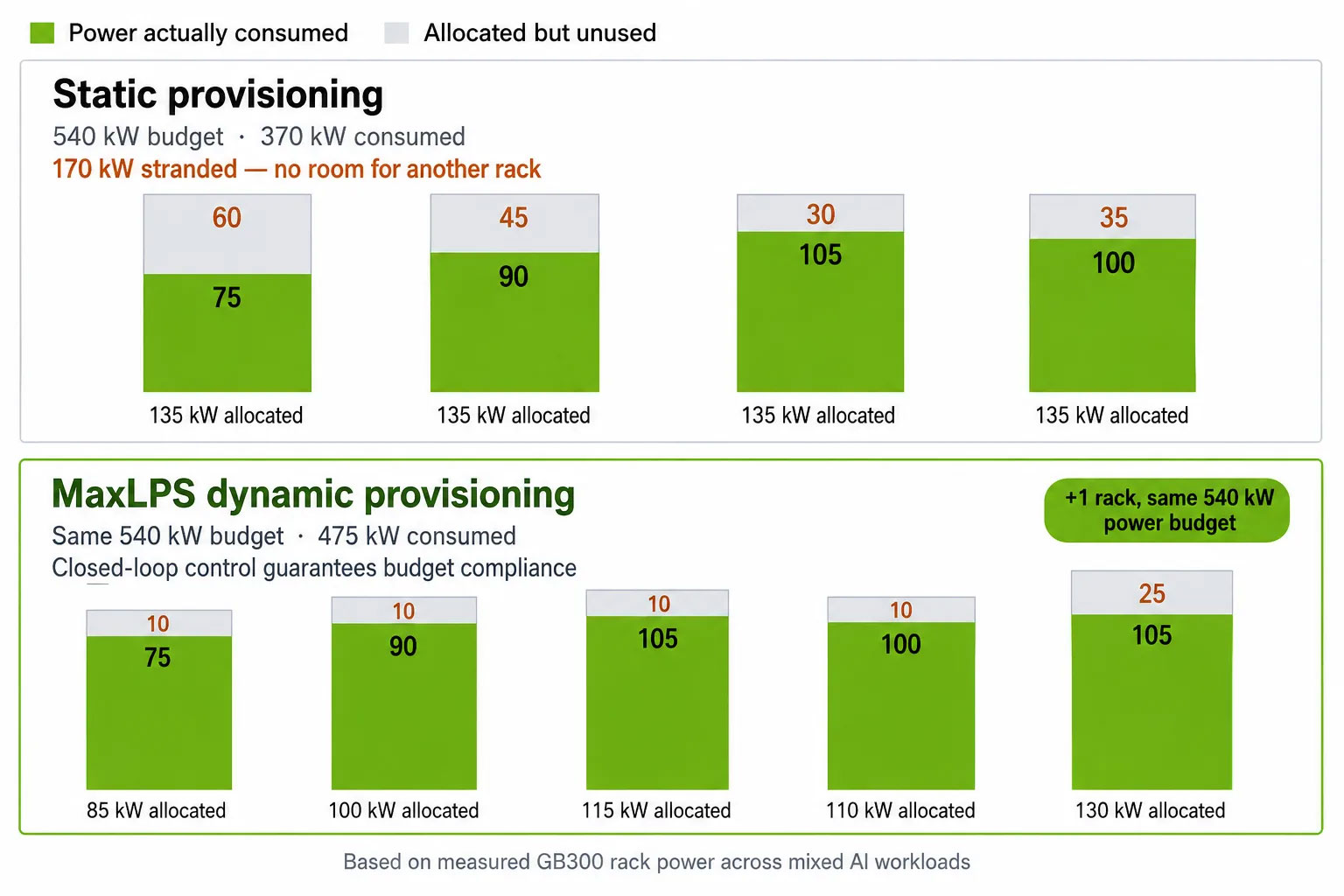
In Nvidia's measured example of current GB300 racks, within a 540kW power budget and with static provisioning, an operator might be able to install four 135kW systems by statically provisioning for peaks rather than measured values from workloads. But in practice, as much as 170kW of that power budget might sit unused due to differences in rack utilization.
For modern rack-scale systems like Nvidia’s NVL72s, that’s an entire rack and change that could safely be installed within the same power budget, and indeed, that’s just what the company’s example shows. And across those five systems, the amount of reserve power allocated for peaks can be much lower.
At the rack level, DSX MaxLPS offers further flexibility through workload-specific power profiles. Much like the quiet, balanced, and high-performance power modes that client PC users are familiar with, Nvidia has produced rack-level power profiles that can be assigned to systems performing example workloads like inference, training, and more general memory-bound or compute-bound tasks.
As we noted, Nvidia didn’t share measured Rubin power or performance-per-watt results, but it has characterized the benefits of MaxLPS for prior-generation systems running inference workloads to prove the concept.
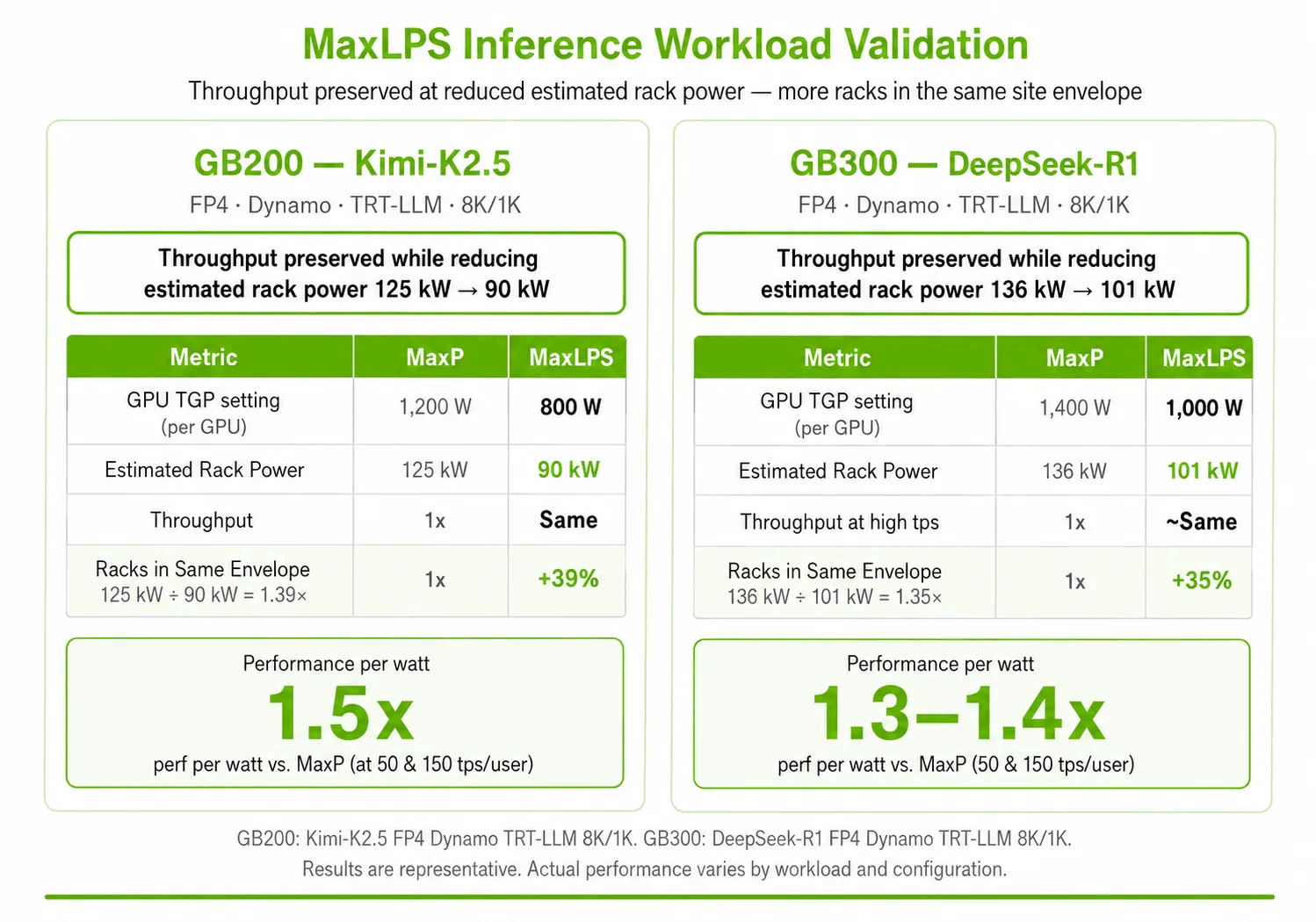
For a Grace Blackwell GB300 system running DeepSeek-R1, Nvidia says the past fixed-peak regime would have assumed a 1400W GPU TGP and an estimated rack power of 136kW. Applying MaxLPS, however, the typical GPU TGP under this workload falls to 1000W, and the total rack power falls to 101kW, all without affecting delivered performance.
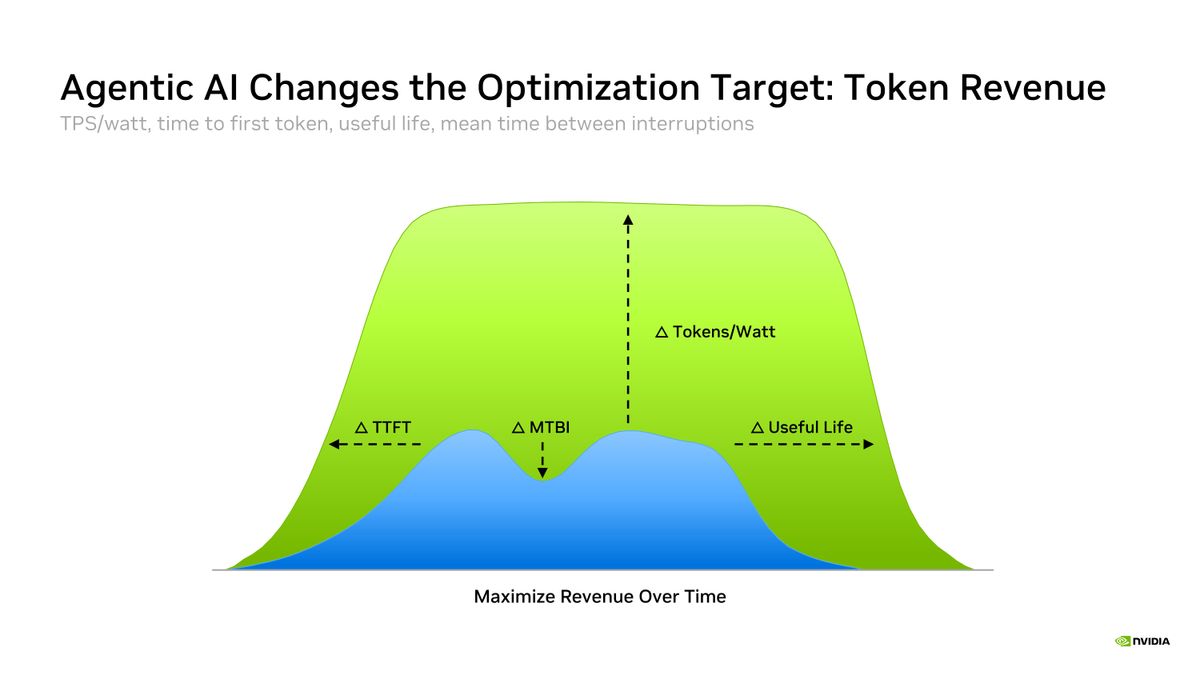
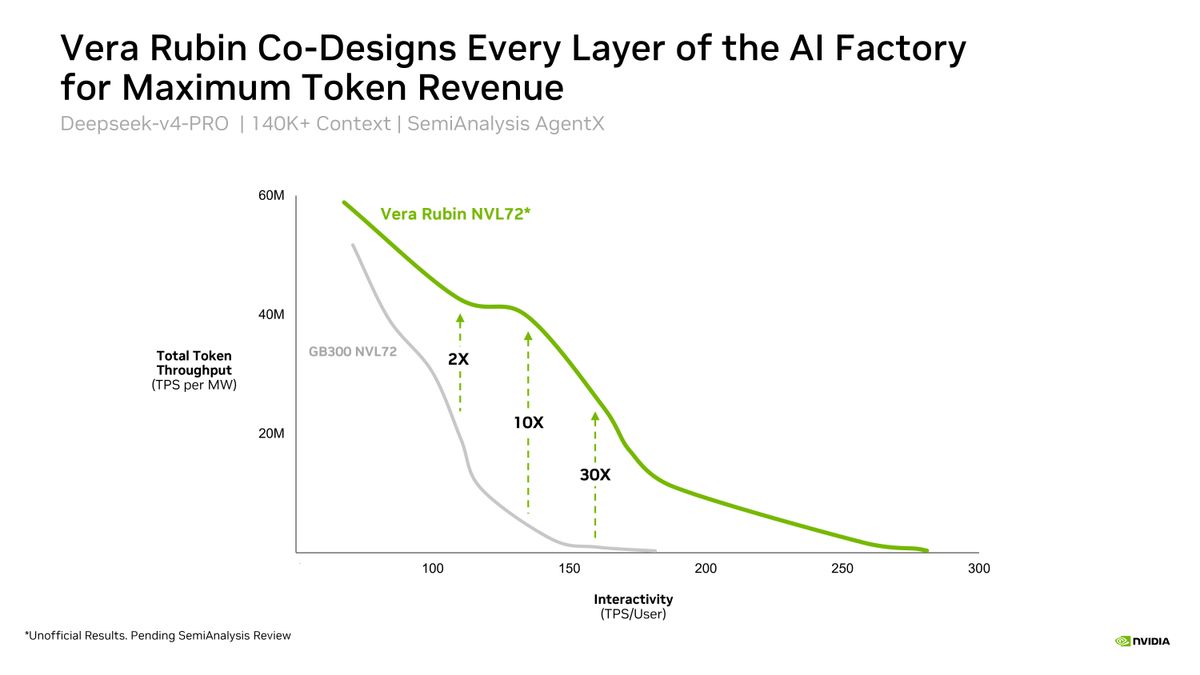
That less conservative envelope translates directly into higher performance per watt, larger numbers of racks that can be installed within the same facility, and ultimately more tokens that can produce revenue for the data center operator or its tenants.
Nvidia further notes that designing a data center with MaxLPS from the start grants an operator greater flexibility over the life of the installation. For example, if a site starts as a training-focused facility outfitted with cutting-edge hardware, each installed system is likely to need a greater share of the available site power for that more intense workload, and so an operator might not want to populate every available floor space for those racks from the get-go.
But later in the life cycle, as training shifts to new generations of hardware and older systems transition into inference roles, the power demands of each GPU and rack will fall, and so a facility with dynamic power provisioning would be able to free up capacity that can then be used to install more hardware within the same facility and to generate more profitable tokens.
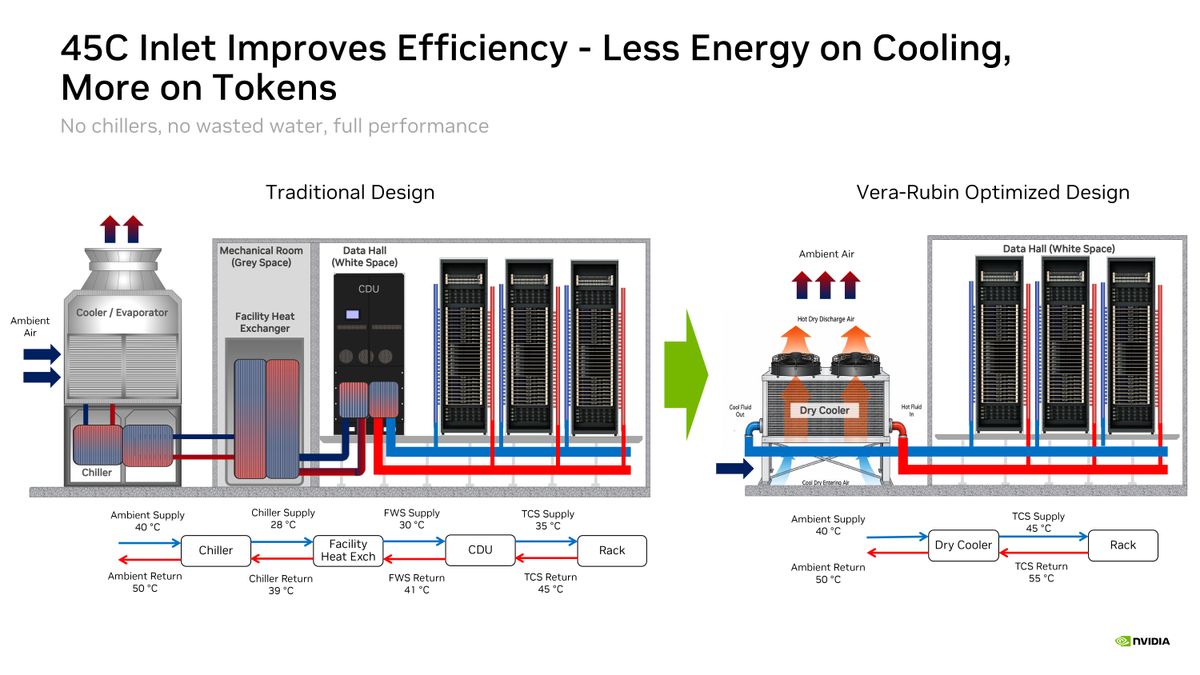
Another major component of MaxLPS in data centers deploying Vera Rubin hardware is the use of higher liquid coolant temperatures for the exclusively liquid-cooled Rubin NVL72 racks. Those systems are designed to work with 45 °C inlet coolant temperatures, much higher than for past liquid-cooled systems. We learned more about this “dry cooling” approach during our visit to Nvidia’s Vera Rubin proving grounds earlier this year.
The use of this higher coolant temperature for Rubin installations is important because the mechanical chillers used to shed waste heat in non-evaporative systems also consume a large portion of the site power budget – as much as 40% for past installations, Nvidia says. As with static provisioning for servers, the company notes that those chillers have traditionally been sized for the worst-case scenario that a facility might face, even if they’re operating well below that capacity for much of the year.
Again, this approach strands power that could be dynamically reallocated to compute given the proper operating conditions and site-level monitoring and management. Those chillers might still need to run during the hottest parts of the year, but outside of those conditions, the higher coolant temperature generally enables more power to be put to productive use, improving a site’s power usage effectiveness (PUE) figure, all else equal.
Power for AI data centers, whether generated by public utilities or behind the meter using alternative power sources, is expected to remain one of the most critical constraints for those facilities for the foreseeable future, and we heard that concern from multiple presenters during Hot Chips.
Nvidia’s DSX MaxLPS approach looks ready to provide the building blocks needed for dynamic allocation of that resource to extract the maximum possible performance per watt from Rubin facilities, and it reflects a comprehensive concern for the interplay of power and achievable performance that only seems likely to grow in importance going forward.
Image 1 of 24

As the Senior Analyst, Graphics at Tom's Hardware, Jeff Kampman covers everything that has to do with graphics cards, gaming performance, and more. From integrated graphics processors to discrete graphics cards to the hyperscale installations powering our AI future, if it's got a GPU in it, Jeff is on it.
What's Your Reaction?
 Like
0
Like
0
 Dislike
0
Dislike
0
 Love
0
Love
0
 Funny
0
Funny
0
 Wow
0
Wow
0
 Sad
0
Sad
0
 Angry
0
Angry
0










Comments (0)