

How a Sequel to a Movie Barely Anyone Saw Became a Sensational (and Originally X-Rated) 1980s Indie
In the late 1970s, University of Minnesota student Victoria Wozniak was hitchhiking and accepted a ride from classmate David Burton Morris, a movie nut who first became Wozniak’s friend, then lover, and ultimately husband. Together they became not only life partners but creative collaborators, with that serendipitous car ride indirectly producing three of the finest independent films to emerge in the pre-“sex, lies and videotape” era.
The partnership didn’t begin with great artistic promise, as Morris and Wozniak initially planned to make a horror movie called “Attack of the Sewer People”; the only independent films they saw being made at the time were exploitation pictures, and they figured they had to go that route. After Morris caught a screening of Tomás Gutiérrez Alea’s “Memories of Underdevelopment,” he convinced Wozniak to make a more personal film that reflected their lives and the lives of the Midwesterners around them.


The result, “Loose Ends” (1975), which Wozniak and Morris co-wrote, produced, and directed, was a low-budget gem about two Minnesota mechanics fumbling through their directionless 20s. Anchored by Chris Mulkey and John Jenkins’ painfully and hilariously realistic performances as men without a clue, the black-and-white drama recalls the best of John Cassavetes in both its sensitivity to the actors and its razor-sharp insight into male neuroses.
“Loose Ends” went around the world on the film festival circuit, which more or less served as its theatrical release; it wasn’t widely seen or distributed outside of festivals, arthouses, and museums. Yet even if few people saw it, the right people did. Prominent critics Robin Wood, Roger Ebert, and Vincent Canby championed “Loose Ends” as a triumph of regional filmmaking, and Morris and Wozniak began to attract notice from the industry at large.
Their next film, “Purple Haze,” won the Grand Prize at the 1983 Sundance Film Festival and led to deals for the couple to make Hollywood films — none of which materialized. Demoralized after a project he had planned with Tom Hanks fell through, Morris went back to his roots; the most fun he had ever had was making “Loose Ends” on a shoestring with friends, so he abandoned his Hollywood dreams and returned to Minnesota for another foray into low-budget filmmaking.
The movie Morris directed (Wozniak helped with the script but sat this one out to stay home in Los Angeles after a debilitating car accident) wasn’t just in the tradition of “Loose Ends” — it was a sequel to “Loose Ends,” picking up sad sacks Billy (Mulkey) and Eddie (Jenkins) 12 years after the events of the first film. Morris didn’t let the fact that “Loose Ends” had been essentially out of circulation for a decade and was unknown to contemporary audiences keep him from making a direct sequel — and it didn’t keep the movie from becoming an indie film sensation when it was released in 1988.
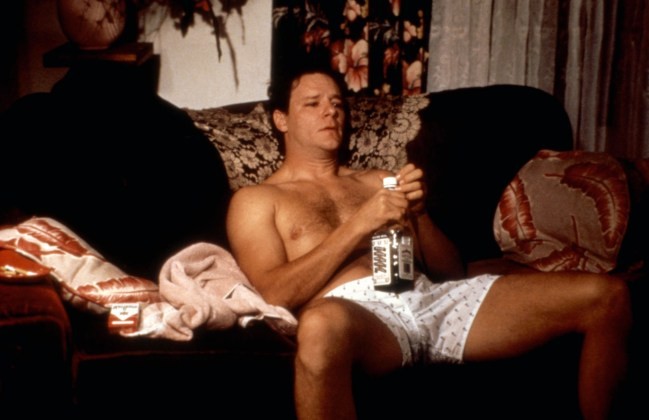
 ‘Patti Rocks‘©Film Dallas Pictures/Courtesy Everett Collection
The well-deserved attention Morris’ sequel, “Patti Rocks,” received had less to do with its internal qualities than a well-publicized kerfuffle with the MPAA, which executive producer Sam Grogg skillfully exploited to generate a mountain of free press. Although there’s only one brief sex scene in “Patti Rocks,” the MPAA slapped the movie with an X rating — the coarse dialogue between Billy and Eddie about Billy’s sexual exploits was so offensive to the ratings board that “Patti Rocks” became a true anomaly: a film rated X for language rather than sex or violence.
Grogg appealed the rating and eventually got the MPAA to knock “Patti Rocks” down to an R so that it could be released in national theater chains and advertised in newspapers. By that time, Grogg and Morris had positioned themselves in the media as free speech warriors and gotten a lot of mileage out of what they argued was the silliness of giving a movie an X rating for language. As a result, when “Patti Rocks” opened at the Waverly in New York, it broke house records, and actor Chris Mulkey appeared on David Letterman’s talk show — a huge deal for an independent film at the time — to promote the movie.
The film’s momentum in New York disintegrated when the Waverly shut down for renovations and Morris and Grogg scrambled to find another booking, but “Patti Rocks” ultimately rolled out nationally and had a robust home video release on both VHS and LaserDisc, standing alongside films like “Stranger Than Paradise,” “The Brother From Another Planet,” and “She’s Gotta Have It” as a seminal independent film of the 1980s. And like all of those movies, it plays even better today than it did then — partly thanks to the vulgar language that so scandalized the ratings board.
In one sense, the MPAA had it right — the language in “Patti Rocks” is appalling and misogynistic, genuinely tasteless in a way that goes beyond the vulgarity in movies like “Scarface” and “Full Metal Jacket” (both of which were used as case studies by Grogg to argue that “Patti Rocks” didn’t deserve an X). It’s also brilliantly written as a futile, pathetic rebellion by men with zero agency or purpose in their own lives. Billy swears profusely for the same reason the characters in Hal Ashby’s “The Last Detail” do — without profanity, he has no identity.
The first half of the film consists almost entirely of a road trip that Billy and Eddie take to visit a single woman the married Billy has impregnated, and who he wants to talk into an abortion. Throughout the car ride, Billy reveals himself to be as self-absorbed as he is unapologetically sexist. The only argument in his favor, ironically, is that he doesn’t seem to respect his male friend any more than he does the disposable women in his life, using him primarily just to keep him awake on a long drive. He’s an equal opportunity asshole.
 ‘Patti Rocks’©Film Dallas Pictures/Courtesy Everett Collection
Morris wrote the script with his actors — Mulkey, Jenkins, and Karen Landry, who plays the title character — employing a similar methodology to Richard Linklater on “Before Sunset,” another sequel to a movie that hadn’t been particularly popular on its initial release. It’s a marvel of sneaky, subtle storytelling: the first half of “Patti Rocks” leads you to believe the movie is one thing, until Patti enters the picture and reveals it’s something else entirely.
The first half of the movie is an objectively photographed portrait of, to use a shopworn phrase, toxic masculinity. The attitudes can be taken at face value or not. It’s as easy to imagine disciples of the manosphere (or, for that matter, the current resident of the White House) identifying with and cheering on the lead characters as it is to imagine women or even just marginally enlightened men being repulsed by them. Once the guys arrive at their destination and Patti enters the story as a fully realized character outside of Billy’s imagination, however, it becomes clear what Morris and the actors are up to.
Landry, like Mulkey and Jenkins, gives an all-time great performance, eschewing cliché with every line reading and gesture. Not only does she quickly dismantle all of the expectations created by Billy’s evocation of her as a projection of his fears and desires — she goes on to surprise both the men in the film and the audience with each passing scene, acting not like a movie character or a metaphor but a person with an independent life outside of Billy and Eddie, as well as the film itself.
The same goes for the guys, who reveal new layers of complexity in the movie’s later scenes that deepen our perception of them without betraying or undercutting the ugliness that has come before. Here, “Patti Rocks” earns its comparison with Cassavetes, as Morris and the actors create behavior and situations wholly specific to these characters and this movie — there’s no other film quite like “Patti Rocks,” not even “Loose Ends.” Positioned between two eras of American filmmaking, it’s the unacknowledged bridge between Cassavetes, Paul Mazursky, and Mike Nichols and the indies that would follow by Steven Soderbergh and Neil LaBute.
Yet while “Patti Rocks” has many obvious points of comparison with LaBute’s work and Nichols’ “Carnal Knowledge,” it has a tenderness and empathy that those films lack (which doesn’t make it better, just different — there’s nothing wrong with simply being scabrous and scathing). Perhaps the most shocking thing about “Patti Rocks” in the end is how beautiful it is. Not many filmmakers can create something where moments as ugly as Billy’s scatological lectures coexist so elegantly with moments of honest longing and tragedy (and, in one or two moments, tentative hope).
Although “Patti Rocks” made a strong impression on critics and indie film fans in 1988, it’s been tough to find in recent years aside from occasional repertory screenings. Now, however, the boutique physical media label Fun City Editions has released a superb Blu-ray of the film, featuring both a gorgeous restoration and illuminating supplements. The release includes an entertaining audio commentary by Morris and Wozniak, plus interviews with Grogg about “Patti Rocks” in particular and his career as a producer and financier more broadly.
Grogg is a somewhat unsung hero in independent film who played a role in several key releases of the 1980s, including “Kiss of the Spider Woman” and “The Trip to Bountiful,” and the Fun City release provides nice context for how “Patti Rocks” fits into his filmography. Fun City has also put out a new disc of another important Grogg production from 1988: Paul Morrissey’s mob comedy “Spike of Bensonhurst,” which makes a nice double bill with “Patti.” Both releases are another reminder of the vital role physical media companies continue to play in keeping film history and culture alive, especially for essential Indies that might otherwise fall through the cracks.
The special edition Blu-ray of “Patti Rocks” is now available from Fun City Editions via their website.
What's Your Reaction?
 Like
0
Like
0
 Dislike
0
Dislike
0
 Love
0
Love
0
 Funny
0
Funny
0
 Wow
0
Wow
0
 Sad
0
Sad
0
 Angry
0
Angry
0









Comments (0)