

How ‘Beef’ Director Jake Schreier Builds a Oner for Maximum Anxiety
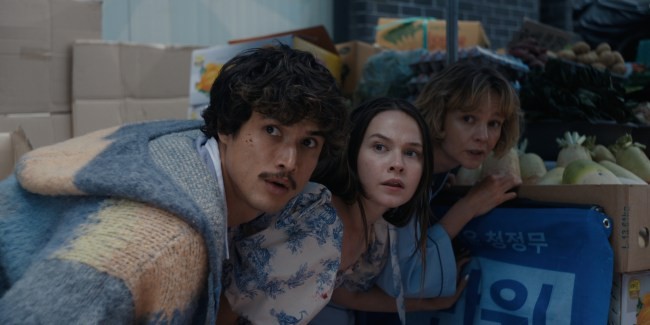
It’s always a challenge — and an increasingly common one in Hollywood — to go somewhere to shoot film or TV and need to disguise that place so it can double for somewhere else: New York standing in for Ohio (and vice versa), Cape Town for Los Angeles, Budapest for everywhere else. Especially as he was still trapped in the Void of post-production on “Thunderbolts*,” director Jake Schreier was grateful that the Seoul locations he looked at for the final episodes of “Beef” Season 2 could just be themselves.
Schreier, series showrunner and creator Lee Sung Jin, and the “Beef” locations team did a small marathon of scouting around Seoul on weekends when Schreier could get out of the MCU edit bay, and it contributed to the creative development of the final act of the season, wherein our heroes* who’ve worked at a “White Lotus” type country club in California, now owned by Youn Yuh-jung, get flown out to Korea.


It’s not a good thing. Youn’s Chairwoman means to corner them, essentially, before they can expose her and her doctor husband (Song Kang-ho) for some medical malpractice.
But the “Beef” production team was the opposite of cornered. “So much energy goes into hiding the fact that you’re not really in that place, into where you can and can’t point the camera. It’s just so refreshing to get to go to a place where the location scout itself can inspire you and can alter what those scenes are and inform what you’re making,” Schreier told IndieWire.
It was while in Seoul (although for another project) that Lee first had the idea for an “Old Boy” style, bravura one-take fight in a Korean skin clinic — which is exactly what happens when Lindsay (Carey Mulligan), Ashley (Cailee Spaeny), and Austin (Charles Melton) make a break for it to meet Josh (Oscar Isaac) on the outside of the Chairwoman’s compound.
The scouts for “Beef” Season 2 helped refine the look and feel, the colors and textures and contrasts between sleek glass and blotchy skin, of how that fight would go — even if it happened on a set purpose-built by production designer Grace Yun and populated by “Beef” Season 2’s stunt team. “I think we were able to just push it even further,” Schreier said.
 ‘Beef’ COURTESY OF NETFLIX
Like “Old Boy,” that fight through a Korean spa is covered in one giant take, something that the show and Schreier have plenty of experience with. The director finds them very fun to do, not the least because they require a kind of all-hands-on-deck collaboration among departments. But they’re also a core part of the visual language of “Beef,” as long single takes that express the frustration, depth of feeling, and increasingly trapped nature of the characters. We get trapped in the shot with them, unable to cut away.
“You don’t want to run a oner beyond where it needs to go,” Schreier said. “It’s a real moment in time. How can you feel like the tension is upheld by the lack of editing and like you’re actually watching something crazy and engrossing unfold in front of you? And at whatever point you’re having to do cheats or tricks, you should just cut. There are no stitches in our oner [in Episode 8]. That’s just a shot we did. At the point you’re doing a stitch, go ahead and cut. That means it’s time to move on to the next shot and make every shot as long as it deserves to be and as great and as engrossing.”
Part of how the visuals of “Beef” get to be so feverishly engrossing is through its baseline coverage, which Schreier describes as being “unbalanced,” just like the show’s protagonists. It was certainly easier to do in Season 1, where Amy (Ali Wong) and Danny (Steve Yeun) lived very separate lives until they would, inevitably, collide. The pairs of couples in Season 2 are constantly underfoot of one another.
But still, Schreier and Lee tend to pick a perspective character for a particular scene or movement of a scene. Their coverage will be clean and close. We’re drawn toward them. But the camera might go one focal length longer or one lens longer on the person the focus character is in the scene with; they might dirty up the reverse shot so that the viewer is sucked into the one perspective we can see clearly: the protagonist’s.
 ‘Beef’ COURTESY OF NETFLIX
A great example is the team meeting in Episode 1 of Season 2, where Isaac’s Josh is hoping to send a coded message of “let’s just be cool” to Spaeny’s Ashley, who interprets what he’s saying as him threatening her job. Schreier shot the scene with both Josh and Ashley as the POV character, although it’s edited to judder messily between the two of them. “We have a clean camera that follows Josh very closely, and you see Ashley from his perspective, but then we also are with her and how she feels about what she believes to be this intimidating boss,” Schreier said. “We had to figure out this multiplicity of perspectives and how the camera needed to accommodate that.”
Given all this unbalanced coverage, oners are the shots where characters on “Beef” can either fully express themselves in an apotheosis of rage and emotion or where the world can snap back, and drop the characters into an even messier, more unhinged situation. The spa fight in Episode 8 of Season 2, “It Will Stay This Way and You Will Obey,” is honestly a bit of both, messy in every sense — emotionally, physically, visually, in the amount of fluids we see.
Doing something “messy,” however, requires meticulous planning. “It began with Grace’s early designs of the space and then working with [stunt coordinator Chris O’Hara] in LA with an LA stunt team to block out a rough version of it, starting to design camera moves and forming by really trying to stay subjective with our characters, not turning it into a kind of objective, fun play,” Schreier said. “We had to figure out beats that make sense for how our group of non-action stars could escape and win in this, where it’s the grossness and the chaos of the skin clinic that even allows them to escape.”
Once in Korea, O’Hara worked with the Korean stunt team to refine the choreography even further, making battles out of the small-scale struggle of opening a door, of how characters could make it to the glass break outside. The “Beef” team had a little warehouse and constructed a fake version of the set out of cardboard boxes, and then sent Melton, Mulligan, and Spaeny over there to start learning the routine during whatever down hours they had.
 ‘Beef’ COURTESY OF NETFLIX
“It’s still a TV show. I think we did that shot and we had it by lunch, and we still had scenes to do the rest of the day, you know?,” Schreier said. “You don’t get to devote that much time to it. But it was very fun. It was fun to have Song Kang-ho running through the whole space and excited to see it, and we had to make sure — I mean, he was really throwing himself into that door — that he didn’t hurt his shoulder. We wanted to protect a national treasure at all costs.”
“Beef” Season 2 shot their spa oner on the same stage where “Parasite” filmed its street flooding sequence, so it certainly could’ve gone worse for Song and the rest of the cast.
Innovations in camera technology have made oners increasingly feasible, and there’s a risk of them getting flattened out, into just being generic action beats. That’s why Schreier really enjoys, on “Beef” and elsewhere, doing everything possible to design beats around character. The movement of the camera and the momentum of the shot, in the “Beef” oner, aren’t designed to make the characters look cool; they’re designed to make them look human.
“It’s about our cast and how much of themselves they bring to it, about how to be in character and be someone who isn’t an action star while hitting all of the beats that are necessary to make all of those things come together,” Schreier said. “You can do all of that technical work, and if you don’t have that magic at the center of it and it doesn’t feel different, you’re just watching another action set piece.”
“Beef” Season 2 is streaming on Netflix.
What's Your Reaction?
 Like
0
Like
0
 Dislike
0
Dislike
0
 Love
0
Love
0
 Funny
0
Funny
0
 Wow
0
Wow
0
 Sad
0
Sad
0
 Angry
0
Angry
0






Comments (0)