

How ‘The Diplomat’ Supporting Stars Allison Janney and Bradley Whitford Stole the Show in Season 3
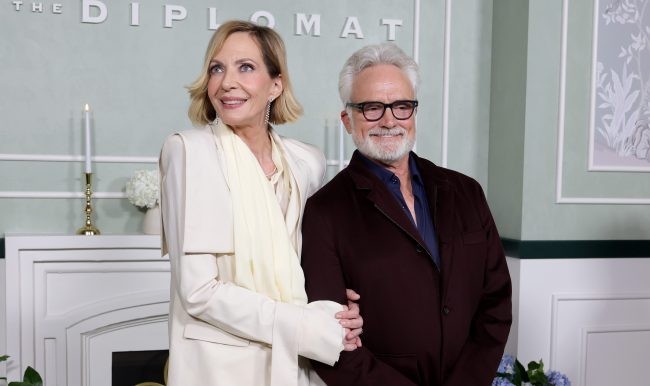

Allison Janney and Bradley Whitford are old pals. Both nabbed Emmys as CJ Cregg and Josh Lyman, respectively, for Aaron Sorkin‘s “The West Wing,” which ran for seven seasons ending in 2000, and for other shows along the way. Janney has played in the movie sphere more than Whitford, accepting an Oscar for “I , Tonya.”
We got on Zoom last week and Janney watched him affectionately as he made us both laugh, often. Whitford is the talker of the two.
This season, they both scored Emmy nominations for their work on Season 3 of Netflix‘s “The Diplomat,” which has racked up six Prime Time nods under creator and “West Wing” alumna Deborah Cahn. The series combines high stakes that could determine the fate of the world with la vie quotidienne issues of coping day to day with your spouse.


Since Season 2, Janney’s Grace Penn has ascended to the presidency. (As VP, she memorably dressed down Keri Russell’s U.S. London Ambassador Kate Wyler for being too sloppy.) She has chosen Kate’s mostly estranged husband Hal (Rufus Sewell) as her VP. Now Kate is playing two roles: Ambassador and, less comfortably, Second Lady.
When we get to Season 3, Episode 6, which is set at the president’s vacation home in Amagansett, Long Island, we meet Penn’s brilliant but miserable husband Todd (Whitford), who is also not happy playing the role of the First Gentleman, and get to the choice meeting of the two couples.
Janney comes onto the Zoom while we wait for Whitford.
The following interview has been edited and condensed for clarity and length.
Allison Janney: Bradley is here now. He’s not even talking to us yet. He’s on. He’s walking and talking. Now he’s behind his headphones.
Bradley Whitford: My iPad didn’t work, and I’m sure Allison was right on time.
Anne Thompson: Let’s go back a bit. When Aaron Sorkin left “The West Wing” after five seasons, leaving John Wells in charge, did you miss the cadence of his dialogue?
Janney: He writes music basically. There is a definite rhythm to it. Sometimes I’d have to go in and loop. I didn’t stress the word that he wanted me to stress. He heard the musicality of it, and it was extraordinary writing. And it was such a thrill to get to do it and to see CJ and Josh bantering back and forth. It was fun.
Whitford: Yes, it was so Josh.
Did you miss it?
Whitford: Yes, and I insist that people still call me Josh. After Aaron left [after Season 4], it was like David Koresh leaving the Branch Davidians. John Wells courageously wrote the first episode. He said, “I feel like Ethel Merman’s understudy.” John will tell you that in the year after Aaron left, the show was trying to imitate Aaron.
The show found a different path in the sixth and seventh years, which was fully inside Aaron’s world, but wasn’t trying to be an Aaron Sorkin tribute machine. I got to be a part of that writers’ room in the sixth and seventh year. Allison will tell you it is so much easier to memorize great dialogue. Aaron didn’t think it was weird “to say what I wrote the way I wrote it.”
This is not a strange concept among the people in the theater, and Deborah is similar. There is a melody and a rhythm in inside it. We need that collaboration in the writers’ room. But for the shows that sing, you need a voice, and Aaron has an incredible voice, and Deborah has a different one. But memorizing her stuff and acting her stuff, you’re surfing up there, and yet there’s a million things you can do with it.
Josh, um, Bradley, during the oyster scene, you emerge from the kitchen with a wounded hand wrapped in a towel, and the platter of oysters is splattered with blood. Is that scene all written? Your scenes together have more comedy, are more broad.
Whitford: No, it is specifically, intricately written. When you trust writers the way you can trust these guys, every bit of it was written. What writers love most about actors like Allison is it doesn’t seem written at all.
Janney: This is so much fun to memorize. I can’t wait to get it to know it because it’s going to be so much fun to play it. And that’s the way the Amagansett scene was for us. We couldn’t wait to memorize it so we could play off each other and find things. Deborah trusted Brad and I enough to write a scene that had no dialogue at all. We were mad at each other and brushing our teeth and going about our nightly ablutions and then we get in bed. No dialogue, but so much was said and revealed in that scene about our relationship.
This series takes these parallel couples who defy and switch off on gender norms. Is that the secret sauce behind the series’ popularity?
Whitford: The engine of this is the parallel between power struggles internationally and power struggles within relationships. This is not a cynical view of relationships that Deborah has. It’s complicated, but ultimately there’s something sweet and optimistic. In the oyster scene, we’re driving each other nuts, but the reason is because I am feeling protective of her, and that complexity within scenes about relationships is compelling to act and watch. I hope.
Janney: Todd is having to negotiate his identity in this marriage dynamic. It’s fascinating to watch that happen to a couple, and the fact that I chose Hal over Kate causes damage. All these dynamics in their personal relationships are exploding, and it’s fun to to watch them try to figure out who they are to each other in these new roles, in their private roles, and in their public roles. Grace is president. I can’t show all the things I’m thinking. I have to keep everything underneath, this current of hating Kate but needing her. All the different things that happen in that episode are wild to me. I wish we could do it as a play. I could do it every day.
 ‘The West Wing’©NBC/Courtesy Everett Collection
Whitford: When I got that Amagansett [episode], I was up in Toronto shooting “Handmaid’s Tale,” and I was sitting in this coffee shop, and I read it: “Oh my God, this is a play.” And I was immediately out in the street because I have to memorize walking, and it was two weeks away. The one thing I know, Allison feels the same way about this, with great writers, the dialogue is not up for debate. Get it in your bones, deeper than being memorized.
Janney: Because then you can play off each other and be there. When you know the lines, you go to town. And it was always different every time. I love dumping the the pretzels into the bowl.
Whitford: That was your idea, wasn’t it?
Janney: That was in honor of my mother because that’s something she would have done.
I wondered about you emptying all the drinks into your drink, including different colors.
Whitford: We played around with that. We did a whole bunch of different versions. Allison and I are grateful that we’ve had this experience previously and we have it now. This incredible dialogue that is not a prison. I felt this with Allison shooting that scene in Italy [in Season 4] out on the porch with the four of us. These great scenes could be a play. There’s a million different things you can do with it. It’s actually not overly prescriptive to you as an actor, and you can feel Deborah getting excited about the different places you take it.
You also took your character to the edge of slightly mad.
Whitford: Yeah, there’s a lot of compression in there that might blow. He married, fell in love with a powerful woman in public life, and fancied himself as a staunch ally. And now he’s in this suddenly crazy position where he’s realizing that he’s going to be playing tambourine, and as a man, he doesn’t know how to deal with it. It’s flicked his gyroscope in a very uncomfortable way.
 ‘The Diplomat‘ Season 3Courtesy of Netflix
Allison, you’re developing a bond with Rufus Sewell’s character Hal.
Janney: Grace and Hal understand that politics involves things you say publicly and things being attempted privately. There’s a big gap there sometimes. Grace sees that he’s more aligned with the way she operates, and and it’s a fun dynamic we have. It’s your boy crush at school. I was always happy to see him, and and he makes me smile. Where Hal says you don’t smile anymore except with him? It’s true. She delights in him. At the end of Season 3, you see where that’s going and what they’re willing to do, which is they use Kate, and it’s dangerous.
Whitford: I want to interject that it’s easy to have a crush on someone who you’ve never paid a gas bill with. The source of a lot of the humor are these highly sophisticated, overly educated people wrestling with these dog park issues: why is she so happy with him and why is she laughing with him and she turns to me and I can see I’m a problem and he’s an opportunity. I love the sort of interaction between the sophistication of what they’re dealing with and the simplicity of the difficulties of a long-term relationship.
You have already finished Season 4. You went to some pretty cool places: Tuscany, Lucca, Florence.
Janney: Yeah, gorgeous. How lucky are we? It was magical. There’s a lot of what we call location porn in “The Diplomat.” It’s just sexy. These locations did not disappoint.
Whitford: They were stunning. We’re shooting in these castles in London, and base camp is on that big wide road that goes right up to to Buckingham Palace.
 ‘The Diplomat’COURTESY OF NETFLIX
Why do you and and Kate visit the Turnbull and Asser shirtmakers?
Whitford: I have lived a life in show business, and I do a lot of political stuff back in my home state of Wisconsin and nationally, and I see different people’s reactions to the spotlight hitting them. There’s some people who it makes giddy, and there’s some people who relax into it. But it’s always funny to watch that moment happen. I’m always grateful that the attention I get is a boiled frog situation.
But suddenly, it turns out the Brits just love Todd, and it’s going to his head, and he’s getting a new suit because he’s got an event. It turns out: “Wow, his could be a way I could be an asset. I don’t know what it is, but they love me.” There’s not a hand he’s not willing to shake.
Allison, you star in the upcoming English-language movie “Fonda,” directed by “The Anatomy of a Fall” Oscar-winner Justine Trier, co-starring Mia Goth, Andrew Scott and Odessa A’zion.
Janney: I got to shoot in France right before I went to Florence. I’ve had a very international working year. It’s another psychological thriller. It takes place in a in England in a beautiful estate that serves as a rehab mental health place. I did had some wild scenes with Andrew, who’s great.
Bradley, what are you up to?
Whitford: You know what I’m doing right after I do this? I am shaving my head. I’m getting ready to do “A Few Good Men” on Broadway, speaking of Aaron Sorkin. Allison’s going to do [Jon Robin Baitz’s] “Other Desert Cities.”
Janney: We’re both going to be on Broadway at the same time. You have to do a movie of [the head shaving.] It would be fun for the people to see that happen.
Whitford: I will. Amy [Landecker] may take a shot of it. I’ve realized that my real passion going forward is a looks minimizer influencer, and this will be a kickoff on looks minimizing.
Bradley, why are you shaving your head?
Whitford: I’m taking it down to zero to see where I want to be. The whole reason I know Allison Janney is I got “West Wing” because the first Broadway play I did, I went in as a replacement and understudied the lead in “A Few Good Men,” and this young playwright Aaron Sorkin saw me do the run through.
And when it was a time in a Broadway play when, no offense to me, you should not cast a fading television personality, Aaron said, “No, I think the understudy can do it.” And I got to run and be the lead in “A Few Good Men.” Now I’m doing the Jack Nicholson part. Yeah, no pressure. It’s like nobody’s got that performance in their head.
What's Your Reaction?
 Like
0
Like
0
 Dislike
0
Dislike
0
 Love
0
Love
0
 Funny
0
Funny
0
 Wow
0
Wow
0
 Sad
0
Sad
0
 Angry
0
Angry
0







Comments (0)