

How to Build a Layered Street Photo From the Background Up
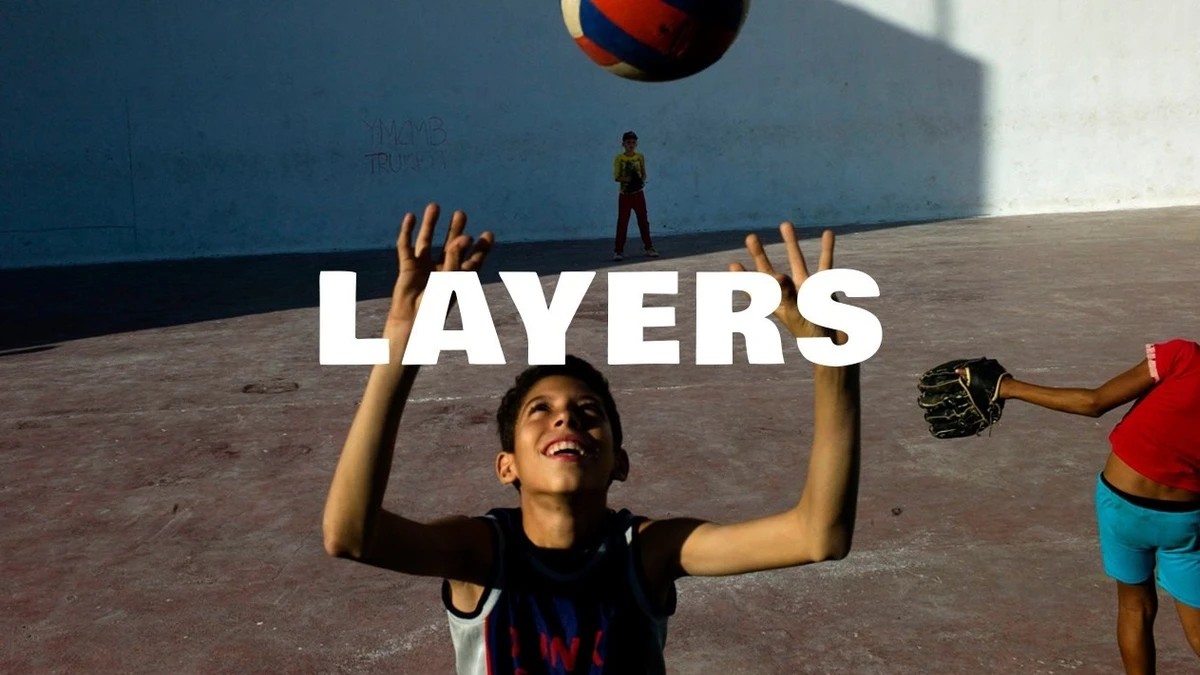
Layering sounds like a checklist: put something in the foreground, something in the midground, something in the background, and press the shutter. Anyone who has tried it on a crowded sidewalk knows the elements rarely cooperate, and a frame with three layers can still read as a pile of clutter.
Tim Jamieson breaks layering into five steps, each borrowed from a documentary or street photographer whose work depends on it, and each one builds on the step before. The first comes from Jason Eskenazi's Wonderland, made across the former Soviet Union. Most people spot an interesting person, point the lens at them, and accept whatever mess happens to sit behind them. Eskenazi often worked the other way around, finding or arranging a background first, frequently one with strong geometry, and then letting subjects move against it. His own shorthand for what he hunts is "geometry and gesture," which covers both halves of the process in three words. Starting with the background gives you a structure to work inside before anything interesting happens.
The second step comes from Alex Webb, whose photographs along the U.S.-Mexico border and in Istanbul are about as dense as street photography gets. Webb has described walking for hours until he could sense a photograph forming, but Jamieson pulls a more practical habit out of his frames: the anchor. An anchor is any element that won't move for a while. Someone leaning against a wall works, and so does a person asleep at a table, a chunk of architecture, or a wedge of light cutting across the scene. Webb positions himself so that element takes up a big share of the frame. With one layer holding still, your attention is free for timing the people walking through, which is far easier than trying to line up several moving targets at once.
Constantine Manos supplies the third step, drawn from his series American Color. Jamieson describes the frame as a three-step staircase. The background sets the context, the anchor holds one plane steady, and the midground usually carries the human action. In Manos' frames, figures sit across several depth planes, each in its own pocket of light and space, and none of them collide. When every plane holds something with its own visual weight, the eye climbs from front to back and keeps moving instead of stalling on one spot.
Shallow depth of field has become the default look for a lot of people, helped along by fast primes and phone portrait modes that blur backgrounds in software. Layered street work runs on the opposite principle. When every plane carries part of the picture, every plane has to be readable, so the photographers in this tradition tend to work at small apertures with wide angle lenses. Zone focusing makes that practical on the street. On a full frame camera with a 28mm lens at f/8, the hyperfocal distance is around 3.3 meters, so focusing there renders everything from roughly 1.6 meters to infinity acceptably sharp, and you never wait for autofocus to lock onto a face. Phones get close to this almost by accident, since their small sensors and wide main lenses keep most of a scene in focus once portrait mode is off. When focus stops being a decision, you're left managing only two things: where you stand and when you press the shutter.
Sage Sohier, known for her environmental portraits of American life from the 1970s and 1980s, shows how far that idea can go. She loved wide angle lenses for the way they let her play with scale, stopped down to f/11 or f/16, and often used on-camera flash to light the whole frame evenly. With everything sharp, blur could never separate her subjects, so separation had to come from spacing. Jamieson walks through how small changes in your own position, sometimes just an inch, can open a gap for a midground figure who is about to disappear behind your anchor. The fifth step comes from Nikos Economopoulos and his years photographing the Balkans, and it takes a very different route to a stronger frame, one built on what you choose to leave out. Jamieson also points to patience as the trait all five photographers share, since a layered scene can't be forced into place by rushing through a city.
Jamieson's example frames from each photographer are in the video above.
What's Your Reaction?
 Like
0
Like
0
 Dislike
0
Dislike
0
 Love
0
Love
0
 Funny
0
Funny
0
 Wow
0
Wow
0
 Sad
0
Sad
0
 Angry
0
Angry
0











Comments (0)