

Hypershell’s Halo Full-Leg Exoskeleton Made Me Dream Big About the Hikes I Hope to One Day Attempt
Do you consider yourself fit and healthy? I strength train, run, hike, climb and swim — albeit not according to any kind of training plan or schedule — and yet there are so many ways my body struggles on a daily basis.
Even people who consider themselves to have a high level of cardiovascular fitness might lack strength, balance or flexibility. It’s almost impossible for one person to adhere to a truly holistic training plan. We all have weaknesses. We all know what it’s like to feel fatigued.
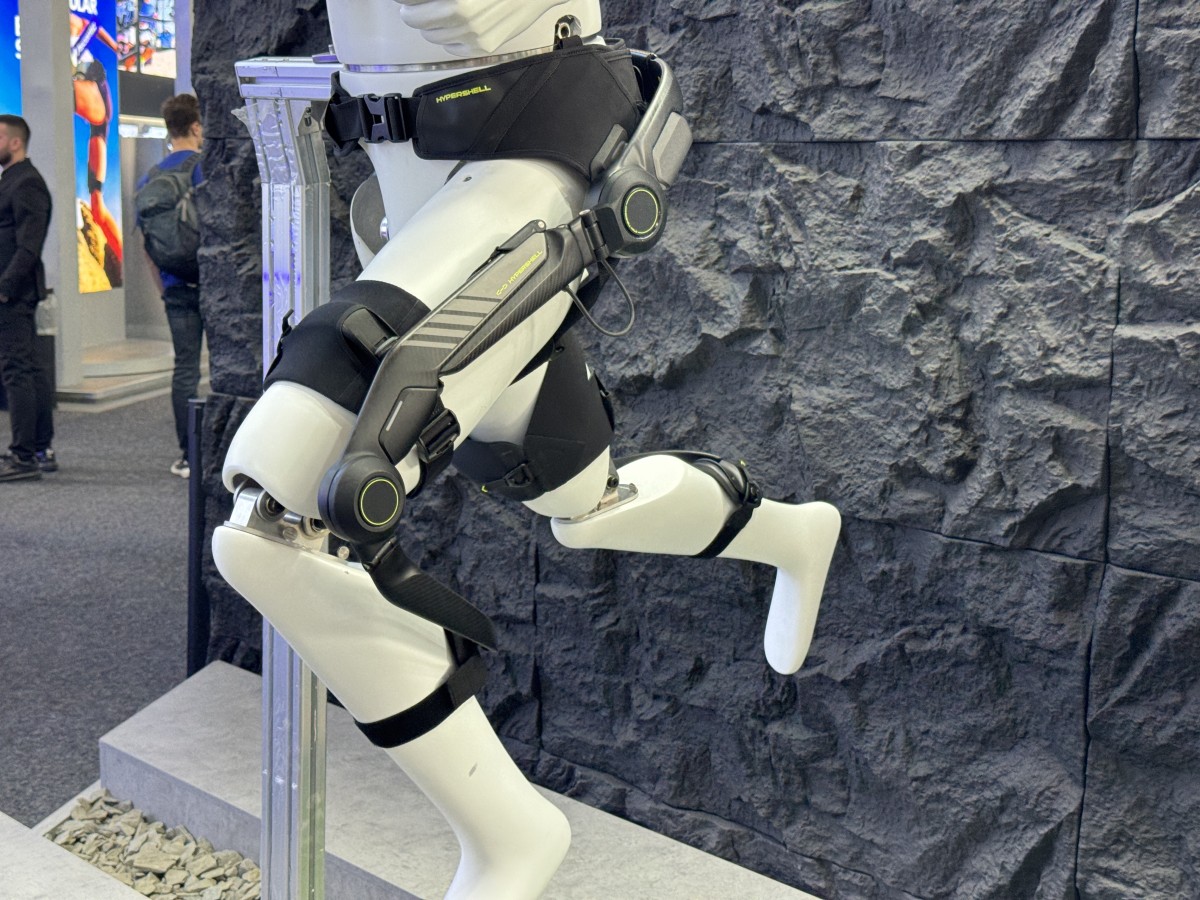
What if technology could pick up the slack? That’s the premise behind the Hypershell Halo, a full-leg exoskeleton unveiled at IFA in Berlin last week. This is far from the first Hypershell exoskeleton, but unlike previous models, the Halo extends further down the leg to provide support through the knee and calf, as well as through the thigh and hip.
 The Hypershell Halo is flexible enough to allow a full range of movement.Katie Collins/CNET
The Hypershell unified architecture is one carbon-fiber, load-bearing structure with what the company is calling a “fish-spine adaptive joint” to allow for flexibility through the hip and into the leg. Its four-motor system is designed to power you through a whole range of movements while reducing knee-muscle fatigue by up to 40% across all types of terrain.
As someone with chronically creaky knees, I was excited to try the Hypershell Halo over the weekend at IFA. The target audience for an exoskeleton may be older adults and people with limited mobility, but Hypershell seems to be hoping the Halo will have broader appeal. Someone like me, who is active and enthusiastic about exploring the outdoors, but who sometimes reaches their physical limits earlier than they’d like, is also a contender.
I quickly discovered that putting the Hypershell Halo on is all part of the adventure. One belt attaches around the waist, and two flexible straps feed around the thighs. It takes a good few minutes and help from two people to adjust the exoskeleton to fit my proportions, but once the settings are right, it’s very quick to take on and off. (In an on-stage demonstration during the Halo launch event, I watched as the presenter put the exoskeleton on in just 16 seconds.)
My first impression is that I feel a little stiff and restricted, but that sensation immediately evaporates once I start moving. The kit weighs 2.6kg in total, with the majority of that distributed around my waist. I thought the Halo would take some getting used to and might disrupt my natural gait, but it doesn’t at all. Instead, I instantly feel lighter in my natural movements. Squatting and standing from a low seated position without using my hands for support and thrust is totally effortless.
 Most of the weight is distributed around your waist.Katie Collins/CNET
As I trample cheerfully all over Hypershell’s multistory booth, I find that that the only pressure anywhere in my legs is in my ankle joints. Going downstairs, I feel none of the usual pressure in my knees, thanks to the cushioning effect. The exoskeleton isn’t doing the work of walking for me, but it feels as though I could keep going for much longer.
This is one of the main use cases Hypershell is putting forward. Avid runners and hikers could potentially do far more than they’re used to without tiring. The Halo supports speeds of up to 17km per hour, which is a 2.5-hour marathon pace. Given that that’s the same as my half-marathon pace, I’d be interested to see what I could achieve while running in the Halo.
As I descend the stairs, thinking about how difficult it usually is walking down the side of a mountain — just one long exercise in trying not to fall — I wonder whether the Halo could allow me to attempt some of the more challenging and vertiginous hikes I’m drawn to, but currently find too intimidating. I have my eye on a multiday Iceland trek, some steep summits in Lofoten and a whole bunch of routes in Patagonia. It also occurs to me that the Halo could be useful for groups with uneven levels of fitness or walking speeds. Could it be responsible for helping couples dodge the infamous alpine divorce? Or is that just delaying the inevitable?
For longer hikes, the battery supports up to 20 hours of use and can be easily swapped out. It only 370g, meaning it shouldn’t be too much of a burden to carry a spare or two.
I briefly switch the Halo to fitness mode, which increases the resistance for people who enjoy the feeling of physically working harder. I get the logic behind it, but I’m not one of these people I ask for it to be turned off again almost immediately. I guess it’s good that it exists for those who want it, but it’s not what I need after multiple days at a trade show.
One of the most interesting aspects of the Halo is how it uses AI. Over 30 sensors continuously capture lower-body movement, feeding data into the on-board AI chip, which can predict how you’re going to move 200ms before you actually do. This predictive technology means the Halo is adapting in real time to your activity, supporting your every move as you make it.
It can’t tell that this is happening while I’m wearing the exoskeleton, but I also suspect that that means it’s working as it should. After all, AI is the kind of technology that’s largely invisible when it’s at its most effective.
Perhaps the only drawback of wearing the Hypershell Halo is that it’s not subtle, and exoskeletons are still rare enough that it will likely attract attention if you wear one in public. If that doesn’t deter you and you’re ready to embrace life as cyborg in the here and now, the Hypershell Halo is available for preorder immediately, priced at $2,299.
Editors’ note: Katie Collins’ travel costs for the IFA conference were covered in part by Xiaomi. The judgments and opinions of CNET are our own.

Katie Collins
Principal Writer
Katie is a UK-based news reporter and features writer. Officially, she is CNET's European correspondent, covering tech policy and Big Tech in the EU and UK. Unofficially, she serves as CNET's Taylor Swift correspondent. You can also find her writing about tech for good, ethics and human rights, the climate crisis, robots, travel and digital culture. She was once described a "living synth" by London's Evening Standard for having a microchip injected into her hand. See full bio
What's Your Reaction?
 Like
0
Like
0
 Dislike
0
Dislike
0
 Love
0
Love
0
 Funny
0
Funny
0
 Wow
0
Wow
0
 Sad
0
Sad
0
 Angry
0
Angry
0










Comments (0)