

I fixed my home office's spotty Wi-Fi with Samsung's free diagnostic tool - and it took just minutes

Follow ZDNET: Add us as a preferred source on Google.
ZDNET's key takeaways
- I used Samsung's Connectivity Labs to diagnose and fix an internet problem.
- The tool shows useful data points like Wi-Fi dead spots, signal strength, and more.
- While it's free and limited to modern Samsung phones, other makers have alternatives.
I recently decided to fix a home office problem that I've put for six years: my desktop location, and its never-quite-adequate internet reception.
See, when I first built out my home office at the start of COVID-19, I worried more about the natural benefits of my desk's positioning relative to the window and door -- the "feng shui" of things, as the WFH influencers say.
Also: My home's Wi-Fi dead zones were worse than I thought - here's what fixed them
It was all about getting as much natural light as possible, not turning my back against the door, and most definitely not "in what quadrant of the room would I get the best internet connection?" -- because that's the least important thing when working remotely.
While I settled quite well over the past six years, more recently, my internet for work really took a tumble. My first call to Verizon led to a pitch to upgrade my Fios plan, and at that very moment, I realized it was time for a change.
The hidden diagnostic tool in your pocket
I've covered Samsung's Connectivity Labs tool -- found in modern Galaxy phones that run OneUI 6.0 or newer -- quite extensively, but this felt like a good time to revisit the hidden feature. (If you use a non-Samsung device, there are alternatives that I'll share later.)
To unlock it on your phone, go to your Wi-Fi settings, tap the three-dot menu (for expanded settings), tap Intelligent Wi-Fi, then tap the version number 7 times, or until you see a notification that says "Connectivity Labs enabled." The previously hidden menu should appear right underneath the version number.
Also: How I use Samsung's secret Wi-Fi menu to seriously improve my connectivity
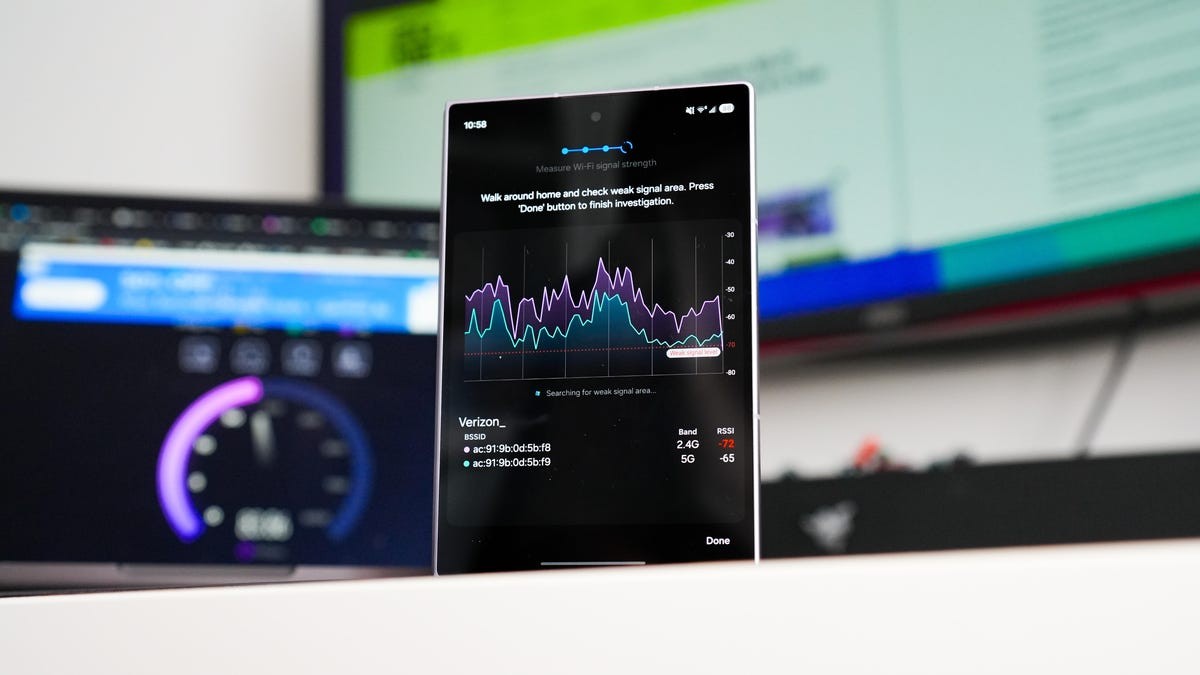
Connectivity Labs includes a suite of diagnostic utilities that help you better understand your local cellular and Wi-Fi performance. The real-time Wi-Fi strength meter, which spawns a heatmap of signal strength as you walk around an area, is what I used to investigate my home office.
Within -30 dBm (decibel-milliwatts) to -50 dBm represents the best signal strength, -60 dBm to -70 dBm is just good enough for browsing, and anything lower is poor. So I ran an internet speed test to measure the existing download/upload speeds and started mapping out my office for any weak or dead spots.
What the data suggested
As I walked around my office (roughly 100 sq ft.), pausing in high-usage spots for five seconds for the most accurate measuring, I noticed a couple of things:
- While the 2.4 GHz Wi-Fi signal, typically used by low-bandwidth devices like smart plugs, smart lights, and security cameras, was mostly excellent, my 5 GHz signal was much worse, dropping as low as -80 dBm when I hovered the phone around my desktop.
- On the other hand, the opposite corner of my room, where my cabinet was set, received a 5 GHz signal ranging from -40 to -60 dBm, suggesting it was the optimal location for wireless connection.
So I swapped the positions of my desk and cabinet, ran the same internet speed test, and found the numbers were much higher (and consistent with my Verizon Fios plan). I'm talking roughly 100 Mbps and 50 Mbps more for download and upload speeds, respectively. What a relief -- and a reminder to always consider your free internet remedies before biting whatever upgrade plan your ISP offers you.
The best alternative for non-Samsung users
As I mentioned earlier, alternatives do exist, especially if you're on a non-Samsung phone. While Google Pixel and iPhones don't have a native equivalent of Connectivity Labs, you can download a third-party service, like WiFiman (built by Ubiquiti), for free. It has a similarly friendly user interface, can measure download and upload speeds, and track signal strength throughout your home.
WiFiman may even be better than Connectivity Labs if you want to specifically measure, label, and log the signal strength of different rooms.
What about Wi-Fi Verbose Logging?
The more technical reader may be asking whether all of this is just another form of Wi-Fi Verbose Logging, an existing developer tool on Android devices that tracks Wi-Fi activity in granular detail. In ways, such as detecting signal strength fluctuations, Samsung's Connectivity Labs is the same thing.
Also: Slow Wi-Fi? I found 10 proven ways to fix your internet this weekend (most are free)
But it's also much more user-friendly and doesn't require any exporting of information for manual analysis. Wi-Fi Verbose Logging captures more extensive data, including handshakes and RSSI readings, and ultimately presents the information in a .txt file, also viewable via ADB on a computer.
What's Your Reaction?
 Like
0
Like
0
 Dislike
0
Dislike
0
 Love
0
Love
0
 Funny
0
Funny
0
 Wow
0
Wow
0
 Sad
0
Sad
0
 Angry
0
Angry
0







Comments (0)