

If you're looking, here's a "good deal" for NASA and the European Space Agency
“We are in the era of people interested in having good deals, and LISA is a very good deal for the US.”
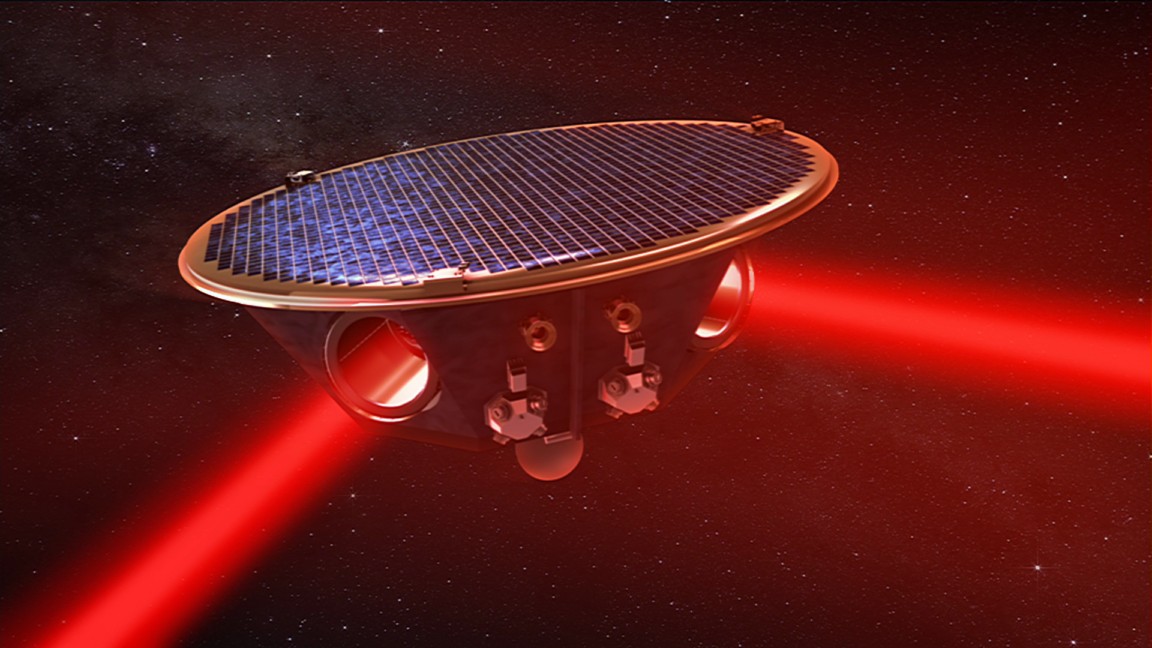
Artist's illustration of one of the three spacecraft that will make up the LISA mission. Credit: AEI/MM/Exozet
It’s no surprise that NASA’s new tack toward foreign partnerships—good deals only, please—is challenging preconceived notions of international cooperation in space.
Without a massive budget hike, the US space agency’s emphasis on building a Moon Base and winning a competition for lunar real estate and resources with China will inevitably leave lesser priorities behind.
Gone is the Lunar Gateway, a space station that was to be assembled in orbit around the Moon. For the United States, Gateway was an unnecessary distraction and expense as NASA goes all-in on placing a surface station near the Moon’s south pole.
NASA canceled the Mars Sample Return mission after its budget ballooned beyond $10 billion. It would have cannibalized the agency’s budget for robotic science missions, a funding line already in jeopardy as the Trump administration directs NASA to focus on human spaceflight and a Moon Base.
Before their cancellation, each project involved extensive cooperation with NASA’s international partners, but NASA was the leader on both. It’s not surprising that a nation’s priorities will change with elections and external pressures, like the 21st-century space race taking shape with China.
Going forward, NASA Administrator Jared Isaacman said NASA’s international partners must be ready to make “meaningful contributions,” with greater urgency than before. That means they should offer something that NASA or US companies aren’t already doing and deliver the contribution when NASA needs it.
This is creating friction in some areas. It’s most apparent between NASA and the European Space Agency, which is struggling to find a place in NASA’s Moon Base program after the cancellation of Gateway. Isaacman dismissed an ESA proposal earlier this year to develop a European cargo lander to carry supplies for the Moon Base, a role NASA officials expect US-built landers to fill sooner.
So what does a good deal in international spaceflight look like in the Trump era? Isaacman cited a couple of examples: Japan’s commitment to provide a pressurized rover for astronauts on the Moon and Italy’s agreement to build what will likely be the first habitat for the Moon Base.
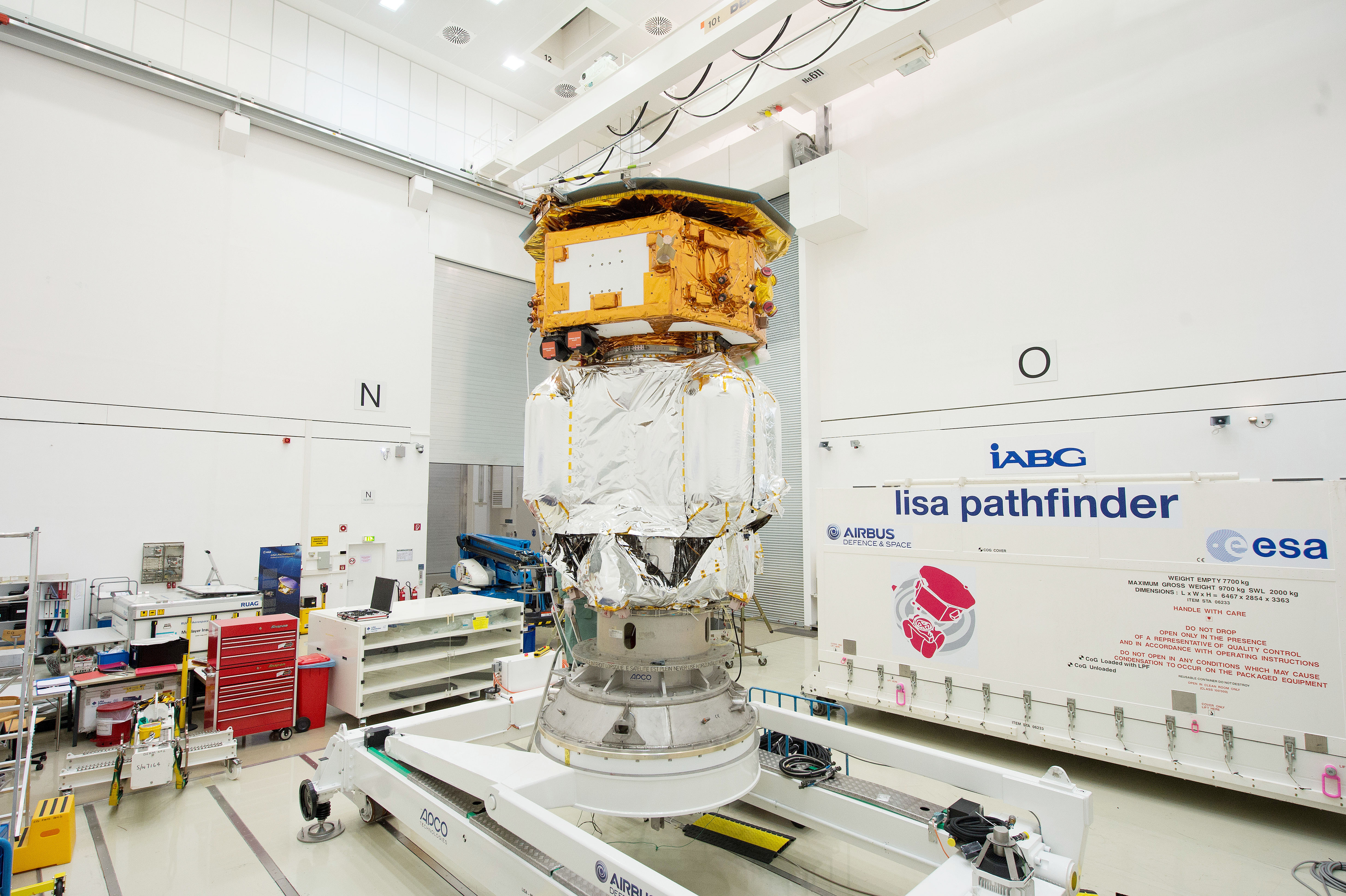
The idea for the LISA mission has been around for decades, but the concept was supercharged in 2015 with the first detection of gravitational waves by a ground-based observatory and the launch of LISA Pathfinder, seen here, a satellite to demonstrate that the technologies behind LISA would actually work.
Credit: ESA–P. Sebirot, 2015
The idea for the LISA mission has been around for decades, but the concept was supercharged in 2015 with the first detection of gravitational waves by a ground-based observatory and the launch of LISA Pathfinder, seen here, a satellite to demonstrate that the technologies behind LISA would actually work. Credit: ESA–P. Sebirot, 2015
Cosmic vibes
Here’s another one. Scientists are in the early stages of developing the Laser Interferometer Space Antenna (LISA) mission, the world’s first space-based observatory for detecting and studying gravitational waves.
As currently envisioned, the LISA mission will be led by the European Space Agency, with significant contributions from the United States. The mission will use three spacecraft flying in a triangle formation in heliocentric orbit, positioned nearly 1.6 million miles (2.5 million kilometers) apart to pick up the faint signals of low-frequency gravitational waves. Launch is scheduled for around 2035.
Gravitational waves are a relatively new area of astronomy, using detectors spread across a wide area, like on a continent or in space, to identify ripples in the fabric of space-time generated by cataclysmic events in the distant cosmos. Beginning with the first detection with a ground-based observatory in 2015, astronomers have used gravitational waves rippling across the Universe to reveal the collisions of black holes and neutron stars in faraway galaxies.
LISA will unlock a new wave of gravitational wave science by spreading its detectors over greater distances. Each spacecraft will carry two free-floating gold-platinum cubes inside an internal Faraday cage that protects them from all external disturbances other than gravitation, canceling out thruster firings, spacecraft vibrations, and the almost imperceptible influences from solar radiation pressure and interplanetary dust.
The LISA spacecraft will literally fly themselves around the free-floating cubes inside them, while inter-satellite lasers will measure the exact distances between the test masses. The laser ranging instruments must be sensitive enough to detect a change in distance smaller than the size of an atom to confirm a gravitational wave detection.
Under its agreement with ESA, NASA is responsible for supplying the transmitters and telescopes for the lasers. NASA will also provide charge management devices to reduce the buildup of electric charge on the proof masses inside each spacecraft and support data analysis on the ground to find the sources of LISA’s gravitational wave detections. Europe will build the spacecraft, launch them, and operate them.
This is exactly the kind of international partnership NASA should hold onto, according to Ira Thorpe, a gravitational wave astronomer at NASA’s Goddard Space Flight Center and leader of the US science team for the LISA mission. NASA isn’t working on its own gravitational wave observatory for space, and the agency likely couldn’t afford it if it wanted to.
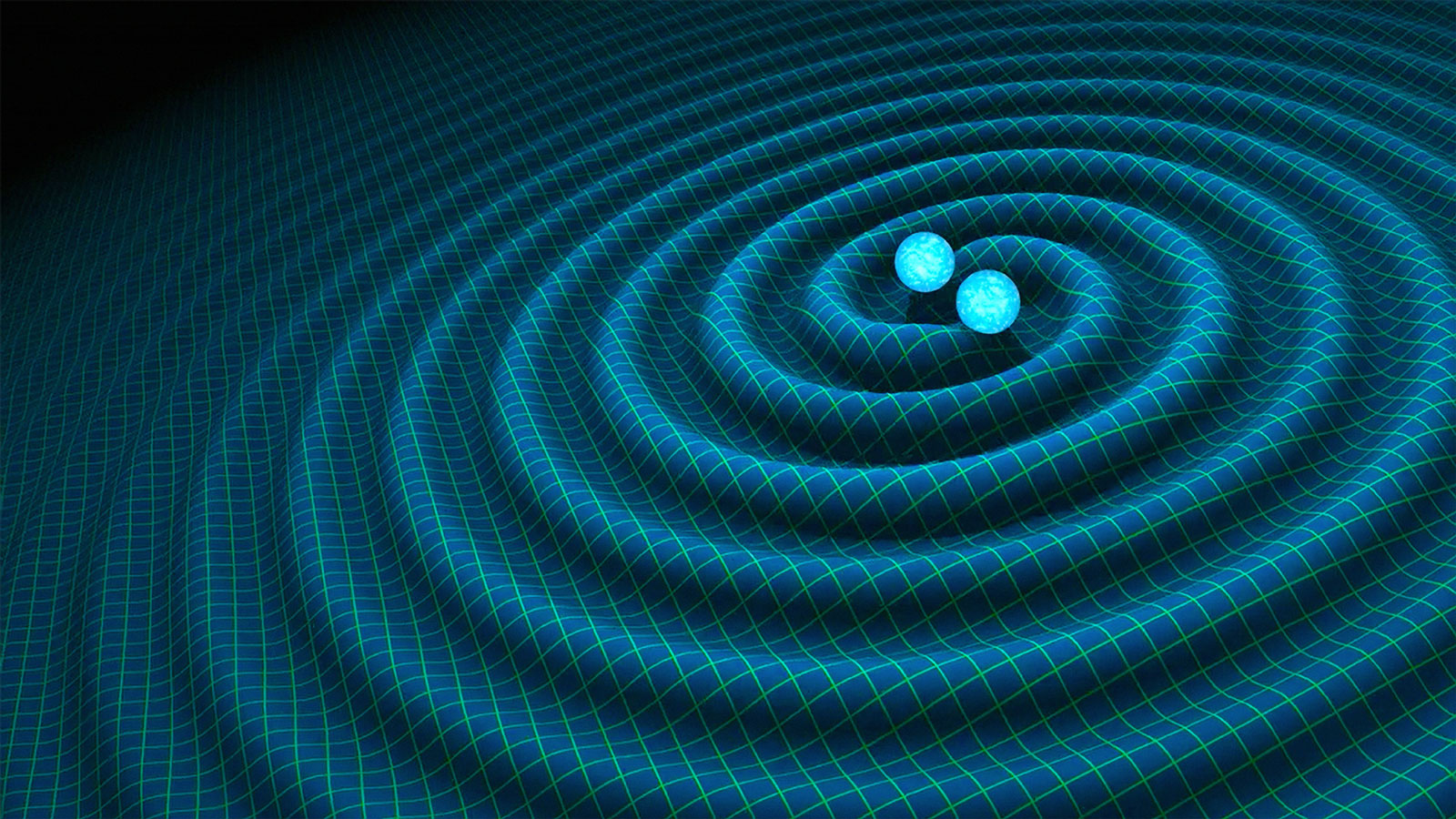
An artist’s impression of gravitational waves generated by binary neutron stars.
An artist’s impression of gravitational waves generated by binary neutron stars. Credit: R. Hurt/NASA/JPL-Caltech
“We are in the era of people interested in having good deals, and LISA is a very good deal for the US,” Thorpe said in a recent presentation at the National Academies’ Committee on Astronomy and Astrophysics.
“We are paying for roughly a third [of the mission],” Thorpe said. “We’re getting all of the science data, 100 percent of it. That is very good leverage. We are giving them (ESA) this flagship. If the US was to do LISA on its own, it would probably be a… $3 billion kind of number as an off-the-top-of-my-head guess. For a fraction of that cost, we are getting the same science.”
Thorpe’s $3 billion estimate isn’t far off the mark. ESA approved development of the LISA mission in 2024 with a budget of 1.75 billion euros ($2 billion), but that figure doesn’t include contributions from the United States or individual ESA member states. As it stands today, NASA’s work on the LISA mission is expected to cost around $1 billion, but the agency hasn’t yet established a firm budget commitment.
“I think this is the largest science mission that ESA has attempted to do. Full stop,” Thorpe said. The LISA mission has a long history, with the first concepts for a gravitational wave observatory dating to the 1970.
“It’s bounced back and forth, depending on how the political winds have shifted on both sides of the Atlantic over decades,” Thorpe said. “I think we’re in a very stable system where ESA is going to clearly lead. NASA is going to be the major partner, a critical partner, for the project.”
But the Trump administration injected doubt into LISA’s future last year when the White House proposed canceling NASA’s participation in the project, alongside dozens of other science missions. Congress rejected the cuts and restored funding for fiscal year 2026, but the Trump administration again proposed cancellation in its 2027 budget request released earlier this year.
“That caused some concern in Europe, which I think is understandable,” Thorpe said. “But at the same time, speaking from the project side, we continue to do our work. We try to just focus on making our deliverables. We’ve met every deliverable commitment to ESA so far. We have not missed.”
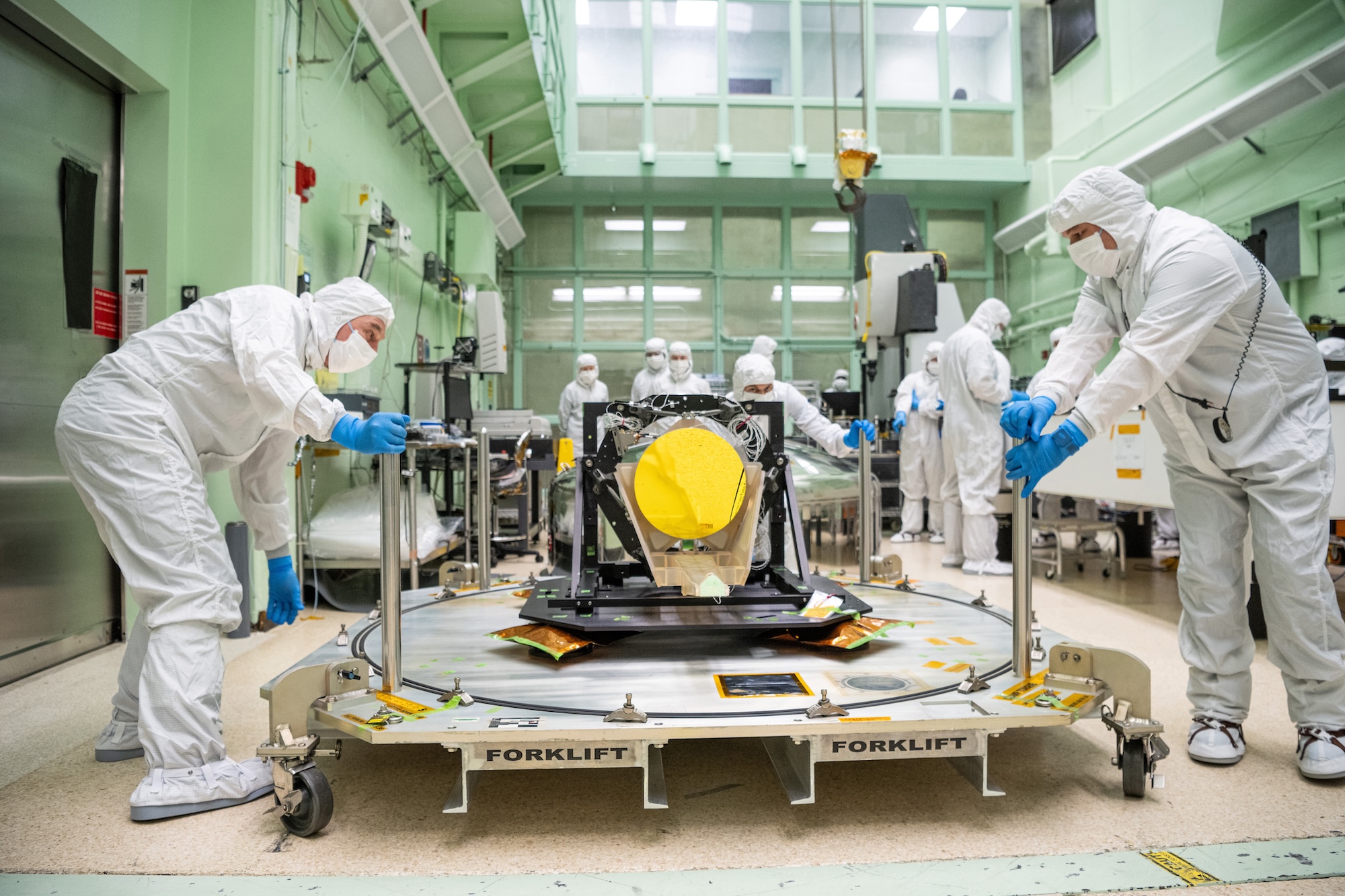
The full-scale Engineering Development Unit Telescope for the LISA mission, still in its shipping frame, is seen inside a clean room in 2024 at NASA’s Goddard Space Flight Center in Greenbelt, Maryland.
Credit: NASA/Dennis Henry
The full-scale Engineering Development Unit Telescope for the LISA mission, still in its shipping frame, is seen inside a clean room in 2024 at NASA’s Goddard Space Flight Center in Greenbelt, Maryland. Credit: NASA/Dennis Henry
Powerful friends
Congress is expected to continue funding LISA, which has powerful patrons on Capitol Hill and was one of a handful of future NASA science missions with a specific funding line in Congress’s appropriations bill for 2026.
Sen. Chris Van Hollen (D-Md.), whose constituency includes NASA’s Goddard Space Flight Center leading the US contribution to LISA, is the top Democrat on the Senate subcommittee responsible for writing NASA’s budget. Van Hollen could take over as chairman if Democrats win control of the Senate in this year’s midterm elections. Across the Capitol, Rep. Glenn Ivey (D-Md.), whose district also includes Goddard, sits on the corresponding subcommittee in the House.
“I think we’re in very good shape going forward,” Thorpe said.
The NASA official overseeing all of the agency’s astrophysics missions is Shawn Domagal-Goldman. Despite the White House’s attempt to end NASA’s contribution to the LISA mission, the 2026 budget passed by Congress and subsequently signed into law by President Trump should signal to ESA that Washington supports the project.
“Something this complex is always challenging, but it’s why it’s important that we reaffirm our commitment with the funding that we have in the FY ’26 appropriations bill,” Domagal-Goldman said. “As long as we have a continuing resolution or anything at our current funding levels, we will maintain our commitment to the LISA mission.”
“I’m really happy for that because when LISA launches, it’s going to answer some of these other big questions that you can only do with a space-based gravitational wave observatory,” he said.
LISA’s scientific pursuits include investigating the origins of black holes and galaxy formation. It could potentially be sensitive enough to detect gravitational waves originating shortly after the Big Bang, allowing scientists to test the theories about the birth of our Universe, according to NASA.
“These are propagating disturbances in space-time,” Thorpe said of gravitational waves. “They can carry energy. They can carry momentum, and I think most interesting for astronomers, they can carry information about the systems that produce them, and we can use them to understand the Universe.”
Physicists will use detections from LISA to test Einstein’s general theory of relativity. Some of the most cataclysmic events in the cosmos, such as mergers of supermassive black holes, should produce a very specific gravitational wave signature, according to general relativity. LISA will be more sensitive to lower-frequency gravitational waves than ground-based observatories, like LIGO, corresponding to the kind of waves scientists expect to be generated by the most massive black holes.
“GR gives us an exact prediction for what this waveform would look like, so any small deviation would give you some hint as to what might be going on,” Thorpe said. “I like to think if GR is going to break—and I don’t generally like to bet against Einstein—but if it is going to break, these are the kinds of places where it may break down.”
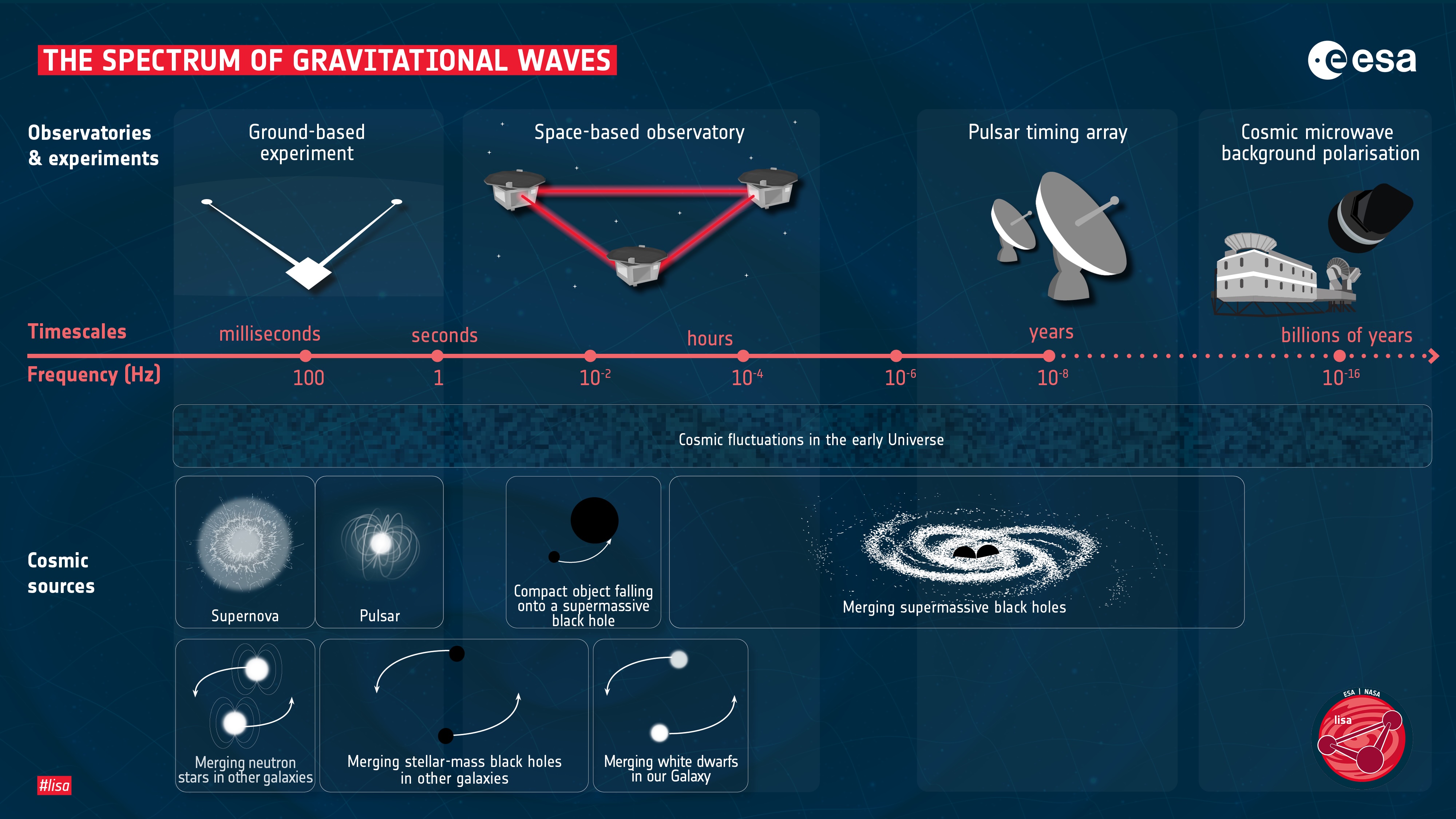
Gravitational waves are ripples in space-time produced by the acceleration of very massive objects, such as black holes coming together and merging. Different objects in space produce gravitational waves of different timescales, ranging from milliseconds to billions of years. Some of these waves can only be observed from space.
Credit: European Space Agency
Gravitational waves are ripples in space-time produced by the acceleration of very massive objects, such as black holes coming together and merging. Different objects in space produce gravitational waves of different timescales, ranging from milliseconds to billions of years. Some of these waves can only be observed from space. Credit: European Space Agency
Another joint science mission between NASA and ESA has, at least so far, survived the White House’s budget ax. NASA has long been on the hook to provide the launch for Europe’s Rosalind Franklin Mars rover, along with a science instrument and retrorockets for the craft that will deliver it to the Martian surface. The Trump administration sought to cancel NASA’s role in the mission, but funding approved by Congress last year was enough for NASA to finally book a launch for Europe’s first Mars rover on a SpaceX rocket in 2028. Notably, Rosalind Franklin is currently the only future Mars rover with any NASA involvement.
Questions remain about NASA’s role in other joint missions with ESA. The New Athena X-ray observatory, scheduled to launch in the late 2030s, is supposed to be the largest X-ray telescope ever built, a successor to NASA’s Chandra X-ray Observatory, still operational after launching in 1999. As with LISA, New Athena was conceived as a European-led mission with major support from NASA.
Domagal-Goldman said NASA is “fully engaged” with ESA on the New Athena mission and remains “fully committed” to the partnership. But New Athena didn’t get a specific funding callout in Congress’s 2026 budget for NASA.
The chances of a major US contribution to ESA’s next mission to Venus, named Envision, are less assured. NASA has its own Venus missions in the pipeline, and although the US space agency has not officially announced that it is pulling out of the Envision partnership, ESA is moving ahead with contracts to begin developing a European-made radar mapping instrument for the Envision orbiter, which was previously supposed to be built at NASA’s Jet Propulsion Laboratory in California.
As NASA’s support wavered, ESA was on the clock to decide on Envision’s radar because the mission is slated for launch in 2031. With Envision, at least, ESA is ready to strike out on its own.

Stephen Clark is a space reporter at Ars Technica, covering private space companies and the world’s space agencies. Stephen writes about the nexus of technology, science, policy, and business on and off the planet.
What's Your Reaction?
 Like
0
Like
0
 Dislike
0
Dislike
0
 Love
0
Love
0
 Funny
0
Funny
0
 Wow
0
Wow
0
 Sad
0
Sad
0
 Angry
0
Angry
0










Comments (0)