

Is the Sirui Vision Prime 1 150mm T4 1.5x Macro a Great Value Full-Frame Cine Lens? Let's Find Out.
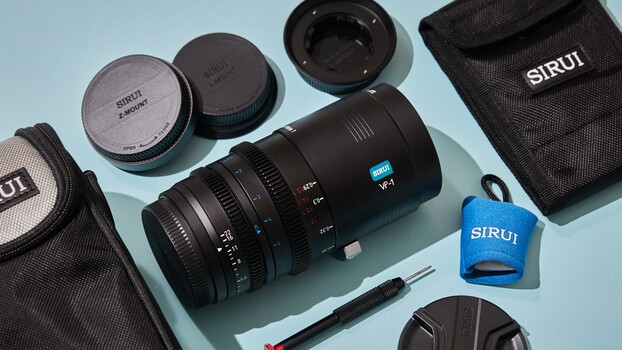
The Vision Prime 1 (VP-1) series full frame cine lenses were originally launched by Sirui back in February 2025, with the first batch of lenses covering all the mid-range focal lengths: the 24mm T1.4, 35mm T1.4, and 50mm T1.4. These releases not only offer great value options to the filmmaking enthusiast community, but also aim at solving traditional pain points by reshaping how we think about lenses and taking advantage of the modern camera setup.
Riding on its successful launch, Sirui expanded the series earlier this year with the addition of 15mm T1.6, 75mm T1.4 & 150mm T4 1.5x Macro (150mm Macro), completing the VP-1 series lineup. The Vision Prime 1 series will now cover anything from ultra-wide to telephoto and macro applications. In this review, we will be diving into one of the VP-1 lenses, the 150mm T4, to see if it fits into professional workflows.
Build Quality
The VP-1 series cine lenses are specifically built for efficient professional workflow, and the 150mm Macro is no different. Being a cine prime lens, naturally it is designed with a set of industry-standard 0.8 MOD pitch-size gear rings on the lens barrel—one for the focus and one for the aperture. But with the VP-1, Sirui did make calculated design decisions by having uniform gear positions across all the lenses in the series. This allows filmmakers to switch between different lenses without needing to reposition their focus pullers or iris controls.
This is where things get interesting to the point that I do want to get the elephant in the room out first. It really has been a while since we’ve seen anything like that implemented in the market. Other than having a consistent gearing position, the VP-1 series cine lenses are also designed with Sirui’s patented versatile mounting system. The mount on the lens itself is user-changeable with the provided mount adapters. This allows compatibility across multiple camera systems such as the Canon RF, Nikon Z, and Leica L-mount despite being a native Sony E-mount lens. And because these mount adapters are specifically designed for the lens, there are no shims required to fine-tune the focusing.
Having a versatile mounting system solves traditional pain points of being tied to a single mount or buying one for every mount. By taking advantage of the modern camera setup these days with short flange distance, manufacturers can easily find the common denominator among all of them and design the lens accordingly. Though that also means that the lens will have to be a few millimeters longer in order to cater to the one with the longest flange distance (Canon RF and Leica L). While I previously spoke about Leica M-mount being the easiest common denominator for all mirrorless in one of my older articles, that method itself possesses a limitation whereby Leica M-mount has the smallest throat opening (44 mm) when compared to the other mirrorless mounts, which are at least 46 mm, indirectly limiting how lenses can be designed.
I am surprised it took so long for brands to rethink how lenses are designed these days. Here I do have to applaud Sirui for taking the risk to implement such a concept. Sirui does this by providing buyers with all the other mounts so that they can easily change them when required. All you need to do is just unscrew four screws, replace them with your desired mount, align the widest mounting tab, screw them in, and you are good to go. While this is a blessing for people like me who run multiple systems, it indirectly introduces a whole new set of issues. Yes, we are talking about supplying more mounts for people who might not need it and also ineffective material usage. Here, Sirui could consider only including it as a cheap $10 add-on modification kit option.
While the entire effort is commendable, I can’t help but think that the practicality of their implementation could have been improved. I don’t think it is as easy to fiddle with four screws on location when everything is stressful, which ultimately limits its application. This is because Sirui was not the first company to attempt this concept. Back in 1973, Tamron explored this “one mount for all concept” called T-mount / Adaptall, where it is a bayonet-style mounting system for all mounts. It was later refined in 1979 to Adaptall-2, which has the ability to communicate maximum aperture data to the camera body. And I really hope Sirui can turn their versatile mount system into a custom interlocking bayonet mount or even a positive-lock mount, as I don’t see how it is not possible since there are no electronic contacts. Even if there are, I also don't see how it is not possible with today’s technology.
Now, back to the lens. Natively, the 150mm Macro with the RF Mount measures at 144.6 mm in length and 80 mm in diameter. It weighs about 750 g with both lens caps and the RF mount on, which is considered somewhat lightweight for what it does, though it is not a very small lens. Aesthetically, it comes in two color options: Black and Metal Gray, with a very nice external metal finish which is satisfyingly smooth to touch. However, it is also a fingerprint magnet, especially if you happen to have oily fingers. For ease of operation, you can find focus distance markings both in imperial and metric units (one on each side), magnification ratio, and aperture value in T stops engraved on the lens barrel itself. You can also find a mounting point below the lens barrel for better support.
In terms of handling, the lens is equipped with a stepless aperture ring, as you would expect from a proper cine prime. It does come with ⅓-stop markings until T11, where it becomes ½ stops and 1 stop from T16 onward. In terms of focusing, the focus barrel does have a generous 270° focus throw with larger gap adjustments toward macro distance for precise micro-adjustments. Being a brand-new lens, both the focus barrel and aperture ring did feel quite tight, but they loosened up after some initial use. Not sure if I should celebrate this, as I would question its longevity even though it has a nice damping now. This is because I have no way to confirm its long-term durability, as I will only have access to this lens for a few months. The same goes for the mount itself—it is noticeably tight at first but breaks in nicely after a few lens swaps with no noticeable damage on the mount itself.
Moving to the front of the lens, there is a slight labeling quirk that might cause some initial confusion. The outer casing clearly states "Front Ø 72mm," while the front ring says "Ø 67mm." Just to clear the air: 72 mm refers to the outer front barrel diameter, while 67 mm is the actual filter thread size. This 67 mm filter thread is another fantastic specification because it remains consistent across the rest of the VP-1 series (with the sole exception of the ultra-wide 15mm), making matte box configurations and circular filter swapping easier between lenses.
When it comes to durability, the 150mm Macro boasts what Sirui refers to as "Triple Protection," making the lens highly resistant to dust, dirt, and splashes. This is largely thanks to its internal focusing design; the outer barrel never extends, and the front and rear are securely sealed off. In fact, the entire inner optical group is housed within its own sealed cylindrical unit. You can actually see this internal sealing for yourself when you switch the camera mounts. This is combined with a rubber gasket positioned at the rear to improve the seal against your camera body. As usual, I would still practice some caution when using it in rougher conditions because I have no way of proving how good the sealing on a loaner unit is.
As a nice little touch for the buyer, Sirui includes a microfiber cleaning cloth that packs neatly into its own cute, small pouch. And if you are planning to invest deeply into this ecosystem, it is also worth noting that purchasing a 3-lens set rewards you with a dedicated hard case to transport them all safely—a huge value-add for traveling filmmakers looking to keep their kit protected.
Features
Underneath its innovative lens housing, the 150mm Macro is constructed with an optical formula of 16 elements in 12 groups. Interestingly, none are aspherical elements. There are only three Extra-low Dispersion (ED) and three High-Refractive Index (HRI) elements, despite their heavy marketing materials promoting the use of compact aspherical lens components in the VP-1 series lenses to reduce weight and control chromatic aberration. This isn't necessarily a bad thing, as the ED glass does play its role in ensuring sharp images with accurate colors, while the HRI glass plays a crucial role in reducing stray light and improving overall light transmittance. Sirui has also applied an HD multi-layer nano-coating which effectively minimizes surface reflections, flares, and ghosting. This ultimately enhances image clarity and color fidelity in the resulting image.
The lens houses 13 aperture blades that move from a T4 to a T22 aperture range, sufficient for delivering incredibly smooth bokeh even when stopped down, though the aperture on the narrow end could use a little bit more range to stop down further than T22, which would really help squeeze out some extra depth of field, especially when this lens features a 1.5x macro magnification capability. This is because depth of field does become thinner the closer you go, but then again, we might run into more issues such as diffraction and availability of light at that kind of aperture.
While most standard macro lenses stop at a 1:1 reproduction ratio, pushing it to a 1.5:1 ratio allows you to render subjects 1.5 times their actual size on the sensor, revealing much finer, clearer details and precise textures. If you want to get more out of that magnification, our Mastering Macro Photography tutorial covers both the shooting and the editing side. Despite this extreme magnification, you can still maintain a comfortable working distance thanks to the combination of a 150mm focal length at a minimum focus distance of just 0.29 m. The 150mm Macro’s focal length provides excellent telephoto compression in producing a field of view of 9.12° vertically, 13.59° horizontally, and 16.26° diagonally. This gives you the flexibility to shoot everything from extreme close-ups to distant scenes, all while keeping focus breathing and distortion to an absolute minimum, a must-have for any cine lens.
According to Sirui, the 150mm Macro will cover a 46 mm image circle, making it compatible with full frame and APS-C format cameras without any serious vignetting. To put the math into perspective, a standard 35mm full frame sensor has a diagonal measurement of approximately 43 mm. So, a 46 mm image circle is definitely sufficient to cover it perfectly. However, if you are thinking of adapting this to something like a Fujifilm GFX system, which uses a 33 x 44 mm medium format sensor with a roughly 55 mm diagonal, you will run into limitations. To completely cover that sensor without hard edges, the lens will require at least a 55 mm image circle, making this lens just about 9 mm short, meaning this lens is strictly designed to maximize standard 35mm full frame sensors, and we most probably will not see it in GFX mount for the Fujifilm GFX Eterna 55.
Real-World User Experience
Cine lenses have become more and more affordable and accessible recently, largely thanks to innovative Chinese companies like Laowa producing them with surprisingly good glass and precision technology. I have been thinking about this for quite some time: with so many cine lenses on the market, and most of them being pretty good, how do we even decide which one to buy? Here is my take, and I am not paid to say this, but if you are just starting out and are about to get serious about videography, you really might want to consider getting these VP-1 series cine lenses as a complete set. If you are coming to this from stills, our Introduction to Video: A Photographer's Guide to Filmmaking tutorial is a reasonable place to start. Buying into the series not only gets you covered in terms of focal lengths, but also futureproofs you (in case you decide to change systems). You also gain crucial consistency in both your physical rig setup and your final visual look. Sirui promises consistent color rendering across the rest of the VP-1 series, though I can't comment on this definitively since I only tested this single 150mm Macro lens. Also, it is worth noting that despite being labeled as part of the Vision Prime T1.4 series, this 150mm macro is actually a T4 lens.
In terms of form factor, it is probably as large as you would want for gimbal use. Though, it is still a nice size and handling it on set is a breeze, and focus pulling is both easy and predictable. I think Sirui intentionally designed the focus ring with a larger diameter than the aperture ring. Combined with the aperture ring sitting further on the inner side of the lens with an appropriate, non-movable gap between them, focusing is seamless, and you won't easily knock the aperture ring by accident. The focusing ring, however, is not perfectly linear toward infinity—it gets considerably narrow at the far end of the throw.
As for the highly advertised interchangeable mount, as we shared earlier, the lens comes with different full frame mirrorless mounts so you can adapt it to whatever system you need. Changing it is relatively easy and straightforward: you just use the provided screwdriver to unscrew the four inner screws. Just a word of warning here: do not unscrew the outer screws with your own tool. All they do is release the outer mount, and trust me, you will have a very hard time putting it back together (don’t ask how I found out) because the rubber weather-sealing gasket will fall out. Likewise, don't attempt to unscrew any other internal screws using that same tool, as you might mess up the optics or cause dust to enter the sealed system. If you need, I made a video guiding you through the process here:
Sirui did include a separate carrying pouch for the mounts in case you feel like changing them on location. Personally, I absolutely would not recommend doing that and would treat this like a fixed system unless necessary. The last thing you want is to deal with screwing and unscrewing tiny parts on site where everything else is so stressful and messy. A positive-lock mount might make more sense for universal adaptability, but I suppose that is the trade-off for wanting to shrink the lens size down by a few centimeters.
Since this is a prime lens, there is no need to worry about it being parfocal; instead, our attention should be entirely on focus breathing, which is especially critical for a macro cine lens. Sirui notes that their 15mm and 75mm focal lengths exhibit nearly imperceptible breathing to ensure visual continuity. As a macro lens, I have to say that the 150mm Macro is doing a good job in keeping the breathing minimal. I found that the frame only started shifting noticeably after the 1.5 m mark, which coincidentally is also where the close-up magnification starts. On top of that, it does not exhibit any focus shift when stopping down.
On the 1.5x magnification capability, there is a practical reality you have to face. When you are pushing into that extreme magnification end, you will not have enough depth of field given that the aperture only closes down to T22. Depending on what you do, this can severely limit its real-world application. It can feel neither here nor there if you are trying to push this lens on the macro side of things. To me, it is best to just treat it as a close-up cine lens instead of chasing that extreme 1.5x limit for everyday video work. Not to mention, the rendering you get out of the lens leans toward the non-clinical kind of sharpness, and may not have the resolving power for images to look sharp at macro level. The image it produces is sharp in the center with a very natural, gradual fall-off to the sides. This behavior is also consistent throughout the focus range from close up to the telephoto end. It also suffers from diffraction for anything above T11, so do stop down sparingly.
There are also signs of chromatic aberration when shooting wide open, though stopping down to f/5.6 visibly reduces it. Now, I can't quite make up my mind if this is intentional by design. When used correctly, this chromatic aberration gives a distinct halation and filmic look to the scene. However, it is quite hard to see and will usually only appear on high-contrast edges. On one hand, it can be annoying if you are shooting a product and expecting the focus to be perfectly clinical, only to start seeing halation instead. The lens will also flare when introduced to a strong light source.
Thanks to the larger image circle I mentioned earlier, vignetting is incredibly low. Personally, I would actually prefer a bit more vignetting to add character and naturally guide the viewer’s eye to the center of the frame. That larger image circle also helps in reducing the cat’s-eye bokeh effect. Speaking of bokeh, I do find the background and foreground rendering to be pleasing to the eye. The bokeh balls remain perfectly round when stopped down, free of ugly onion-ring textures, thanks to its 13-blade aperture. Having 13 aperture blades also means that you will technically get a 26-point sunstar, which can look rather distracting, and is something I generally would not want in video. Thankfully, it only starts forming at T8 and becomes highly defined by T11. For cine lenses, priority should always be given to making sure the highlight fall-off and bokeh remain smooth, which this lens does brilliantly.
Summary
What I Liked
- True 1.5x Macro Magnification: Pushes beyond standard 1:1 magnification, allowing you to capture finer details while shooting at a comfortable working distance with the focal length.
- Omission of Aspherical Elements: The lack of aspherical glass in the optical formula feels like a deliberate choice. It introduces a touch of halation when shooting wide open toward high-contrast scenes, which actually lends a pleasing, organic filmic character to the footage.
- Versatile Mount System: The ability to swap mounts prevents you from being locked into a single camera ecosystem or needing separate lenses for different bodies.
- Uniform Cine Design: Consistent gear positioning across the VP-1 series allows fast lens swaps on set without having to reposition focus pullers or iris controls.
- Standardized 67 mm Filter Thread: Uniform across almost the entire lineup (except the ultra-wide 15mm), making matte box setup and filter swapping effortless.
- 270° Focus Throw & Stepless Aperture: Generous rotation angle enables precise micro-adjustments, which is essential for managing razor-thin macro depth of field.
- Well-Rounded Bokeh & Low Vignetting: 13 aperture blades keep bokeh highlights remarkably round even when stopped down, with edge vignetting and cat-eye distortion kept to a minimum.
- Subtle Sunstar Rendering: The 13-blade design technically produces 26-point sunstars, but they remain pleasantly muted and only become rather prominent at T8 onward.
- Accessible Pricing: Offers a low barrier to entry for filmmakers looking to add a dedicated full frame macro cine prime to their kit.
What Could Be Improved
- Physical Size & Weight Consistency: A more compact build matching the rest of the series would eliminate the need to rebalance gimbals when swapping focal lengths.
- Faster Aperture: While T4 is manageable, a T2.8 version would be a welcome improvement for low-light performance and creative depth-of-field control.
- Smarter Mount Mechanism: Replacing the small screws with a tool-less positive-lock or bayonet system (similar to the vintage Tamron Adaptall) would make swapping mounts on location much more practical.
- Fingerprint-Resistant Exterior: The smooth exterior finish attracts fingerprints easily and requires frequent wiping to keep clean.
- Unbundled Mount Option: Supplying every mount adapter in the box creates material waste as most users may only need one; offering additional mounts as an affordable add-on modification kit would be far more efficient.
- Electronic Contacts / Autofocus: Adding electronic pins to transmit EXIF metadata—or ideally incorporating an autofocus option—would greatly enhance its versatility on modern hybrid setups.
Final Thoughts
Are they the absolute best cine lenses on the market? Probably not, as we do have to navigate certain limitations here and there, such as the somewhat tedious screw-based mount switching process, slower aperture, and no EXIF metadata recording. However, when you consider the price of entry, the Sirui VP-1 150mm Macro is a lens that provides some of the greatest utility available at this price point. This is especially true if you are a solo shooter or part of a small crew wanting to use dedicated, manual cine lenses on mirrorless hybrids without breaking the bank or being locked into a single ecosystem.
While this 150mm Macro lens is incredibly value-for-money on its own, I believe its ultimate value truly shines when you work with the entire VP-1 set. The uniform size, consistent gear placement, and unified look across the focal lengths make it an incredibly efficient system for on-location professional workflows.
For those who are interested, the Sirui VP-1 Vision Prime Full Frame 150mm T4 1.5x Macro is available now for $649. As for the 24mm, 35mm, and 50mm 3-lens kit, it goes for $1,499 and the 15mm, 75mm, and 150mm kit goes for $1,899.
What's Your Reaction?
 Like
0
Like
0
 Dislike
0
Dislike
0
 Love
0
Love
0
 Funny
0
Funny
0
 Wow
0
Wow
0
 Sad
0
Sad
0
 Angry
0
Angry
0










Comments (0)