

‘Is there a point where refresh rate just stops mattering?’: I chat to Samsung’s monitor experts about its crazy-fast 1100Hz gaming display

 (Image credit: simpson33 / Getty)
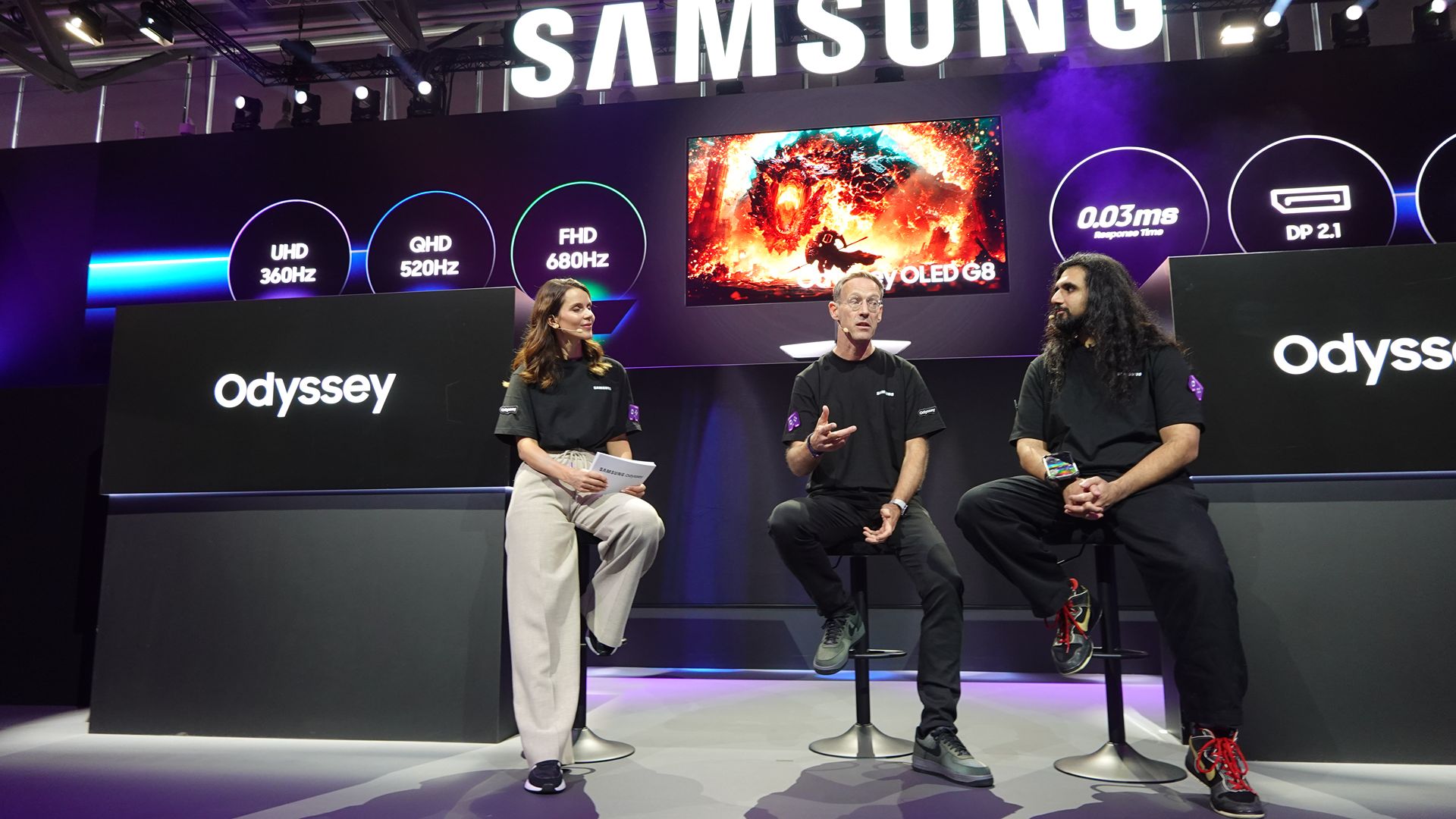
At Gamescom 2026 in Cologne, fresh off Samsung's reveal of its 2027 Odyssey OLED lineup, I sat down with two of the people shaping the company's monitor and TV strategy: Jeremy Demont, Product Management Director for TV, Sound and Monitor at Samsung UK & Ireland, and Pepe Distra, Head of Monitor for Samsung's European visual display organisation.
We chatted about everything from the prevalence of 1000Hz and higher refresh rate screens to 6K gaming, the brand's ongoing commitment to glasses-free 3D and how important strong partnerships with eSports professionals and studios are to getting the best out of screens.
A triple mode screen is more useful than you might think
Triple mode gets its debut on the new Odyssey OLED G8, a 32-inch 4K tandem QD-OLED panel that runs at 360Hz natively, drops to 1440p resolution for 520Hz, or goes all the way down to Full HD for 680Hz.
It's a first for Samsung: dual-mode switching already exists on its 6K panels, the ultrawide G9, and other, more conventional choices, but triple mode isn't something that can be patched in later via firmware. Distra confirmed it's baked in on the panel side.
I pushed on whether this is solving a real problem or just adding a marketing bullet point. Halving your resolution to double your refresh rate is a genuinely large image quality penalty, so a middle ground – dropping from 4K to 1440p rather than all the way to HD – makes sense on paper.
However, Distra was refreshingly candid about the uncertainty here: "If it's high-end gamers, they'll definitely benefit. But if the average Joe Bloke buys the gaming monitor, are they actually going to use it practically?" He described it as something Samsung still needs to watch play out once the hardware reaches the market, and said community feedback will directly shape what comes next.
1100Hz might not be the limit, after all
The number causing all the excitement is 1100Hz, supported by the new Odyssey G6 G60H – a 1440p Fast IPS panel that runs at 600Hz natively, but which can drop to HD resolution to unlock that 1100Hz ceiling, the fastest refresh rate I've seen on a gaming monitor to date. It wasn't long ago 500Hz felt like an extreme number, so I put it to Distra directly: is there a point where refresh rate just stops mattering?
Sign up for breaking news, reviews, opinion, top tech deals, and more.
If you deliver only 1100Hz and focus purely on eSports, that's a small market
Pepe Distra, Head of Monitor, Samsung EuropeHe didn't dodge the eSports-only framing. "If you deliver only 1100Hz and focus purely on eSports, that's a small market," he told me.
The reasoning behind Samsung's dual- and triple-mode panels, he explained, is about giving that headroom without forcing everyone to live with it – you can drop back down to a lower resolution for everyday use rather than running flat-out all the time. Whether the industry pushes past 1100Hz next, he wouldn't commit to. "If we go faster in the future, we'll have to see."
6K gaming screens have a genuine purpose outside of vanity
I've used 6K panels in a professional context on a few screens in the past, but never on a gaming screen, and 4K is already a heavy ask for most GPUs. So who is Samsung's 6K gaming monitor for?
Distra's answer leaned on future-proofing rather than the present day: those with high-end PCs can already drive that resolution, and the dual-mode option covers anyone who can't.
It's worth noting the new G9 ultrawide also carries a dual-mode option of its own – 5120 x 1440 at up to 360Hz, or 'dual HD' at 2560 x 720 for 720Hz – so the same philosophy runs across Samsung's 2027 range rather than sitting in one flagship alone.
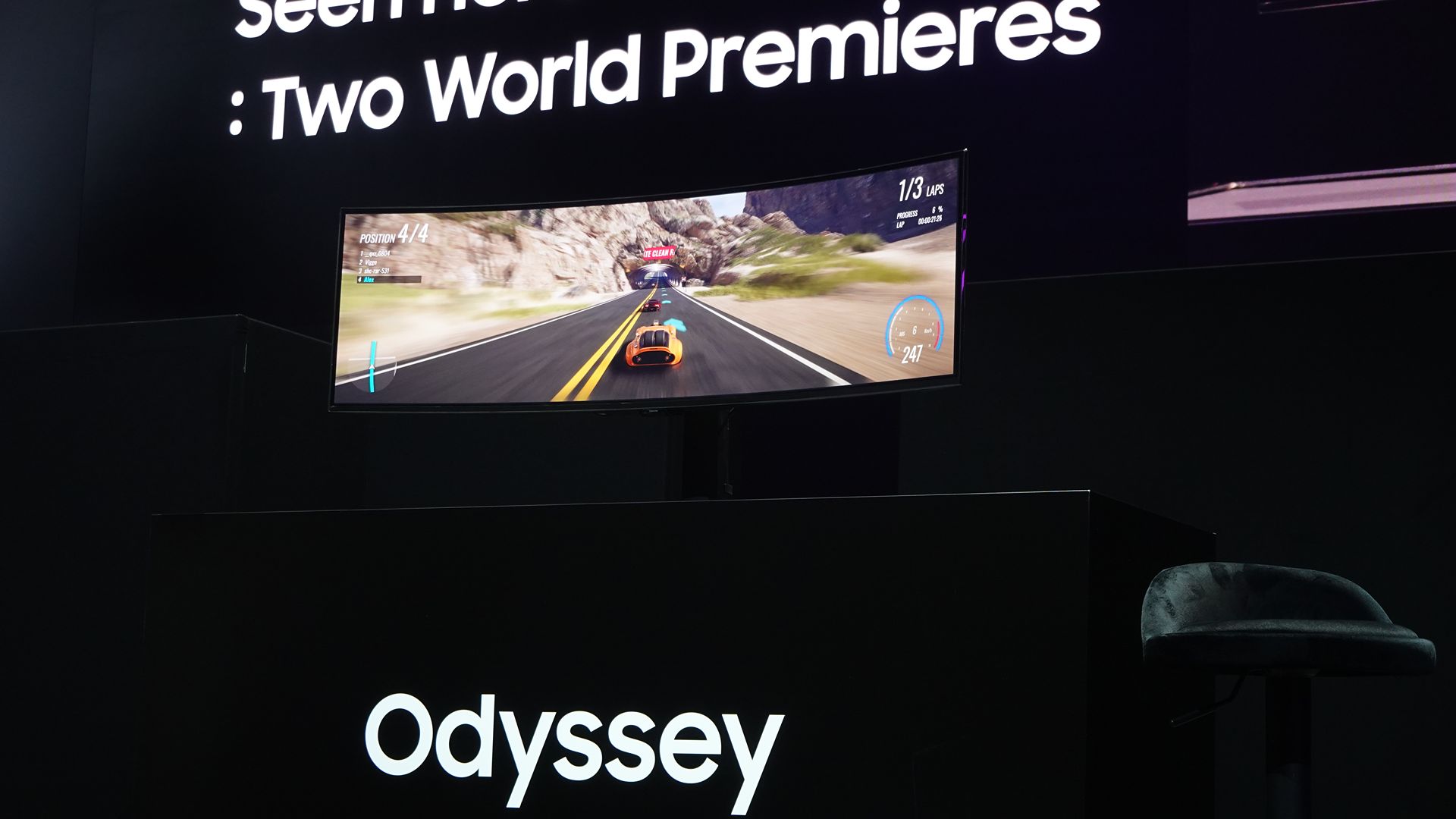
Likewise, he noted that the option for a 6K gaming screen offers a higher refresh rate than the professional screens on offer with the same resolution, which are stuck at 60Hz. Offering a higher refresh rate at that detail level aids both responsiveness for productivity tasks and helps where it counts for games, too.
After all, as both he and Demont noted, people are buying monitors for more than one purpose, so a 6K gaming screen covers off the pros who need the detail for high-res creative work and the gamers who have a beefy enough system to play games at 5K or 6K, assuming the game supports the resolution of course.
Glasses-free 3D is back – but content, not hardware, is the bottleneck
Samsung has kept glasses-free 3D alive longer than most of the industry, and at CES it showed a 6K, 32-inch glasses-free 3D panel. At Gamescom, it reaffirmed its commitment to glasses-free 3D and the importance of working with developers to keep the dream alive.
Distra's framing was that the previous failure wasn't really a hardware problem – it was a content problem. "People were mind-blown by the product capability, but it's the content" that lagged, he said.
Rather than pour more resources into pushing the panel technology further, Samsung's product teams have shifted focus toward securing AAA game support, headlined by the newly announced Cyberpunk 2077 3D compatibility. It's a bet that immersion sells itself to gamers specifically – people who already spend hours in front of a screen – in a way it never quite did for passive TV viewing.
Demont drew the TV parallel further, comparing it to Samsung's early, unpopular push into 4K resolution at a time when broadcasters barely had any programming in such high-resolution or the likes of the BBC had caught up: "We can't just do it by ourselves, we need the whole industry behind it."
He sees HDR10+ gaming following a similar adoption curve to HDR10+ on TV, where streaming giants like Prime Video and Netflix moved quickly once the ecosystem made it easy to support. Samsung's own numbers back that up: the new Call of Duty is among the titles confirmed to support HDR10+ gaming, with more than 20 games expected to carry the standard by the first half of 2027.

OLED burn-in isn't as big of an issue as it used to be
Samsung has introduced a new fifth-gen QD-OLED panel for a lot of the new monitors it announced at Gamescom, which features the brand's Penta Tandem tech and an RGB stripe sub-pixel layout for greater power efficiency, longevity, and sharper text.
Compared to the quality of OLED panels for gaming monitors when they were first introduced, this tech has been through several generations of optimization and improvement.
At the time OLED gaming monitors were first introduced, it seemed you couldn't go five minutes without someone talking about burn-in (an issue with early OLED panels where static images that were displayed for too long could damage the screen). Now, both Demont and Distra tell me it's virtually a non-issue. It's barely raised internally anymore, sitting towards the bottom of presentations as an improvement point.
Demont also noted that the improvements made to the OLED panels is a particularly good thing, especially because "if we can increase the product lifecycle or the durability of the product, that's all in the benefit of that end customer". After all, a high-end monitor or TV is a big purchase, and it's important that it lasts.
For what it's worth, my own two-and-a-half-year-old 32-inch 4K 240Hz OLED monitor has never shown a hint of burn-in – though the new Odyssey OLED G8 is, I'll admit, tempting me to upgrade anyway.
Pro feedback filters down for monitors, too
On the subject of product development, Distra confirmed Samsung takes direct input from eSports professionals – citing an ongoing relationship with a multiple-time League of Legends world champion in Korea, where the eSports scene is especially demanding. "Their team plus others are just continuously pushing back that feedback," he said.
The trickle-down effect is vital to this, according to Demont – Samsung's stated strategy is to introduce new technology at the top of the range first and cascade it downward over time, never the reverse – something he framed as core to protecting the end customer's investment in what remains a significant purchase.
Monitors and TVs are converging – deliberately
Perhaps the most interesting part of the conversation was Demont noting that Samsung is folding its monitor team into the same visual display division as TV in the UK, given the convergence between them. We're at a point where some desktop monitors are the same size as TVs; this also works the other way, as people can use TVs as monitors, either on a desk or with a living room PC.
He was upfront that this decision is about capturing overlap: customers can opt for an equally rich spec TV or monitor depending on their situation, and there is an overlap in certain features for a consistent experience whichever product you go for.
For instance, some of the brand's smaller-sized OLED TVs boast a 165Hz refresh rate, while there are specific variants of some of its gaming monitors that come with its Tizen OS smart TV operating system built-in.
I maintain Tizen's presence on monitors is one of the more underrated moves Samsung's made recently: a screen that's a smart TV in one moment and a 240Hz gaming monitor in the next, with Samsung's Gaming Hub meaning you don't need a console or PC to access cloud gaming services like Xbox and GeForce Now.
We all agreed that this remains a surprising niche, and Demont stated Samsung is trying to change this with its TVs through retail bundling with the likes of Argos and Currys in the UK by offering incentives such as free controllers or game vouchers tied to TV purchases, specifically to get people asking what "Gaming Hub" actually means.
The bigger picture
Both executives repeatedly came back to the idea that Samsung's scale is its advantage: a portfolio broad enough to cover a 49-inch ultrawide monitor, a portable outdoor TV, and a glasses-free 3D gaming panel simultaneously, developed with a genuinely global customer base in mind rather than any single region's habits.
Demont pointed to the brand's clever Movingstyle TV, originally designed with Southeast Asian markets in mind, that ended up selling worldwide once its appeal proved broader than expected.
Whether triple-mode refresh rates or glasses-free 3D end up following that same trajectory – from a niche flex to a more mainstream feature – is, by Samsung's own admission, still an open question the company is waiting for customers to answer for them.

Follow TechRadar on Google News and add us as a preferred source to get our expert news, reviews, and opinion in your feeds.
Reece Bithrey is a freelance journalist with credits in Trusted Reviews, Digital Foundry, PC Gamer, TechRadar, PCGamesN, and Custom PC magazine reviewing all sorts of computing gubbins, including keyboards, mice, laptops, and more. He also has his own blog, UNTITLED, has bylines for WatchGecko's online magazine, and graduated from the University of Leeds with a degree in International History and Politics in 2023. When not writing, you'll usually find him bellowing at virtual footballers on Football Manager or tinkering with mechanical keyboards.
What's Your Reaction?
 Like
0
Like
0
 Dislike
0
Dislike
0
 Love
0
Love
0
 Funny
0
Funny
0
 Wow
0
Wow
0
 Sad
0
Sad
0
 Angry
0
Angry
0












Comments (0)