

‘One Night Only’ Review: Fascism Gets Off Easy in This Flirty Humiliation Ritual for Will Gluck Fans
Travis Braun’s original “One Night Only” screenplay is available to read for free online, and the opening to that truly fascinating 2024 Black List script spells out its strange premise plainly.
“In the near future, premarital sex has been outlawed in the United States.” New page.
“Except for one night a year.” Oh, my.
Of course, Will Gluck‘s glossy new film adaptation for Universal Pictures takes that idea one step further, adding yet another cutesy slate to an already very 2026 intro that reads: “Yeah, it’s been a lot.”
Foregrounding the audience’s lived reality before its fictional love story can even begin, that meta wink feels unmistakably like Gluck’s work. Fresh off turning “Anyone But You” into an astonishing box office hit, he’s also the writer/director behind “Easy A,” a beloved 2010 riff on “The Scarlet Letter” in which Emma Stone’s clever teen heroine reframes her sexual notoriety through a series of webcam videos.


But neither the feisty spirit of Olive Penderghast nor the tragic legacy of Hester Prynne can be found anywhere near Gluck’s baffling interpretation of Braun’s once-promising tale. Slightly more fun than its calamitous press cycle suggests, “One Night Only” is still a deeply unsettling misfire for the rom-com veteran that may bode badly for the genre overall. Sometimes funny but consistently uncanny, it feels like a filmmaker going through the motions of romance long after he stopped caring about real love.
 ‘One Night Only’©Universal/Courtesy Everett Collection
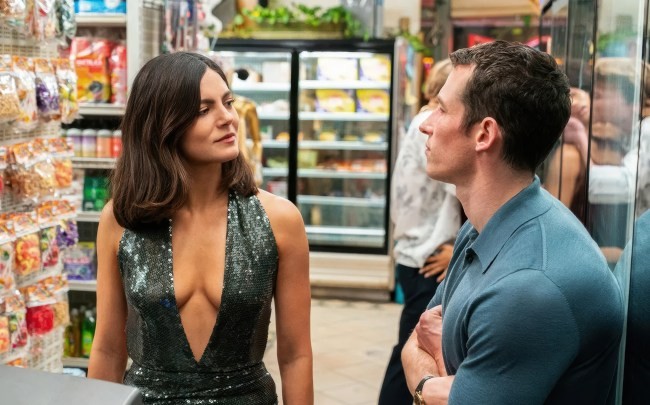
Three years after the United States outlaws premarital sex, one annual exception allows unmarried citizens to hook up without fear of arrest. Allie (Monica Barbaro), a jingle singer for infomercials, intends to take full advantage — while Owen (Callum Turner), a pizza shop owner whose strained relationship with his girlfriend (Maya Hawke) has reached its breaking point, isn’t nearly so eager.
It’s a terrific hook for a meet-cute: one part high-concept farce, one part dystopian satire, with a built-in ticking clock and temptingly obvious questions about what forbidden sex actually looks like under creeping authoritarianism. And Allie and Owen’s star-crossed meeting works well enough… until the visibly anxious leading man vomits sushi on the street, instantly resetting their chemistry to zero.
From there, “One Night Only” settles into the loose outline of a slow-burn friends-to-lovers spoof. That could make for a great afternoon at the movies, but Gluck either won’t — or can’t — explain why these two people he and Braun created are uniquely right for each other. The tale of a hero finding “the one” should reveal something about who they are, and both Allie and Owen are frustratingly generic.
Broadly speaking, Gluck had earned more benefit of the doubt than most directors attempting a big-budget romance today. Still, he delivers a movie so spectacularly incurious about its own intricacies that even its most forgivable shortcomings have an unpleasant habit of seeming smug. In that sense, the critical query here isn’t whether “One Night Only” understands contemporary politics — but if Gluck understands why rom-com appreciators fell for his perspective in the first place.
Even across his two “Peter Rabbit” outings, Gluck has always enjoyed reminding audiences that his movies know they’re movies. At its best, that instinct lends his comedies a shaggy warmth and a conspiratorial mood that suggests the filmmaker, character, and even viewers are all surviving the humiliation of modern intimacy together. With “One Night Only,” that instinct curdles into a false gesture — toward reproductive oppression, queer erasure, consumerism, incel culture, and the emotional paralysis of young people — without meaningfully engaging with any of it.
 ‘One Night Only’©Universal/Courtesy Everett Collection
Recognizing those forces in the world isn’t the same thing as interrogating them, and as a seasoned artist with real power in Hollywood, Gluck repeatedly mistakes implication for insight.
So, for her part, Barbaro supplies Allie the illusion of depth through sheer charisma, and the film is funniest when it lets the actress embody a chaotic yearning that’s fully absurd. Whether Barbaro is performing a suspiciously catchy pharmaceutical jingle about plaque psoriasis, or fleeing police half-naked across a rooftop while hiding a condom in her mouth, the few true-blue sex comedy sequences we get here briefly recover Gluck’s gift for turning attractive movie stars into fearless comedians.
The director leaves Turner, on the other hand, mostly stranded in a forgettable role that never makes Owen compelling beyond his availability. By the end, he looks less like a romantic lead than the human equivalent of pizza — primarily occupying the frame as proof that any option is a good option if it’s also your last resort.
That scarcity mindset extends well beyond the romance, as the film’s various supporting characters broadly accept corporate manipulation and government overreach as unavoidable conditions of life. They don’t dream of changing the system and barely seem capable of imagining one that functions differently, which marks a fundamental departure from the arc in Braun’s screenplay.
Without spoiling Gluck’s revised ending, Braun’s version at least understood that choosing someone because society insists your time is running out is a terrific way to trap yourself in a miserable future. Its protagonists don’t overthrow their presumably authoritarian leaders, but the ending at least suggests they could someday. Gluck’s version, however, seems content watching a broken system stay that way.
That’s an astonishingly passive instinct for the “Easy A” filmmaker. Olive Penderghast didn’t merely survive the drama Gluck imposed on her; she hijacked it by staging a protest in the middle of a basketball game and ultimately seizing control of her own narrative. By contrast, Allie and Owen spend nearly all of “One Night Only” obeying the law. They encounter so-called criminals as often as police, and yet neither the emotional consequences of loneliness nor the legal ramifications at work seem real.
What’s worse, the countdown clock that gave Braun’s screenplay its propulsive feel becomes almost meaningless onscreen. There’s no mounting panic, no erotic urgency, and no persuasive reason these two characters must sleep together before sunrise in a New Year’s Eve-like framing. Without that tension, “One Night Only” struggles to answer a more commercially pressing question: Why should audiences buy tickets to watch these people fall in love? And under such unpleasant circumstances, too!
 ‘One Night Only’©Universal/Courtesy Everett Collection
Gluck never quite figures that out, and the film’s approach to its few queer characters proves even more discouraging. Mandate Night is explicitly described as a holiday culturally “for” straight people because LGBTQ people have long been forced to conceal their relationships by law. That premise creates an obvious opportunity to explore how oppression is normalized differently across communities. But instead, Allie’s Black roommate (Quintessa Swindell) appears only to register as a lesbian visually… before eventually exiting the plot and babysitting the child next door.
Similarly, King Princess arrives as one of Allie’s friends. She’s a “straight hoochie mama,” as the pop star put it in a recent interview, who meets her dream man while waiting for the bathroom on Mandate Night. Casting a queer icon with such a specific relationship to young audiences reads like an intentional choice that will pay off. But it never does, and the character disappears into a pile of potential left unexplored.
The issue is not simply that “One Night Only” is insufficiently progressive. Gluck has openly described himself as a “liberal” filmmaker, and nothing here suggests an obviously concealed right-wing agenda. That said, the more dispiriting possibility is that Gluck as a creator has gradually become too insulated from the industry’s rougher edges to recognize that his work makes an impact regardless of his intentions.
Gluck’s earlier films, particularly “Friends with Benefits,” displayed a sharp understanding of entertainment, advertising, and the overlapping social economies of Los Angeles and New York. But “One Night Only” resembles the ethos of someone so comfortable inside that machinery that passive identification has replaced observation. Product placement abounds even as the film vaguely satirizes the commodification of dating. During one emotional scene, Owen arrives carrying two conspicuously framed Dunkin’ coffees and the line between satire and sponsorship becomes impossible to find.
None of that makes “One Night Only” dangerous to real American society. If anything, the film is more embarrassing than incendiary, and its unexamined message — that privileged, straight people can still fall in love under fascism — is, technically, true. But building an entire romance around that premise demands considerably more compassion and intellectual ambition than Gluck offers Braun’s material.
That’s a shame for everyone involved, audiences especially. The theatrical romantic comedy has spent years trying to prove it still belongs on the big screen, and “One Night Only” is arriving at the exact moment a generation is renegotiating what intimacy even looks like under mounting political pressure.
Barbaro (who has an Oscar nomination, mind you!) might’ve been able to do something real if the project had a director more committed to understanding the challenge he assigned her. And ultimately, the deepest disappointment comes from realizing that one of modern studio comedy’s sharpest romantic observers has confused awareness for insight, and in the process, left his most devoted fans behind.
Grade: C-
From Universal Pictures, “One Night Only” is in theaters on August 7.
Want to stay up to date on IndieWire’s film reviews and critical thoughts? Subscribe here to our newly launched newsletter, In Review by David Ehrlich, in which our Chief Film Critic and Head Reviews Editor rounds up the best new reviews and streaming picks along with some exclusive musings — all only available to subscribers.
What's Your Reaction?
 Like
0
Like
0
 Dislike
0
Dislike
0
 Love
0
Love
0
 Funny
0
Funny
0
 Wow
0
Wow
0
 Sad
0
Sad
0
 Angry
0
Angry
0











Comments (0)