

Prehistoric builders transported Devil's Arrows 11 miles
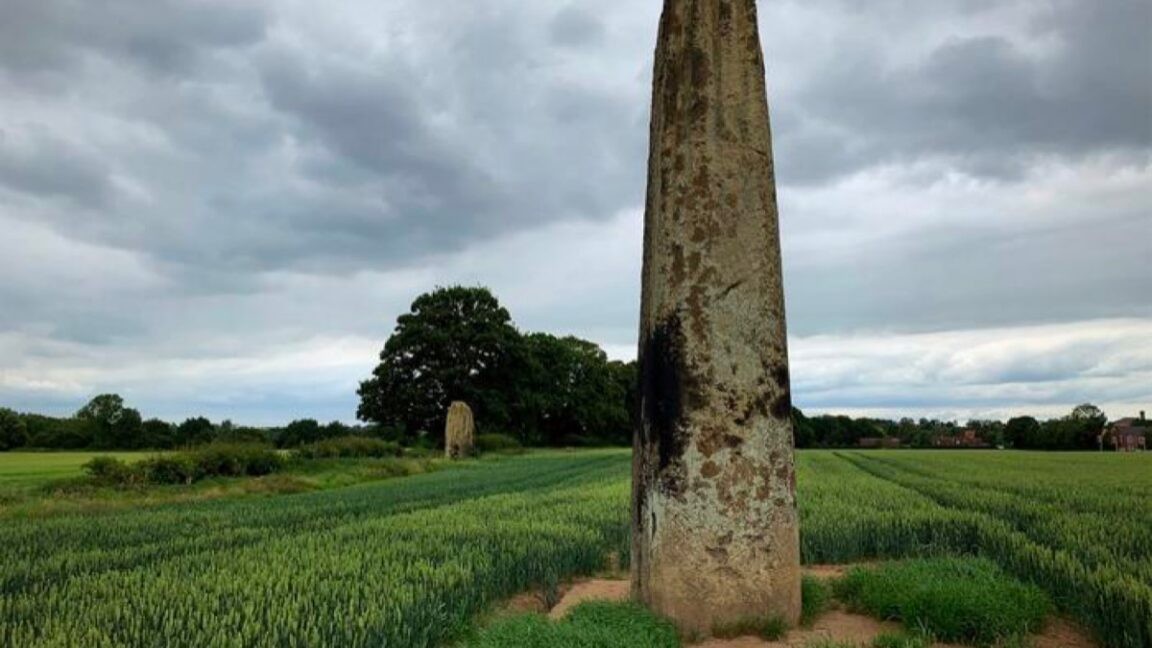
Clarke et al. took samples from all three Devil’s Arrows stones, as well as from the Battle Cross monument and Peg Bridge, using small sections of adhesive tape applied to inconspicuous areas of the stones free of lichens or mosses. Grain samples stuck to the tape and were later removed by dissolving the tape glue with mineral turpentine. They removed coarse magnetic materials and light minerals like quartz and feldspars, and imaged what remained in the samples using field emission scanning electron microscopy. They also performed an isotopic analysis of zircon and apatite minerals to get an age “fingerprint” in order to match the stones to their likely source.
The Devil’s Arrows are made of a coarse-grained sandstone. Plumpton Rocks, which is closer to the Devil’s Arrows, had previously been identified as the probable source of the stones. Based on their analysis, Clarke and his team concluded that the most likely source is actually Brimham Rocks, meaning the stones were transported by prehistoric builders significantly farther than originally thought. Regional ice-flow reconstructions ruled out a possible glacial transport mechanism for the stones.
“Our research shows these stones weren’t simply taken from the nearest available source—they were deliberately chosen from a challenging landscape 18 kilometers away,” said Clarke. “Moving them would have required incredible planning, coordination, and engineering skill. This tells us prehistoric people placed real importance on the landscape itself. It wasn’t just about convenience—the location the stones came from likely held meaning for them.”
Their results also confirmed that the Battle Cross monument is composed of one of the missing Devil’s Arrows stones.
“Reuse does not erase meaning,” the authors concluded. “Rather, it adds further episodes to the stone’s biography. A monolith may begin as bedrock, become a selected and transported prehistoric object, acquire significance within a megalithic setting, and later be reimagined as building stone, bridge fabric, a crossing marker, or part of a Christianized or civic landscape. Each phase modifies the interpretive frame. The object is not a static remnant of a single past, but a material witness to repeated acts of human engagement.”
Proceedings of the Royal Society A Mathematical, Physical and Engineering Sciences, 2026. DOI: 10.1098/rspa.2026.0504 (About DOIs).
What's Your Reaction?
 Like
0
Like
0
 Dislike
0
Dislike
0
 Love
0
Love
0
 Funny
0
Funny
0
 Wow
0
Wow
0
 Sad
0
Sad
0
 Angry
0
Angry
0












Comments (0)