

Rare Arctic Bobtail Squid Filmed in Its Natural Habitat for the First Time
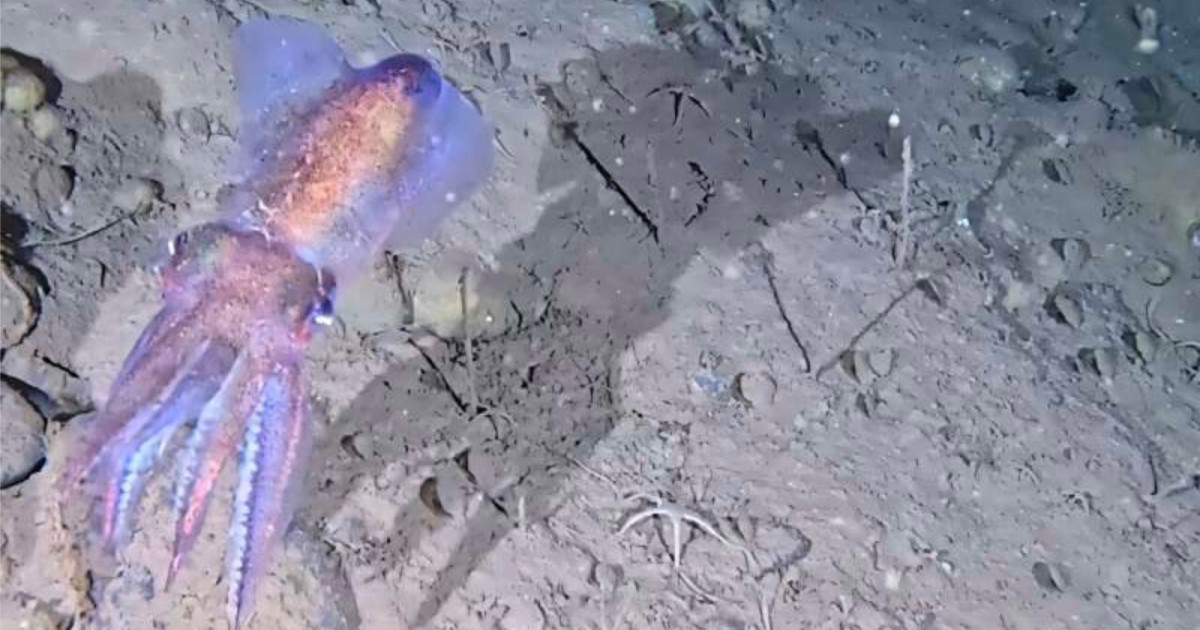
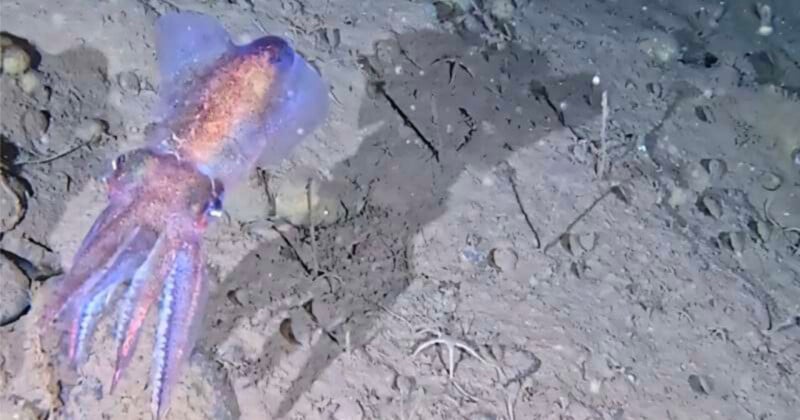 Arctic bobtail squid seen in its deep-sea habitat for the first time, with its eggs visible in the final moments of the footage captured. | Image by University of Western Australia
Scientists have filmed the Arctic bobtail squid in its natural subzero habitat for the first time, including the rare discovery of a mature female tending to its eggs.
In a world-first, researchers, from the University of Western Australia’s School of Biological Sciences, observed the Arctic bobtail squid in the North Atlantic Ocean, which is one of the most extreme environments on earth.
The research team’s discovery included a mature female bobtail squid and multiple egg masses, providing direct evidence of active cephalopod reproduction in the remote, sub-zero Arctic fjord system.
“The squid and eggs were recorded at a depth of 50 meters in water around −1.6 °C, which highlights the resilience of marine life in one of Earth’s most extreme environments,” Dr Paige Maroni, lead author of the study published in Polar Biology, says in a statement.
According to a report from BBC Wildlife Magazine, researchers deployed underwater robots known as remotely operated vehicles (ROVs), along with baited remote underwater video systems (BRUVs), to explore these extreme habitats and investigate the health of their fragile ecosystems.
BBC Wildlife Magazine reports that the team sent an ROV fitted with a GoPro camera into the freezing waters, where temperatures fell from 6.7°C at the surface to -1.6°C at a depth of 164 feet (50 meters). During the dive, the scientists made a remarkable discovery: a mature female Arctic bobtail squid resting alongside three clusters of eggs attached to a hard surface — marking the first time the species had ever been observed in its natural environment.
Cephalopods such as squid and octopus are sensitive to environmental change and play important roles in the ecosystem as both predators and prey, according to the researchers.
“Northeast Greenland National Park is the largest national park on Earth but one of the least biologically documented marine regions in the Arctic,” the study’s lead author Paige Maroni, a deep-sea biologist at the University of Western Australia’s School of Biological Sciences, says in a statement.
“Establishing knowledge of the biodiversity in this region is crucial for understanding ecosystem function and resilience under accelerating climate change,” Dr Maroni adds. “This study provides a valuable new baseline for tracking ecological change in the rapidly warming Arctic.”
PetaPixel articles may include affiliate links; if you buy something through such a link, PetaPixel may earn a commission.
Love PetaPixel? Go Premium.
PetaPixel is the world’s largest independent photography publication and we’re only able to continue our work with your help. Become a PetaPixel Member now and support our mission to bring you regular, high-quality reviews, features, news, and more.
- Remove banner ads
- Gain access to full-resolution RAW and JPEG Sample Galleries
- Get 5% off orders from KEH.com
- Get a $15 coupon to spend at Moment
- Get 10% off lighting equipment from FJ Westcott
- Get 10% off film development, scanning, and printing from Blue Moon Camera and Machine
What's Your Reaction?
 Like
0
Like
0
 Dislike
0
Dislike
0
 Love
0
Love
0
 Funny
0
Funny
0
 Wow
0
Wow
0
 Sad
0
Sad
0
 Angry
0
Angry
0









Comments (0)