

Roborock Q7 M5+ review: A capable budget robot vacuum that nails the fundamentals
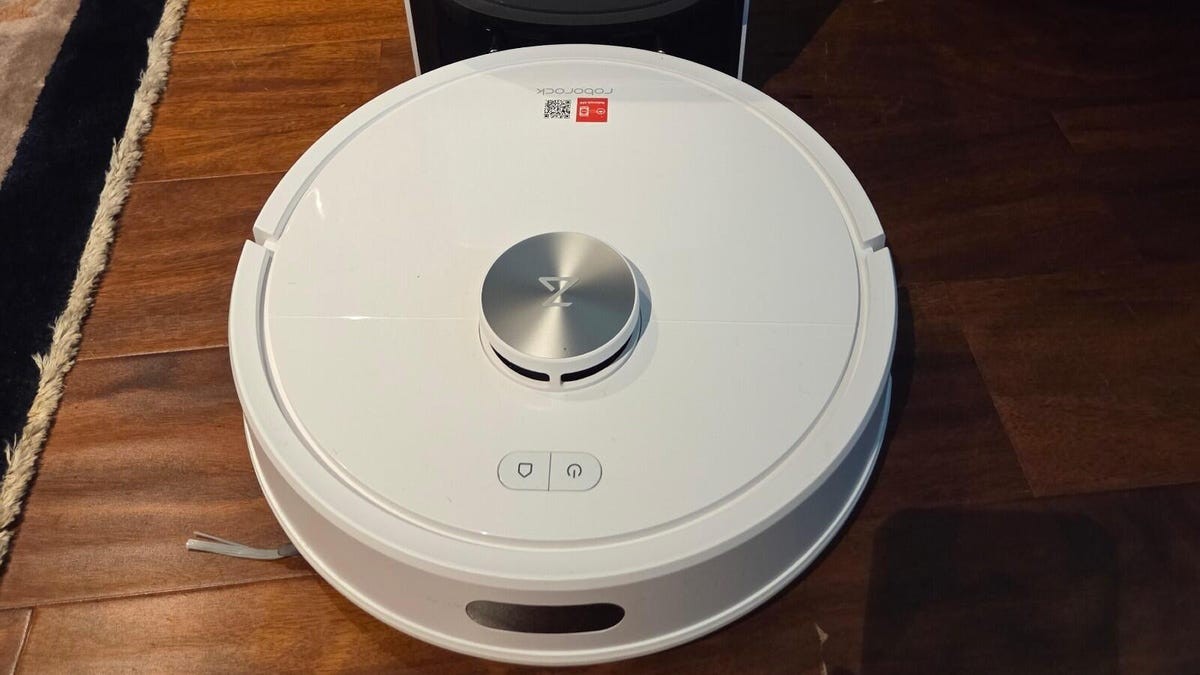

pros and cons
Pros
- Auto-emptying dock.
- Great for pet hair.
- Strong 10,000Pa suction.
Cons
- No camera or AI-powered obstacle avoidance.
- Basic mopping capabilities.
- Dust bags are a permanent cost.
Follow ZDNET: Add us as a preferred source on Google.
I've wanted a robot vacuum since I saw Rosie the Robot on The Jetsons. I'm still waiting for Rosie, but I've been using robot vacuums since the first iRobot Roomba rolled out in 2002. However, I haven't been crazy about them for the last few years; they seem to be getting more expensive and more prone to acting up.
However, I recently found one I like at a reasonable price: the Roborock Q7 M5+. It's an uncomplicated robot vacuum in the best and worst senses of that phrase.
Also: We compared 10 robot vacuums for sand pickup - and one model was the clear favorite
For example, it doesn't promise the fully autonomous floor-care experience offered by high-end robot vacuums as there is no self-cleaning mop station, no spinning mop pads, and no system designed to recognize every charging cable, sock, or pet-related surprise on the floor. Instead, Roborock focuses on the basic (and more important) factors: good suction, excellent pet-hair handling, and easy routine maintenance.
Best robot vacuum deals of the week
Deals are selected by the CNET Group commerce team, and may be unrelated to this article.
The Q7 M5+ combines LiDAR-based mapping with a claimed 10,000Pa of HyperForce suction and an auto-empty dock with a 2.7-liter bag rated for up to seven weeks of dust and debris.
That specification is more meaningful than it may sound. Robot vacuums are useful when they run often, and they run often only when you do not have to rescue them from poorly set out maps or empty a tiny onboard bin every day. The Q7 M5+ addresses both of those friction points.
Basic cleaning done well
For me, the vacuum's ability to handle pet hair shedding is the biggest win. With three cats, two dogs, and Telly the Pomeranian/Shih Tzu mix (who contributes more fur than the other animals combined) I need all the help I can get.
Also: 7 simple gadgets that can make your home smarter for under $100
The vacuum's dual anti-tangle system uses a main brush and side brush intended to limit hair wrapping. That's an important feature because tangled brushes undermine pickup performance and turn supposedly automated cleaning into another recurring chore. That capability alone puts it ahead of the Roombas I've used over the years.
Behind that innocent face is an insane amount of fur ready to shed at a moment's notice.
I eat too many crackers for my own good, and when the dogs don't get to them first, I can end up with a mess, complete with crumbs that call for a vacuum.
Roborock's LiDAR navigation is another practical advantage. It creates room maps and supports targeted room cleaning, scheduling, no-go zones, and virtual walls through the Roborock app. That means you can send it through high-traffic spaces daily while reserving less-used rooms for a separate schedule.
Also: We lab-tested Ecovac's next-gen robot mop - here's where it shines (and struggles)
The self-emptying dock is also important. Rather than being a deluxe feature, it changes the ownership experience. The robot can return after a cleaning cycle, empty debris into the dock's bag, and remain ready for the next scheduled run. Roborock says the bag can support up to seven weeks of hands-free emptying, but that estimate will vary depending on your carpeting, pets, and home size.
I'm on week three of my unit cleaning my 1,000-square-foot office, home theater, and my wife's studio four times a week, and the bag is just over half full. That's a big win in my book.
Where it falls short
Roborock says this unit is both a vacuum and a mop. That's sort of true. The Q7 M5+ uses a mopping pad and a water tank with adjustable water flow. The device does not scrub floors with rotating pads, lift its mop over rugs, or wash and dry the pad in the dock. It's doable for a light maintenance pass on hard floors, but won't replace a proper mop or compete with premium combination robots on dried-on drink spills or unfortunate dog stains.
Also: I bought cheap smoke detectors and soon regretted it - here's what I recommend now
Also, while the dock empties vacuum dust, it doesn't automate mop care. If you use the mopping attachment regularly, you will need to remove and rinse the pad, refill the water tank, and allow the pad to dry between runs. For me, the mop function does too little with too much trouble to be all that useful.
The Roborock Q7 M5+ is up to the job.
Object avoidance is another trade-off. LiDAR helps the Q7 M5+ navigate rooms and avoid fixed obstacles, but it is not the same as sophisticated visual or AI-based recognition. Before running the vacuum, you should clear cords, clothing, delicate objects, and anything a robot could drag, snag, or spread around the room.
I will add, however, that in my office, with its 14 PCs and power cords and Ethernet cables everywhere, the Roborock did a remarkable job of avoiding getting tangled in all the wiring.
ZDNET's buying advice
The Q7 M5+ is worth buying as a budget or midrange robot vacuum when what you really need is dependable, autonomous vacuuming rather than mopping. The device is especially compelling for pet-owning homes with a mix of hard floors and carpets, which describes my space to a T.
While the Roborock Q7 M5+ has a $359 list price, recent sale pricing has it as low as $237 (about $122.50 off), while other recent listings show around $279. I'd still buy the vacuum at full price, but you likely won't need to.
Also: What the FCC ban on foreign-made robot vacuums means for your Roomba
That said, you can skip the purchase if your priority is hands-off mopping, robust obstacle recognition, or a robot that can safely operate in an unpredictable household without pre-cleaning. In that situation, paying more for a model with active mop washing, drying, and object recognition, like the Eufy Omni S2 or the Narwal Flow 2, is the better, albeit far more expensive, solution.
What's Your Reaction?
 Like
0
Like
0
 Dislike
0
Dislike
0
 Love
0
Love
0
 Funny
0
Funny
0
 Wow
0
Wow
0
 Sad
0
Sad
0
 Angry
0
Angry
0










Comments (0)