

Saudi Arabia wants a car industry, launches Ceer with two EVs
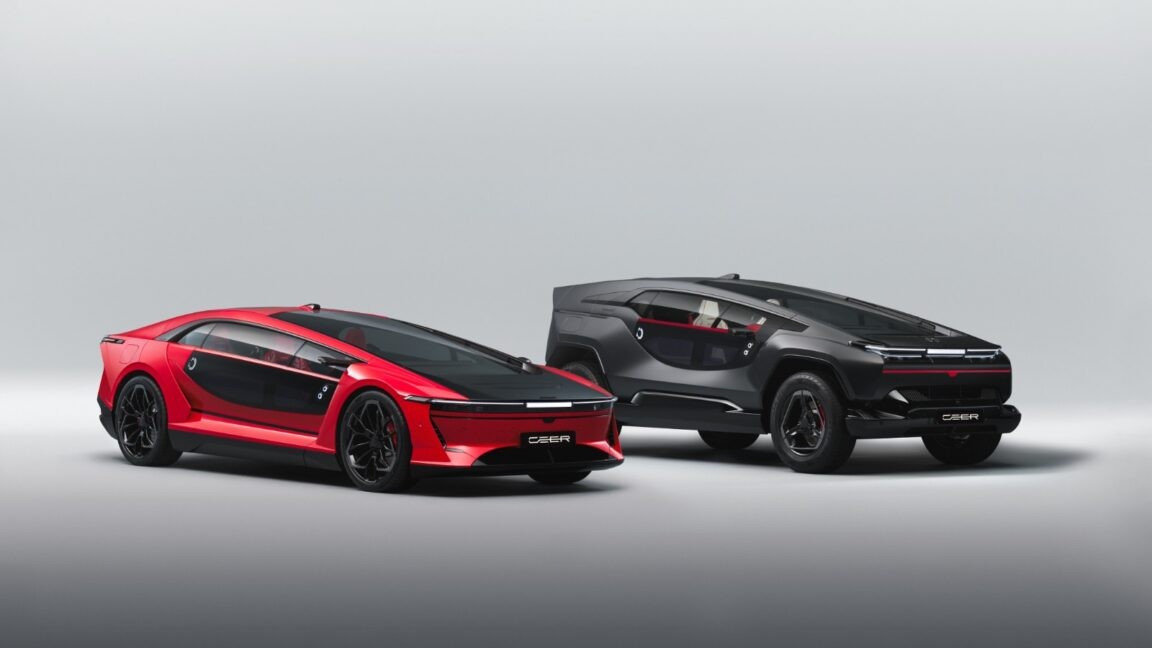
The new carmaker is a joint venture between the Saudi PIF and Foxconn.
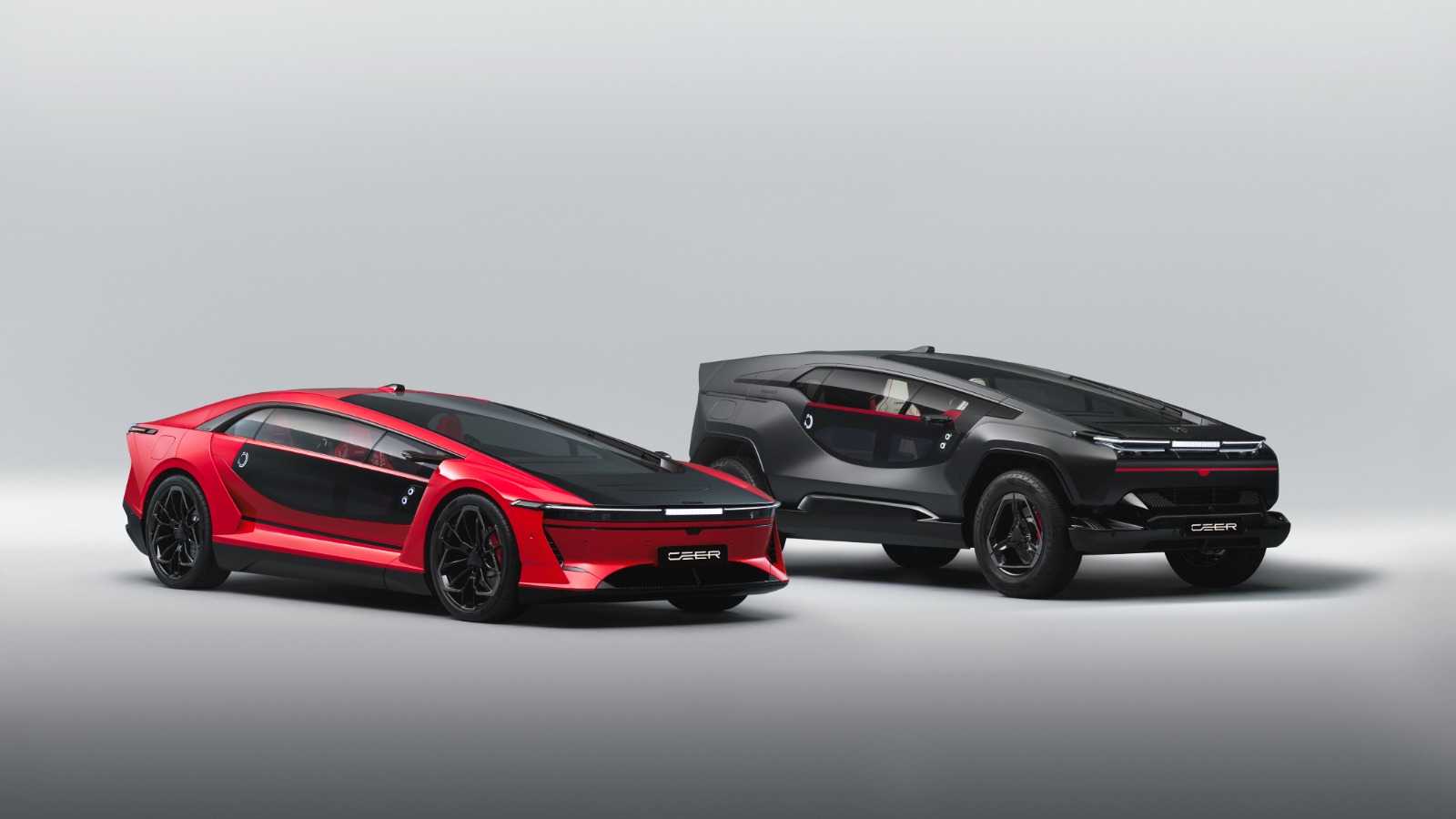
The Ceer Exobot sedan and SUV. Credit: Ceer
The Ceer Exobot sedan and SUV. Credit: Ceer
KING ABDULLAH ECONOMIC CITY, Saudi Arabia—It may come as a surprise to some, but Saudi Arabia has never had a domestic automaker. That changes with Ceer. A joint venture between the country’s Public Investment Fund and Foxconn, it’s the Kingdom’s first home-grown automaker and a significant part of Saudi Arabia’s Vision 2030 plan to diversify its economy away from oil production and bring technological innovation locally by the end of the decade.
Ceer in Arabic means to “drive forward,” and this forward-looking approach applies to the vehicle lineup. The flagship vehicles you see here—the Exobot sedan and SUV—are demonstrations of what the company is capable of and the vision it sees for future vehicles in the portfolio.
It plans to have seven new cars in its portfolio by 2030—some of which will be hybrids—and while that doesn’t currently include sales outside the GCC (Gulf Cooperation Council) region, Ceer says it’s building a competitive, world-class product and that if the demand is there, expansion is possible.
A flagship shouldn’t be boring, and Ceer met that brief. Both SUV and sedan would look at home in Westworld. The SUV had something familiar about it, and Ars auto editor Jonathan Gitlin said it reminded him of the Isuzu VehiCross. Maybe this is a modern-day interpretation of that vehicle? After seeing the SUV in person, I can tell you I can’t unsee that reference.
The Exobot sedan. Chad Kirchner
Both vehicles have falcon doors, called a Shahin Wing here, to get in and out of the vehicle. The doors add to the drama befitting a flagship for a startup automaker and will certainly draw attention out on Saudi roads. The doors don’t open wider than a standard car door, so it shouldn’t be much of a challenge in a tight parking lot. As long as the roof isn’t too low, presumably.
Not having a B-pillar makes access to the second row much easier, but I’d be surprised if those doors appear on any of the future cars the company is planning to build. The region’s extreme climate will certainly put the engineering of the doors to the test.
Push-button for more visibility
One unique feature of the doors is built into the glass. The lower portions of the door feature electrochromatic glass that can be dimmed at the press of a button. Especially useful in the SUV: If the driver needs more side visibility, the lower part of the door becomes clear at the push of a button.
During the reveal presentation, Ceer CEO James Deluca mentioned that during an early briefing on design, the Crown Prince inspired the team to look at what is already out there and take a different path. “If the world goes left, we go right,” he quoted the Crown Prince as saying.
Other design details call out Ceer’s national heritage. Both models have 32 independent elements in the front and rear light bar. Thirty-two, because 1932 was the year the Kingdom of Saudi Arabia was established.
Inside, a 48-inch digital instrument cluster stretches across the entire dashboard, running a custom infotainment system that is inspired by the Riyadh skyline. To help deal with the extreme climate of the Kingdom, there’s a new cooling mode for the cabin that creates a cool air barrier between the roof and the glass and the passengers’ heads that the company calls Halo cooling.
A 10-inch center cluster handles media controls, and there’s an 8-inch screen for rear passengers. Ceer believes in bringing your own device, and the vehicle should be able to integrate with a mobile phone. In an interview with Ars Technica, Chief Technology Officer Markus Leitner confirmed that Apple CarPlay and Android Auto will be available at launch. The infotainment system is unique Ceer intellectual property co-developed with Foxconn and the other partners. Of course, over-the-air updates will be available that can improve any aspect of the vehicle, including performance and range.
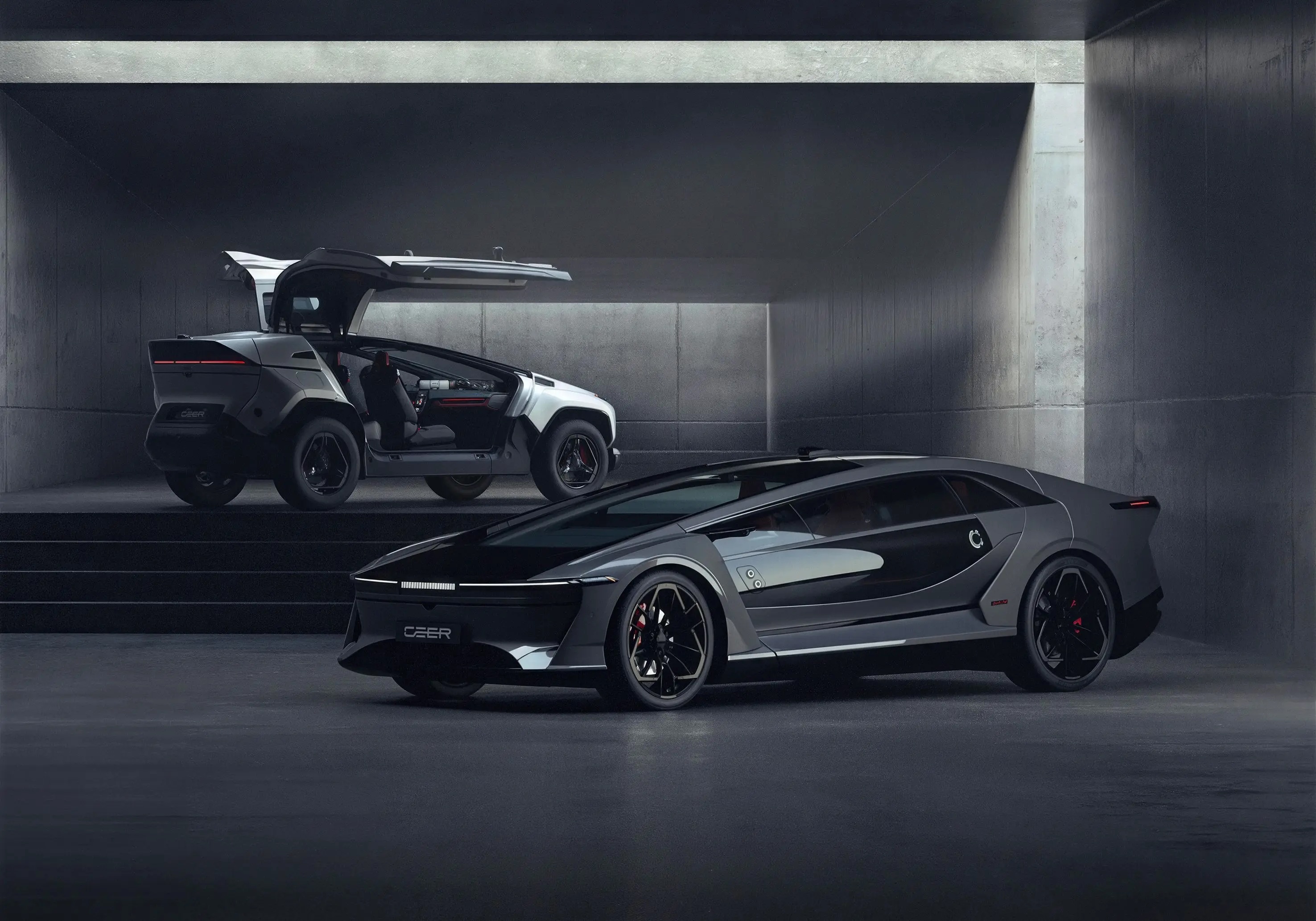
Doors add to the spectacle.
Credit: Ceer
Doors add to the spectacle. Credit: Ceer
Despite all of the touchscreens and technology, Ceer is emphasizing physical controls where it makes sense. The gear selector is on the column, like on a Mercedes, or all manner of machines from Detroit. There are physical buttons for changing the climate control and adjusting the volume. It’s almost like the executives at Ceer are paying attention to our complaints.
The launch model Exobots will have a 112-kWh battery pack with over 310 miles (500 km) of range for the SUV, and at least 373 miles (600 km) for the sedan under the New European Driving Cycle (ironically an old standard that has since been replaced by WLTP in Europe). In the real world, 300–400 miles seems like a reasonable expectation, which would put it on par with the latest BMW and Mercedes platforms.
Performance is the main goal of these vehicles, and with 1,111 hp (828 kW) and 1,100 lb-ft (1,500 nM) of torque, the Exobot should be able to hit 62 mph (100 km/h) in a hair over 2 seconds for the sedan, and 2.4 seconds for the SUV, with the standing-quarter dispatched in 10 seconds.
A tri-motor setup with torque vectoring has been chosen to deliver the power to the wheels to reach those numbers. Available air suspension should smooth out any of the rough terrain.
The vehicles will use an 800 V electric architecture, and the company is quoting a DC fast-charging time of around 30 minutes to 80 percent. Based on the size of the battery pack, that’s on par with what we’ve experienced from vehicles like the Kia EV9 and the Hyundai Ioniq 9.
The 800 V system also powers the vehicle’s steer-by-wire system. Does that mean it’s getting a yoke? Yes. But from my experience in the Lexus RZ with a similar setup, I appreciated the sharper steering and more precise control that comes with the setup, even if it took a little getting used to. I didn’t care for the yoke itself, and I can’t see the one in the Exobot winning me over, but it can be done pretty well if done properly. The Tesla Cybertruck is a good example of when it’s done poorly.
What is clear is that Ceer from the start developed these vehicles to be quickly homologated for global markets, including Europe and maybe even North America. That’s no guarantee, but it does mean it’s fair to compare these vehicles to the best of what the rest of the world is doing regarding EVs. To that end, I asked Leitner what he thought makes Ceer stand out.
“Everyone has triple motors,” Leitner said. “Everyone has torque vectoring. Everyone has air suspension. What we do better than anyone else is integrate that all together to provide the best driving experience.”
Ceer models will be built at a dedicated complex in the King Abdullah Economic City just north of Jeddah, and suppliers will also be stationed nearby. If all goes to plan, Ceer expects 35,000 direct and indirect jobs to be created by 2034.
Will this be successful or will it be the next Fisker?
With the direct backing of Saudi Arabia’s Public Investment Fund, the financial resources are certainly available for success. Unlike Lucid, the PIF is the owner of Ceer and not just an investor, for one thing.
And the state wants to use its investment to create jobs locally, and not just at Ceer. In the United States, for every one automotive job, there are five additional jobs created in the local economy, when you factor in the suppliers and related support systems needed to run a car company.
Deluca spent a lot of time at General Motors in manufacturing, so he knows how to build cars, and much of the leadership team has experience with GM, Magna Steyer, or other deeply established legacy automakers. Deluca also spent time at VinFast, and while it may not have taken off in the United States, that company’s startup, building gas cars, and then pivoting to EVs happened lightning-quick. To hit the lineup targets, a similar approach will be needed here.
Ultimately, the success will depend on how Saudi car buyers take to the products. The company admits these two products are aspirational, as they are an entirely new industry for the country. But what will matter is the upcoming more mainstream models, their affordability, and how well they compare to the offerings already on sale in Saudi Arabia, which are Chinese brands.
One additional factor to consider is that, as part of the Vision 2030 plan, Saudi Arabia is encouraging products to be made locally for the domestic market. This manifests in a “Saudi Made” branding initiative. Many products, including the Coke Zero I’m drinking while writing this story, carry a logo and a Saudi Made badge. When it comes to Ceer, the country will have a completely home-grown alternative to the established automotive brands, including even Lucid, that they’ll be able to buy from that will directly support local manufacturing and the economy.
If this sounds a bit familiar, it’s something that GM, Ford, and the North American arm of Stellantis spend a lot of time emphasizing. While Americans have had a local automaker for nearly as long as the automobile has existed, this is a new experience for Saudis. Ceer is more than just a car, but a point of pride for the Kingdom. While I can’t say for sure if Ceer will be successful, they do seem to have the basics figured out.
What's Your Reaction?
 Like
0
Like
0
 Dislike
0
Dislike
0
 Love
0
Love
0
 Funny
0
Funny
0
 Wow
0
Wow
0
 Sad
0
Sad
0
 Angry
0
Angry
0







Comments (0)