

Sigma FP2: everything is better for the second-gen modular mirrorless camera
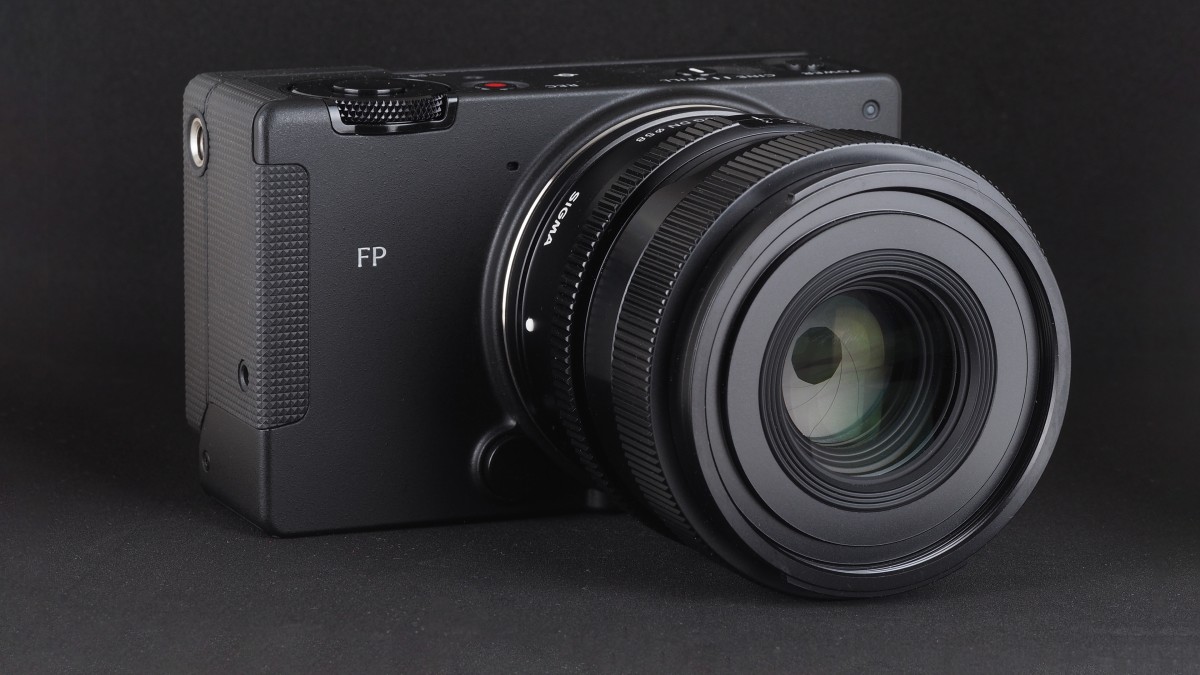
A similar exterior belies the amount that’s changed in Sigma’s latest modular stills/video full-framer
 DPReview
The Sigma FP2 is the company’s second-generation ultra-compact full-frame mirrorless camera, and one that brings substantial improvements over the original. It’s also the world’s smallest full-frame interchangable lens camera.
Sigma talks about preserving all the things that made the original fp special, but trying to improve every aspect. Specifically, a camera that’s designed to be as small as possible, with an equal weight given to stills and video so that it can adapt to either.
Key specifications
- 24MP partially stacked CMOS sensor
- Up to 20fps stills
- Video up to 6K open gate, including ProRes RAW output to SSD
- Two USB-C sockets
- Full-sized HDMI port
- Tilt up/down 3.2″ 2.1M dot rear LCD
- Optional 5.76M dot electronic viewfinder
- Optional OM System/Panasonic compatible hotshoe
- 70GB internal memory
- Larger, 16Wh battery, giving 370 shots/charge rating
- 460g (16.2oz) including battery and card
The Sigma fp2 will be available from November 11th at a price of $2199, body only, or $2749 with the new EVF-21 accessory or $2749 with the I-series 50mm F2 DG lens.
What’s new
Despite the very familiar appearance, the fp2 has been almost entirely redesigned. It has a bigger battery and a tilt-out screen and yet manages to be smaller than its predecessor. There are a host of improvements in the optional accessories, too (this should still be seen as a modular camera). But perhaps the most significant update it the sensor.
Partially stacked CMOS sensor
The FP2 is built around a 24.5MP partially stacked CMOS sensor. That is to say: it’s a BSI sensor with more complex readout circuitry applied at the edges of the chip, allowing faster readout without the cost and complexity of a fully stacked design with additional layers of circuitry behind the full area of the sensor. It’s reasonable to assume this will be comparable with the sensors in Nikon’s Z6III and Panasonic’s S1II models.
 DPReview
This faster sensor not only boosts the camera’s video capabilities but also reduces rolling shutter in its still images /because, like Sigma’s other full-frame cameras, the FP2 relies entirely on electronic shutter modes. The new sensor still only promises a flash sync speed of up to 1/50th of a second, but this is nearly twice as fast as its predecessor was capable of in its fastest, 12-bit readout mode.
The faster sensor, along with the development that went into the BF means faster, more advanced autofocus than the previous fp, including bird recognition, for the first time. This improved AF is combined with shooting at up to 20fps, which the FP2 can sustain for up to 200 JPEG frames or 180 DNG Raws. Drop to 8fps and these numbers leap to 630 DNGs or 3000 JPEGs.
We’ll cover the changes to the camera’s body in the body and handling section of the review, but another significant area of change for the FP2 is in the optional accessories that can be added to the camera.
New accessories
EVF-21 add-on viewfinder: the FP2’s optional viewfinder is not only much higher resolution than the one for the original fp models (it uses a 5.76M dot OLED panel, giving 1600 x 1200px resolution), it’s also a much smaller module. Rather than connecting to both the USB and HDMI sockets, the new unit just connects to the upper of the camera’s two USB-C connectors, though it ends up blocking the 7-pin interface, even though it doesn’t use it. It also includes an eye sensor to let the camera auto-switch between using the viewfinder and the rear screen.
HU-21 add-on hotshoe: the new hotshoe adapter is an improvement in a number of ways, over the version for the fp. The first is that it is fully compatible with the flash protocol shared by OM System and Panasonic, as can be used by third-party flashes from the likes of Godox, that work with that system. But more than this, it can also be used with Panasonic’s hotshoe mics (eg DMW-DMS1) and DMW-XLR2 adapter or Tascam’s XLR adapter. If you use the Panasonic accessory, the camera is able to record 32-bit Float audio, into the camera.
There’s also the LVF-21: a large hood and loupe ‘viewfinder’ that slots onto the back of the camera. This is a different model from the one used with the original fp models but, as you might expect, only works when the screen is flat to the back of the camera.
The FP2 works with both the HG-11 hand grip designed for the original cameras and the SH-11 screw-in strapholder lugs.
Body and handling
 DPReview
Like the fp models, the FP2 is probably best thought of as a modular camera: the body itself is home to a fully-functional camera, but one that will make most sense when accessories such as hand grips, viewfinder modules, flash hotshoes or external SSDs are added.
So the camera itself remains very small, with only a handful of external controls. There are power and stills/cine switches on the top plate, along with a large command dial that encircles the shutter button. There’s also a dedicated movie REC button.
 DPReview
On the back are the same series of buttons as the original fp models: a customizable AEL button, QS quick menu button, a four-way dial with central button and a main Menu button below it.
Ranged along the bottom of the screen are Playback, Display, Color and exposure Mode buttons. The Color button replaces the Tone button from the previous version and selects from a reworked list of color modes.
The FP2 gains three color modes (Rich, Calm, 709 Look) from the BF, but sees the total number of color modes drop from the 16 of its predcessor to 13. Sigma says it’s narrowed it down to most “usable” options. These color modes have the same fine-tune parameters as the BF.
Ports and connectivity
 Much of what’s clever about the FP2 stems from the many functions performed by its two USB-C ports.DPReview.com
Where things get really interesting is on the side of the camera. The FP2 gains a full-sized HDMI port, rather than the more delicate Micro HDMI socket on the original. It also gains a seven-pin accessory interface, through which the new flash/audio hotshoe adapter attaches.
Next to these are twin USB-C sockets, which can perform a range of roles, depending on how you plan to use the camera. In common with several recent cameras, one socket runs at USB 2.0 speeds, but can also be used for providing power to the camera, or as a headphone or mic connector, or to use Sigma’s CR-51 cable release. This upper port is also how the new EV-21 viewfinder attaches to the camera.
The lower socket is a 10Gbps USB 3.2 Gen 2 port, to which you can attach an SSD for recording files to or for fast file transfers. But this too can be used to power/charge the camera, or as a headphone or mic connector, or for the CR51 USB cable release if the upper socket is already in use for something else. The lower socket can also be used for plug-and-play UVC/UAC conntections. This flexibility helps the FP2 deliver a lot of different combinations for a host of different photo or video approaches.
There’s also a 3.5mm mic socket that can be used with phantom power mics or to deliver a timecode signal into the camera in environments where it needs to be perfectly synced.
Battery
 DPReview
The FP2 uses a new BP-91 battery that looks very similar to, and is cross-compatible with, Panasonic’s BLK-22 units. This means 16Wh, rather than the 8.6Wh of the BP-51 used in the original fp models. This helps power the camera to a much more useful 370 shots per charge, rather than the 280 offered by the fp. This is a big step forward for applications such as travel photography, and makes it all the more impressive that the new camera is smaller and only slightly heavier than its predecessor,
Video
The faster sensor in the FP2 allows it to shoot at higher resolutions and framerates than its predecessor, including full sensor, 6K “open gate” capture at up to 60p. This includes the option to output ProRes RAW (in standard or HQ compression) at up to 6K/30. 4K can be recorded at up to 60p from the full width of the sensor, or at up to 120p with a crop. The camera also offers 16:9 “2K” at up to 120p.
Unlike the original fp, which could either output Cinema DNG raw to an SSD or capture 8-bit footage internally, the FP2 can now record 10-bit footage internally, with the option to use Leica’s L-Log profile. Sigma says the intention is to devote 7EV of the camera’s DR to the highlights in Log and Raw modes, making everything below ISO 1250 an ‘extended’ setting.
ProRes RAW can only be written to an external SSD because the camera’s bit rates are up to 5800Mbps (725MB/s) in HQ mode and 3900Mbps (488MB/s) in standard, far outstripping what its UHS-II card slot (and many users’ hard drives) can cope with.
Directors viewfinder mode
The FP2 expands the number of professional video cameras the camera can mimic in its “Directors viewfinder” mode. This includes a variety of Red, Arri and Sony models, with the FP2 mimicking the framing and aspect ratios that those cameras would give, in a range of their shooting modes, giving the director a preview when planning a shot. Adaptors from the FP2’s L-mount to use either EF or PL-mount lenses also mean that you can preview (and capture previews) using the optics you’ll use for the final shot.
Initial impressions
 The screen tilting out not only makes the camera more flexible to use, it also aids cooling when shooting video for extended periods.DPReview
Sigma’s CEO and owner, Kazuto Yamaki has consistently expressed his disappointment that the original fp was primarily interpreted as a cinema camera. Whether it was because of the large Cine/Stills switch on the top, drawing attention to its video capabilities or just that the video community is more familiar with the concept of rigging up a camera with different accessories, the misunderstanding set in early.
With this in mind, it’ll be interesting to see how the FP2 is received. The newer, faster sensor should improve its performance as a stills camera, and the option to add a high-res viewfinder or flash hotshoe that operates with a widely-used flash standard both improve its utility as a stills camera. That 1/50 second rolling shutter rate will continue to limit the range of photography the FP2 can turn its hand to, but its status as the smallest full-frame camera, along with the much larger battery is likely to (deservedly) broaden its appeal.
That said, it’s easy to imagine video users embracing the FP2 just as keenly as before, given how extensive the improvements on that side of the top-plate switch are. ProRes RAW, the use of a pre-existing log profile in 10-bit, plus a full-sized HDMI port all represent big steps forward. The lack of a headphone socket may seem like an odd omission, but the ability to use either USB socket for headphones mitigates that.
 The Sigma FP2 can be as minimalist as you want, or can be expanded to add a viewfinder or hotshoe, for photos, or an external monitor and SSD for video shooting. It’s shown here with the HG-11 add-on grip.DPReview
That could perhaps be read as the perfect example of the FP2’s modular concept: it doesn’t have every possible port that video users might want, and it doesn’t necessarily include every feature that stills shooters might want, but those dual, multi-purpose USB-C sockets mean that it can be expanded and adapted to better suit itself to a range of different needs.
It’s also interesting to see how much Sigma has been able to work with its L-mount partners, in the development of the FP2. The camera is built around the same sensor as the Panasonic S1II and, despite re-badging, the same battery, too. Similarly, there’s the adoption of the flash prototcol used by Panasonic and OM System. But the FP2 also leans on Leica, both for the L-mount around which its based but also the L-Log profile, meaning that Sigma doesn’t have to develop its own LUTs and ecosystem around the FP2, for it to be immediately usable.
The original fp was a really interesting camera: a stills/video camera pared back to its very core, with the option to adapt it to your needs. The faster sensor in the FP2, along with a remarkable list of shared technologies and feature enhancements make for a much more polished result: a camera that better lives up to its clever concept.
We’ve not had a lot of chance to use the FP2 but we will be adding sample images and more in-depth testing in the coming days.
Want to stay up to date on the latest product news and releases? Add DPReview as a preferred source to ensure our independent journalism makes it to the top of your Google search results.
What's Your Reaction?
 Like
0
 Dislike
0
 Love
0
 Funny
0
 Wow
0
 Sad
0
 Angry
0











Comments (0)