

The 90-year history of the binoculars bolted to scenic overlooks
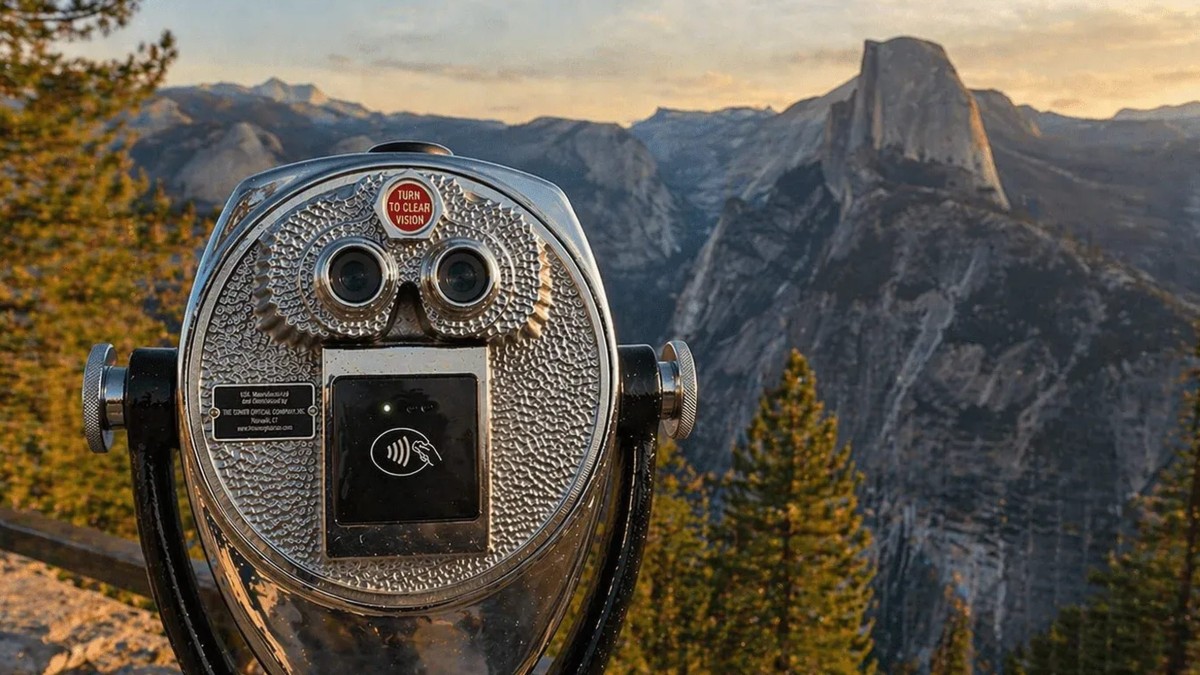
Tower Optical’s coin-operated binocular viewers have stood at American overlooks since the 1930s, built by a company almost nobody can name. For the first time, it’s selling some of them off.
 Tower Optical
When you use DPReview links to buy products, the site may earn a commission.
If you’ve ever stood on an observation platform at Niagara Falls, at the edge of the Grand Canyon, or overlooking the Golden Gate Bridge, chances are pretty good you’ve seen a Tower Optical binocular viewer, and maybe even dropped a quarter into one, even if you’ve never heard of the company that made it.
These heavy, chrome-plated viewers are bolted to observation decks and overlooks across the US and Canada. But somewhere along the way, the viewers themselves became icons. And, for the first time in its history, the company is selling a small number of them to private buyers.
Tower Optical began in a Norwalk, Connecticut, machine shop in 1933, and remained in the same family until 2025. Between the 1930s and 1980s, it manufactured roughly 2,000 of the machines, with every component hand-assembled in the company’s factory in Norwalk, where the original machinery from the 1930s and 40s still stands. Today, the company has about 1,800 machines spread across roughly 400 locations in North America.
 Tower Optics binocular viewfinders have been deployed to all corners of North America, in all types of environments.Tower Optical
In many places, these viewers have become part of the landscape as much as a means of viewing it. As someone with an interest in optics, what’s always fascinated me are the conditions these devices endure: freezing winters, blistering summers, rain, snow, ice, sand and every other environmental hazard you can throw at them. Yet the 10×42 binoculars inside keep delivering a sharp image, decade after decade.
Adam Rice, one of the company’s current owners, says the location and history of every viewer has been meticulously tracked by hand, decade after decade, as they moved around the continent.
 For decades, Tower Optical used a pair of push-pin maps at its headquarters — color-coded by site — to monitor where each viewer was deployed.Tower Optical / Adam Rice
“There are two push-pin maps at headquarters that are pretty outdated now, but they were used to track all the different sites, color-coded by location. Beyond that, we have a physical card for every single machine detailing its maintenance and whereabouts. I scanned thousands of these cards with a high-speed scanner to digitize the company’s historical records.”
Looking at one of these cards can be like a walk through history, Rice tells us. “If someone’s interested in the history of a machine, we’ll look at the maintenance cards… For example, machine #507 was manufactured in the 1950s. Our records show it went to the Staten Island Ferry in 1961, Battery Park in New York City in the ’80s, the North Carolina Zoo in the ’90s, and, most recently, Coit Tower in San Francisco.”
 The company maintained physical index cards for every machine, detailing its maintenance history and locations over the decades. This viewer appears to have spent a portion of the ’90s at the Empire State Building in New York.Tower Optical
One thing the company isn’t doing today is building new units, and the original manufacturing process may be lost to time.
“I’ve tried to understand the original manufacturing process, but no one is really left who knows how they were originally made. In our warehouse, there’s about 5,000 square feet of space filled with lathes and grinders from the ’30s and ’40s with overhead shafts to operate the pulleys. Our machinist estimated that if you had to make one of these domestically today, it would probably cost $15,000 to $20,000. The viewer heads are cast bronze and chrome-plated, and the rest of the components are iron.”
The glass inside has a pedigree of its own. “Interestingly, the metal plates on the viewers used to say ‘Bausch & Lomb Optical Viewer,'” he continues, “because the internal binoculars were manufactured by Bausch & Lomb. Many units still have the original Bausch & Lomb optics inside. At one point, they had a partnership where if binoculars needed to be serviced or replaced, we would send them directly to Bausch & Lomb, and they would fix them.”
Not much has changed over the years. The price crept up from a nickel, and the coin mechanisms were revised and hardened against people who tried sawing or drilling their way to the quarters inside.
 Tower Optical assembled every machine by hand at its Norwalk factory, which still houses the original manufacturing equipment from the 1930s and ’40s.Tower Optical
The biggest challenge the company faces today is one the founders probably never saw coming: “No one carries quarters anymore, but people still love using these machines, so our goal from day one was to retrofit them with tap-to-pay,” says Rice.
“Another challenge was that every machine was built by hand, so the dimensions aren’t exact CAD measurements. The engineering firm we worked with did an outstanding job engineering retrofit brackets that fit regardless of slight variations in screw hole placement between a machine built in the ’30s versus one built in the ’50s.”
What the company was unwilling to change was the viewers’ nostalgic appearance.
“Our mandate to the engineering firm from day one was that we did not want the look of the machines to change beyond the payment terminal itself. The terminal is very minimal, just a small black box, and we’re even considering putting a chrome foil on it to blend in further. The only other physical modification was drilling a small hole in the top shell for a cellular antenna,” Rice explains.
While many have encountered Tower viewers in their travels, it’s never been possible to own one. Tower Optical’s viewers are placed through revenue-share arrangements with host venues, but for the first time, the company has decided to sell a small number of the historic units.
 Tower Optical currently has about 1,800 machines operating across roughly 400 locations in North America.Tower Optical
“It allows us to finance the engineering work and expand our network, since retrofitting and deploying machines isn’t cheap. We receive a ton of inbound interest from people who want to own one. It makes sense to pull the lever on sales for units we can’t retrofit,” says Rice.
“In an ideal world, we probably don’t want to sell more than 50 to 100 of them.”
Owning a piece of history won’t be cheap. According to the company’s website, they start at around $9500. “That includes full refurbishment, the original historical maintenance card, and a new pair of optics,” Rice tells us. “We work with OM Digital to supply those binoculars. Prices may carry a premium for units originating from iconic locations like the Empire State Building, Rockefeller Center, or the Statue of Liberty.”
So next time you’re at a scenic overlook in the US or Canada, look out for a Tower viewer. Rice envisions a future in which they might even get more upgrades than its founders could have imagined.
“Moving forward, we’re exploring ways to layer in digital experiences, like augmented reality at high-traffic sites like Rockefeller Center, while keeping the core viewing experience intact.”
About the Author: Dale Baskin is a professional photographer, writer, and filmmaker based in the Pacific Northwest. He is the Managing Editor of DPReview.com.
Want to stay up to date on the latest product news and releases? Add DPReview as a preferred source to ensure our independent journalism makes it to the top of your Google search results.

What's Your Reaction?
 Like
0
Like
0
 Dislike
0
Dislike
0
 Love
0
Love
0
 Funny
0
Funny
0
 Wow
0
Wow
0
 Sad
0
Sad
0
 Angry
0
Angry
0







Comments (0)