

The Camera Lost on Mount Everest in 1924, and the Photograph It Might Still Hold
Somewhere on or below Everest's northern side, perhaps buried in snow, rock, or moving ice, there may be a camera the size of a bar of soap. If it is ever found, and if the film inside survived, it could answer a question that has hung over mountaineering for 100 years: did George Mallory and Andrew "Sandy" Irvine stand on the summit of Everest in 1924, three decades before Edmund Hillary and Tenzing Norgay?
The two men were last seen alive on June 8, 1924, high on the summit ridge and, in the words of the teammate who watched them through a break in the clouds, "moving expeditiously" toward the top. They never came down. What happened in the hours after that sighting is the most durable mystery in the history of high-altitude climbing, and the object most likely to solve it is a small folding Kodak that has never been recovered.
In September 2024, a National Geographic film team working below the north face found something that pulled the whole question back into the present: a weathered leather boot, a foot still inside it, and a sock with a red label that read A.C. IRVINE. It is the first suspected human remains of Irvine discovered since his disappearance, and it may narrow the search for the one artifact that matters most.
The Last Sighting on the Ridge
Mallory was 37, a schoolmaster and the most famous climber of his generation, a man who had already been to Everest twice and who answered a reporter's question about why he wanted to climb it with the line that outlived him: "Because it's there." Irvine was 22, an Oxford undergraduate and a gifted engineer who had spent the expedition nursing the temperamental oxygen sets that Mallory decided, at the last minute, to gamble on for the summit push.
On the morning of June 8, 1924, the two set out from their high camp toward the top. Lower on the mountain, geologist Noel Odell was climbing in support when the weather briefly cleared. He looked up and saw two tiny figures moving on the ridge near one of the rock steps that guard the summit. Odell wrote that the clouds parted at 12:50 p.m. and that he watched one figure move up to join the other on a step before the mist closed in again. That glimpse, lasting only a few minutes and never repeated, is the entire basis for a century of argument.
The trouble is that Odell was never certain which step he had seen. If the men were on the lower feature at that hour, moving as slowly as the timing suggests, reaching the summit and surviving the descent becomes very hard to believe. If they were already atop the higher Second Step, a summit becomes more plausible. Odell himself changed his account over the years. Everything downstream of that ambiguity, every book, documentary, and expedition, has been an attempt to replace a memory with evidence.
A Camera the Size of Your Palm
The evidence everyone wants is photographic. The 1924 party carried Vest Pocket Kodak cameras, a folding roll-film design so compact it could ride in a coat pocket, which is exactly why it went to altitude when heavier gear stayed behind. Howard Somervell, another member of the expedition, later said he had loaned his own Vest Pocket Kodak to the summit pair as they passed him on the mountain. Accounts differ over whether Mallory or Irvine ultimately carried it on the final climb. Irvine, an able photographer in his own right, may have carried a camera of his own as well, though that is conjecture rather than documented fact. Whatever went up the ridge with them never came back.
The format matters to the mystery. Each little roll produced eight small negatives, contact-print sized but detailed enough to place two men against a recognizable skyline. A single frame of Mallory or Irvine standing on a patch of ground that could only be the summit, with the curve of the horizon and the neighboring peaks falling away below, would settle the question in a way no diary entry or boot ever could. That is the prize, and it has kept expeditions combing the same terrible slopes for decades.
What a Century of Cold Might Have Preserved
The reason the search is not obviously hopeless comes down to chemistry and climate. Film degrades with heat, humidity, and time, and the upper reaches of Everest supply little of either. If the camera stayed cold, dry, and undisturbed, it would have spent the century in something close to a natural deep freeze, and Kodak has said that film kept in those sub-zero conditions could still be developable, with any latent images printable well enough to show whether the pair reached the top. That is an if, not a fact. Nobody knows whether the camera stayed sealed, stayed continuously frozen, or stayed in one place through a hundred years of storms, melt seasons, and grinding ice.
A recoverable image is a real possibility, not a certainty, and it is worth keeping the two apart. A latent image, the invisible chemical change that exposure leaves on film before development, can survive for a very long time when it is kept cold and dark. Restoration specialists have coaxed pictures out of film recovered from old expeditions and wrecks that spent years in ice. But a century is a century. Water intrusion, a single thaw, physical crushing under moving ice, or simple fogging could erase everything. The honest position is that the film might yield an image, or might yield a gray blank, and no one will know until specialists carefully remove and process the roll.
Whoever eventually develops it will not do it in the field. The film would need to be kept frozen from the moment of recovery, transported without a thaw, and handled by conservators who specialize in aged emulsions. The stakes are high enough that a botched development would be its own tragedy, turning the one piece of proof into a smear.
The Body on the North Face
For 75 years, the mountain yielded no confirmed remains of either Mallory or Irvine. That changed on May 1, 1999, when a research expedition set out specifically to find the climbers and, if possible, a camera. Climber Conrad Anker was searching a snow terrace on the north face when he spotted a patch of bleached white that he first took for rock. It was the back of a body, frozen into the slope, remarkably preserved. Clothing labels and personal effects identified it as Mallory.
The find was extraordinary and, for the central question, maddening. Mallory's body showed a rope injury at the waist and a serious leg fracture, evidence of a fall. His snow goggles were tucked in a pocket, a small detail that hints he may have been descending in the dark, which in turn hints at a very late summit push. But the camera everyone hoped to find was not on him. If Mallory carried Somervell's Vest Pocket Kodak to the top, it was not with him where he came to rest, which pushed suspicion toward Irvine and the camera he was thought to be carrying.
The 1999 expedition, and the several that followed, worked from a rough map of clues: a 1933 discovery of an ice axe believed to be Irvine's, and a secondhand account from a Chinese climber who reported seeing an "English dead" on the terrace in the 1970s. Those fragments defined a search box on some of the most dangerous ground on the planet, and expedition after expedition came home without the second body or the camera.
The Boot in the Ice
Then, in September 2024, the mountain moved the story forward again. A National Geographic documentary team led by climber and photographer Jimmy Chin, working with filmmakers Erich Roepke and Mark Fisher, was on the Central Rongbuk Glacier below the north face when they came across a boot melting out of the ice. Inside the old leather boot was a foot. Inside the sock, Chin found a red label stitched with the name A.C. IRVINE.
Andrew Comyn Irvine. It was the first suspected human remains of him to surface since 1924. Chin estimated the boot had emerged from the ice only about a week before they reached it, a reminder that melting and moving ice can suddenly expose objects hidden for decades. The team carried the remains down carefully, and DNA comparison with Irvine's living relatives, including his great-niece Julie Summers, was arranged to confirm the identification. As of October 2024, that confirmation was described as pending rather than settled, so the identification rests for now on the labeled sock and the location.
What makes the 2024 find matter beyond sentiment is geography. Glaciers carry what falls into them slowly downhill, so the boot's position says something, however imprecise, about where the rest of Irvine and anything he carried may have ended up. Working that path backward through a century of flowing ice is nothing like an exact science, but Chin said publicly that he believed the discovery narrowed the search area, and that more of Irvine, and perhaps the camera, could lie nearby. He declined to give a precise location, a deliberate choice to keep trophy hunters and unprepared climbers away from a site that could still hold the answer.
How Modern Climbers Document the Same Ground
It is hard to overstate how differently the mountain is photographed now. The men of 1924 were shooting on a folding camera with a fixed lens and a handful of frames, setting exposure by hand with a simple aperture stop and shutter and no meter to guide them, their fingers stiff inside wool gloves at an altitude where the brain starves for oxygen. A summit photograph then was a genuine feat of process, not just of nerve. Today a climber can carry a weather-sealed mirrorless body like the OM System OM-1 Mark II that meters, focuses, and stabilizes on its own, plus a phone with GPS that stamps the exact coordinates of every frame. Documenting a summit is now comparatively straightforward. In 1924 it was almost impossible, which is exactly why a single surviving negative would carry so much weight.
The craft of shooting in brutal cold and thin light has not gone away, though. Batteries die fast, condensation ruins a lens when you step from cold to warm, and the flat glare off snow wrecks exposure. If you want to understand how photographers handle demanding natural light and post-process the results, Elia Locardi's landscape photography course, shot on location in Iceland and New Zealand, works through exactly that kind of problem, minus the risk of dying at 28,000 feet. The point is that the 1924 team was doing all of it blind, on faith that the little Kodak would hold the picture until someone could develop it. A century later, we are still waiting to find out if it did.
What a Found Frame Would Actually Prove
Suppose the camera turns up and the film gives an image. Even then, the answer would have edges. A photograph of Mallory or Irvine on the summit would prove they reached the top. It would not, on its own, prove they got back down, and mountaineering has long held that a climb counts only when you survive the descent. Both men clearly died on the mountain, so a summit photograph would rewrite the record of who stood highest first while leaving the tragedy intact.
There is also the harder case, the one nobody likes to say out loud: the camera could be found and show nothing conclusive. A frame of ridge and cloud with no clear summit marker, or a roll fogged past reading, would not close the question so much as sharpen the ache of it. The mystery has survived this long precisely because every new clue, the ice axe, the body, the goggles in the pocket, the labeled boot, has narrowed the possibilities without eliminating them.
For now the search continues on a warming mountain that is slowly handing back what it took. Irvine's boot waited a hundred years and surfaced in a single melt season. The camera, if it survives at all, could lie somewhere on the upper mountain or have been carried miles down-glacier, ticking down its own century in the cold, still holding whatever it saw on the eighth of June, 1924.
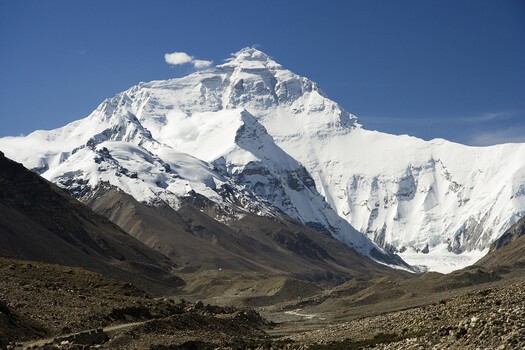
Lead image - The north face of Mount Everest rising above the Rongbuk valley in Tibet, the terrain where Irvine's boot melted out of the ice in 2024. Luca Galuzzi (www.galuzzi.it), CC BY-SA 2.5. Source
What's Your Reaction?
 Like
0
Like
0
 Dislike
0
Dislike
0
 Love
0
Love
0
 Funny
0
Funny
0
 Wow
0
Wow
0
 Sad
0
Sad
0
 Angry
0
Angry
0











Comments (0)