

The Future of Cinema Is the Cinema Itself
Sam Fleischner is a filmmaker and co-founder and Artistic Director of the Rockaway Film Festival, where he leads the design and construction of its cinema spaces. His films include “Stand Clear of the Closing Doors,” “Wah Do Dem,” “Below the Brain,” and “Donald Cried.” His most recent film, “Jetty” (2025), examines the reconstruction of Rockaway’s coastline and the human impulse to out-engineer nature.
It’s always tragic when a cinema goes dark. With the recent news of the Kips Bay AMC shuttering, the term “cinema desert” has resurfaced. It’s a relative term, though, especially in New York City, one of the greatest cinema cities in the world, with incredible theaters, programming, and devoted audiences. But the real cinema deserts of NYC exist farther out, in places like the Rockaways.


Over the course of the 20th century, the Rockaways had nine movie theaters: movie palaces in Far Rockaway, a cinema built over the water on the Arverne pier, and neighborhood theaters like the Surfside Twin, the last to close in 1996. Since then, getting to the movies has generally meant traveling for more than an hour each way for the 125,000 full-time residents of the peninsula.
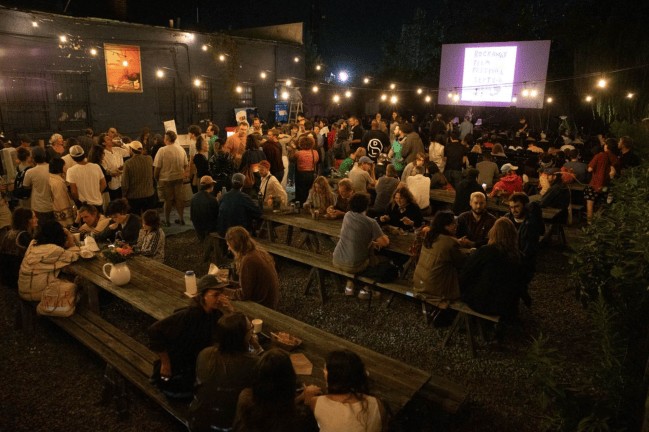
This was the driving force behind the Rockaway Film Festival, which launched in 2018. We wanted to bring cinema back to a place that had lost it, and a festival was a low-stakes experiment to test the waters. People showed up. For the past six years, we have operated a temporary, community-built, open-air theater called Arverne Cinema.
The organization has become more than a film festival, and more than a series of movie screenings. The experience extends before and after the film and encompasses everything from the approach to the venue, to the food and drinks served, to music and dancing, and, most fundamentally, the exchange between artists and audience. Most of what we have built has been ephemeral, but our audience has endured, and that has kept us devoted to this work.
Rockaway itself is an unusually cinematic place, with its open sky and quixotic light. Dolphins, surfers, and cargo ships move across the horizon of the Atlantic. Across Jamaica Bay, you can see the Manhattan skyline and the constant movement of planes coming in and out of JFK. The dense housing reflects the backgrounds and histories of people who have arrived from all over the world, by choice or by circumstance, and the mixture has produced a culture all its own.
While it’s impossible to satisfy everyone’s cinematic tastes, curating for such a diverse audience presents a particular challenge. Of course, many residents would love to see the latest franchise movie on the biggest IMAX screen. But it’s worth asking what we miss when that becomes the default. The industry has engineered a system in which the stories are the same, the stars are the same, and the formulas are the same. We call this entertainment, but it is also an enormous machine for manufacturing sameness, with profit as its organizing principle. And the many multiplex cinemas built to accommodate that output are also generic, and often they’re the ones that have been closing, one after another.
In a society ruled by capitalism, there is an assumption that everything be done for profit, and if that’s not the mission, it falls into a special category all its own: nonprofit – everyone run before they’re asked to donate! But aren’t some of the most valuable things in life – including art and culture – valuable precisely because they are not driven by profit? Perhaps their value lies in their resistance to that logic, and to the monoculture it produces. I’m not sure I have anything new to add to the age-old debate between art and commerce, but it’s impossible to ignore when thinking about the future of cinema. The idea that some things are worth doing simply because they enrich our lives, rather than because they generate a return, feels increasingly fragile.
 Rockaway Film Festival, Photo by Alec Kugler
Cinema has always been more than either art or entertainment. It is a gathering place for people to experience something collectively, apart from the arena or the cathedral. In its short lifespan, cinema has evolved from a facsimile of live theater, to sound pictures, added color, new aspect ratios, 3D, IMAX, 4DX, and on and on. There is always a new spectacle, a new gimmick to lure people into a theater and justify the cost of a ticket. But what about the simple draw of a shared experience that brings us back to something as primal as storytelling around a fire?
And what about films not designed around formulas, stars, spectacle, awards and profit? What about the strange, transcendent experiences that only fully reveal themselves when encountered collectively, in a room, over time? How do we preserve and present these works as events, much as theater has historically existed as a live art form?
When we make the effort to go out, we want it to be worthwhile, and the evidence is already here. Over the past decade or more, New York City moviegoers have shown a real appetite for this kind of experience. Repertory screenings on 35mm film, artist presentations at microcinemas, and other special programs continue to draw full audiences. People will show up to watch something they’ve never heard of simply because someone they trust has built an experience around it.
This feels especially important now, as people grow more isolated, and speaks to some of our most basic needs as a species. Since the pandemic, a loneliness epidemic has continued to spread, while we spend more of our lives alone with personalized feeds of imagery and information. As we gravitate toward convenience, something essential is lost when experience becomes individualized. A community is a kind of cultural petri dish: a physical environment where ideas collide, artists experiment, and unexpected things can happen. Culture emerges from proximity, friction, and coincidence. This is why we need not only to create more cinemas, but to rethink their design and function so they can be sustainable.
As we look for space and begin to fundraise for a permanent home for cinema in Rockaway, there are many considerations. The program will encompass everything from blockbusters to obscure documentaries, silent classics with live accompaniment, films from around the world, expanded cinema, and everything in between film and performance. The space must be flexible: optimized for film but able to transform for other uses like dancing, concert, puppet theater, private event space, or film production location. A kitchen will serve delicious food and drinks, with plenty of comfortable space for people to sit, talk, and gather before and after events.
There are examples of this model all over the world, but we need more of them here in the United States, and I wish for each one to be as unique as the community it serves. As we establish our own version in Rockaway, I hope it can serve as a useful model and contribute to a broader network of small, independent cinemas capable of doing what a centralized commercial distribution system cannot. By prioritizing cooperation over competition, we can use our interconnected world to share infrastructure, knowledge, and resources while providing meaningful, sustained support for artists and filmmakers.
Cinemas are a public good, strengthening communities, supporting local economies, and cultivating the next generation of storytellers and audiences. They invite us to put down our devices, pay attention, and experience new perspectives. Cinema was always a technology for capturing the human experience and bringing us together in the dark to imagine other worlds. Perhaps its future depends on remembering why it mattered in the first place. Where will we gather? How will we connect in real life? If cinema is to survive, we must protect spaces for collective imagination – and recognize that building them and maintaining them is, above all, a human endeavor.
What's Your Reaction?
 Like
0
Like
0
 Dislike
0
Dislike
0
 Love
0
Love
0
 Funny
0
Funny
0
 Wow
0
Wow
0
 Sad
0
Sad
0
 Angry
0
Angry
0








Comments (0)