

The Production Design of ‘Widow’s Bay’ Is Also Cursed (Complimentary)
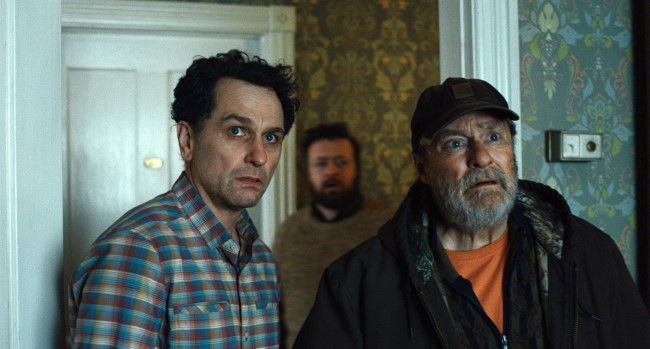
Tim Baltz in clown makeup is scary enough, but “Widow’s Bay” isn’t a show that does things by halves. Production designer Steve Arnold and his team are always game to lend a hand, and to make a space that little bit creepier, or that little bit stranger, on New England’s best-kept secret/most accursed island.
Arnold has plenty of experience operating in every kind of tonal mode, from “Mindhunter” and “Midnight Mass” to “Bridesmaids” to the original Sam Raimi “Spider-Man,” earlier in his career. But for “Widow’s Bay,” both creator Katie Dippold and director Hiro Murai wanted to make sure that the show didn’t look too expressive or dramatic — “Dr. Caligari strange,” as Arnold put it, except in a few instances where the builds could be suddenly threatening.


There are key moments in the show where the environment teeters on the verge of swallowing up the characters, once benighted mayor Tom Loftis (Matthew Rhys) begins awakening the dark forces that lurk beneath his sleepy town by trying to turn it into a tourist hub. One such exception is the basement of the Breakwater Hotel in Episode 2, “Lodging.”
After toying around with finding a location for the hotel, Arnold successfully advocated for a complete build of the interior so that the production could have control over the lights, layout, the spaciousness or narrowness of hallways, just how many tiny closets get stuffed into the Captain’s Suite, and more. When it came time to create the crawl space that Loftis finds himself in at the end of the episode, Arnold invoked some time-honored production design sorcery to make it more intimidating and scary.
 ‘Widow’s Bay’ Screenshot/Apple TV
“ We actually did forced perspective on that space. So the floor sloped up, and the ceiling sloped down so that as you got farther in, it seemed more claustrophobic,” Arnold told IndieWire. “We also had a back wall that was movable so that we could extend it and make it even deeper once you got in there. It kept getting bigger and bigger, the farther and farther he got in there. We did engineer a few things like that. The Stone Room is another one we adjusted to be this very, you know, ‘What’s going on here?’ kind of thing.”
While the references are never pointing-meme direct, the hotel is also designed to be a spiritual cousin to those completely normal and fine establishments in “The Shining” and “Psycho.” Arnold and his team designed the wallpaper, corridors, stairway, and lobby to all slowly take Loftis in, and unsettle him more and more over the course of his one-night stay in the (deeply) haunted hotel.
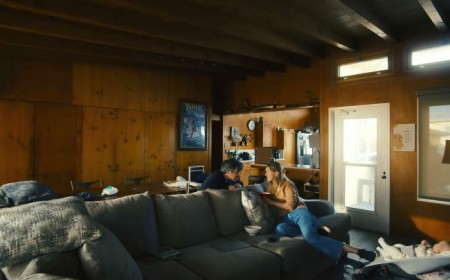
“I wanted the parlor to be a little warmer, more cozy, a little less threatening. Then the hallways and the entry were kind of a neutral thing. And then we did something completely different for the Captain’s suite itself. When I read the script, there was this subtle kind of tone, this strangeness to it, so we tried to incorporate that,” Arnold said.
 ‘Widow’s Bay’ Apple TV
The strangeness rests on the antique, out-of-time nature of the set dressing, but also in the slightly off color combinations Arnold and his team chose, and in the sense of things being hand-made, injecting the sense of A Presence into the space. There’s the sense of a presence even in the layout of the island itself, and it’s Arnold’s handiwork. Literally, it’s his hand.
“I knew that we were going to need all these maps related to the island and we had outlines for pretty much everything,” Arnold said. “I was trying to come up with something for the island shape, and I drew around my hand and made it very ragged and primitive and rugged. I didn’t think too many people would catch that, but some of the sleuths online did, and now it’s been discussed as the island is kind of this hand that has gripped the lives of all these people and is holding on for dear life, and they can’t get away.”
“Widow’s Bay” excels at moments where it feels like the characters can’t get away. Whenever there’s a subterranean or confined space, the production design and the camera conspire together to create frames where the darkness only feels larger the less of the image we’re able to see; but how much room it looks like the characters have to operate and/or escape hinges on spaces that are carefully designed to look normal and have deeply weird energy underneath. For Episode 6, “Our History,” there are moments where Sarah Warren (Betty Gilpin) seems to exist in light that’s the size and sharp angle of a butcher’s knife, against the darkness of the period spaces that Arnold designed.
 ‘Widow’s Bay’ Apple TV
It wasn’t enough to simply find a New England museum town and build a log cabin interior. The “Widow’s Bay” team looked at heritage sites around New England, and most of them were too touristy or didn’t allow filming, or did but didn’t have what the show needed. The Rebecca Nurse Homestead had a meeting hall with a side room, which worked well for several sequences in the episode and was able to be redressed, so Arnold and his team could reorganize the space for new phases of Sarah’s calamitous marriage to Mayor Richard Warren (Hamish Linklater).
The production design team also wanted to figure out how to craft a period set it in such a way that connected back to the present-day location. “ Ti [West], the director who did that episode, had a great vision for, ‘Let’s put it so that the meeting hall and the rest of the stuff is in the background of the well opening, let’s build the graveyard so it connects the spaces, and all that. And whenever we can reuse something, I tend to,” Arnold said.
The lobster shack in present-day Widow’s Bay, for instance, was repurposed into the dock from which Sarah and the Warren children flee. The ferry landing site in the pilot became the town common. Arnold used the tunnel design from Episode 2 to expand the path into the Stone Room in Episode 6. The Breakwater basement was expanded to become the emergency shelter beneath town hall in the season finale.
 ‘Widow’s bay’ Apple TV
These are choices to control the show’s budget, of course. But there’s also something subtly interconnected about “Widow’s Bay,” something analog and thrown-back, that lines up well with Arnold’s design process. “I was a draftsman for many, many years and I still draw everything by hand with a pencil. The process of actually drawing… there’s a different connection, and it’s hard to describe what is missing when it’s done digitally. Digital’s good for many things. But when I’m drawing something, I start figuring it out,” Arnold said.
Analog can be comforting or creepy, as in the vintage board game Tom and ‘William’ (Baltz) play in Episode 2. Arnold trawled all over New England for as many phone booths as he could find, and put them in “Widow’s Bay,” although the efficacy of calling for help there is up for debate.
“I was adamant about the phone booths because it’s something that is lost now. And it’s kind of similar with the board games. Why are those games interesting to us?” Arnold asked. “ I think there’s this human connection to something that’s physical as opposed to something that’s almost completely electronic. It also takes you back in time.”
The production design of “Widow’s Bay” does a fantastic job of subtly evoking a sense of connection that is also, somehow, coming at the wrong time. The trouble — but also the fun — is that connection isn’t always human. To build that into production design, Arnold told IndieWire you have to trust your gut.
“ I’ve been in the art department for a little over 42 years. I’ve done many, many films, worked with some really fantastic directors and designers, and you just pick things up. Sometimes it’s just a gut feeling [that] something is right,” Arnold said.
“Widow’s Bay” is streaming on Apple TV.
What's Your Reaction?
 Like
0
Like
0
 Dislike
0
Dislike
0
 Love
0
Love
0
 Funny
0
Funny
0
 Wow
0
Wow
0
 Sad
0
Sad
0
 Angry
0
Angry
0








Comments (0)