

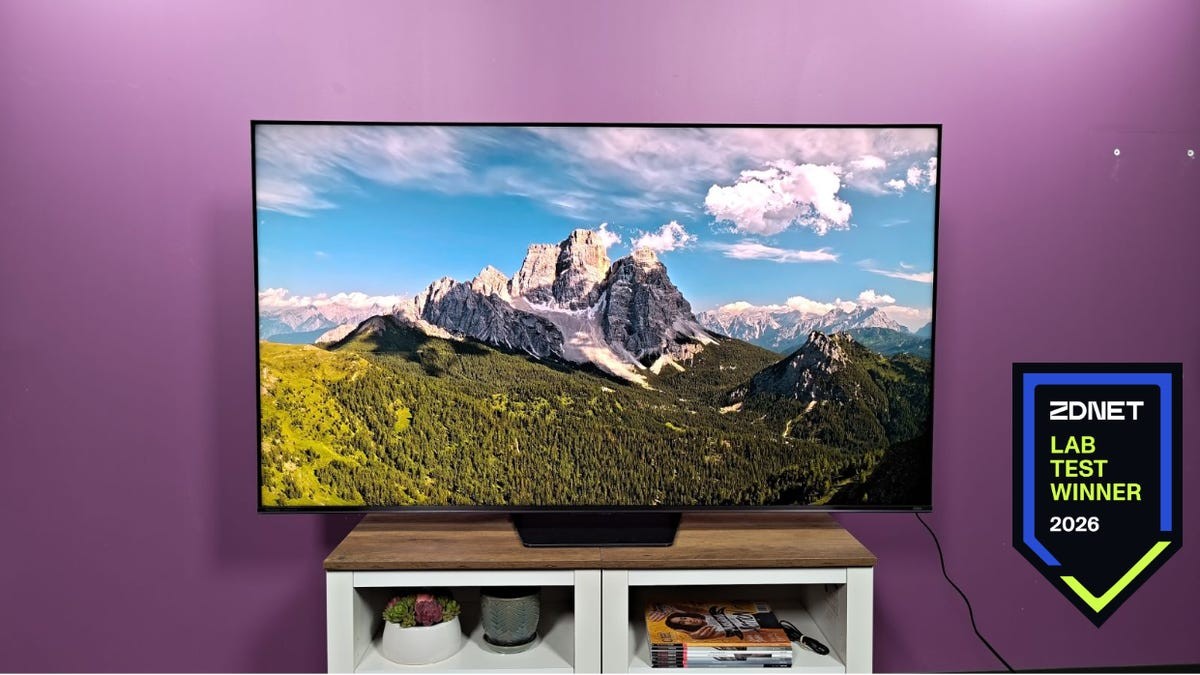
We lab-tested 7 TVs for color accuracy - and the winners weren't Sony or Samsung

Follow ZDNET: Add us as a preferred source on Google.
The first commercial TVs were five to seven inches long and displayed grainy black-and-white pictures. Now, the best TVs can reach a whopping 98 inches (or more) and feature color technology that creates rich, realistic images with individual pixels, AI processors, and even ambient light adaptation to make your movie nights feel immersive.
Also: The best TVs: Expert tested
TVs are only getting better and better in color and picture every year, so we decided to put them to the test. ZDNET tested seven flagship TVs from popular brands like Samsung, LG, and TCL in our Louisville-based lab. The lab team's goal was to evaluate each TV's color reproduction in different picture modes using the industry-standard display color calibration software, Calman.
The TVs that stood out above the rest were the LG C6 for the most accurate SDR color reproduction and the Hisense U8 for the most accurate HDR color reproduction. We chose to separate these awards and TVs because SDR and HDR are two distinct picture formats that are calculated slightly differently, so we wanted to designate a winner for each.
How we tested TVs
We tested the TVs in our lab using Portrait Displays' Calman software, the industry standard used by Hollywood film studios, broadcast networks, and more to validate color accuracy. The lab team chose two different ways to test each TV's color: color gamut and color accuracy.
Also: Get better color accuracy on your TV with these simple steps
Color gamut is the amount of colors that the TV is capable of displaying, measured in a percentage of the broadest color gamut (rec.709 for SDR and rec.2020 for HDR). Every color has a numerical designation determined by three different numbers in red, green, and blue. Calman measures where it thinks a perfect red should be, for example, and measures where the TV's closest approximation is relative to that, as shown in the image below.
Calman results of the LG C6 test in SDR Filmmaker mode.
On the other hand, color accuracy is how well a TV reproduces the colors sent by the pattern generator. Color accuracy is measured in two different values: Delta E 2000 (dE2000), which we used to measure SDR mode, and Delta E ITP (dEITP), which we used to measure HDR. For both of these values, the lower numbers are better results, since the closer you get to zero, the more accurate the TV's color is.
Some caveats to keep in mind about our testing are that we used the results of Filmmaker mode to determine our winners, since it is generally the most accurate color mode on a TV. If a TV did not have a Filmmaker mode (such as the Sony TVs and the Sunbrite model), we tested the brand's equivalent to Filmmaker mode.
The results
In SDR mode, the TV with the most accurate color reproduction was the LG C6, with a dE2000 score of 1.84. Standard dynamic mode is the traditional video format that is enabled by default on most TVs. On the other hand, for HDR mode -- which expands the contrast and color range in a picture -- the TV with the most accurate color reproduction was the Hisense U8, with a dEITP score of 7.73.
Read the reviews: LG C6 | Hisense U8
An honorable mention goes to the TCL QM8L, which had the third-best score for SDR mode (Fig. 1) and the second-best score for HDR mode (Fig. 2).
In both charts, you can see that the shorter the bars, the better the color accuracy, so the TVs that performed the worst in both SDR and HDR were the Hisense U7 and the Sunbrite Veranda. However, this does not mean that these TVs don't have good color; for example, in our testing, they both performed better in Standard mode than in Filmmaker mode.
Our test results may differ from your at-home experience with these TVs, depending on the picture mode you are using, the environment where your TV is located, and other factors. However, as a baseline, our testing provides expert analysis of how well the flagship TVs from top brands show color accuracy.
The best way to find your ideal TV screen size is to measure the distance (in inches) between your couch and where the TV will be wall-mounted or placed on a dedicated stand. Next, divide that distance by two. So if your couch is 120 inches (10 feet) from where the TV will be, the ideal size would be 60 inches.
You can always go a bit bigger or smaller depending on your budget and what's available, but you don't want to go wild and get a huge screen if you don't need to. Not only do you run the risk of having your new, expensive TV not fit your space, but a screen that's too big can overwhelm a room and even cause motion sickness. On the other end of the spectrum, while smaller screens tend to be more affordable, a TV that's too small for a room can make the space feel cavernous and force everyone to crowd around in order to see.
OLED and QLED panel types use the same basic components to create images on screen: a power source, a light source, and a color source. The key differences are exactly how these panels get power, light, and color.
A QLED screen, mostly seen in Samsung, TCL, and Hisense models, uses a modified LED panel and a "quantum dot" screen to create images. The "quantum" in QLED seems to be more of a catchy marketing term than an allusion to actual quantum tech, but it does give you enhanced color and detailing over a regular LED display.
An OLED panel, found in LG, Sony, and Vizio TVs, uses an array of mini LED lamps that are individually lit along with organic substrates for color. The individual LEDs allow for true blacks to create stunning contrast and make colors pop. It's an expensive technology to produce, so OLED TVs are pretty pricey. But if picture quality is your top priority, it's a worthwhile investment.
What's Your Reaction?
 Like
0
Like
0
 Dislike
0
Dislike
0
 Love
0
Love
0
 Funny
0
Funny
0
 Wow
0
Wow
0
 Sad
0
Sad
0
 Angry
0
Angry
0










Comments (0)