

What Happens When You Jump From 4x5 to 8x10 Film
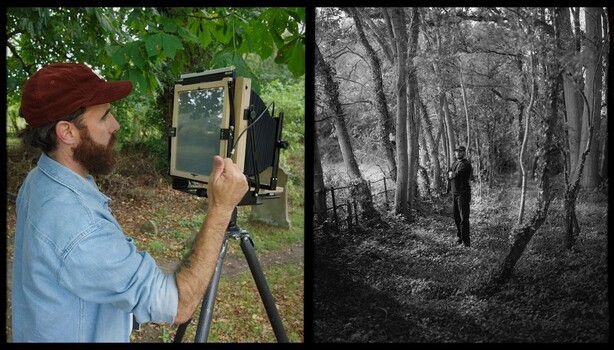
Jumping from 4x5 to 8x10 film means bigger negatives, longer focal lengths, slower shutters, and a bill that climbs fast with every accessory. Anyone weighing whether the leap is worth it will recognize the mix of excitement and sticker shock that comes with building a fresh large format kit from scratch.
Kyle McDougall walks through the whole setup after finally getting out to shoot 8x10 for the first time, starting with the camera itself. He landed on the Intrepid 8x10, which came in at a little over $750 in the UK. The camera is light, has a magnetic back that pops off to rotate, and offers a full range of movements with zero positions. For a brand new field camera in this format, that price is hard to argue with. McDougall is holding off on a full verdict until he has shot with it for a few months.
The lens choice drives much of the look he was after. He picked a Fujinon 250mm f/6.7, which translates to roughly a 32.5mm field of view in 35mm terms, right in the range he wanted. At f/6.7, it's fast for an 8x10 lens, since 5.6 tends to be the ceiling unless you move to old barrel or brass glass. It's also mounted in a compact Copal 1 shutter that tops out at 1/400 of a second, far quicker than the Copal 2 and 3 shutters he was seeing with their 1/125 limits. For film, he went with Fomapan 100, where a 50-sheet box runs cheaper than a 25-sheet box of Ilford.
Here's the part that makes a fast 8x10 lens so interesting: depth of field scales with format. That 250mm f/6.7 behaves like something close to a 32mm f/0.8 in full frame terms, which is a look no full frame lens can physically produce. Shooting wide open on a negative that large gives you a shallow plane of focus combined with the tonal smoothness of an enormous piece of film. McDougall leaned into this for all three frames, including two environmental portraits of his friend Eric. If you're drawn to large format for the resolution alone, the depth of field behavior is the other half of the equation, and it's the reason people put up with the weight and cost. It also raises the stakes on focus accuracy, which is exactly where a couple of his frames ran into trouble.
Developing 8x10 at home forced a change too. McDougall's usual TH Darkroom processor can't handle an 8x10 tank, so he pulled out an AGO processor paired with a Real Paper 4 drum that runs a single sheet inside a Paterson tank. The AGO monitors temperature and adjusts development time automatically as it rises or falls. It's compact and simple, though one negative came out with dark streaks running down it, and he's still tracking down whether that was a loading error or something else.
Not every frame came out clean. His dark cloth was too small, he wants a Fresnel screen, and a stronger loupe is on the list after focus landed just behind Eric's face on both portraits. McDougall is clear that 8x10 isn't a replacement for his 4x5 Horseman, since he'd never haul this rig on the hikes he does in North Wales.
Watch the video above to see the three frames he came home with and hear his full first impressions of shooting 8x10.
What's Your Reaction?
 Like
0
Like
0
 Dislike
0
Dislike
0
 Love
0
Love
0
 Funny
0
Funny
0
 Wow
0
Wow
0
 Sad
0
Sad
0
 Angry
0
Angry
0







Comments (0)