

Will plug-in solar plus batteries solve your power problem? I did the math
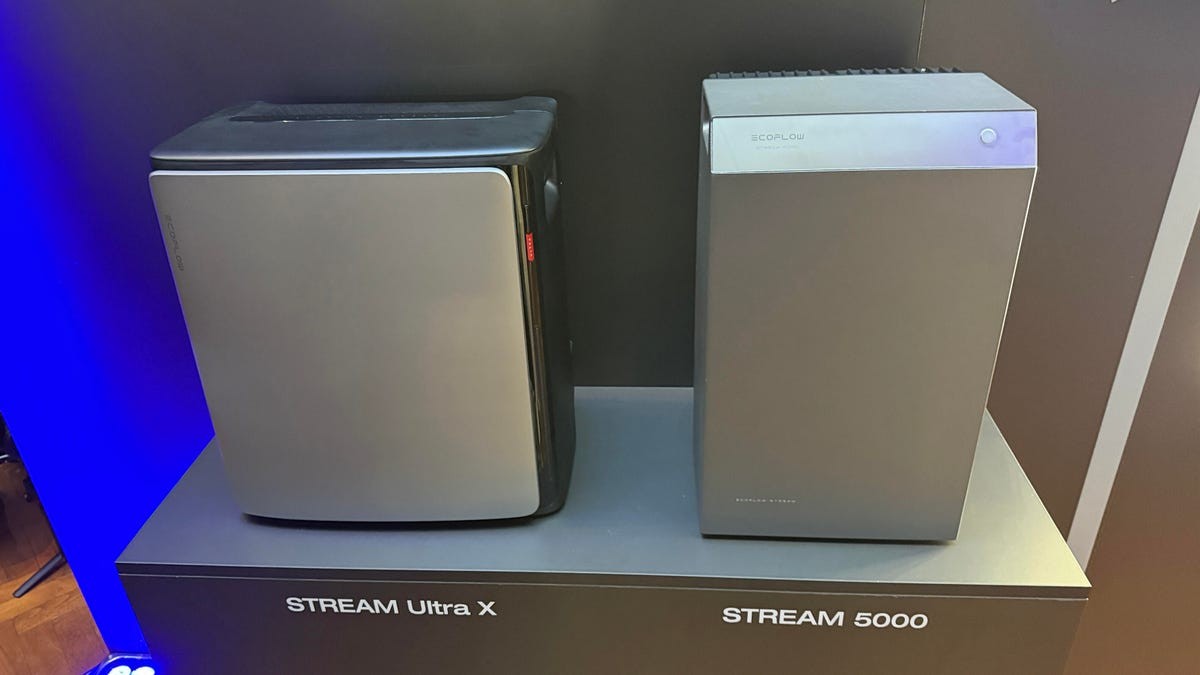

EcoFlow showing off its new in-home battery systems.
Follow ZDNET: Add us as a preferred source on Google.
ZDNET's key takeaways
- Batteries let you store and timeshift power.
- They can store solar-generated power or cheap, off-peak power.
- To make this work, you need a TOU tariff with a decent peak/off-peak rate spread.
Last week, I traveled to London to see some new products EcoFlow is releasing now that plug-in solar is set to become legal here in the UK. But what struck me was how I feel that pure plug-in solar has already been superseded by hybrid systems offering greater potential for savings.
Also: You're charging your phone all wrong: 6 common myths, debunked
Don't get me wrong, I still think there's a place for pure plug-in solar systems where you take solar panels, hook them up to a microinverter, and feed that power into your system to handle some of the energy usage during the day.
The problem
The problem, in a nutshell, is a mismatch between household energy use and peak solar energy generation. The average household's power usage peaks twice a day, morning and evening, with a trough between the two. This trough, rather annoyingly, coincides with the single solar energy-harvesting curve, which peaks at midday, a time when most people are out of the house.
Also: I tested this backup power station during a real blackout - don't make my mistakes
Those of us who work from home or outside traditional hours will win in this scenario because we're there to make maximum use of the power, but for the majority who go to and from work humming Dolly Parton's "9 to 5," this isn't the optimal setup.
A microinverter does the job of connecting solar panels to an AC outlet.
Sure, solar can carry a fair amount of that daily base load, and it's a step in the right direction when it comes to energy independence, especially if you live in sunnier parts of the country. (Note: Base load is the stuff that's always on -- refrigerator, Wi-Fi router, chargers, and appliances left on standby.)
However, there's a limit to solar's effectiveness. The allowable size of a plug-in solar setup -- 800W for Utah and in European countries where it's allowed, up to 1,920W in Colorado -- isn't much, and even under perfect conditions, won't be enough to give you energy independence. Not by a long shot.
Time-shifting power - no solar panels needed
Ideally, people want a way to capture that power during the day, when it's abundant, and time-shift it to times of day when it's needed.
For that, you need batteries.
Lots of power in a tiny, stylish space.
And those batteries can not only store solar power but also be charged from an outlet. In fact, if you have a time-of-use (TOU) or time-of-day (TOD) power tariff where electricity costs less during specific periods, you don't need solar panels.
You fill up the batteries with cheap, off-peak power to use during costlier peak periods.
Does time-shifting power make sense?
One question I get a lot is whether, even with a TOU or TOD rate, it makes sense to fill a portable power station using AC. After all, there are losses every time you charge up a unit, and more losses when you discharge.
Don't these losses mount up? How does the math work out for real-world energy prices?
Also: I tried a solar-powered AirTag alternative that lasts 2 years - and looks like my Apple Watch
Well, I did the math...
A portable power station is a battery pack with an AC-to-DC charger and DC-to-AC inverter. Every time power is shifted through one of the parts of the power station, there are losses due to heat during charging and discharging, battery chemistry inefficiencies, and standby drain.
A smart meter is used to monitor power consumption.
The smart meter fits into the breaker panel box (called a consumer unit in the UK).
The average round-trip efficiency (grid AC into the battery, then out via AC to your load) is in the range of 80% to 90%. This means that for every 1 kWh you draw from the wall outlet, you get 0.8-0.9 kWh of usable AC power back out.
This is why you want to store power when prices are low and use it when they're high. And even then, there are losses that eat into your gains.
Let's look at a real-world example based on Con Edison prices. Currently, prices are as follows:
- Off-peak prices: $0.0522/kWh (all hours outside 8 a.m. to midnight)
- Peak in summer (Jun. - Sep.): $0.2786/kWh
- Peak in winter (Oct. - May): $0.1711/kWh
I have a 12 kWh "Tower of Power," and if I filled it with off-peak power, I'd need to pay for 15 kWh (this accounts for losses), which would cost $0.783. This would get me 12 kWh of power, which would cost me $3.3432 to buy in summer and $2.0532 in winter.
So, each refill has the potential to save about one to two and a half bucks a day. If I took a more modest 3 kWh setup, that would need 3.75 kWh to fill, costing $0.19575, and get $0.8358 worth of summer power, and only $0.5133 of winter power. Here, the savings are down to $0.30 to $0.60 per day.
All this is before any customer charges and surcharges start eating into your savings. I think it's vital that you check the math and work out the savings for yourself.
Oh, and this is all before you consider the cost of the portable power station and any solar panels, which can be considerable.
Is it worth it?
People who buy a basic plug-in balcony solar setup will be looking at it purely from a savings perspective. These systems start at around $300 for a 180W system, going up to $1,500 to $2,000 for 800W setups.
Throw in a battery (and a smart controller and an energy meter), and the costs go up. The 5,024Wh Stream systems that EcoFlow had on display cost in the region of $2,000 and had an installation charge on top of that, close to $1,000.
The modern batteries look more like home appliances than the portable power stations of old.
That's a fair chunk of cash to make back, and that's without adding more expansion batteries (the Stream systems are expandable to a massive 90kWh) or solar panels, line items that will push the price up considerably. To make your money back here you're going to have to make sure you're on the best possible energy tariffs, and make sure you work the system.
Also: You've been using your power bank wrong, and airline rules make that obvious
Fortunately, the system is smart, and everything is app-controlled, making it easy to get the most from your investment. For most, it will be completely automatic, from charging up the batteries when power is cheap, to pushing that power into the system when it's expensive.
What also sets these systems apart is the 10-year warranty they come with. That's a good lifespan for a product like this.
This isn't you buying a few LED lightbulbs in order to save money. It's more like buying a boiler or fitting insulation -- it's a long-game investment in your home.
As for how much money you'll make, I wish I could give you a dollar-and-cents figure. I can't. You'll come across all sorts of calculators and estimates online, along with all sorts of claims that your system will pay for itself in two years, to even more optimistic claims that you'll save a whopping $150,000 over 25 years.
I've run the numbers for various locations in the US and UK, and it's my belief that most systems will pay for themselves in around 5 years, unless you're at the extremes of sun and electricity prices. And after you've paid for the system, you'll save money.
And remember that people are buying batteries and solar systems for a wide range of reasons. For some, it's about saving money. For others, it's about reducing the effect they have on the planet. Then there are those, like me, who want power where there isn't any.
Also: This $50 power bank is safer than my lithium-ion battery - and it's coming on my next flight
The other thing to think about is the scale of your system. If you are a light power user, you don't need a huge amount of battery storage, since you'll be paying big bucks for storage you're not using. But heavy power users will benefit from being able to store more power to time shift.
We're also living in uncertain times, with power outages becoming more commonplace, and having backup power in the home can make sense.
What's Your Reaction?
 Like
0
Like
0
 Dislike
0
Dislike
0
 Love
0
Love
0
 Funny
0
Funny
0
 Wow
0
Wow
0
 Sad
0
Sad
0
 Angry
0
Angry
0











Comments (0)