

X-rays add new twist to narwhal's spiral tusk
A double helix
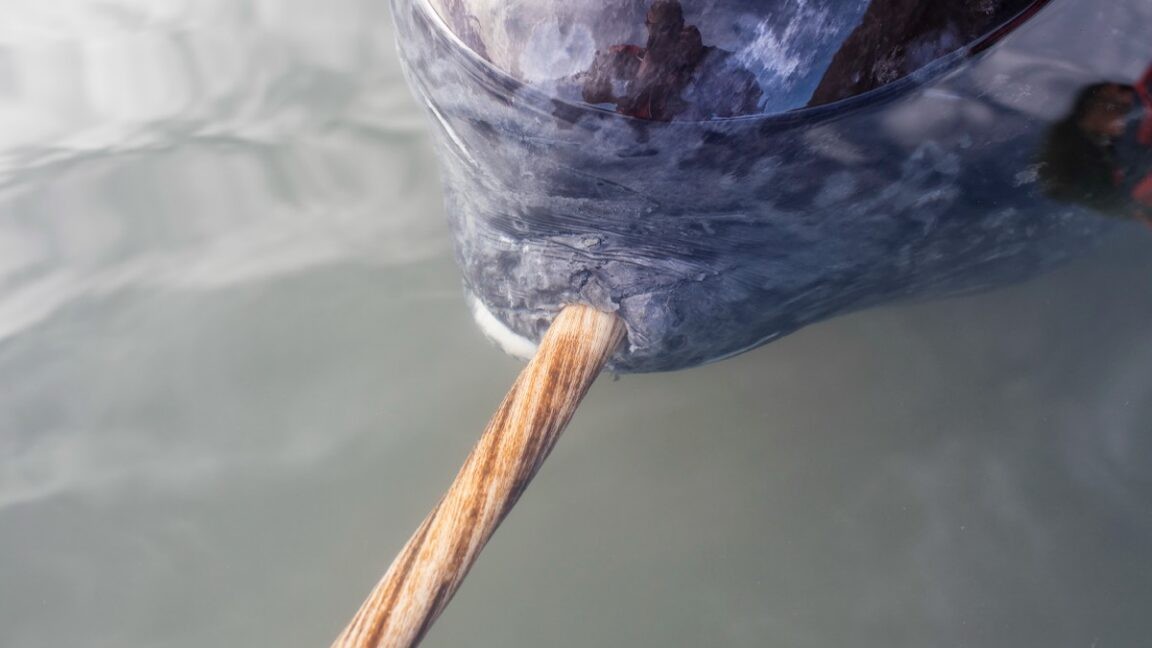
Scientists know that the tusk consistently twists in the left-handed direction and that it is composed of dentine covered by a thin layer of cementum encasing a central pulp chamber. The dentine and cementum, in turn, are made up of microscopic collagen fibrils mineralized with nanoparticles of hydroxyapatite. The macroscale spiral shape emerges somehow from how those fibrils organize themselves. That structure also determines the tusk’s material properties. One question is whether the helical structure is also present at the micro- and nanoscale.
But nobody had mapped the interior structure in three dimensions at the atomic, nano, and macroscales. So the authors of this latest paper studied two male narwhal tusk and skull specimens by combining multiple imaging techniques: X-ray computed tomography, scanning X-ray diffraction, scanning small-angle X-ray scattering and tensor tomography, and bifringence microscopy. That required reserving time on three large synchrotrons in Sweden, Switzerland, and France. They also performed standard morphological measurements and conducted mechanical three-point bending tests.
The results showed that the collagen fibrils and hydroxyapatite nanoparticles orient themselves along the tusk’s longitudinal axis, so there is a consistently high degree of anisotropy at all scales. But there are tiny systemic deviations at small angles in that orientation, which in turn create the twisted structure. While the cementum layer forms the known left-handed helix, the dentine forms a right-handed helix.
That double-helix structure is the secret to the tusk’s remarkable stiffness and strength, with the flexible fibers and stiff mineral matrix enabling the tusk to withstand strong forces, like bending and twisting without cracking. It also allows the narwhal tusk to grow straight, unlike, say, an elephant’s curved tusk. The team also noted a finer underlying microstructure in the cementum of collagen fiber bundles radially extending outward, which they plan to study further using micro- and nano-beam experiments.
“Since whales can live for up to 80 years, their teeth form a kind of historical record of changing environmental conditions throughout the animal’s lifetime,” said co-author Henrik Birkedal of Aarhus University in Denmark. “And because the North Atlantic is currently undergoing very rapid changes, it is obvious to investigate whether we can trace these changes in the hard tissue of the narwhal tusk. That is what we are now working on.”
DOI: Nature Communications, 2026. 10.1038/s41467-026-75689-z (About DOIs).
What's Your Reaction?
 Like
0
Like
0
 Dislike
0
Dislike
0
 Love
0
Love
0
 Funny
0
Funny
0
 Wow
0
Wow
0
 Sad
0
Sad
0
 Angry
0
Angry
0












Comments (0)