

A $700 Smart Telescope vs. a $4,000 Milky Way Rig: Which Wins?
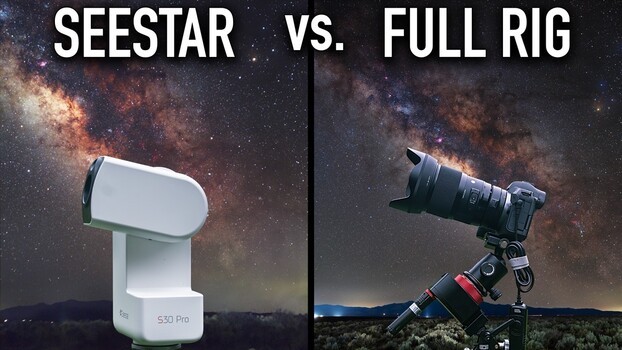
A $700 smart telescope and a $4,000 traditional rig pointed at the same patch of sky on the same night in northern New Mexico, and the gap between them was smaller than the price tags suggest. If you've been weighing whether a point-and-shoot device can stand in for a full Milky Way setup, this is the comparison that answers it.
The head-to-head comes from Nico Carver, who put the ZWO Seestar S30 Pro against a rig built around the Move Shoot Move Nomad star tracker. The Seestar treats the Milky Way as one mode among many, so it's a bonus feature rather than the reason to buy it. The traditional kit runs a Canon EOS Ra with a Sigma 28mm f/1.4 Art lens on a Peak Design travel tripod, and Carver notes that everything he says about the S30 Pro applies to the new S50 Pro, since they share the same wide-field camera system. His camera and lens are both discontinued, which pushes the used cost of the full rig to around $4,000. A DSLR or mirrorless body and a suitable lens most people already own, so the real added spend can be just the Nomad kit at about $330.
Carver walks through the settings that actually change the result. On the Seestar in alt-az mode, he landed on 20-second sub-exposures as the sweet spot, since 30 seconds introduced rotational star trailing in the corners. He keeps live view on raw, turns on save-each-frame as a safety net, and points out that the freeze-ground feature only works if you let the Seestar do the stacking rather than stacking the subs yourself. For the traditional rig, he recommends ISO 1,600 to 3,200, stopping an f/1.4 lens down to around f/2 for sharper stars, and reading the histogram after a test shot to keep the peak a quarter to halfway from the left edge. Both setups need only 20 to 30 minutes of exposures for a solid stack, and the tracker rig takes a separate long foreground exposure, two minutes at ISO 800 or four minutes at ISO 400, with tracking switched off.
The images tell the honest story. In a single 20-second frame, the full-frame rig pulls in far more signal and far more small, sharp stars, while the Seestar frame shows more noise. Stacking closes the distance. The Seestar gets the bigger glow-up from 20 minutes of subs, building up fine stars and clean detail, while the Canon stack looks close to its already-strong single frame. Because the Seestar sensor is open to H-alpha light, red nebulae like the Cat's Paw pop nicely in the processed version, though the dark nebula structures come out a little muddy and the stars stay soft, a fair result from what amounts to a phone-grade lens.
If you're deciding where to put your money, the useful frame is what kind of night shooter you are and what you already own. The Nomad fits a specific and growing habit among Milky Way imagers: traveling light and setting up fast. Carver polar-aligns it with a green laser on Polaris in seconds, and he's used it at 85mm to track comets and the Large Magellanic Cloud, which puts it in reach of some deep-sky work beyond nightscapes. Compact trackers like this have quietly reshaped how people chase dark skies, because the barrier to bringing serious gear on a flight has dropped to something that fits in a daypack. Anyone who already carries a mirrorless body and a fast wide lens is a short step from real tracked results, and the Seestar makes more sense for someone who wants deep-sky objects first and treats the Milky Way as a welcome extra. The two products aren't really rivals so much as answers to different questions about how you like to work at night.
Carver is candid that cost isn't the point of the test, only image quality and workflow, and that the Seestar's Milky Way mode has improved through software updates since he shot the comparison in April, with the current app options shown as of August 2026. Watch the video above to see the side-by-side stacks and the final processed frames for yourself.
What's Your Reaction?
 Like
0
Like
0
 Dislike
0
Dislike
0
 Love
0
Love
0
 Funny
0
Funny
0
 Wow
0
Wow
0
 Sad
0
Sad
0
 Angry
0
Angry
0







Comments (0)