

The Preacher Who Patented Flexible Film in 1898 and Died Before Kodak Paid $5 Million for It
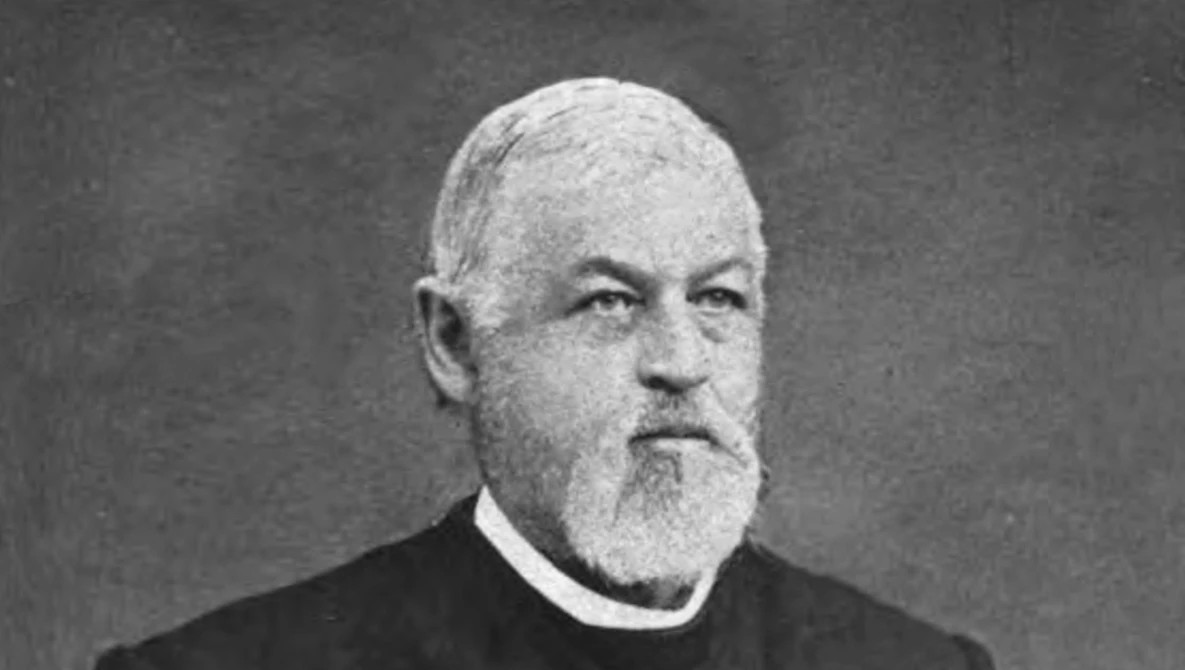
Hannibal Goodwin's application for a photographic pellicle reached the Patent Office on May 2, 1887, and stayed there for eleven years and four months while a succession of five examiners rejected it. George Eastman's chemist filed his own flexible film application on April 9, 1889, and had a granted patent eight months later. By the time Goodwin's US Patent 610,861 issued on September 13, 1898, Kodak had been selling transparent roll film to the public for nine years.
What Goodwin Actually Claimed
Goodwin spent twenty years as rector of the House of Prayer in Newark, New Jersey, and was at the end of that service when he filed. A wire story in 1898 put him at six feet three inches and remarkably well preserved for a man close to eighty. When the Second Circuit came to describe him in 1914, it did so in one flat sentence: his salary was small, and for the ten years before his death he had no regular charge.
The problem he set himself was glass. Serious photography in the 1880s still ran on coated glass plates, which meant carrying a box of heavy, breakable rectangles into the field and bringing them home unbroken. Eastman's roll holder had put paper negatives in photographers' hands since 1885, but the emulsion had to be stripped off its backing before printing, and professionals stayed with glass. Goodwin's specification says the object of his invention is to provide a transparent sensitive pellicle better adapted for photographic purposes, especially in connection with roller cameras. That is the whole of modern film in one clause.
His method was chemistry rather than machinery. Dissolve nitrocellulose in a slow-evaporating solvent that does not take up water, such as nitrobenzole. Thin the solution with alcohol, which evaporates quickly. Flow the mixture over a sheet of glass, let it set, and strip the dried skin off. The result was a support that survived the developing, fixing, and intensifying baths without dissolving or fogging, and that could be wound on a spool. Claim one covers dissolving nitrocellulose in a menstruum containing a hygroscopic element and an element which is non-hygroscopic, the second being itself a solvent of nitrocellulose and slower to evaporate than the first. The two-solvent trick is the invention. Everything else in the patent is housekeeping.
Eleven Years in the Patent Office
Kodak's own account of the prosecution history, quoted back at it by the appeals court in 1914, is the clearest summary anyone wrote. Kodak's brief complained that the application “was uniformly rejected by the five different Examiners who successively had it in charge during its eleven years’ pendency in the Patent Office.” Kodak meant this as an indictment of the patent. Circuit Judge Alfred Coxe turned it around and read it as an indictment of the Patent Office. “Truly an extraordinary and deplorable condition of affairs!” he wrote. “But who was to blame for it—Goodwin or the five examiners who improperly deprived him of his rights during these eleven years?”
While the file sat, Rochester moved. Eastman's company began experimenting with nitrocellulose as a paper substitute in late 1888, the chemist Henry Reichenbach carried the work into February 1889, and on April 9, 1889, he filed. Patent 417,202 issued to him on December 10 of the same year. His formula was not Goodwin's. Reichenbach used camphor and fusel oil with wood alcohol as the diluent, and both courts that looked at it later called it an improvement rather than a copy, an improvement that nonetheless fell inside Goodwin's claims.
None of that was the decisive move. Manufacturing was. Kodak's sales manager showed the new film to the New York Society of Amateur Photographers on July 30, 1889, and the factory produced film for public sale by the end of that August, three months before Reichenbach's patent even issued. By October, the plant was turning out several hundred lineal feet a day of transparent film forty-one inches wide. The National Science and Media Museum has traced that production ramp in detail from the company's own records.
The Patent Office declared an interference between the two applications, which is the proceeding that decides who invented first. It ground on for years. Goodwin kept amending, and some of those amendments came late enough to be awkward. The Second Circuit noted that the entire second page of Goodwin's printed specification was inserted after he had learned what Kodak was doing. Coxe's verdict on the whole episode was that the interference, and most of the other complications in the case, would have been avoided had the patent gone to issue in due course, as it should have done. The delays and reversals, he added, “would have discouraged an inventor who had not supreme faith in the justice of his cause.”
When the patent finally issued, the wire story that ran on September 17, 1898, predicted it would likely make Goodwin a millionaire, or nearly so. It counted roughly 1.6 million cameras in the United States and noted that one manufacturer alone was making 60,000 spools of film a week.
The Suit That Outlived Its Inventor
Goodwin incorporated the Goodwin Film & Camera Company in 1900 to make film himself. He never got the chance. On December 31, 1900, he died at 78 of complications following a street accident; the accounts that have come down describe a fall near a construction site, a broken leg, and pneumonia after it. The company had not begun manufacturing. In July 1901, his widow sold it to a pair of photographic manufacturers, E. & H. T. Anthony and Scovill & Adams, which merged that December into Anthony & Scovill, the Binghamton, New York firm renamed Ansco in 1907.
The bill of complaint was filed in December 1902, alleging infringement of eleven of the patent's twelve claims. It came on for final hearing on May 6, 1913, more than a decade after filing. District Judge John R. Hazel ruled on August 14, 1913, and his opinion is unusually candid about how close it felt. He found the patent valid and entitled to a liberal construction, then wrote that the record was so contradictory that a doubt remained about the correctness of that conclusion, a doubt he resolved in the patent's favor. He called Goodwin a pioneer inventor. He entered a decree for an injunction and an accounting on five of the claims in suit, and held two of them not infringed.
Kodak appealed. The case was argued in the Circuit Court of Appeals on January 5, 1914, and the decree was affirmed on March 10. Eight days after that, the same court issued the order that actually hurt. An injunction would issue within eight days unless Kodak handed Ansco a verified statement of the total list prices of every infringing film it had sold between September 9, 1913, and March 10, 1914, and paid over 20 percent of that total or bonded it. For April through July, Kodak was to file a monthly statement and pay 20 percent in cash each time. Coxe opened that order by saying that after the almost unprecedented delays of this controversy, the complainant was entitled to prompt and adequate relief.
What the Record Says About the Money
Nine days later, it was over. On March 27, 1914, representatives of both companies confirmed to the Associated Press that a money settlement had been reached, refused to state the amount, and said the two firms had agreed to keep it secret. The dispatch that ran that day notes what the deal bought: it did away with the accounting, which could have forced Kodak to pay a royalty on every film it had sold in fifteen years, and it gave Kodak permission to manufacture under the patent. Estimates of the amount, the wire said, ran into the millions.
Neither company announced the figure, and nothing in the 1914 settlement made it public. It surfaced in the courts twice, both times sideways. The first was a fee fight. Edmund Wetmore, the counsel who argued the appeal for Ansco, went to court claiming a lien after the settlement was made without his knowledge. The Second Circuit's 1915 opinion says only that the case was settled for a very large sum. Wetmore billed $100,000 for his work. The Goodwin company tendered $5,000. He lost the lien and was told his remedy was an ordinary lawsuit.
The number itself turns up fifteen years later, in a tax case nobody reads for film history. Ansco's successor was fighting the Treasury over deductions, and the court had to explain where the company's money had come from. It walked back through the suits begun against Kodak in 1902 and widened to other defendants afterward, all of them, in the court's words, "terminated by the payment to the Goodwin Film & Camera Company of $5,180,000." The opinion then follows the money one step further, to the $1,530,000 that ended up owed to the people who had held Goodwin stock before Ansco bought the company out. Note the plural in "suits": the figure is what the patent collected in total, not a receipt from Kodak alone.
Scale is easy to lose in old dollars, so use Kodak's own. In the government's antitrust case, tried in the same courthouse before the same Judge Hazel, the record put Kodak's 1912 sales at $24,763,407.65. Five million dollars is a little over a fifth of a single year of that. In August 1913, right after Hazel's ruling, Ansco's president had said publicly that the accounting could yield anywhere from $5,000,000 to $25,000,000. If the $5 million figure is right, the settlement landed at the bottom of his range.
The Delay Was the Asset
The story usually gets told as a David and Goliath win. A country parson invents the thing, the corporation takes it, the courts eventually put it right, and justice arrives late but arrives. Most of that is true, and it deserves to be said plainly: Goodwin did get there first, two federal courts said so on a full record, and his widow shared in real money paid by a company that had fought for years to keep the patent from issuing at all.
Kodak's side of it was not frivolous. By 1902, the process it actually ran had drifted a long way from the patent: fusel oil and camphor as the solvent, wood alcohol and acetone as the diluent, against Goodwin's nitrobenzole thinned with alcohol. Kodak argued that the specification had been rewritten during the eleven years to reach a process nobody had described in 1887, and that shutting down a twenty-four-year-old industry over it was absurd. Both courts rejected that, holding that Goodwin was the first to pair a slow, water-shunning solvent with a fast diluent, and that improving on a patented method does not entitle you to use it. That is ordinary patent law, applied the way it is applied every year. It is also why the eleven years mattered so much. By the time anyone got around to applying the rule, applying it changed nothing about who owned the market.
The popular version leaves out who benefited from the calendar. Judge Hazel put it plainly in the antitrust decision he handed down in August 1915. Although Goodwin was the original inventor of the nitrocellulose pellicle for roll holder cameras, Hazel wrote, the Eastman Kodak Company was nevertheless the first to commercially use such film, and was generally accredited with being its originator.
That is the whole transaction. From the end of August 1889 to March 1914, Kodak sold flexible film for twenty-four and a half years without an injunction against it. In that window, it built the Brownie, the drugstore film counter, and the habit of amateur photography itself, and by 1912 it was doing nearly $25 million a year. A patent the Office might have granted in eighteen months instead landed in 1898, was litigated from 1902 to 1914, and was actually enforced only when the market it described had already been settled. Kodak did not need to win. It needed the clock.
Goodwin's patent, like every US patent of its era, ran seventeen years from issue. It expired on September 13, 1915. Counting from the affirmance that finally made it worth something, the exclusive right his eleven-year fight secured was good for eighteen months, and he had been dead for thirteen years when it started.
Lead image by Robert Grau, public domain. Source.
What's Your Reaction?
 Like
0
 Dislike
0
 Love
0
 Funny
0
 Wow
0
 Sad
0
 Angry
0











Comments (0)