

A Close Look at a $100M Piece of Photographic History: Machine E
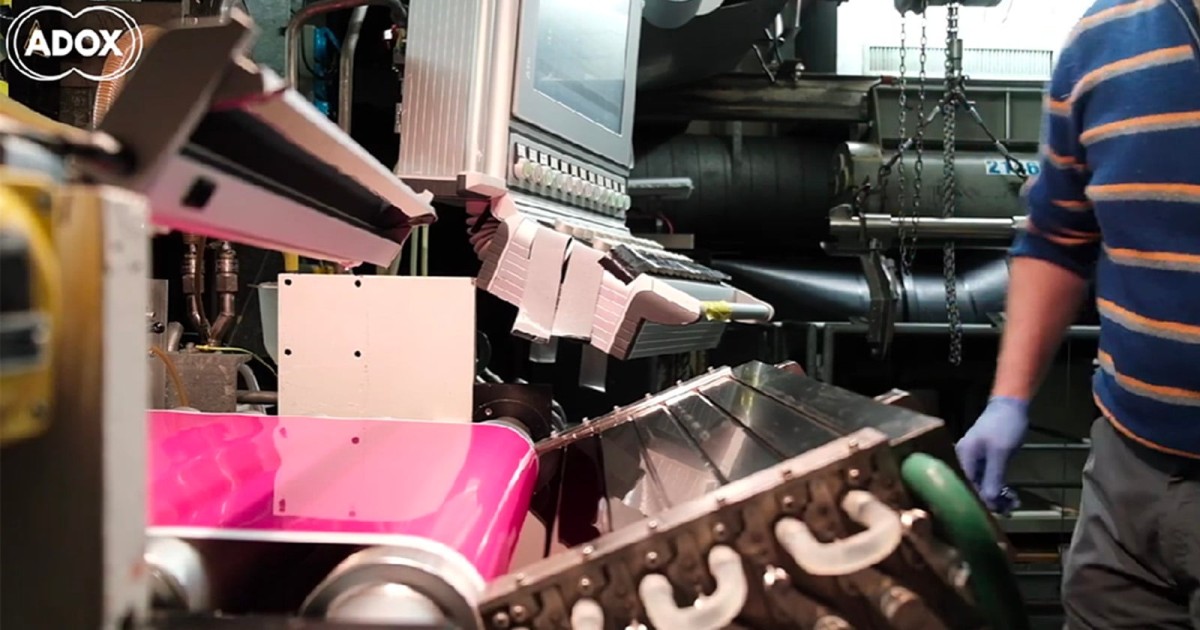
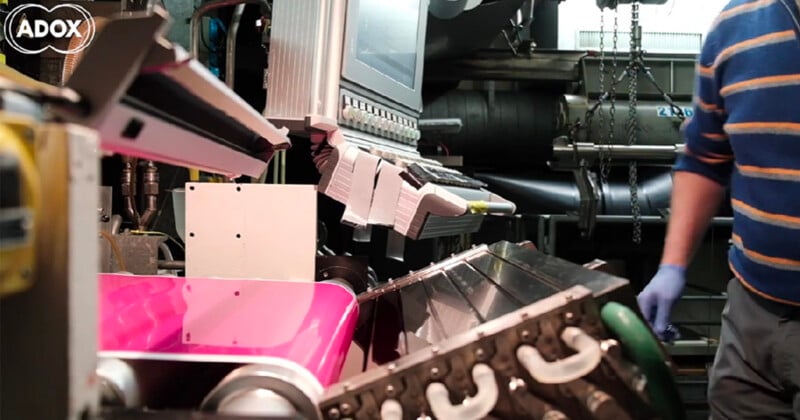 Machine E Coating six slot coating head
In a town close to the French/German language split in Switzerland lies a piece of photographic history that is worth taking a look at. In Marly, Switzerland, lies Machine E, a multilayer photographic coating machine that has been used to bring many world-beating photographic products to the market.
Having worked for Ilford in Marly for over 10 years and being an avid photographer, now that Machine E is entering its next phase for Adox, I thought it time to reveal the machine’s history and how it has been used to bring many world-leading photographic and inkjet products to the market.
Originally built by the chemical company Ciba as part of its dye and pigment research and development facility in the late 60s, it was originally used to develop graphic art films and then later to help Ciba develop the famous Cibachrome color photographic material, which is a 13-layer coated photographic film/paper. Ciba had taken over the Swiss photographic company of Tellko. Tellko coated both photographic paper and films in Fribourg/Marly. Its name refers to Wilhelm Tell, the national Hero of Switzerland.
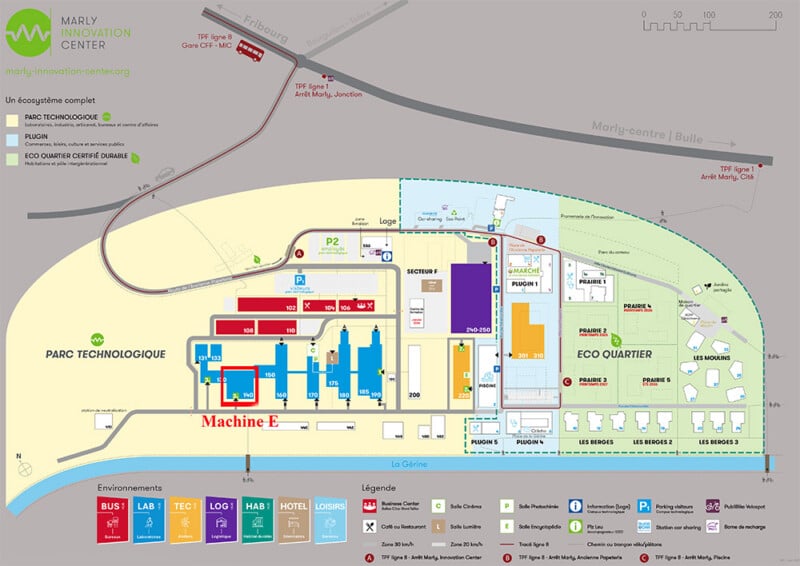
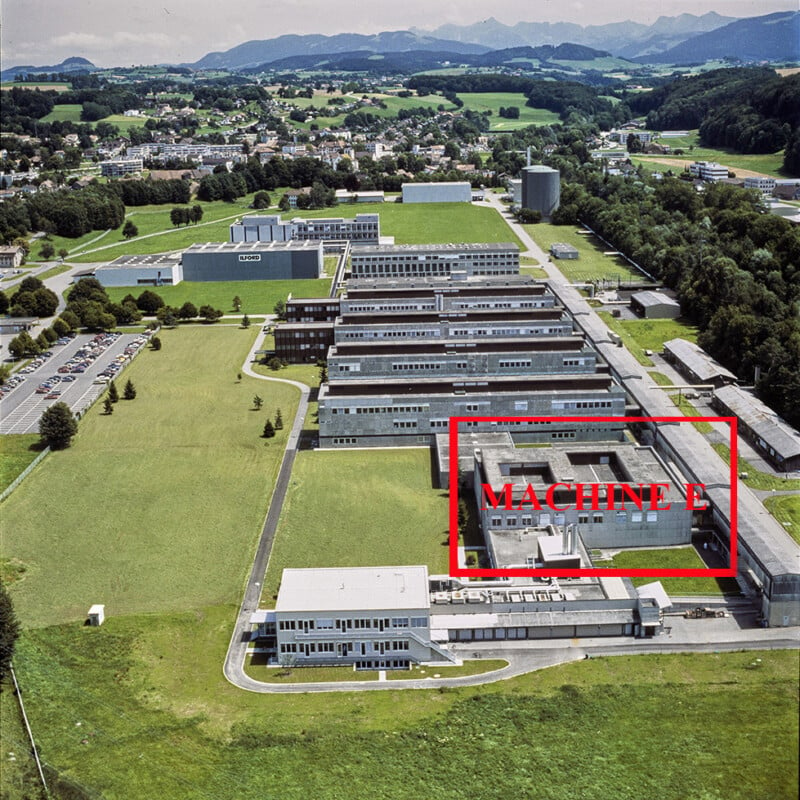 Ciba Marly site of the late 60’s until ILFORD closed. Machine E shown in RED
Ciba purchased shares in Ilford in 1963. Ilford had coating facilities in both the UK and France, coating both film and paper photographic products. It became totally owned by Ciba in 1969. This association continued until 1989, during which time the Machine E development and pilot coater was used to improve the various photographic products before being moved to the larger and automated production T4 coater in Marly. Machine E was also used to help check out new components and changes in coating recipes.
Ilford’s main products were black and white, for which they had built up a reputation for excellent paper and film, but these were not coated in Marly, but in the UK. While Kodak pursued color materials, Ilford continued with black and white products in the UK and Cibachrome and color paper in Switzerland, which, after Ciba pulled out, leaving Ilford in control, Cibachrome was renamed ILFOCHROME in 1992. This product had superb color, which, after processing, had no silver in the final result, just high color performance and very stable, vibrant dyes. Prints made when Cibachrome was first produced still survive and look as they were when originally printed.
Under Ciba, Machine E was built for several million Swiss Francs, which today might cost around $100 million, and is contained within a building at the bottom of the site.
Ilford, which at the time had photographic coating facilities in France, the UK and Switzerland, closed its French coater, which was sold to an Indian company and has still not yet been rebuilt decades later. The UK coating machine was also moved from Brentwood in Essex to its current location in Mobberley, Cheshire. Moving such a coating machine was seen as impossible, but Ilford managed it, and the machine M14 is still in use today with various upgrades. Harman, which now operates the Mobberley site and continues to coat Ilford and other black and white films and paper in addition to inkjet, has recently developed its own color films. Harman has the rights to use the Ilford name on some photographic products they coat.
In the late 1990s, ILFORD developed polymer inkjet products to coat in Marly. I joined Ilford in 1998 at the time it launched its desktop inkjet Printasia range. This was followed in 2000 with its professional Galerie inkjet products. The polymer inkjet media could be used by most inkjet printers; it did not dry quickly, but produced a good color, and the Galerie Pearl finish was seen by many as the one to use. Ilford also coated and supplied inkjet media to a number of OEM`s. As things developed, one OEM wanted something special, and Ilford developed a version of its polymer inkjet for them. The OEM wanted the best inkjet media it could get, and Machine E was used to help fine-tune the recipes and conduct pilot coating before being transferred to the production coater.
As inkjet printers developed and the inks started to move from dye-based to pigment-based, the polymer inkjet media was not really suited for use with pigment inks. The market was also demanding fast printing and drying, which was an Achilles heel for polymer-type inkjet media, so development started around 1995 to coat nanoporous (ceramic) inkjet. This type of media was termed “Instant Dry,” although it takes around two days to dry in ambient temperatures, the ink remains trapped in the ceramic structure of the coating.
Ilford was one of the first companies to really start with ceramic coatings, and over a number of years the coating was perfected using the same base materials used for its polymer inkjet media. The ceramics used for the coating required a special dispersion process to ensure an impressively tiny particle size of 20 nm, which provides for a transparent layer receiving layer. The Galerie range of inkjet was increased to include versions using the nanoporous coating technology and was well received on the market as they could be used with both dye- and pigment-based inks. Epson was the first printer company to use pigment inks in desktop printers. Ilford was taken over by OJI paper in 2005, and continued to produce its inkjet products.
In 2011, the final coating of ILFOCHROME was made due to falling demand and also the supply of some required chemical components. Cibachrome/ILFOCHROME still has a loyal following online. Also in 2011, Ilford announced the development of some chemically treated mulch film to help farmers protect growing seeds from pests. Unfortunately, Ilford’s fortunes declined, and in 2013 the company went into receivership. In 2015, ADOX gained access to Machine E to use it to coat photographic materials.
As mentioned at the start of this article, Machine E is a six-layer development and pilot coating machine.
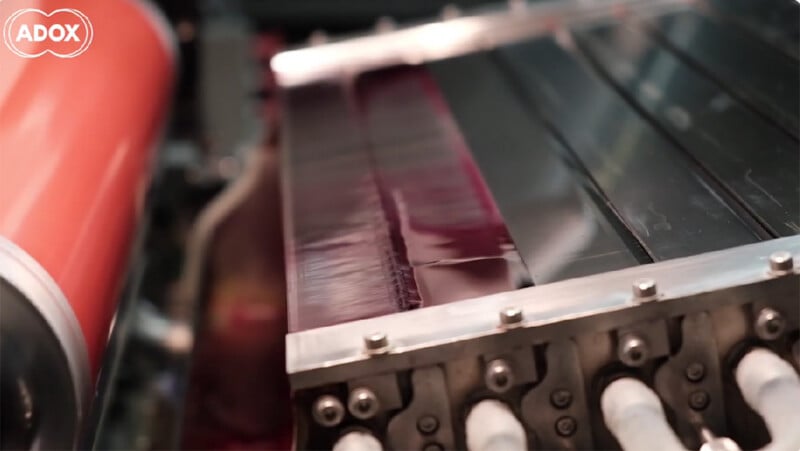 Six slots of the coating head of Machine E
It sits in a self-contained building, number 140, on the Marly site and runs over three levels and is actually a small factory.
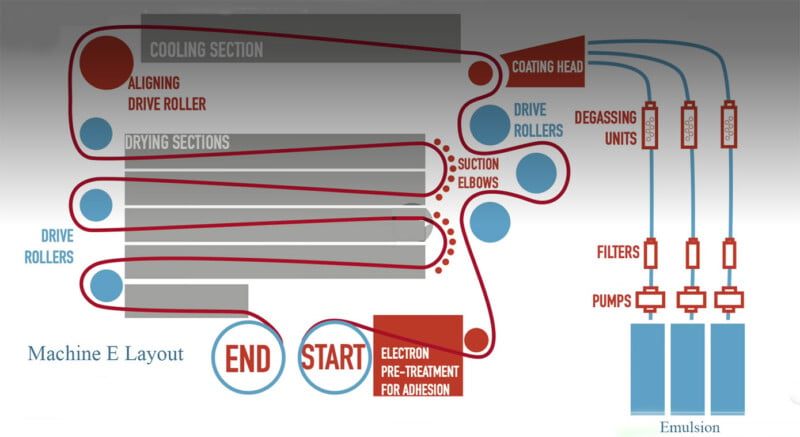 Schematic of Machine E showing the various parts of the coater
The building was effectively built around the machine, and it would not be possible to move the machine, which was ADOX’s original idea when it started having access to the machine in 2015. Building 140 also has laboratories to support the machine, but does not contain any finishing machines. The coater has a width allowing coating up to 20 inches, which is sufficient for coating photographic paper and film at around 30metres/min. Ilford’s production coater was wider and considerably faster. In addition, Machine E does not have the capability of continuous coating, which the production machine did have along with automatic loading and unloading. Because Machine E does not have automatic addition/removal of material while coating, it is limited in the amount that it can coat in any one coating run. This is approximately 2,500 metres, enough to produce a good run of either film or paper product. In ADOX’s case, the coated material is transferred to its Berlin operation to be converted. In the case of film, this will include slitting into 24mm width strips and then perforated before being spooled in the final 35mm cassettes and boxed. To ensure that the coated surface never touches anything during coating, the machine uses several vacuum turns.
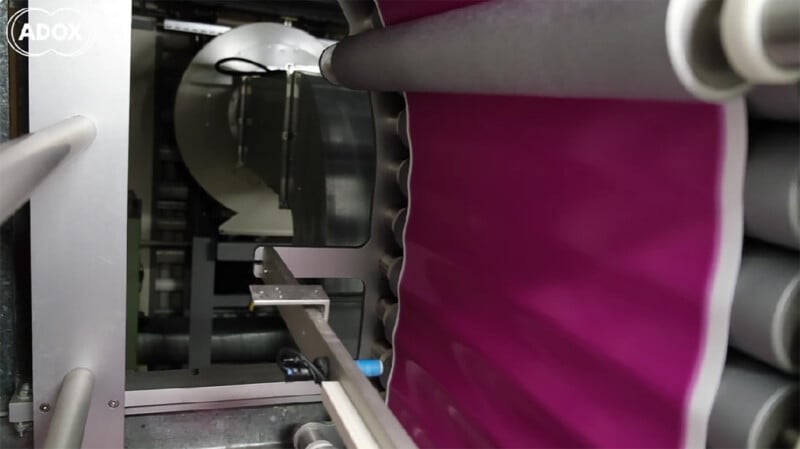 The vacuum backs used to turn the material without touching the machine’s rollers
Machine E has a cooling section after the coating head, followed by a multi-stage drying system to allow the film to dry during the short period it is actually in the coater. ADOX tells me that they buy in the coating emulsion, which is common for some of the other coating operations in Europe.
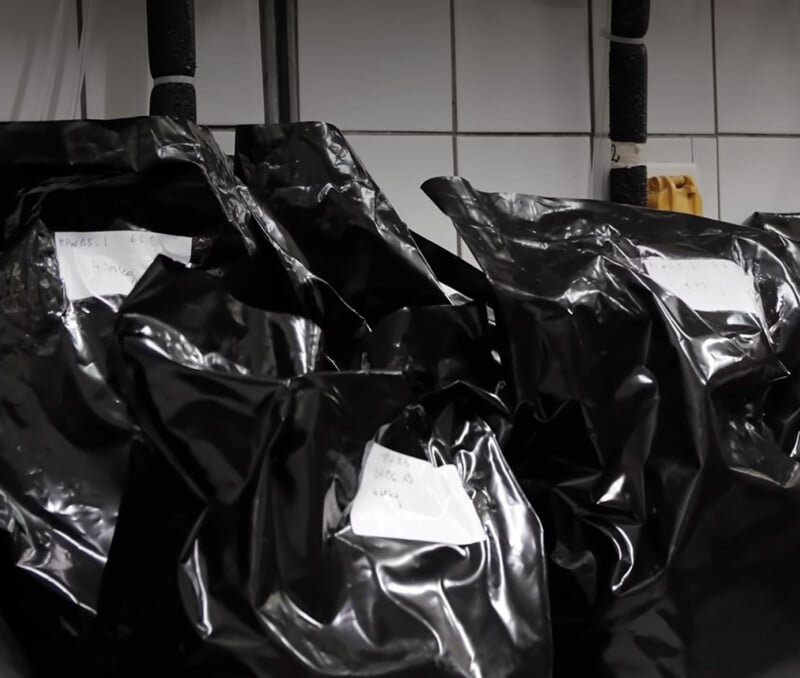 Emulsion arrives in light pour bags before ADOX make it ready for coating
Adox tells me that they will do some upgrades to Machine E to improve its drying capability and reduce costs. This will be a sizeable investment and shows ADOX’s commitment to the future of Machine E and analogue photography.
Since ILFORD ceased production at the Marly site in 2013, it has developed into the Marly Innovation Centre for many companies to operate from and continue to develop new products. The site even has a hotel as people from many nations work on various projects on site. A lot of the old CIBA/ILFORD buildings still exist on site alongside a vast array of new buildings and laboratories for these Innovation activities.
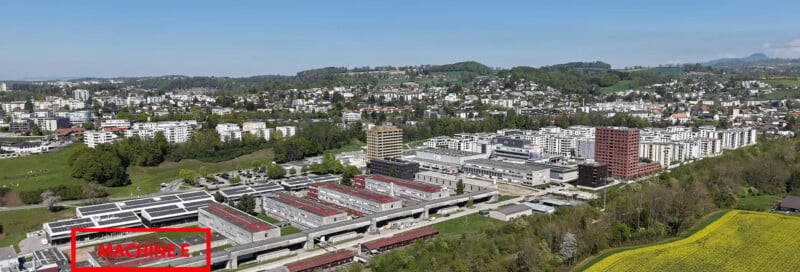 View showing the Marly Innovation Centre today with Machine E shown in red.
Additional significant developments at Ciba’s Marly Research Centre include:
- The red paint pigment used to paint all red Ferrari cars; this red pigment will never fade or degrade like the majority of red pigments used to paint cars. The pigment is around 10x the price of pigments used for normal car painting. Ciba’s Dyes & Pigments division was responsible for this development.
- Development of some of the best inkjet dyes and pigments used in inkjet printers by major manufacturers came from Ilford’s chemists. The dye technology came from the development of the Cibachrome/Ilfochrome developments and its talented chemists.
Below is one last image showing the current Marly Innovation Center. Machine E is shown in red, and the blue buildings in this group are all part of the original Ciba site and also Ilford.
I hope that you can see that Machine E has been part of photographic history since it was built in the late 60’s and, under ADOX, will continue to provide high-end photographic coating for use in analogue film cameras today and in the future. The Marly Innovation Centre also shows that the Marly site can continue to lead new innovation in many areas moving forward.
Information in this article has come from my own collections, talking to former employees of Ilford, and from its archives. Adox also provided me with an interview to help show where they see things going in the near future. It has taken a long time, but at least Machine E will again do what it was designed to do, and that is coat photographic media.
What's Your Reaction?
 Like
0
Like
0
 Dislike
0
Dislike
0
 Love
0
Love
0
 Funny
0
Funny
0
 Wow
0
Wow
0
 Sad
0
Sad
0
 Angry
0
Angry
0










Comments (0)