

Christopher Nolan and Guillermo del Toro Break Down ‘The Odyssey’ Monsters and AI’s Limitations with Production VFX Supervisor Andrew Jackson
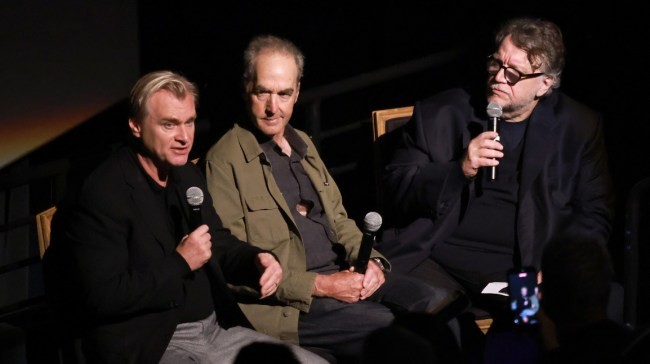
With “The Odyssey,” Christopher Nolan ventured into the realm of fantasy for the first time, realizing a time of towering monsters, swirling whirlpools, and apparent magic. The production is a true showcase for his longtime collaborator, production visual effects supervisor Andrew Jackson, who began working on the film‘s elaborate set pieces far ahead of production.
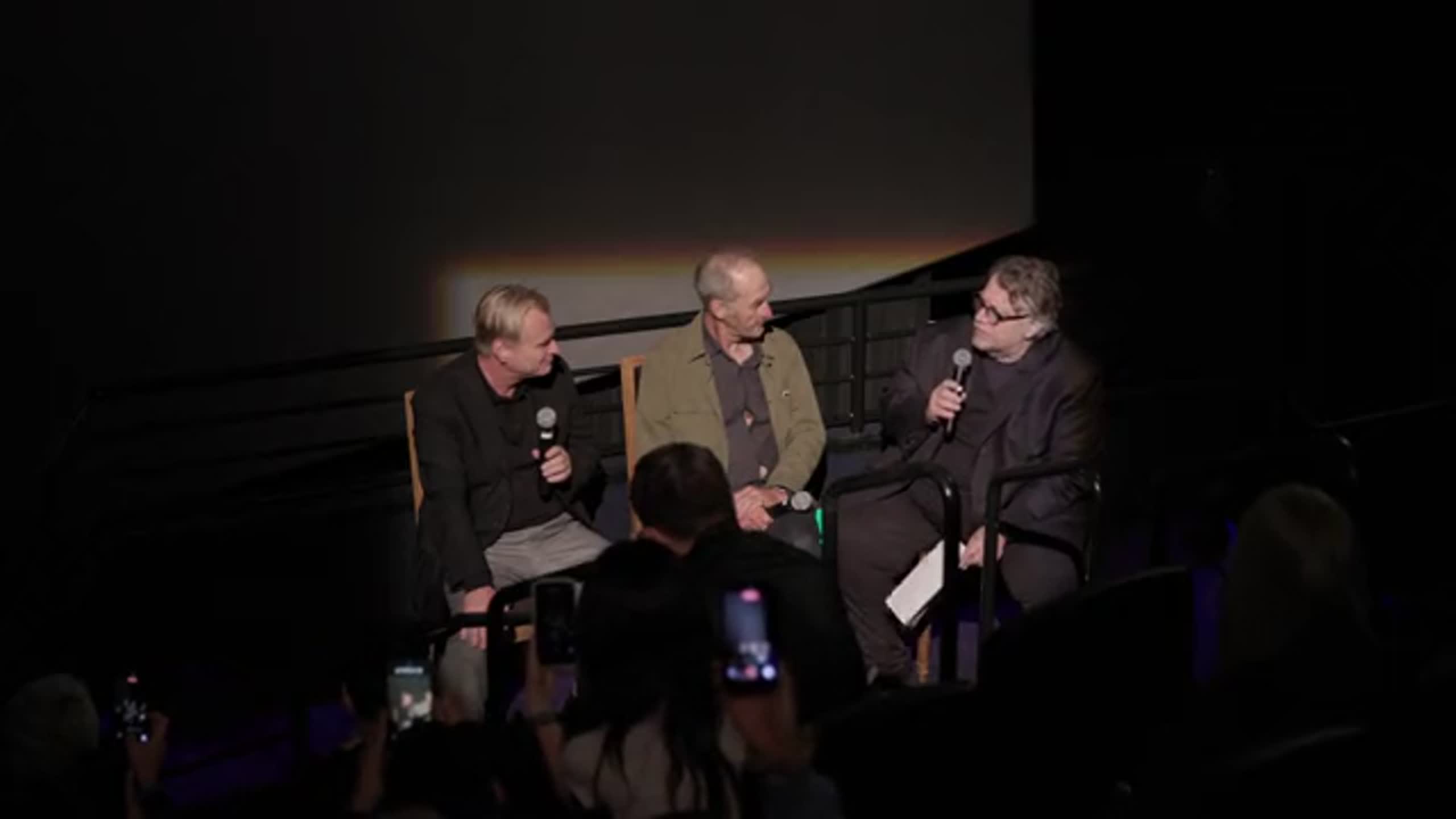
“What’s essential is having the visual effects team be part of the main unit through prep, through the shoot, everything — and not treating you guys as somebody that’s going to come on afterwards and add to the film,” Nolan said, speaking with Jackson during a panel following a Visual Effects Society screening of “The Odyssey” at the IMAX auditorium of AMC Theatres’ Universal Cinema location in Los Angeles. The discussion was moderated by Guillermo del Toro.


“What I’ve found through the years is to treat the effects as a remedial thing that is separate from everything is a big mistake,” del Toro added. “The beauty of it and the respect for the crafts is to integrate them early enough so that they are part of a physical solution as well as the post-production solution.”
The panel offered a detailed breakdown of several standout sequences in “The Odyssey,” including the early encounter with the Cyclops, which was realized with a mix of animatronic puppetry, digital effects, and a performance by clowning veteran Bill Irwin. Nolan shared that Jackson, who started as a model maker, is always one of his earliest collaborators — he was the first person to read the script for “Oppenheimer,” even. Integrating the various design elements of the Cyclops required a constant conversation from pre-production through the editing room.
“We were forced to shorten the time we had to build it,” Jackson began. Nolan then offered a joke: “I like the word forced. It’s good. I’m getting used to my crew members just vilifying me completely as we sit in these Q&As.”
“We both know that the result of being forced to trim away all the more complex parts of the plan resulted in a solution that was better than it would’ve been if we had continued with the original plan,” Jackson continued. “We basically just made a very, very simple marionette, which had still detailed solid components for the physical body, but just missed out on all the complicated joints and where the parts intersected. But the fact that it was simple and moved in a fascinating way that had a life of its own became really compelling.”
“I knew that one day you’d be sitting here and Guillermo del Toro would say it was perfectly integrated, so it’s all worth it,” Nolan said.
As with many industry Q&As these days, the topic of artificial intelligence’s impact on the filmmaking process, particularly on the field of visual effects, was addressed. Nolan, Jackson, and del Toro each emphasized the need for human oversight of the technology’s implementation, suggesting that “The Odyssey” could not have been realized without the conversations that happened across the film’s various departments.
“In an age with artificial intelligence looming — with synthetic creativity around us, or whatever — it’s actually very important to acknowledge the artistry that goes into the compositing process,” Nolan said. “My demand on the compositors and the animators is always to be using their eye rather than their brain, if you like, rather than simulating things or creating a simulation reality. I want them to look at it with an artist’s eye: the way matte painters who were working on glass paintings did, so that there’s an impressionistic quality in the composites.”
“The defense of the human touch and the defense of the craft is as urgent, if not more urgent, to VFX because it is the one that has gotten assailed the fastest by things like AI, which was not invented or demanded from any artist,” del Toro said. “It was demanded and created by people that were alien to that and appeal only to time and money mostly.”
“Well, time and money and also a misunderstanding of the process,” Nolan said.
“You’re absolutely going to need artists to know even whether the new tools have delivered things that you want. You need people to be able to assess that,” Jackson said.
Watch the panel below.
What's Your Reaction?
 Like
0
 Dislike
0
 Love
0
 Funny
0
 Wow
0
 Sad
0
 Angry
0






Comments (0)