

All Kids Out of the Pool: An Oral History of the Adult Swim Launch
On September 2, 2001 at 10 p.m., Cartoon Network abruptly began airing live-action footage of elderly swimmers diving into a pool. The footage was interspersed with quick cuts to lifeguard-inspired signage that promised strong language and adult situations were ahead. The message should have been familiar to anyone who spent childhood summers at public pools: it was time for kids to get out and temporarily cede the space to adults.
The bumper marked the beginning of Adult Swim, an experiment that would change comedy history.
In the nine years since Cartoon Network launched in 1992, the cable network noticed that an increasingly large percentage of its audience were adults, particularly men, who enjoyed watching cartoons. Later in the evening when kids were likely to be in bed, the TV audience was overwhelmingly grown-up. The decision to launch a separate block of programming aimed at those viewers, filled with raunchy cartoons that actively subverted nostalgia and violent anime that couldn’t be shown during daytime hours, was logical. But that didn’t negate the sense of risk for a network that kept its lights on with toy and cereal commercials and promised cable providers that they could count on it to be a family-friendly channel.


Fortunately, the gamble paid off. Not only did Adult Swim find an audience almost immediately, the business grew to eclipse the children’s side of Cartoon Network.
Over the next quarter century, Adult Swim would come to be known as an incubator for comedians and writers whose voices fell outside the mainstream before they went on to bigger things. It became synonymous with a dry, surreal sense of humor that was as apparent in the bumpers played between commercial breaks as it was in the shows themselves. The term “Adult Swim-syle comedy” has been dropped in countless dating app profiles and pitch meetings that have nothing to do with the Atlanta-based network. What began as a low-cost experiment to fill late night programming slots with projects made by an in-house creative team after hours developed into a distinct brand with Velvet Underground levels of influence over 21st century comedy.
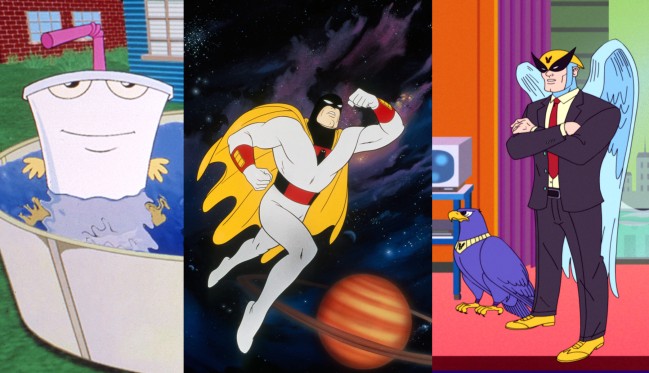
This month marks the 25th anniversary of Adult Swim, and the network has spent much of it taking a victory lap. The festivities began with a “Robot Chicken” special that brought dozens of its signature characters together on a stop-motion cruise ship. Then, on September 2, it recreated its first night of programming by airing episodes of “Home Movies,” “The Brak Show,” “Harvey Birdman, Attorney at Law,” “Sealab 2021,” “Space Ghost Coast to Coast,” and “Cowboy Bebop.” That nostalgic programming continues throughout September as the network reruns the first handful of original shows that put Adult Swim on the map and shaped its voice.
In the lead-up to the anniversary, IndieWire spoke to a group of the executives and show creators (who, in many cases, did both jobs at the same time) that played roles in the formation of Adult Swim to compile this oral history of its launch.
 ‘Space Ghost Coast to Coast’©Cartoon Network/Courtesy Everett Collection
It all began in 1991, when Ted Turner purchased the rights to the Hanna-Barbera animation library for $320 million. The TV mogul, who had already founded TBS and CNN, saw the growing cable market’s potential as a place to monetize existing films and shows. (He had already acquired rights to much of the MGM film library and would found Turner Classic Movies with a similar goal in 1994.) With control of properties like “Scooby-Doo,” “The Flintstones,” and “Yogi Bear,” among countless others, he set out to build a network that would keep the characters on the air full time. In 1992, the Cartoon Network was born.
Perhaps it was inevitable that a channel with unlimited access to some of the 20th century’s most iconic characters, but little budget to do anything else, would turn to pastiche. The first few years of Cartoon Network featured reruns abound, but it wasn’t long before the young group of animation enthusiasts who moved to Atlanta to work at the network found ways to put their own spin on the characters.
To Michael Ouweleen, who currently serves as president of Cartoon Network, the biggest early opportunities for creative expression came in the form of graphics that aired between shows. Ouweleen would go on to create “Harvey Birdman, Attorney at Law” and help define the Adult Swim animation voice a few years later, explained that he began experimenting with repurposing old Hanna-Barbera footage to make contemporary comedy when he began serving as creative director of Cartoon Network’s On-Air Group.
“We made promos and stuff for shows and marathons and things like that, but there was also four minutes every hour we had to fill. So we would make little mash-up cartoons where we’d take cartoon characters out of context and we’d put them together in the real world. And we called those interstitials,” Ouweleen said. “It began with the idea of using the characters that Ted had sold his boat to buy in these sort of Hamburger Helper ways, to make something out of the leftovers. We all got intoxicated by how fun it was to take a Froopy Dog and cut him out and make him say things. And that was the ethos that birthed Adult Swim.”
 ‘Space Ghost Coast to Coast’©Cartoon Network/Courtesy Everett Collection
The greatest early example of this mentality came in the form of “Space Ghost Coast to Coast.” Created by Mike Lazzo in 1994, the satirical talk show served as Cartoon Network’s first piece of fully original programming. It took the characters from the 1960s cartoon “Space Ghost,” which followed the generic adventures of a vanilla Superman knock-off who frequently rescued his intergalactic sidekicks from a praying mantis named Zoltar. The original show was utterly forgettable, but recognizable to Cartoon Network’s early adult audiences who would have been kids watching whatever aired on Saturday mornings in the ’60s.
The underdeveloped character proved to be the perfect canvas for the early Cartoon Network writers to impose their sensibilities onto. “Space Ghost Coast to Coast” saw the masked hero hosting his own talk show from outer space, with his former enemy Zoltar serving as his reluctant bandleader. The character would sit behind a desk and speak to movie stars promoting current projects on earth who were beamed in via a TV screen.
Space Ghost was as the most incompetent talk show host the world would see until Adult Swim launched “The Eric Andre Show” 20 years later, frequently asking non sequitur or blatantly offensive questions to guests who often appeared to have no idea what was going on. In between the surreal interviews, the show-within-a-show always appeared on the brink of collapse, with re-dubbed scenes from the original “Space Ghost” cartoon showing the character flying around the galaxy trying to keep his crumbling talk show on the rails.
“It was amazing, but it was also ramshackle,” said Dave Willis, who began his career working on “Space Ghost” before co-creating Adult Swim staples like “Aqua Teen Hunger Force” and “Squidbillies” a few years later. “We would interview guests, but we wouldn’t fly them in, there were no niceties, we would do it over a speakerphone. It lent itself to the quality of being in outer space, because they’d be sitting there in a CNN studio somewhere, looking around, going, ‘Where is this voice coming from asking me questions?’ It wasn’t like a host hugging them and asking them about their current projects. It was more like a host trying to understand what a human does, because he’s a ghost from space!”
While “Space Ghost Coast to Coast” was produced long before Adult Swim was ever conceived, it provided a template for the network’s style that would remain in place for years. The juxtaposition of old cartoon footage from the ’60s and ’70s with darker, off-the-wall humor might have emerged out of necessity, but it was the perfect way to reach an audience of older animation viewers who had a working knowledge of Hanna-Barbera characters from their own childhoods but were now old enough to want something edgier.
 ‘Harvey Birdman, Attorney at Law’©Cartoon Network/Courtesy Everett Collection
The tight community of Atlanta-based creatives who built Adult Swim would return to the format with projects like “Sealab 2021,” which repurposed the gentle ’70s underwater cartoon “Sealab 2020” into something closer to “Below Deck,” with a crew of submarine researchers that were too preoccupied with hookups and petty grudges to do anything for the environment; and “Harvey Birdman, Attorney at Law,” which used a courtroom format to place various Hanna-Barbera characters on trial for adult crimes (think Fred Flintstone ordering mob hits and Shaggy and Scooby getting caught with weed).
By the turn of the century, the Atlanta team’s growing creative ambitions and increased evidence of an adult audience sparked the idea of a nighttime block of adult-focused programming. But it was a tough sell to a Turner leadership team that was content to keep enjoying the benefits of adults watching its children’s network without tainting the family-friendly brand by explicitly catering to them. Early appeals to management were met with dismissals or suggestions to simply re-run old shows in the company library like “Gunsmoke” and “Bonanza.”
“I had to go sit down with Andy Heller, who was the head of our distribution at the time, with Vicky Miller, who was our CFO at the time, with Phil Kent, who was the CEO, all of these people who are opposed to this, they thought it was frivolous, that it was a waste of money, and so on,” said Jim Samples, who took over as Cartoon Network president in 2000 and ran it through the first seven years of Adult Swim. “And literally, I told Vicky Miller, ‘Look, I’m so convinced of this that I will resign if it doesn’t work.’ And all of us, not just me, we were all convinced of it because we could just see it starting to take on this viral, for whatever viral meant back then, kind of life.”
The idea was eventually approved with a limited budget and an even more limited timeframe, forcing everyone involved to work around the clock to meet the initial deadline.
“They said ‘You have one year to do it, one year to name it, one year to make the shows,’” Ouweleen said. “And one year is not a huge amount of time. So all these shows had been developed around the office, ‘Aqua Teen,’ ‘Sealab,’ ‘Harvey Birdman,’ were suddenly gonna get made because we had no other choice.”
The majority of the original Adult Swim show creators were already working at Cartoon Network or its in-house production company Williams Street and had been dreaming about writing their own series for years. That meant that quickly getting shows into production wasn’t a problem — but choosing a name for the programming block became a bigger challenge. With sensitive relationships with advertisers and cable customers to manager, Turner leadership gave the team a clear mandate to choose a name that made it abundantly clear that children were supposed to turn off the TV when the adult programming began.
“We came up with four names,” Ouweleen said. “One was ChannelBlock, which was a super witty name, because back in the day, cable boxes had a thing where pants could turn off certain channels. So it was ChannelBlock, it was a pun. I’m glad it didn’t turn out to be that, because no one knows that that was a thing today. And then another was Aviso, which just means warning [in Portugese], and that came out of us just seeing one of those little yellow stands after a guy mops in our bathroom. So we came up with a graphics package that was all that little stickman wiping out and stuff. And then Insert Quarter was another one, which had nothing to do with scaring kids away.”
In addition to “Space Ghost Coast to Coast,” “Sealab 2021,” and “Harvey Birdman,” the initial batch of Adult Swim originals also included “Home Movies” and “Aqua Teen Hunger Force.” “Home Movies” was the only show produced outside of the company, with Brendon Small selling the cartoon about an eight-year-old aspiring filmmaker who makes crude movies while dealing with his own childhood difficulties to UPN when he was just 23 years old. Though the show struggled to find an audience on the Paramount-owned network (being frequently preempted by hockey games did not help anything), it was exactly the kind of thing that Lazzo and the Adult Swim team were looking for.
 ‘Home Movies’
“We were pretty much canceled within a month or two. But by month three or four, we got a call from Adult Swim,” Small said. “And they said they’re trying to build their own evening of adult animation, and they thought that ‘Home Movies’ would be a pretty good gap from Cartoon Network Kids World to Adult World, because our show is not a kid’s show, but there are prominent kid characters in it.”
And then there was “Aqua Teen Hunger Force.” Even after 25 years, Dave Willis and Matt Maiellaro’s series about an anthropomorphic milkshake, french fry container, and a wad of meat wasting their days in suburban New Jersey remains one of Adult Swim’s most recognizable properties.
The show’s original intro makes it look as if the fast food mascots are ready to solve crimes and go on adventures, though the vast majority of the show involves them lazily hanging around the house, passively reacting to supernatural events and feuding with their neighbor. The mix of deliberately lo-fi animation (the show repurposed backgrounds from other cartoons in the Turner library like “The PowerPuff Girls”), dry surrealism, and slacker nihilism made it an often-imitated fixture of Adult Swim’s lineup for decades to come.
 ‘Aqua Teen Hunger Force’©Cartoon Network/Courtesy Everett Collection
“We just thought of them as a sentient value meal that lived in a rental house in New Jersey,” Willis said “I think our boss was like, you know, they need to be like detectives. They need to have a goal. And he was right, maybe, in the sense of traditional television development. Like, yeah, of course, the characters have to have a reason to exist, to do something, you know? But we were like ‘No, it’s just sort of funny when things just kind of happen to them.’ In television development speak, they would say your characters aren’t proactive, they’re reactive. But who cares, people liked it. Plus, we couldn’t afford to have them go places. That would mean we would have to make additional backgrounds. That cost money, and no one gave us any money to make it.”
As the September 2001 launch approached, there was an overwhelming sense of confidence that the Adult Swim project was going to succeed. Viewership data showed that one third of the Cartoon Network audience was adults who watched without children. And while competition from Disney and Nickelodeon tended to beat Cartoon Network because of its relative underperformance with young girls, its success with male viewers of all ages led the leadership team to believe that animated programming aimed at adult men would be a home run.
“The dirty secret is, Nickelodeon always kicked our butt with children,” Ouweleen said. “Because we never thought of ourselves as a kid network. We were like, this is for cartoon lovers. We’re adults, and we love cartoons. And we would never talk down to kids, because we’re like, ‘They’re cartoon lovers, they’re smart, right?’ So, we thought it was gonna be totally successful. We were like ‘We already have the audience, they’re gonna be totally psyched!’ We weren’t nervous at all.”
“Part of the logic was, ‘OK, let’s not compete for those girls, but instead let’s compete with these guys where they don’t expect it,'” Samples added. “Viacom owned Nickelodeon, but it also owned Comedy Central. So let’s compete with Comedy Central because we have a lot of older adults, men and women, mostly men, watching Cartoon Network. That was a long-term plan that we’re going to do kind of a flanking attack on Comedy Central and the late nights and go after the 18-34 numbers while keeping our boys 6-11 numbers solid. That was the business plan was to begin to do that. It was a stretch. It was hard for our management to believe, but that is what happened.”
Even factoring in setbacks like launching a comedy brand the week before 9/11, the initial Adult Swim ratings proved strong enough to justify airing the programming block two nights a week for the next two years. In 2003, a decision to expand Adult Swim to four nights a week proved to be the final piece of the puzzle. A more consistent presence on TV, largely anchored by reruns of recently-cancelled cartoons like “Family Guy” and “Futurama,” turned the block into a dependable countercultural hangout space.
“It was almost two years after launch that it really started to take off when we began to do four nights a week,” Samples said. “And ‘Family Guy’ and ‘Futurama’ made it. It went from being a quiet success to being a phenomenal success. It was about that time that we started to beat a lot of the late night shows, even broadcast television shows with ratings.”
That was also when many of the brand’s signature aesthetics — the black-and-white [as] logo, bumps and interstitials that break the fourth wall, and legendary April Fool’s Day pranks — began to take shape. Adult Swim SVP, Creative Jacob Escobedo, who has worked on the brand’s visual language since before it launched, explained that it quickly developed a voice that felt like a precursor for much of what we would come to recognize as “internet culture” over the next few decades.
“When we started to talk to people through our bumps and really create this personality, it felt like the internet before the internet,” Escobedo said. “It just felt like we were a part of that culture before it was kind of significant.”
A quarter century into its run, Adult Swim’s influence on pop culture is not up for debate. What’s less clear is what’s next for the brand.
While it continues to survive corporate merger after corporate merger, many of the strategic advantages that made its inception possible no longer exist. The internet has provided alternative comedy fans with a multitude of other opportunities to consume off-the-wall humor at any hour of the day. And while Adult Swim is still capable of producing shows that resonate with its core audience — just look at recent hits like “Smiling Friends” and “Common Side Effects” for evidence of that — the decline of linear TV dilutes the appeal of a product that was designed as a parody of the traditional TV viewing experience.
But the Atlanta-based leadership team, much of which remains unchanged after 25 years, isn’t worried. Ouweleen, who took over the top job following the retirement of longtime leader Mike Lazzo in 2022, stressed that the network retains its commitment to subverting expectations even as formats change. Even when streaming numbers matter more than cable subscriptions and social media content plays a bigger role in maintaining the brand’s voice than interstitials, that voice and the people who developed it remain largely unchanged.
“We do obviously think of it as a brand, but we think of it more as a conspiracy to surprise people,” Ouweleen said. “And there’s not that many entities or groups of humans whose job it is to surprise people and catch them unaware and do something interesting. So we’ve all decided, this is what our job is. We just gotta keep this thing going.”
What's Your Reaction?
 Like
0
Like
0
 Dislike
0
Dislike
0
 Love
0
Love
0
 Funny
0
Funny
0
 Wow
0
Wow
0
 Sad
0
Sad
0
 Angry
0
Angry
0








Comments (0)