

Ava Duvernay Didn’t Make a Sequel — She Made ‘14th’
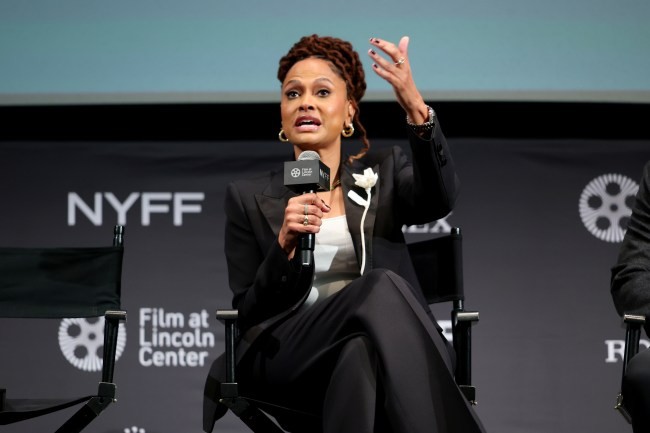
There are, of course, many connections between filmmaker Ava DuVernay’s Oscar-nominated documentary “13th” and her latest film “14th,” including both films world premiering at the New York Film Festival, a decade apart. “What a beautiful symmetry to be able to bookend it. Ten years ago, it’s opening night. Ten years later, it’s closing night,” the director told IndieWire over Zoom.
However, “I wouldn’t say it’s a sequel,” she said. “Even in its construction, all that it’s doing, it’s something different in a series of films and analyzing the Constitution against our current-day happenings, really.”
If “13th,” her documentary about the 13th Amendment of the Constitution of the United States, and how it pertains to America’s prison industrial complex and mass incarceration, was “very linear,” as DuVernay described it, then “14th” “was really a puzzle.”


Initially, the Academy Award-nominated filmmaker intended to make a documentary focused on birthright citizenship. This was before President Trump was re-elected in 2024, though he had already made his intentions to immediately eliminate that core part of the 14th Amendment to the Constitution his first day in office known to his base. “I literally did the worst thing you could do, pitched that very casually to Adam Del Deo who runs docs at Netflix. And he said, ‘Well, yeah, we should do that,’” she said.
What DuVernay didn’t realize was that “it [would] open this Pandora’s box.” Birthright citizenship is just one part in a document with five parts, with the first part being split into three sections. “Part of the journey of the film was learning the rest and seeing how it was ricocheting against current events in ways that were so startling and shocking. I couldn’t believe it was unfolding in front of my eyes as we were making it,” said the director. “I’ve likened it to building the plane while you’re flying.” As news would break, she’d often find herself saying “Oh, my God, this happened. Put that in there!”
She pitched and sold the film without having full grasp of what the 14th Amendment was, but she soon found out, even in interviewing top legal experts, “nobody knows.”
One part of the amendment, which was crafted during the Reconstruction period post-Civil War, was about public debt, and basically says that taxpayer money on both the federal and state level is not allowed to be used to pay off the debts of those who rebelled against the United States. “The secret, crazy thing about this is I couldn’t figure out how to do [it],” DuVernay said. “I can’t force some public debt thing. It’s so obscure. Even Eric Foner, our grandfather of everything, he’s reading it in his pocket [Constitution] because he doesn’t even know it off the top, public debt. And then he looked at the camera, and he said, ‘They must have thought it was important.’”
 Director Ava DuVernay and historian Eric Foner in ’14th.’Netflix
She said, “I was going to make a joke out of it. And then Trump puts together an insurrection fund.” The director saw the news, called legal expert Sherrilyn Ifill, a key participant in the film, and “I was like, ‘Is this public debt?’ And she was like, ‘Yes, it’s the public debt! We can’t believe it. It’s the public debt.’”
As a U.S. citizen, it was difficult to not be horrified at the precision with which the Trump administration was attempting to dismantle every part of the amendment, but as the director of “14th,” it contributed to making DuVernay’s vision for the film even clearer. She had an idea of using a star as a symbol for the amendment, with each point being ripped away by news of some new executive order the president signed, but “you can’t really rip when there’s one piece that’s unripped,” she said. The slush fund for January 6 rioters was the last bit she needed.
“It just shows how deliberate this is. How every single piece of every part of this is being undermined. Because if you can get one to crack, then the whole thing starts to crack. You could actually legally destroy the whole thing,” said the documentarian, in reference to the 14th Amendment. “And so, look, all hands on deck. Everything is attacking it. And it’s challenging because we don’t even know what to fight for because we don’t even know what it is.”
“14th” also became an opportunity for DuVernay to be more expansive as a director. “In ‘13th,’ my idea was that all the environments felt like labor, so [participants] were behind glass and brick and steel, forced labor of slavery and then of prison industrial complex,” she said. “And this, I wanted to get the pillars around folks, the railings, the iron, the things that hold us in place, because that’s what the 14th Amendment is.”
With that idea of the “architecture of democracy” in mind as both a thematic and visual motif, DuVernay added some verité to her repertoire, shooting librarian Carla Hayden inside the hallowed halls of the Library of Congress shortly before she had been fired by the Trump administration. Conversely, she followed contractor Devon Henry, who has made a career out of taking down Confederate monuments. “The question is, how does that fit in with everything else? At some point, you just put it in the stew and mix it up,” she said.
 Ambassador Jeff Flake, Sherrilyn Ifill, Ava DuVernay, Spencer Averick, Tammy Thomas-Garnes, and Paul Garnes attend the ’14th’ Press Conference during the 64th New York Film Festival at Walter Reade Theater on October 09, 2026 in New York City.Dimitrios Kambouris/Getty Images for FLC
The director tapped designer William Roy Hodgson, who works at the Monuments Lab that tracked where and when all those Confederate statues first were erected, to be the film’s chief graphic artist and animator. He had never worked on a film before, but had the institutional knowledge she needed in addition to his artistic skill. “It’s one thing for me to assign, ‘Hey, make a graphic on this.’ It’s another thing to work with an artist who is also researching and bringing things too,” she said. “It’s really rare to have that in one person. So, all those graphics were done by one guy in his apartment in New York.”
DuVernay also collaborated with Asteria Film Co. to help restore some photos she and her team had come upon as they plowed through archives, from the Smithsonian Library of Congress to the Arkansas Historical Society, even people’s family albums. So while access was not a problem, “some of that stuff was really degraded,” she said. “We were down in boxes and crates and with slides that had never been digitized. They said, ‘Well, if you can digitize it, you can use it.’” The director added, “You can’t really get it to be high resolution enough to put in a film,” and that’s where Asteria’s AI-powered tools were of assistance.
That whole process of digging through photo archives and restoring them led to DuVernay developing a stereoscopic technique, building on the old idea of how two photos side by side could be framed in a way that made them look 3D. “When I saw those at the Library of Congress, I thought, ‘Oh, I want to do that for my audience to see a picture like that.’ And so, first you have to restore it, then you have to do rotoscope, and then just a little bit of animation for a little movement. And the artists there used those tools and brought it to life in the way that I wanted,” she said.
The way in which all of those elements are weaved together in “14th” is impressive, but DuVernay understands that it can be too much information to receive in one go, and so audiences need a break. In “13th,” she used music. “Lyrics come up on the screen. Different people through different times are talking about prison embedded in the artwork of their music,” she said. She got the notion from watching and studying Ken Burns documentaries. “I’m going to slow this down and just watch this flower bloom for a little bit so I can just process what’s been going because we’re moving really quickly,” she added.
 ’14th’Netflix
The breaks in “14th” come through stand-up comedy segments. The first clip she found was one of Paul Mooney, which she uses in the film. “It makes me laugh so much. And I thought, ‘Oh, wow, let’s look at other political comedians, comedians who’ve really used comedy to pierce through. And I will say right now, the reason why I became so enamored with the idea of using the comedians is I believe they really are truth tellers in this moment,” said DuVernay. “News is skewed. Democrats have their news. Conservatives have their news. Ultraconservatives have their news. Super Progressives have their news. It’s just everyone is in their camp, and it really feels like it’s only the comedian who can get out and say what needs to be said, and pierce through it.”
The director also tried to cast participants in the film that were across party lines. “We wanted far right, far left, Anna Paulina Luna and AOC, completely different sides of the thing. It’s really important to get as much of that in there as I can. We tried,” she said. It was much more challenging than she thought, with former Arizona Senator Jeff Flake being the highest-ranking conservative politician among the handful she interviewed. “Three hundred and twenty-six requests to every sitting [Republican] congressperson, senator, governor, and mayor of a major city. Who said yes is who’s in the documentary.”
She said, “It was pretty challenging and a tough pill to swallow that none of them wanted to sit down with me. I feel offended,” but with “14th” now premiering at NYFF, DuVernay believes that audiences will be able to realize that the dismantling of the 14th Amendment is not a scenario in which everyone loses. She compares the film to the bell in a boxing match. “I want people to fight,” she said. “I want people to come out of it alert, aware, and wanting to stand up for this.”
That is one more difference between the America in which “13th” was released, and where the country is now. “[Then], we had the capacity to focus on the plight of one particular group,” she said. “Now, everyone is being attacked. Everything is happening. We see it with the immigrant community. Enough people are not leaning into what’s happening.”
DuVernay concluded, “You have to put on your own oxygen mask first,” but “what this [film] says is, ‘Look, we’re all in this together. And whether I like you or not, it’s going to take that kind of groupthink to dig ourselves out of it.’ That’s not possible if we’re not even talking to each other and we don’t know what we’re talking about. So, hopefully this gets people on the same page.”
“14th” will have its world premiere at the 2026 New York Film Festival on Friday, October 9. Netflix will release the film in select theaters on Friday, November 27. The film will arrive on Netflix on Friday, December 4.
What's Your Reaction?
 Like
0
Like
0
 Dislike
0
Dislike
0
 Love
0
Love
0
 Funny
0
Funny
0
 Wow
0
Wow
0
 Sad
0
Sad
0
 Angry
0
Angry
0






Comments (0)