

‘Company’ Review: Casey Affleck’s Nesting Doll Narrative Is Pretty but Directionless
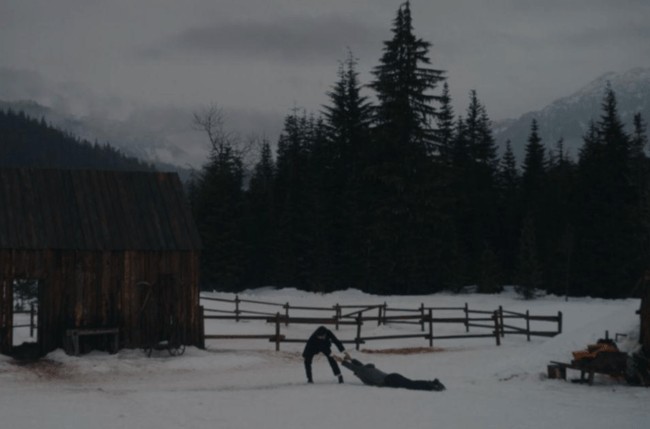
While it takes an appropriately rigid approach to its withdrawn characters, Casey Affleck’s “Company” ends up a stiltled story-within-a-story (within another story, with some segues), and therefore strains to connect. Despite its mere 92-minute runtime, its shadowy, eye-catching tableaus extend for lengthy stretches without conjuring much meaning — or at least, without meaning appropriate to its characters’ sprawling, novelistic dialogue.
These result in some stellar performances, but they end up in service of a tale whose inflexible form is so paramount to its telling as to be self-defeating, rather than self-reflexive. It’s also a film where explaining its narrative mechanics and its crisscross production takes a while — it has eight different cinematographers: Masanobu Takayanagi, Lachlan Milne, Adam Arkapaw, Marcell Rév, Holger Jungnickel, Joaquin Baca Asay, Noah Fallis, and Affleck himself — but then actually explaining the function of each moving part doesn’t feel worth the effort.


It begins in the 1970s, as a mysterious traveler, Evelyn (Emily Alyn Lind), shows up to an ongoing dinner party while claiming to be lost. As Bob Dylan’s “Shelter From The Storm” accompanies a downpour — thankfully, the track’s significance ends up a tad deeper than mere respite from a deluge — Evelyn’s voiceover speaks of welcoming and learning from guests, and of Persian mystics who spin grand tales, gesturing towards “Company” as a modern “One Thousand and One Nights.” So, it’s no surprise when Evelyn takes on the role of Scheherazade, regaling the evening’s guests with a story she attributes to her recently deceased relative.
This second tale unfolds in an isolated cabin in the 1950s, as a lonely man on death’s door, Tom (Nick Nolte), a father in wait for his estranged daughter, finds an unconscious maiden, Alice (Caylee Cowan), outside in the snow. She awakens in his care and, in turn, begins narrating yet another story. of which their situation reminds her: that of her grandmother Rebecca (Adelaide Clemens), her grandfather Emmett (Scoot McNairy) and the wayward teen they themselves found passed out on their farm in the Nebraska winter, Caleb (Atticus Affleck). This is, thankfully, the final dream layer, but the “Inception”-like heist “Company” pulls isn’t all that interesting or cathartic by the time the pieces fall in place.
This third story, of the drifter Caleb, is set somewhere near the turn of the 20th century, and ends up with the lion’s share of the runtime, since it’s the only one intended to have a legible plot. Although the other two are mere framing devices, they keep recurring as reminders of fictitious artifice. Caleb’s arrival on the couple’s farm coincides with rumors of grisly killings — every time someone mentions these or other anecdotes, they tend to play out on screen, each one courtesy of a different camera team (though the movie still has an overarching style and mood). The couple hires Caleb as a lookout and braves his sullen outbursts, learning more about the lonely, angry youth as the murders draw nearer.
A sense of mystery pervades each tale, thanks to most of its scenes being set by fireside, allowing flickering flames to imbue the characters with hints of life and volatility. The camera itself, however, remains largely locked off as Affleck captures at-length monologues in which the characters (primarily, Caleb) begin to relay thoughts of closely-held angst, death, and a dozen other unpleasant things that cause their ramblings to get lost within themselves. Others speak of letting go and moving on, hinting at ideological skirmishes between nihilism and existentialism which aren’t quite allowed to emerge from beneath the film’s oppressive wordiness until late into its runtime.
It also features certain gothic genre elements that, when they finally emerge, are more likely to engender a shrug than a dropped jaw. Their casual arrival an hour in doesn’t allow them to steal an ounce of attention from the flowery monologuing. The words themselves feel poetic, almost decadent, but the images are robbed of their power to meet them, as each frame feels aimed only at presenting, rather than luring or excavating.
Some actors create worthwhile moments. McNairy is wryly funny as Emmett; Ben Mendelsohn shows up as his fierce, sarcastic Australian neighbor; Nolte is deeply sympathetic as a man filled with nebulous remorse; and the director’s son Atticus performs admirably as a teen out of time — though perhaps in the wrong direction, with a discernibly modern moodiness. Still, he plays a hormonal, frustrated teenager to a tee, ensuring that unraveling the mystery of Caleb is at least a mildly intriguing prospect. Unfortunately, even though the movie’s women are given the power of narration, they’re stripped of narrative power in the process, becoming vestigial to their own recitals.
By the time it’s all said and done, once the dots are laboriously connected, and Affleck’s other son Indiana shows up in a small but significant role — it’s a family affair — “Company” seldom coheres around a guiding idea beyond vague notions of mortality and platitudes about learning to live well. That the film is dedicated to Affleck’s parents is certainly sentimental, but it’s a struggle to make sense of what its static images are trying to say, even though its characters explain their anxieties at length.
As a story about their stories — and about guests who bring wisdom, and tales which can heal — it ends up especially noncommittal, with barely a flourish to accentuate its subjects’ moods, or judicious directorial decisions to grant the camera meaningful relationships with their points of view. If the film is about itself, and the company it provides… well, it’s time to head out. You have an early day tomorrow.
Grade: C+
“Company” premiered at the 2026 Venice International Film Festival. It is currently seeking U.S. distribution.
What's Your Reaction?
 Like
0
Like
0
 Dislike
0
Dislike
0
 Love
0
Love
0
 Funny
0
Funny
0
 Wow
0
Wow
0
 Sad
0
Sad
0
 Angry
0
Angry
0









Comments (0)