Corsair HX1000i Shift Crystal power supply review: 1000W Platinum efficiency with an eye-catching transparent aesthetic
Nov 12, 2026 - 20:05
01
Built by CWT, the HX1000i Shift Crystal is a showpiece that backs its looks with real substance. Efficiency is excellent, regulation and ripple are tight, and the fanless window covers half of its rated output at room temperature. Taiwanese capacitors, a noisy hot run and a 200 mm long chassis are the compromises, while the ten-year warranty and iCUE LINK integration add genuine value.
Reasons to buy
+
Excellent overall efficiency
+
Cybenetics Platinum certified
+
Tight voltage regulation
+
Low ripple
+
Fanless up to 500W
+
Striking transparent design
+
Integrated iCUE LINK hub
+
Per-pin 12V-2x6 protection
+
10-year warranty
Reasons to avoid
-
Taiwanese capacitors
-
Long 200 mm chassis
-
Loud when hot
-
Needs side clearance
Why you can trust Tom's Hardware
Our expert reviewers spend hours testing and comparing products and services so you can choose the best for you. Find out more about how we test.
Corsair needs very little introduction to anyone who has built a PC over the past two decades. Founded in California in 1994 as a manufacturer of memory modules, the company has since grown into one of the largest brands in the PC component and peripheral market, with a catalog that covers cases, cooling, keyboards, mice, streaming gear, and of course, power supplies. Corsair entered the PSU market in the second half of the 2000s and built its reputation there by choosing its OEM partners carefully rather than manufacturing in-house. Channel Well Technology (CWT) has been one of the most important of these partners, producing a large portion of the RMx and HXi units over the years. The HXi series in particular has long been Corsair's high-end, digitally monitored family, positioned just below the flagship AX models.
We take a closer look at the HX1000i Shift Crystal to see if it deserves a spot in our best power supplies list. The HX1000i Shift Crystal is a bit of an odd bird, and Corsair is clearly fine with that. First shown at Computex 2026 and launching on November 12th, it combines the side-mounted connector layout of the SHIFT models with the digital HXi platform, and then wraps everything in a chassis with clear polycarbonate panels on three sides, turning the internals of the PSU into a part of the build's aesthetics. Beneath the show, the platform is built by CWT. It holds a Cybenetics Platinum certification at both 115 VAC and 230 VAC, and it is fully compliant with the ATX 3.1 and PCIe 5.1 design guides. It also integrates an iCUE LINK System Hub and Corsair's PinProtect+ per-pin current monitoring for the native 12V-2x6 connector. The 1000W model that we are reviewing today is rated to deliver its full power output continuously at ambient temperatures up to 50°C and comes with a ten-year warranty.
Specifications and Design
Swipe to scroll horizontally
Corsair HX1000i Shift Crystal Power specifications ( Rated @ 50 °C )
RAIL
+3.3V
+5V
+12V
+5Vsb
-12V
MAX OUTPUT
25A
25A
83.3A
3A
0A
Row 1 - Cell 0
150W
150W
1000W
15W
0W
TOTAL
1000W
Row 2 - Cell 2
Row 2 - Cell 3
Row 2 - Cell 4
Row 2 - Cell 5
AC INPUT
100 - 240 VAC, 50 - 60 Hz
Row 3 - Cell 2
Row 3 - Cell 3
Row 3 - Cell 4
Row 3 - Cell 5
MSRP
$ unknown
Row 4 - Cell 2
Row 4 - Cell 3
Row 4 - Cell 4
Row 4 - Cell 5
In the Box
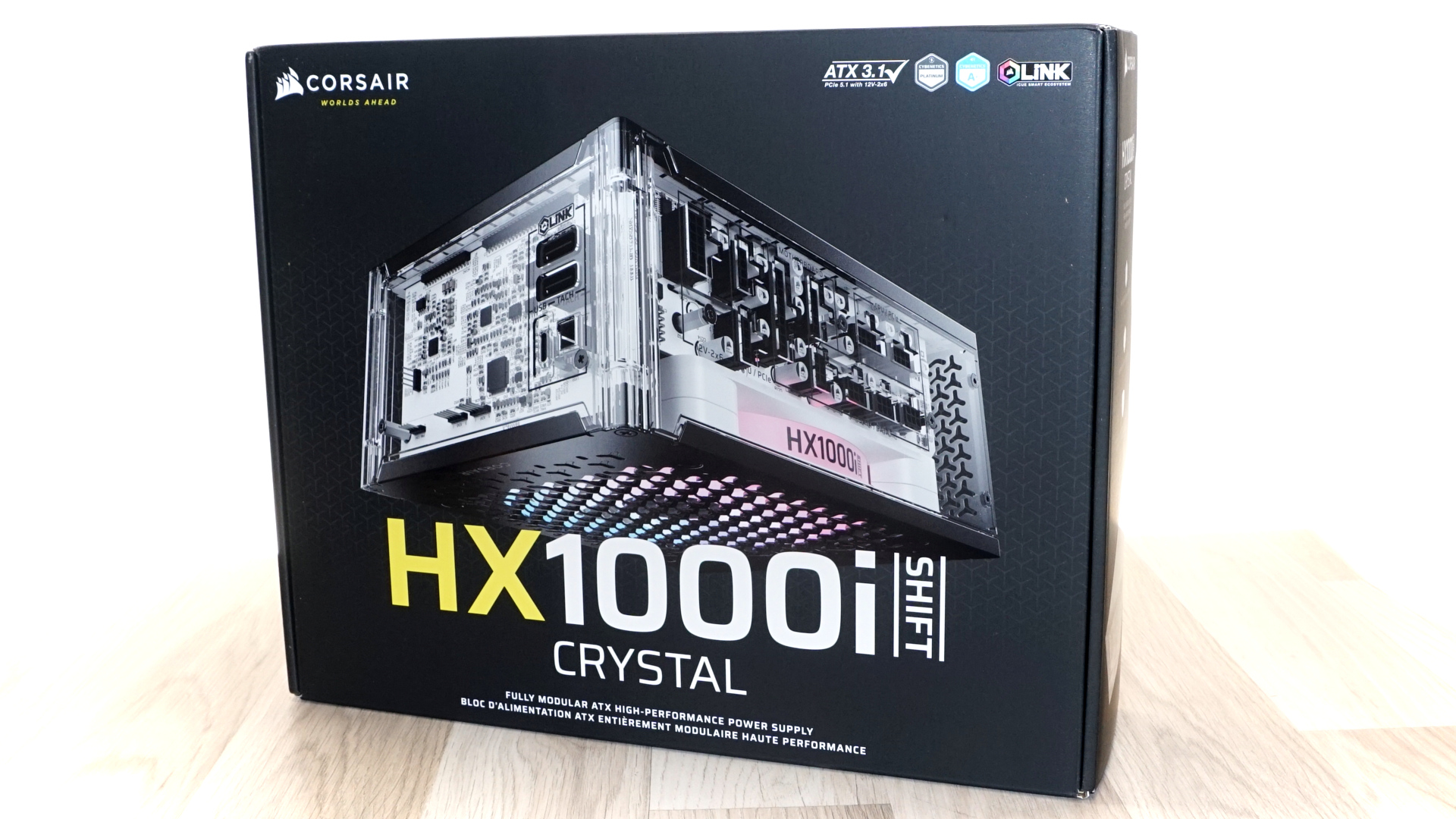
The HX1000i Shift Crystal ships in a very large and sturdy black cardboard box, with a large render of the unit on the front that does a good job of showing off the transparent panels and the lit fan. The model name is printed in big yellow and white letters across the bottom half, while the badges in the top right corner - ATX 3.1 with PCIe 5.1 and 12V-2x6 support, the Cybenetics certifications, and the iCUE LINK logo- tell you most of what you need to know before even opening the package.
Latest Videos FromTom's Hardware
(Image credit: Tom's Hardware)
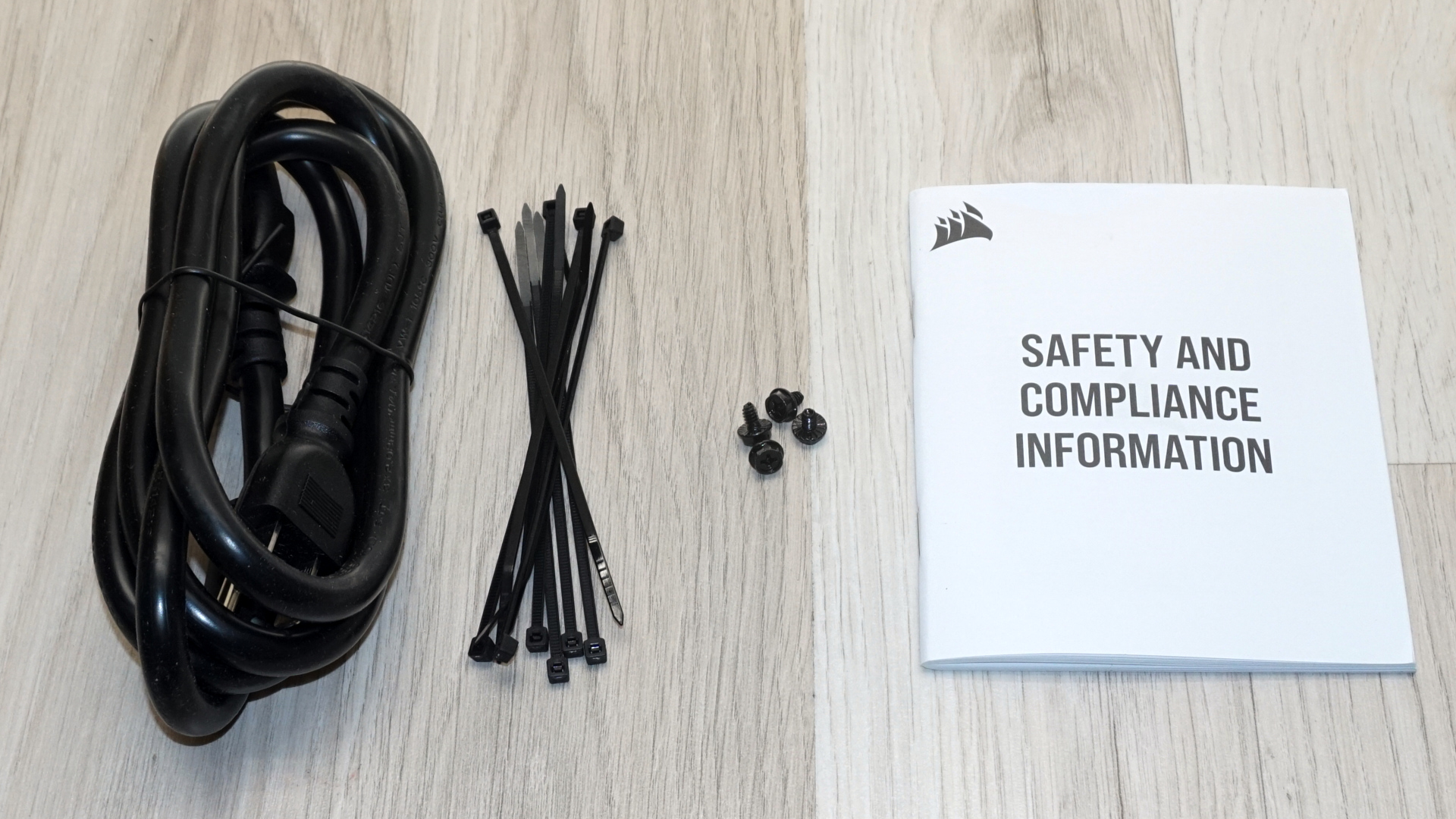
The bundle is rather spartan for a product of this class. Inside the box, we found the AC power cord, four mounting screws, a handful of black cable ties, and a leaflet with safety and compliance information. There are no Velcro straps, no cable combs beyond those already on the cables, and no other accessories of any kind. It is not a deal breaker by any means, but a premium unit like this that is focused on aesthetics could have been a little more generous in this department.
(Image credit: Tom's Hardware)
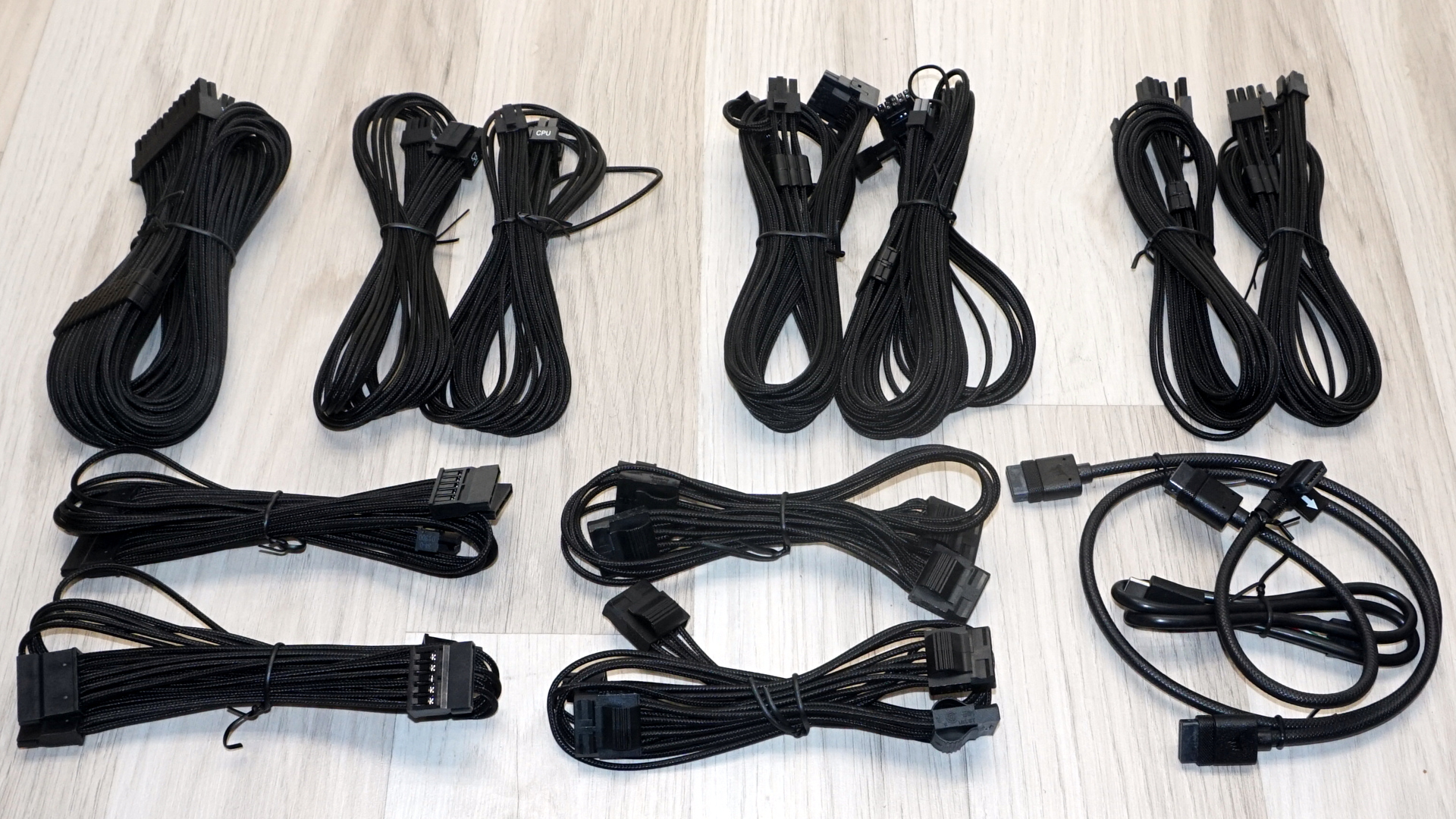
All of the cables are fully modular and black, with individually sleeved wires and low-profile cable combs. There is a 24-pin ATX cable, two 4+4-pin EPS cables, three PCIe cables carrying four 6+2-pin connectors in total, and a native 12V-2x6 cable rated for 600W, alongside two SATA and two Molex cables with four connectors each. Eight Molex connectors on a modern 1000W unit is extremely generous, frankly more than any reasonable build will ever need. Corsair also supplies two iCUE LINK cables of different lengths and a USB cable that connects the PSU's monitoring interface to the motherboard.
(Image credit: Tom's Hardware)
Swipe to scroll horizontally
Corsair HX1000i Shift Crystal
Connector type
Hardwired
Modular
ATX 24 Pin
-
1
EPS 4+4 Pin
-
2
EPS 8 Pin
-
-
PCI-E 5.1
-
1
PCI-E 8 Pin
-
4
SATA
-
8
Molex
-
8
Floppy
-
-
External Appearance
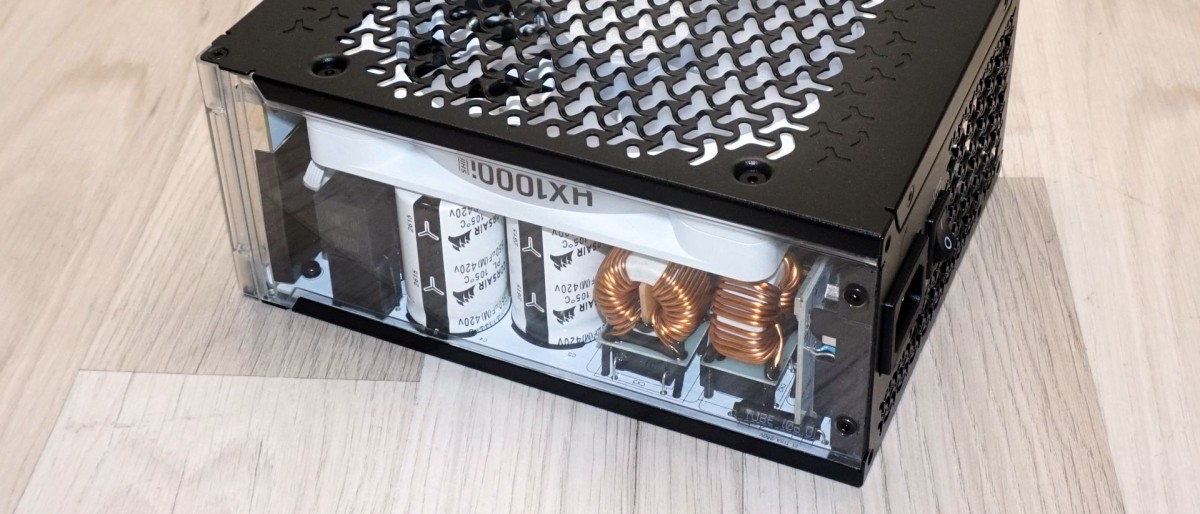
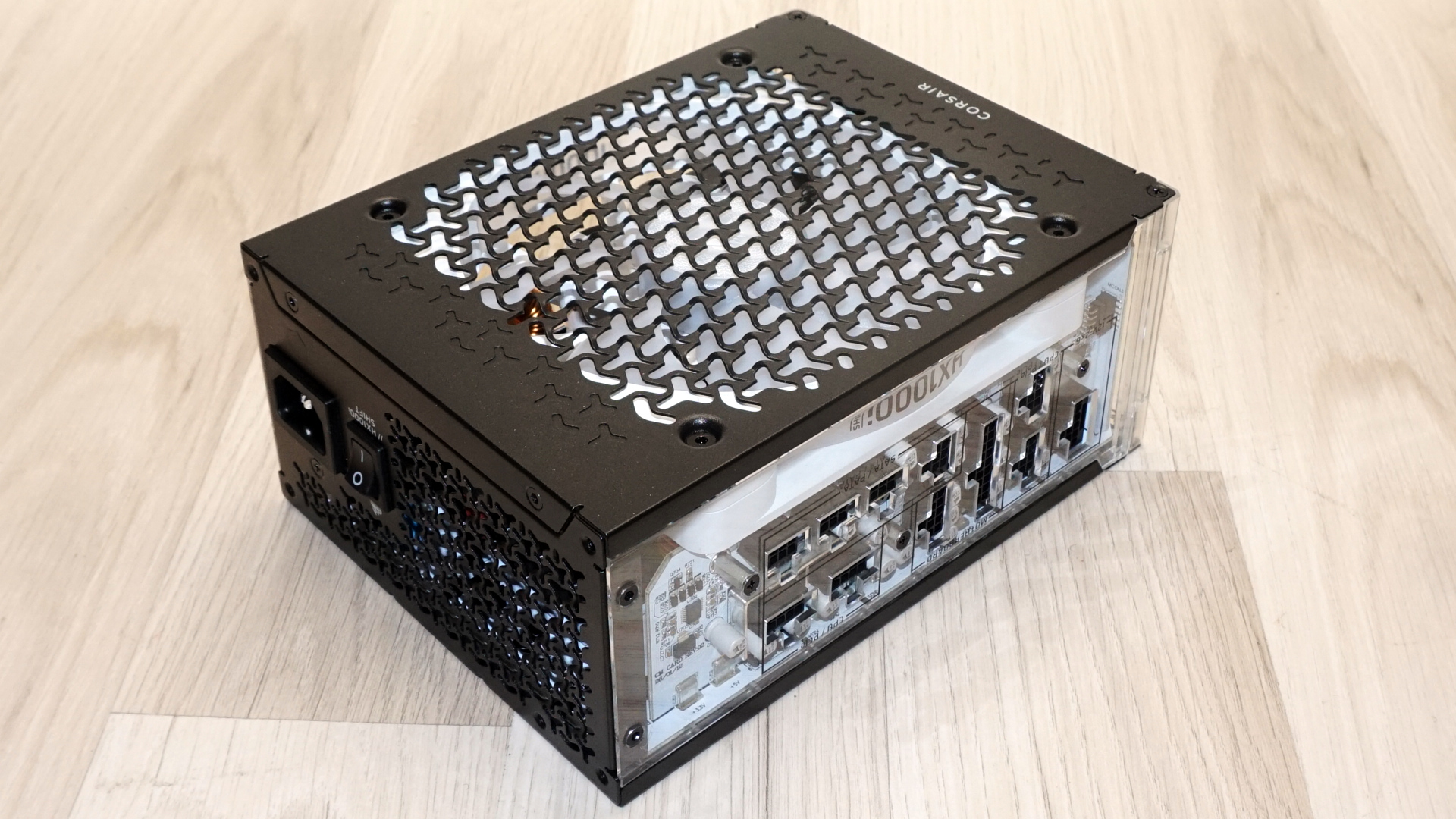
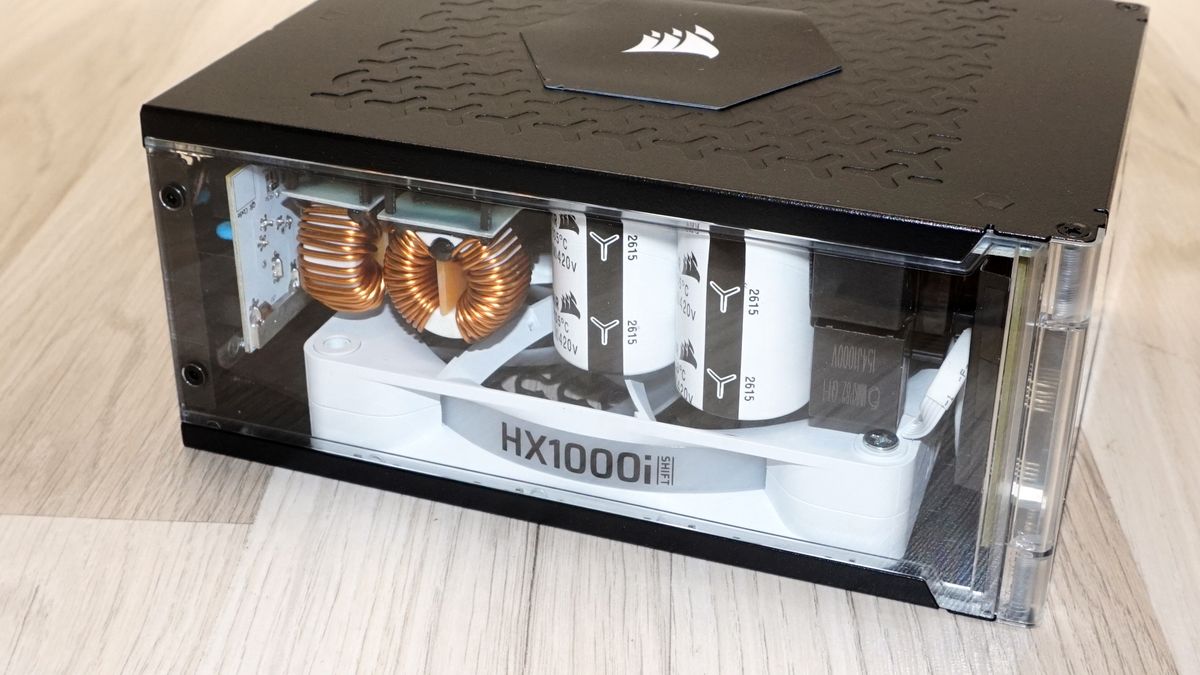
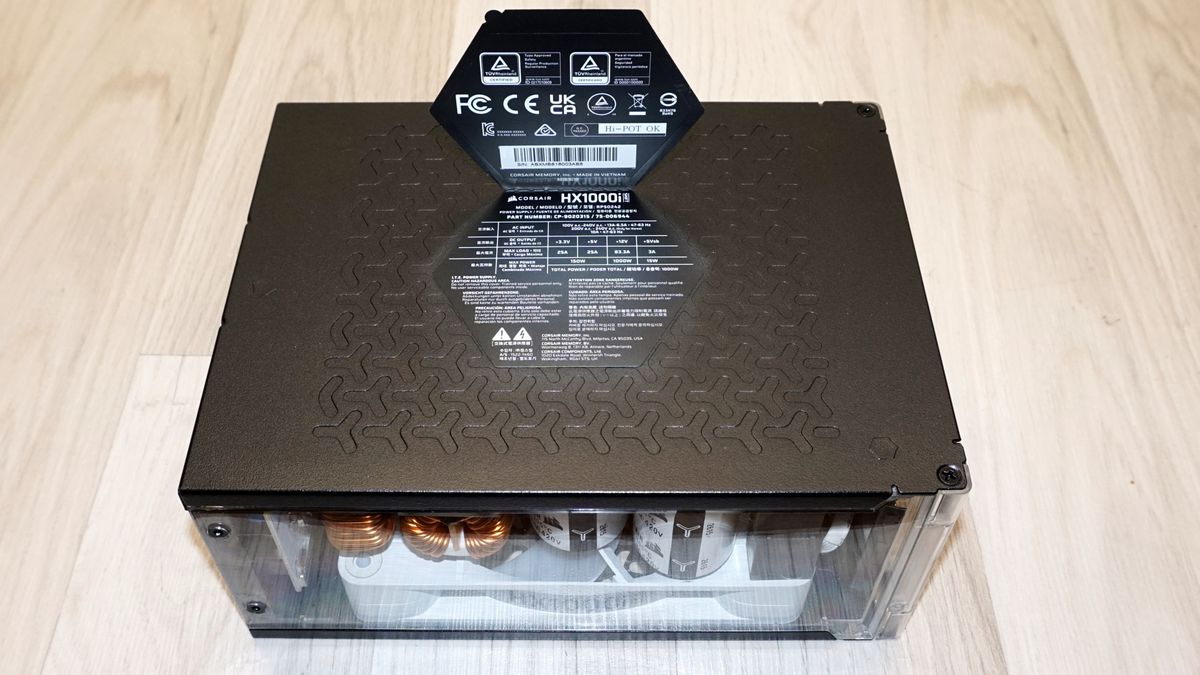
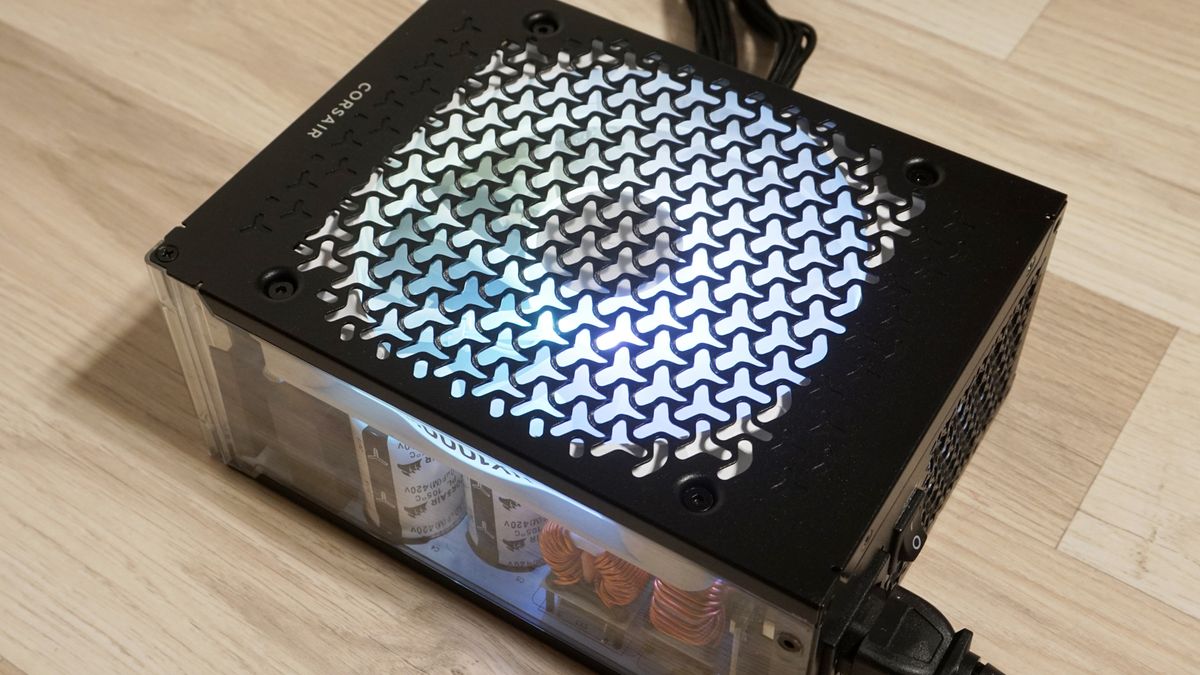
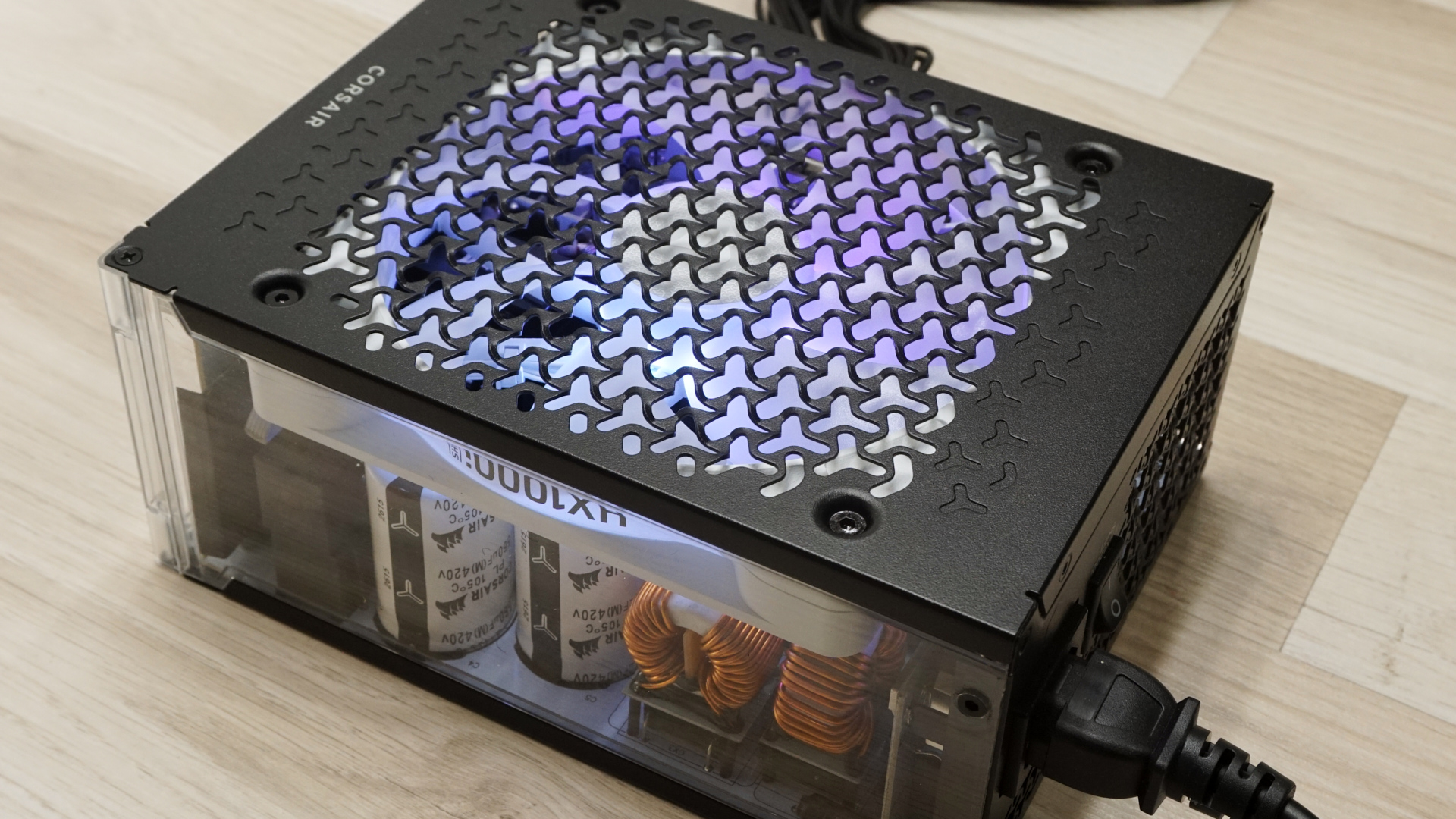
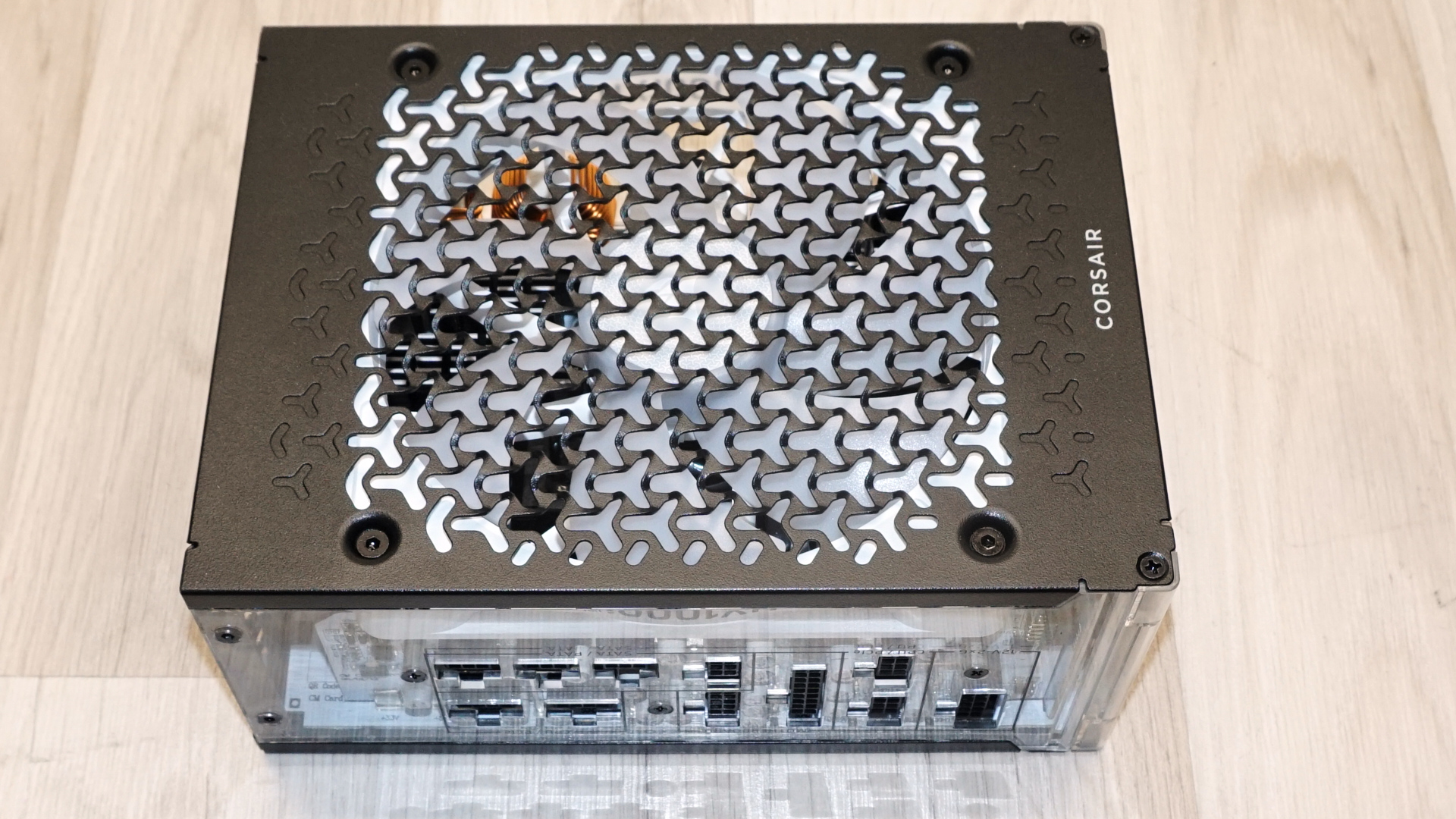
With dimensions of 150 x 86 x 200 mm, the HX1000i Shift Crystal is a long ATX unit, which is a non-issue if you are getting the matching Corsair 4500X case anyway. In any other case, you will need to check your case's specifications before buying one. The side-mounted SHIFT connectors also require some free space next to the PSU, as the cables plug into the side of the unit instead of its face, which is great for cases with a hidden PSU compartment but not suitable for every chassis. The design is unlike anything else on the market. The steel frame is black, with Y-shaped cutouts forming the fan grille and a debossed pattern of the same shape on the opposite panel, while three of the sides are clear polycarbonate panels that reveal the white fan frame, the bulk capacitors, the coils, and the white PCBs. With the RGB fan lit, the unit very much looks like a piece of display hardware rather than a power supply.
(Image credit: Tom's Hardware)
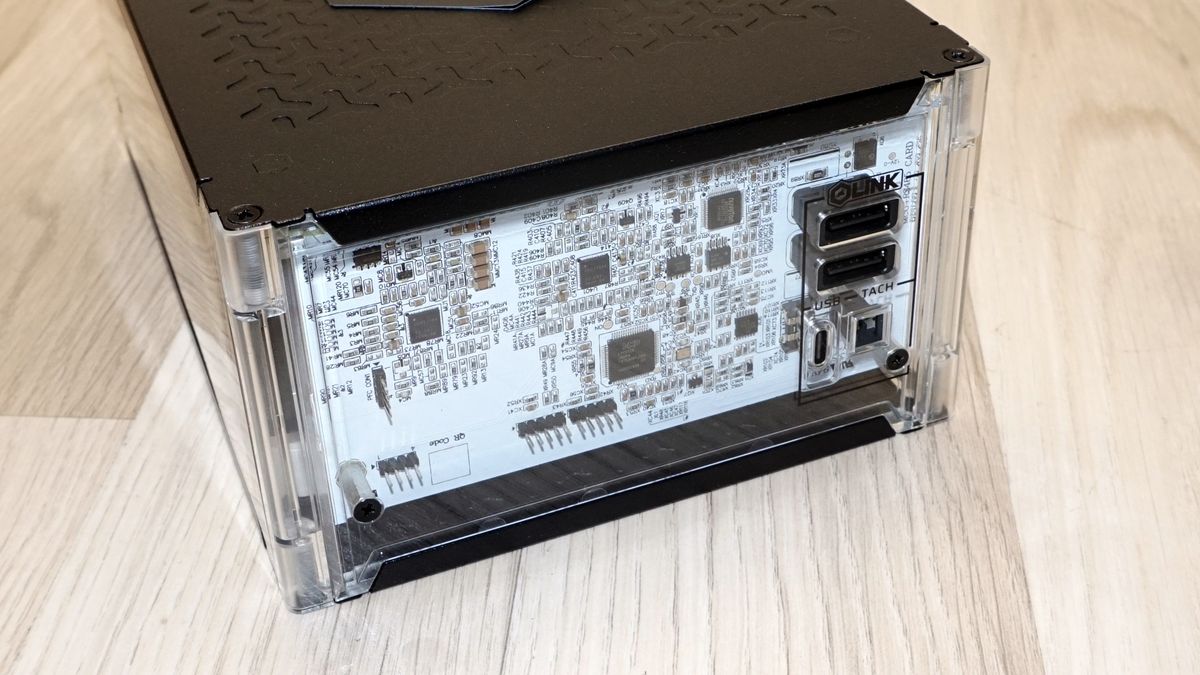
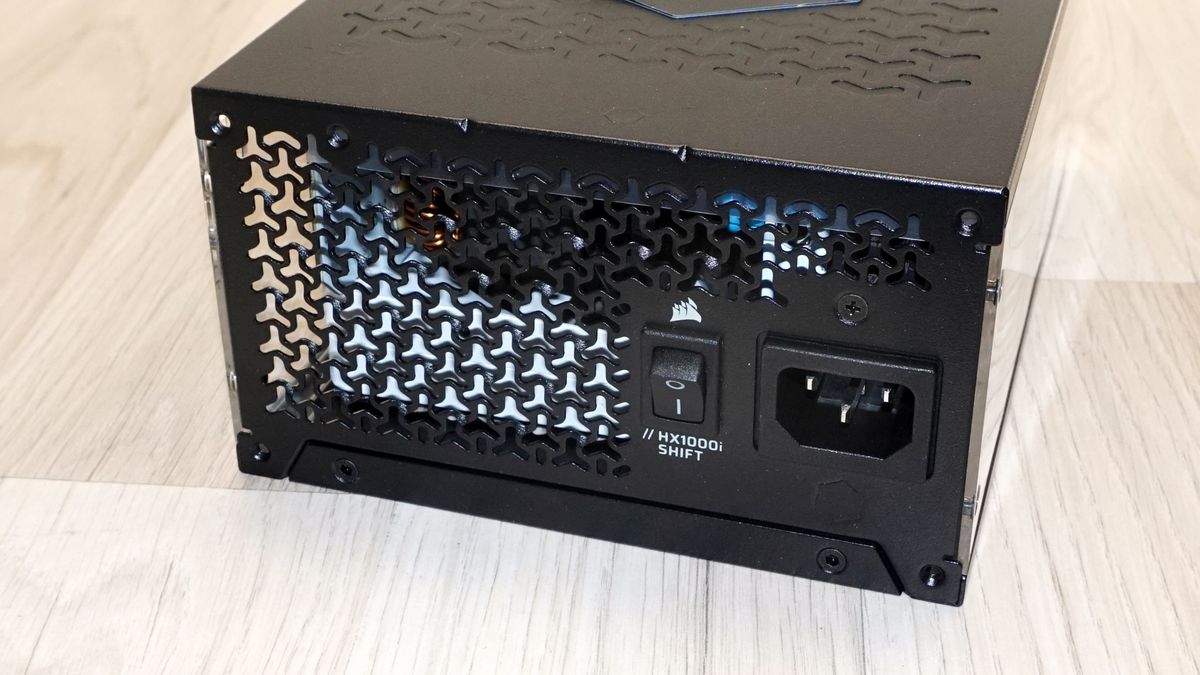
The rear of the unit is a little more conventional, with the AC receptacle, a rocker on/off switch marked with the "HX1000i SHIFT" logo, and a large perforated area with the same Y-shaped cutouts for the exhaust. The modular connector bay is on the side, behind the clear panel. The face opposite the AC receptacle hosts the white control PCB, also visible through its clear panel, with two iCUE LINK ports, a USB Type-C port, and a small port marked "TACH". The hexagonal specifications sticker is on the solid steel top side of the unit and is an envelope-type that can be closed to hide the text.
Stay On the Cutting Edge: Get the Tom's Hardware Newsletter
Get Tom's Hardware's best news and in-depth reviews, straight to your inbox.
Image 1 of 2
(Image credit: Tom's Hardware)
(Image credit: Tom's Hardware)
The CRYSTAL is fully compatible with Corsair's iCUE software, which can be used to monitor the PSU, adjust its fan speed, and switch the 12V overcurrent protection between single- and multi-rail modes. Corsair also integrated an iCUE LINK System Hub that, according to the company, supports up to 24 iCUE LINK devices without the need for a separate hub. The most interesting addition, however, is PinProtect+, Corsair's per-pin current monitoring for the 12V-2x6 connector. If the current on a pin exceeds a user-customizable threshold, the PSU cuts power to the connector, and the RGB fan lighting turns red to signal the fault. Given the history of melting connectors, this is a genuinely useful feature rather than marketing fluff. We can confirm that it is working as intended, as we tried pulling 20A from a single wire of the 12V-2x6 connector and the PSU shut down instantly.
Image 1 of 3
(Image credit: Tom's Hardware)
(Image credit: Tom's Hardware)
(Image credit: Tom's Hardware)
Internal Design
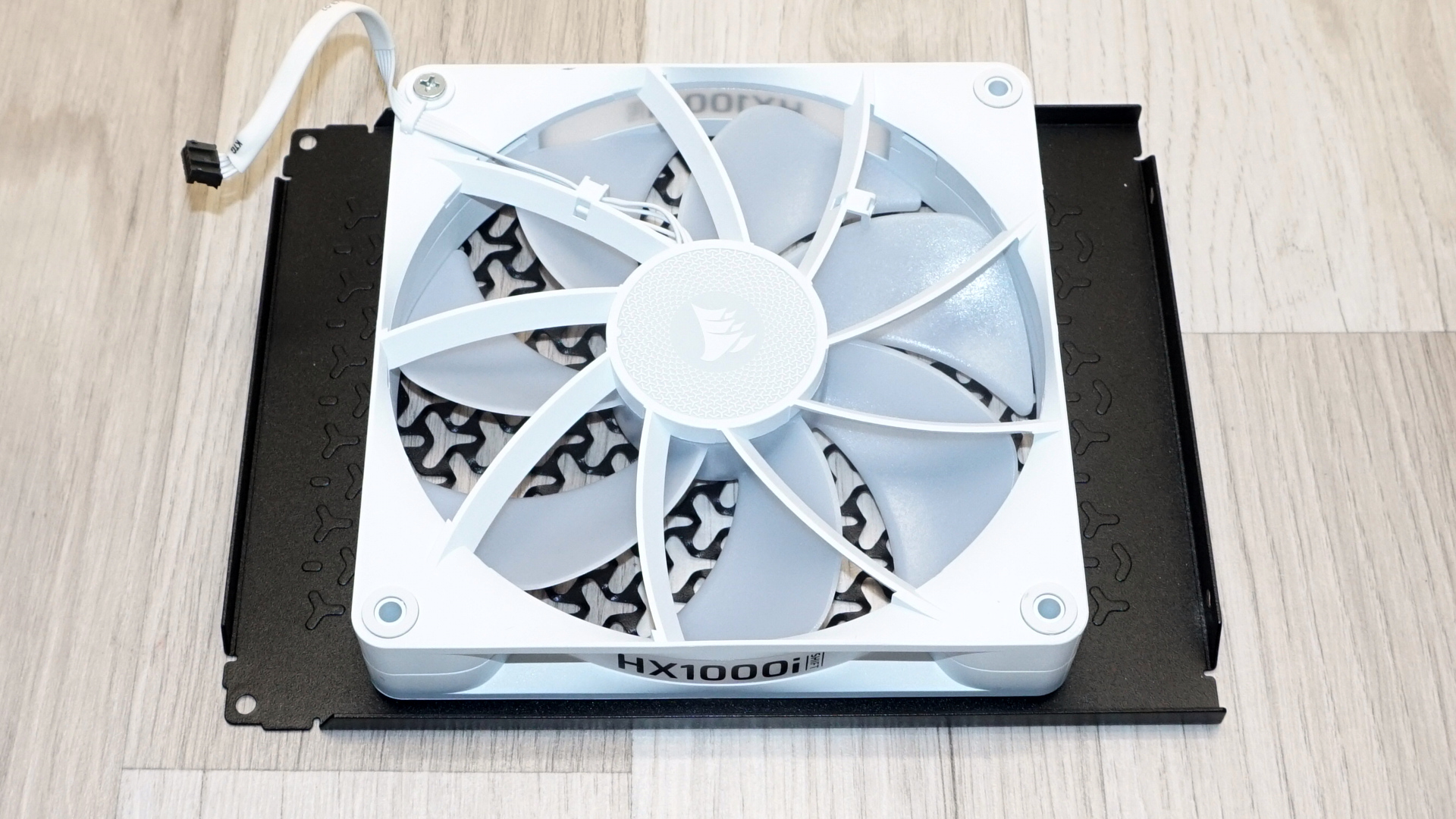
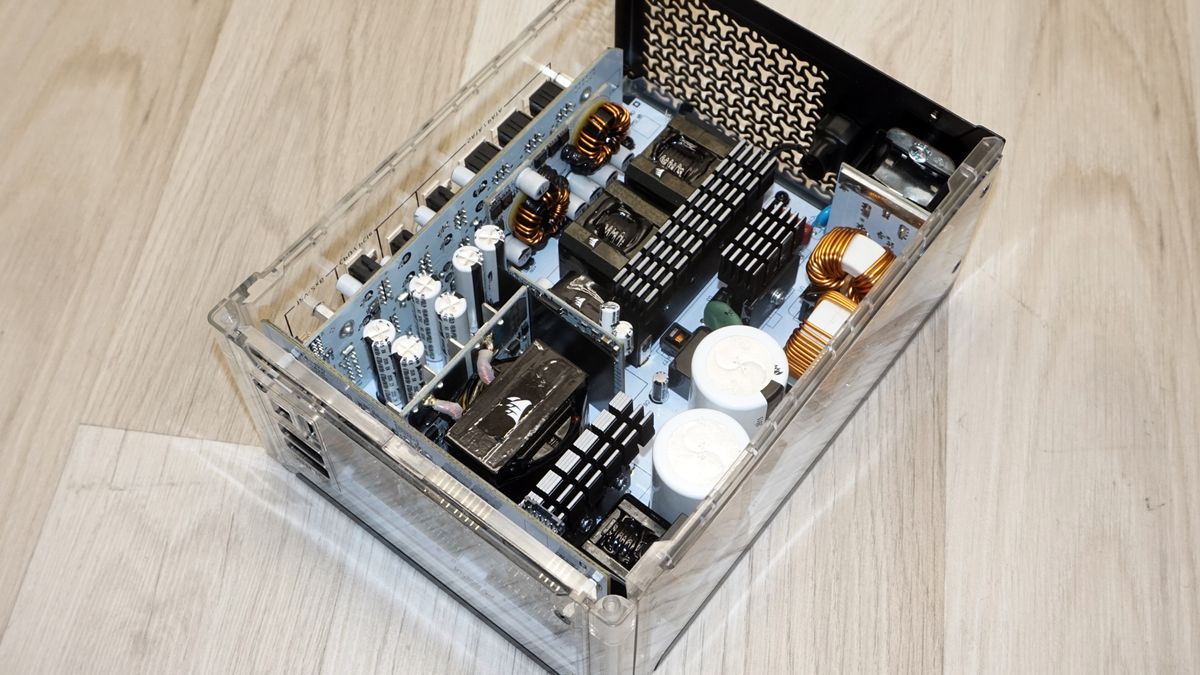
Cooling is handled by a 140 mm Corsair NR140HL-RGB fan. Corsair calls it a magnetic dome bearing design, and in practice it is a rifle-bearing fan with a half-domed shaft magnet, rated at 0.55A on 12V. The fan is white with addressable lighting, which also doubles as the visual alarm for PinProtect+. It is a decent fan, and the magnetic shaft should help with longevity, but it is worth mentioning that the regular HX1000i SHIFT uses a fluid dynamic bearing fan, which we would normally consider the better choice for a premium unit.
(Image credit: Tom's Hardware)
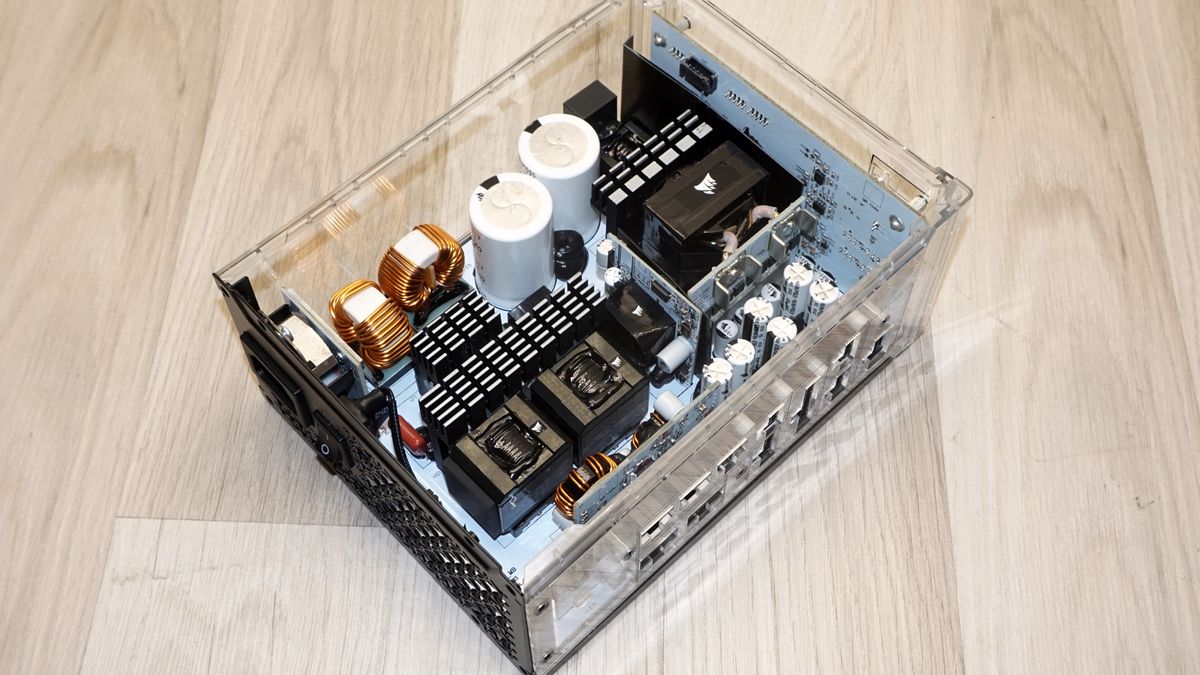
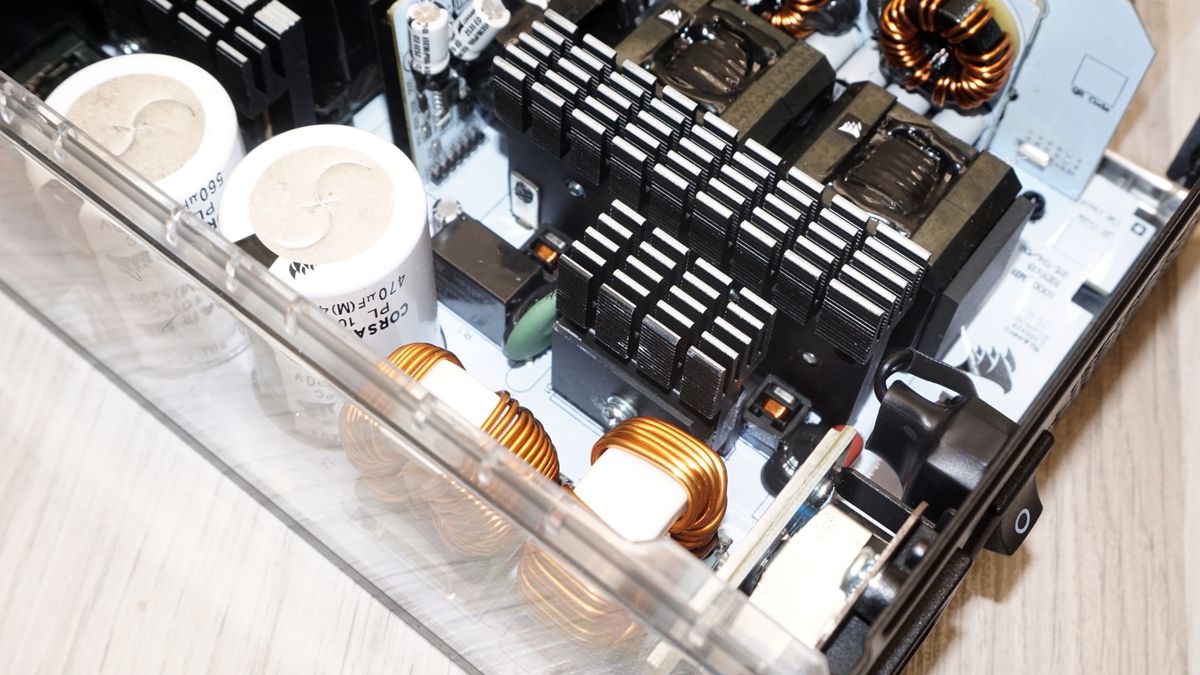
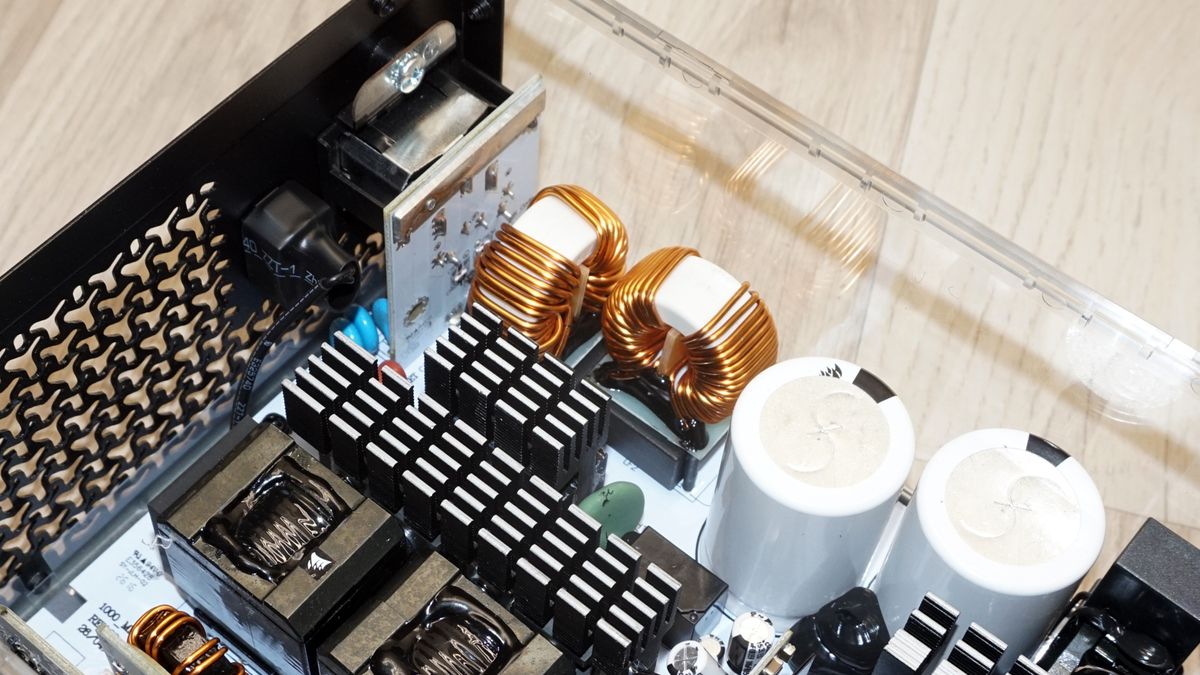
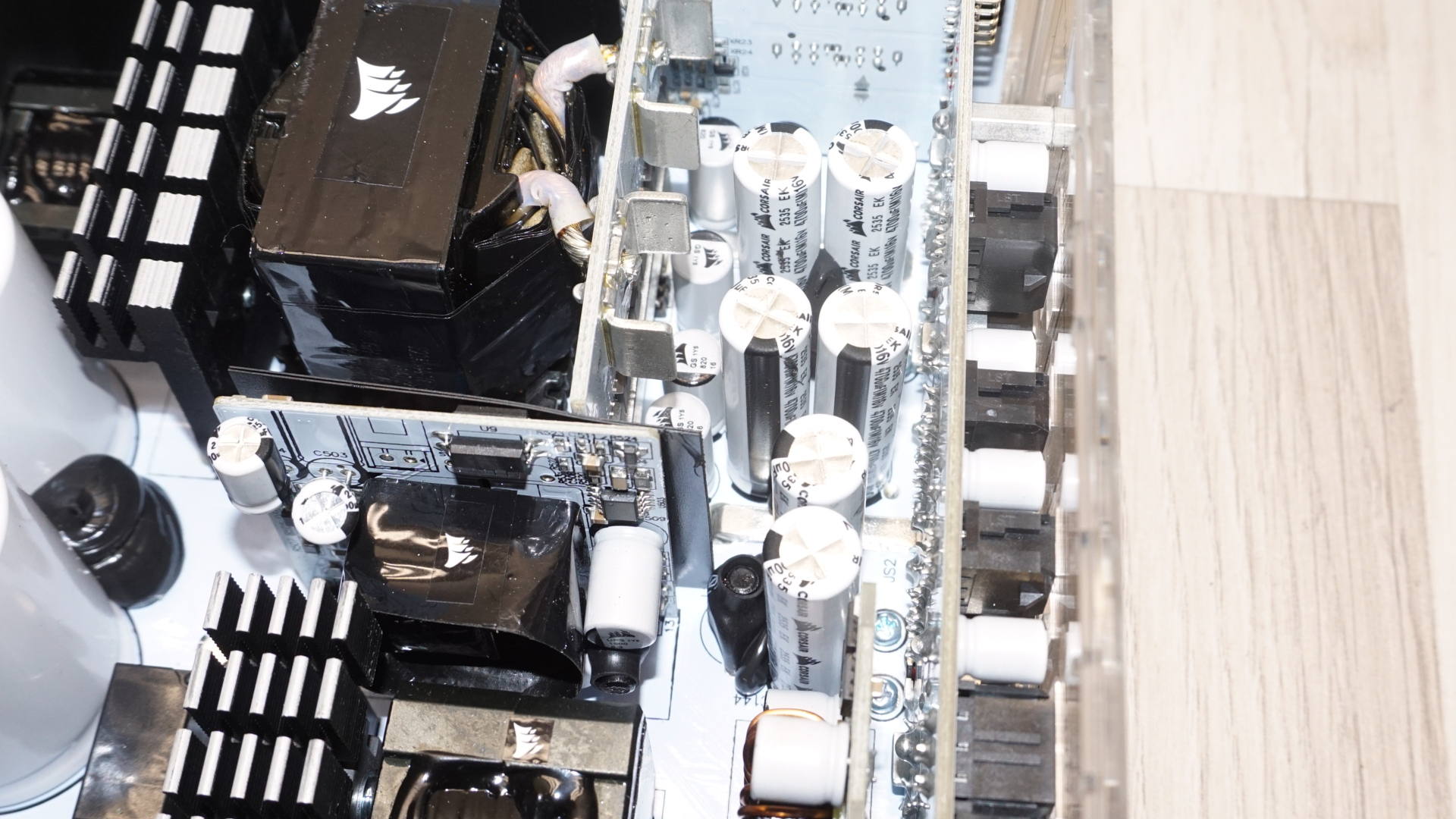
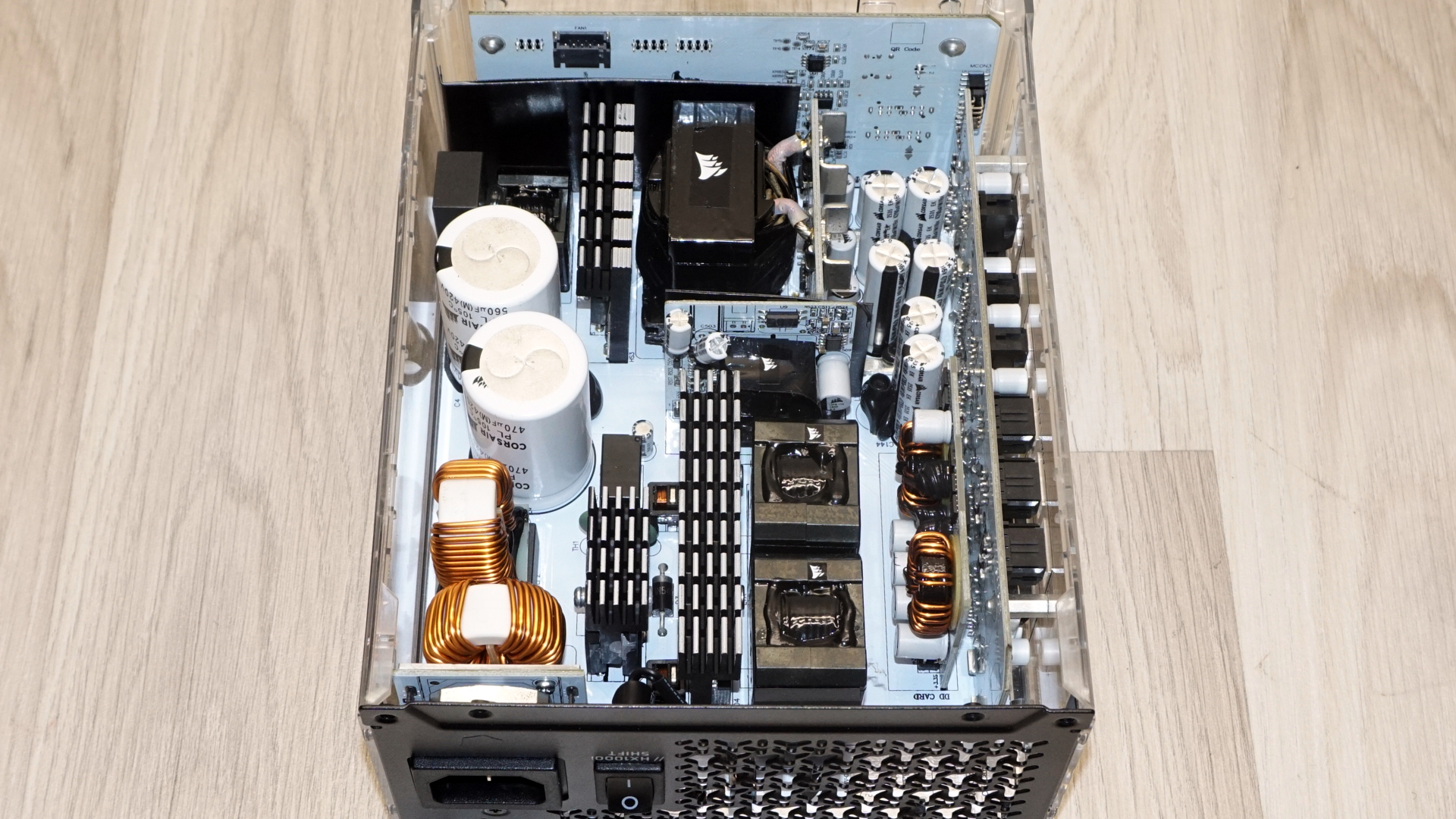
The OEM behind the HX1000i Shift Crystal is Channel Well Technology (CWT), Corsair's long-time partner for its HXi units. Almost every part inside the unit has been relabeled as "Corsair", including the capacitors and the magnetic components, so the OEM is not obvious at a glance, but the Cybenetics report confirms it. The layout is extremely clean and obviously optimized for aesthetics, which also explains the excessive length of the chassis. The bridge rectifiers have their own heatsink, the APFC components sit on another large heatsink, and the primary switchers have their own heatsink as well, while the secondary side components are on a vertical PCB right after the main transformer. All heatsinks are of good size and quality.
Image 1 of 2
(Image credit: Tom's Hardware)
(Image credit: Tom's Hardware)
The transient filtering stage has four Y capacitors, three X capacitors, and two filtering inductors. Two bridge rectifiers sharing a large heatsink feed the APFC stage, which relies on two Infineon 60R099P6 MOSFETs and two fully encased filtering coils. The APFC stage also includes two bulk capacitors, one Corsair 560 μF / 420 V capacitor and one Corsair 470 μF / 420 V capacitor, for a combined capacity of 1030 μF. According to the Cybenetics report, these capacitors are supplied by Elite, a relatively reputable Taiwanese manufacturer, and they are rated for 105°C. They are not capacitors that we frequently encounter in anything above mid-tier, though, and we feel they are not a great match for a premium unit.
Image 1 of 2
(Image credit: Tom's Hardware)
(Image credit: Tom's Hardware)
The primary inversion stage uses two more Infineon 60R099P6 MOSFETs in a half-bridge LLC resonant topology. On the secondary side, ten Infineon 014N04LS MOSFETs handle the synchronous rectification of the 12V rail, and the minor rails are derived from DC-to-DC converters. All of the capacitors on the secondary side are rebranded as Corsair, with black and white sleeves that match the color scheme of the unit, and are also made by Elite. These are mostly good parts, but it is a bit ironic that Corsair advertises 105°C Japanese electrolytic capacitors for the regular HX1000i SHIFT, while the version built to show its capacitors off uses Taiwanese ones.
(Image credit: Tom's Hardware)
Cold Test Results (25°C Ambient)
Cold Test Results (25°C Ambient)
For the testing of PSUs, we are using high-precision electronic loads with a maximum power draw of 2700 Watts, a Rigol DS5042M 40 MHz oscilloscope, an Extech 380803 power analyzer, two high-precision UNI-T UT-325 digital thermometers, an Extech HD600 SPL meter, a self-designed hotbox, and various other bits and parts.
Image 1 of 5
(Image credit: Tom's Hardware)
(Image credit: Tom's Hardware)
(Image credit: Tom's Hardware)
(Image credit: Tom's Hardware)
(Image credit: Tom's Hardware)
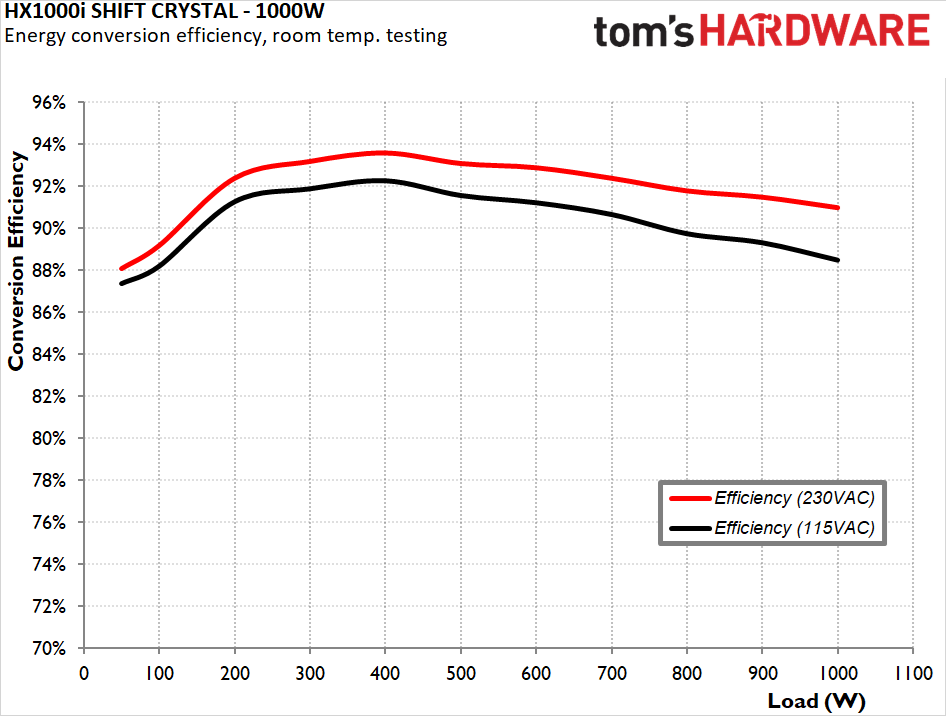
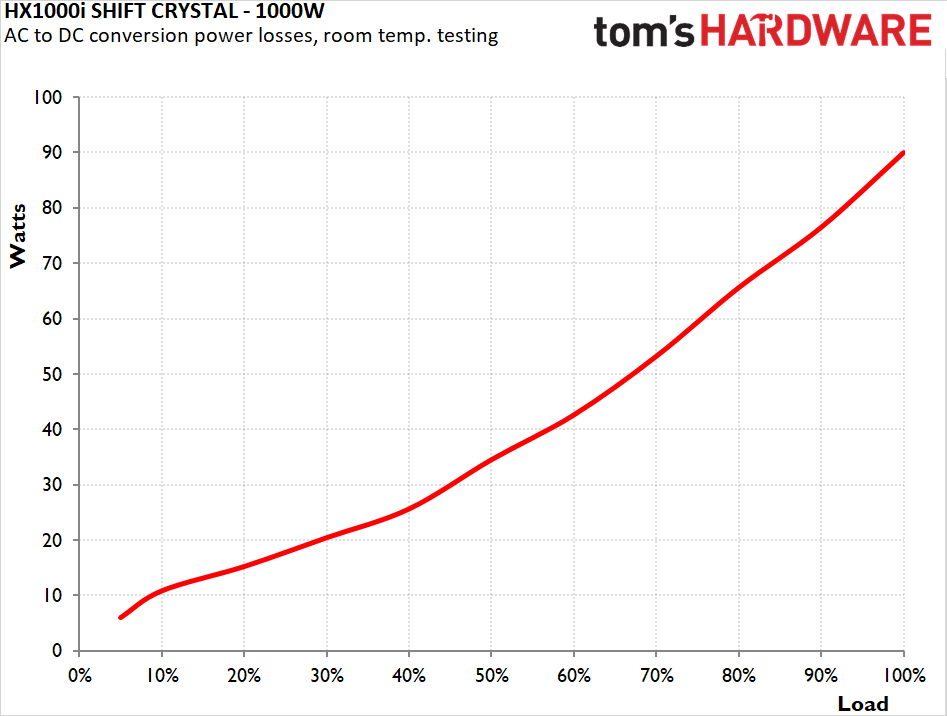
At 25°C ambient, the HX1000i Shift Crystal is a very efficient power supply. It averaged 92.1% at 230 VAC and 90.5% at 115 VAC across the nominal load range, with the efficiency peaking at 93.6% (230 VAC) and 92.2% (115 VAC) at around 40% load. The curve is relatively flat after that, with the unit still achieving 91% at 230 VAC and 88.5% at 115 VAC while delivering its full 1000W. The efficiency at very low loads is good as well, at just over 88% with a 50W load on 230 VAC. These figures are in line with the unit's Cybenetics Platinum certification at both input voltages. There is no 80 PLUS certification for this unit.
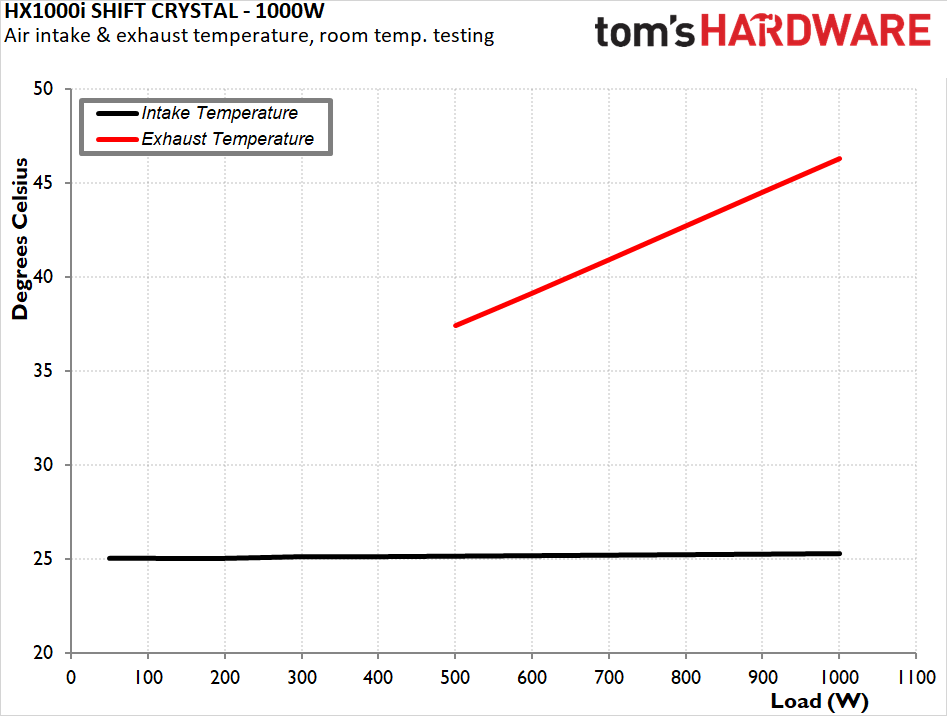
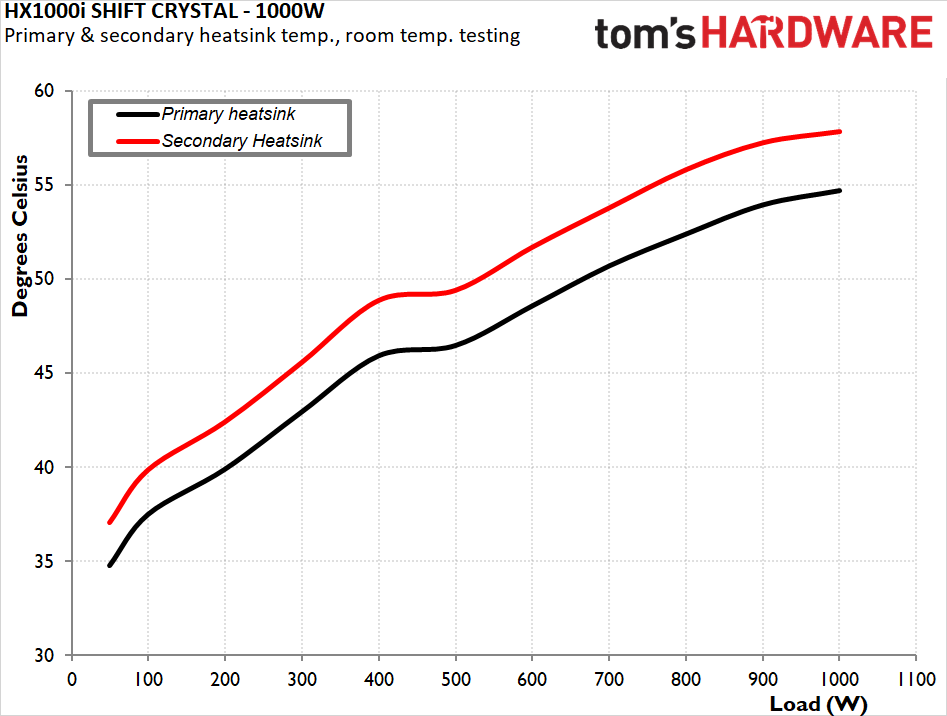
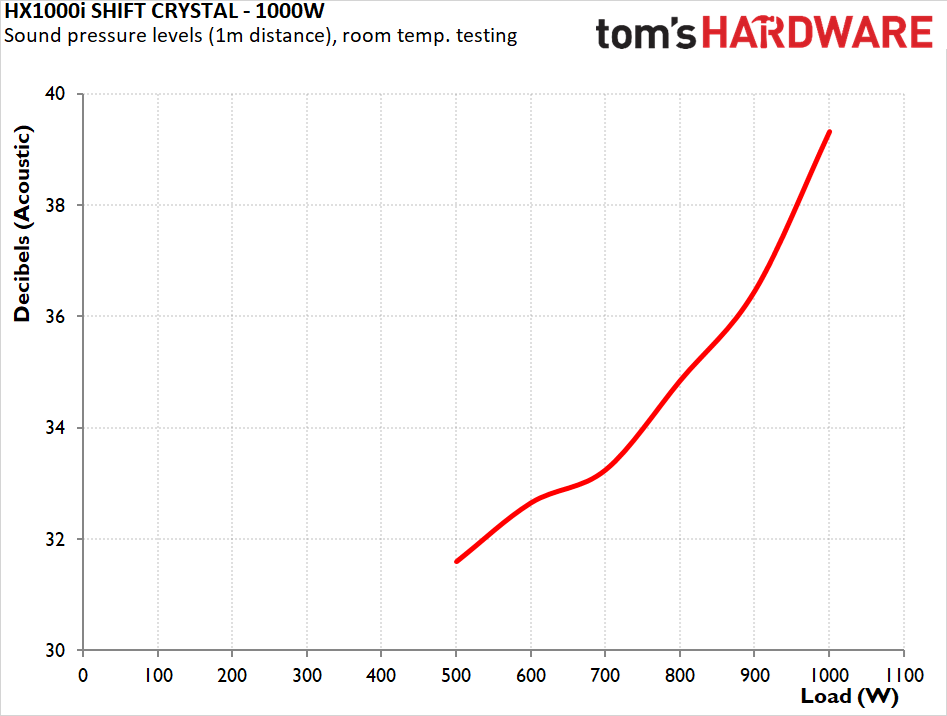
The acoustics at room temperature are very good. The fan stays completely off up to 50% load, so a typical gaming system with a powerful graphics card will rarely ever wake it up. Once it starts, the unit registers 31.6 dB(A) at 500W, and the fan ramps up very gently, staying around 33 dB(A) at 700W and below 37 dB(A) at 900W. Only at full load does the noise climb to about 39 dB(A), which is still a low figure for a 1000W unit. Thermal performance gives no reason for concern at all, with the primary and secondary heatsinks reaching just 55°C and 58°C respectively at full load.
Hot Test Results (~45°C Ambient)
Hot Test Results (~45°C Ambient)
Inside our hotbox, at roughly 45°C ambient and still within the unit's 50°C rating, the HX1000i Shift Crystal hardly lost any efficiency at all. It averaged 91.7% at 230 VAC and 90.1% at 115 VAC, a drop of just 0.4 percentage points compared to the cold test. The peak efficiency dropped to 93.3% and 91.9%, respectively, and the full-load efficiency to 90.6% and 88.1%. That is a very strong result that shows how well the platform tolerates high ambient temperatures.
Image 1 of 5
(Image credit: Tom's Hardware)
(Image credit: Tom's Hardware)
(Image credit: Tom's Hardware)
(Image credit: Tom's Hardware)
(Image credit: Tom's Hardware)
The fan is the part that changes its behavior the most in the heat. It starts spinning a bit earlier, at about 400W, registering 32.2 dB(A), and the noise climbs relatively fast to about 36 dB(A) at 600W and 39.5 dB(A) at 700W. Beyond 800W, the fan profile becomes much more aggressive, with the unit reaching 45.7 dB(A) at 900W and 46.8 dB(A) at its maximum output. That is definitely loud, though it takes very adverse conditions to get there. Internal temperatures rose considerably, with the primary heatsink reaching 84°C and the secondary heatsink 89°C at full load, figures that are high but comfortably within what the platform can handle.
PSU Quality and Bottom Line
Power Supply Quality
Voltage regulation is very good. Across the 20% to 100% load range, the 12V rail deviated by 1%, from 12.10V down to 11.98V; the 5V rail by 1% as well; and the 3.3V rail by just 0.7%. These are not the sub-0.5% figures of the very best digital platforms on the market, but all of the rails are well controlled, and the 12V rail stays very close to its nominal voltage across the whole load range. The ripple suppression is excellent. The 12V rail peaked at 48 mV under maximum load and 44 mV during the 12V cross-load test, while the 5V and 3.3V rails both topped out at 26 mV. Compared to the ATX design limits of 120 mV and 50 mV, that leaves a margin of 60% on the 12V rail and about 48% on the minor rails, which is very comfortable headroom for a 1000W unit.
During our thorough assessment, we evaluate the essential protection features of every power supply unit we review, including Over Current Protection (OCP), Over Voltage Protection (OVP), Over Power Protection (OPP), and Short Circuit Protection (SCP).
All protection mechanisms were verified and triggered correctly during testing. With the unit hot, OCP tripped at 148% (37A) on the 3.3V rail, 144% (36A) on the 5V rail, and 132% (110A) on the 12V rail, with OPP shutting the unit down at 130% of its rated output, or 1300W. These thresholds are on the high side, especially for the minor rails, but they are not unusual for an ATX 3.1 unit.
Swipe to scroll horizontally
Main Output
Load (Watts)
201.85 W
Row 0 - Cell 2
503.24 W
Row 0 - Cell 4
749.85 W
Row 0 - Cell 6
999.1 W
Row 0 - Cell 8
Load (Percent)
20.18%
Row 1 - Cell 2
50.32%
Row 1 - Cell 4
74.98%
Row 1 - Cell 6
99.91%
Row 1 - Cell 8
Row 2 - Cell 0
Amperes
Volts
Amperes
Volts
Amperes
Volts
Amperes
Volts
3.3 V
2.27
3.38
5.66
3.38
8.5
3.36
11.33
3.36
5 V
2.27
5.05
5.66
5.03
8.5
4.99
11.33
4.99
12 V
15.1
12.1
37.75
12.07
56.62
11.99
75.5
11.98
Swipe to scroll horizontally
Line
Regulation
Voltage Ripple (mV)
Row 1 - Cell 0
(20% to 100% load)
20% Load
50% Load
75% Load
100% Load
CL1 12V
CL2 3.3V + 5V
3.3V
0.7%
16
18
24
26
20
26
5V
1%
18
20
20
26
20
24
12V
1%
24
30
36
48
44
34
Bottom Line
The HX1000i Shift Crystal is a power supply designed to be looked at, and that is not something we often get to say. Corsair took a CWT-built HXi platform, cleaned up its layout to the point that it can be shown off, and placed it behind three polycarbonate panels with an RGB fan on top. The result is unique, and it is backed by a genuinely modern feature set, with ATX 3.1 compliance, full iCUE support, an integrated iCUE LINK System Hub, and a native 12V-2x6 connector with PinProtect+ per-pin current monitoring. The latter is more than a bullet point on the box, as the unit shut down instantly when we pulled 20A from a single wire of the 12V-2x6 connector.
(Image credit: Tom's Hardware)
Most importantly, the looks did not come at the expense of performance. The efficiency is excellent, with averages of 92.1% at 230 VAC and 90.5% at 115 VAC, and it barely moved when we raised the ambient temperature to 45°C. Voltage regulation is tight on every rail, and the ripple suppression is excellent, leaving a large margin against the ATX limits. At room temperature, the fan does not even spin up before the load reaches 500W and it stays quiet all the way up to the maximum output.
(Image credit: Tom's Hardware)
The compromises are few, but some of them are hard to ignore on a unit like this. The capacitors are all made by Elite and rebranded as Corsair. Elite is a relatively reputable Taiwanese manufacturer, but its capacitors are not something we frequently encounter above the mid-tier, and they are not a great match for a premium unit when the regular HX1000i SHIFT advertises Japanese capacitors. The fan uses a rifle bearing with a magnetic shaft instead of a fluid dynamic bearing, and it becomes loud under heavy load in a hot environment. The bundle is also spartan for an aesthetics-focused premium product. Finally, the 200 mm long chassis and the side-mounted connectors mean that not every case will accommodate the unit, although most buyers are likely to pair it with Corsair's matching 4500X case anyway. On the bright side, the ten-year warranty covers the unit for a period that very few users will ever need, and it makes the component choices easier to accept.
(Image credit: Tom's Hardware)
At the time of this review, Corsair had not made the price of the HX1000i Shift Crystal public, which makes a definitive value judgment impossible. The regular HX1000i SHIFT is the obvious comparison, as it offers the same side connector layout, iCUE integration, and iCUE LINK hub for $339.99 at Corsair's own store, along with a fluid dynamic bearing fan and Japanese capacitors. Compared to other showy high-end units, such as the Asus ROG Thor 1000W Platinum II or the Lian Li Edge 1000, the CRYSTAL is the only one that actually puts its internals on display, and its Cybenetics Platinum efficiency and tight electrical performance mean that it does not need its looks to justify itself. If it arrives at a reasonable premium over the regular HX1000i SHIFT, it is an easy recommendation for anyone building a showcase system, and a well-performing 1000W unit for everyone else who simply likes how it looks, as long as they can live with its parts selection.
Dr. E. Fylladitakis has been passionate about PCs since the 8088 era, beginning his PC gaming journey with classics like Metal Mutant and Battle Chess. Not long after, he built his first PC, a 486, and has been an enthusiast ever since. In the early 2000’s, he delved deeply into overclocking Duron and Pentium 4 processors, liquid cooling, and phase-change cooling technologies. While he has an extensive and broad engineering education, Dr. Fylladitakis specializes in electrical and energy engineering, with numerous articles published in scientific journals, some contributing to novel cooling technologies and power electronics. He has been a hardware reviewer at AnandTech for nearly a decade. Outside of his professional pursuits, he enjoys immersing himself in a good philosophy book and unwinding through PC games.
quorm
Are Taiwanese capacitors really still inferior in 2026? Is it still hard to make a reliable capacitor? Seriously asking.



 Like
0
 Dislike
0
 Love
0
 Funny
0
 Wow
0
 Sad
0
 Angry
0









Comments (0)