

Flowerscapes: Photographing Flowers From a Bug’s Eye Perspective
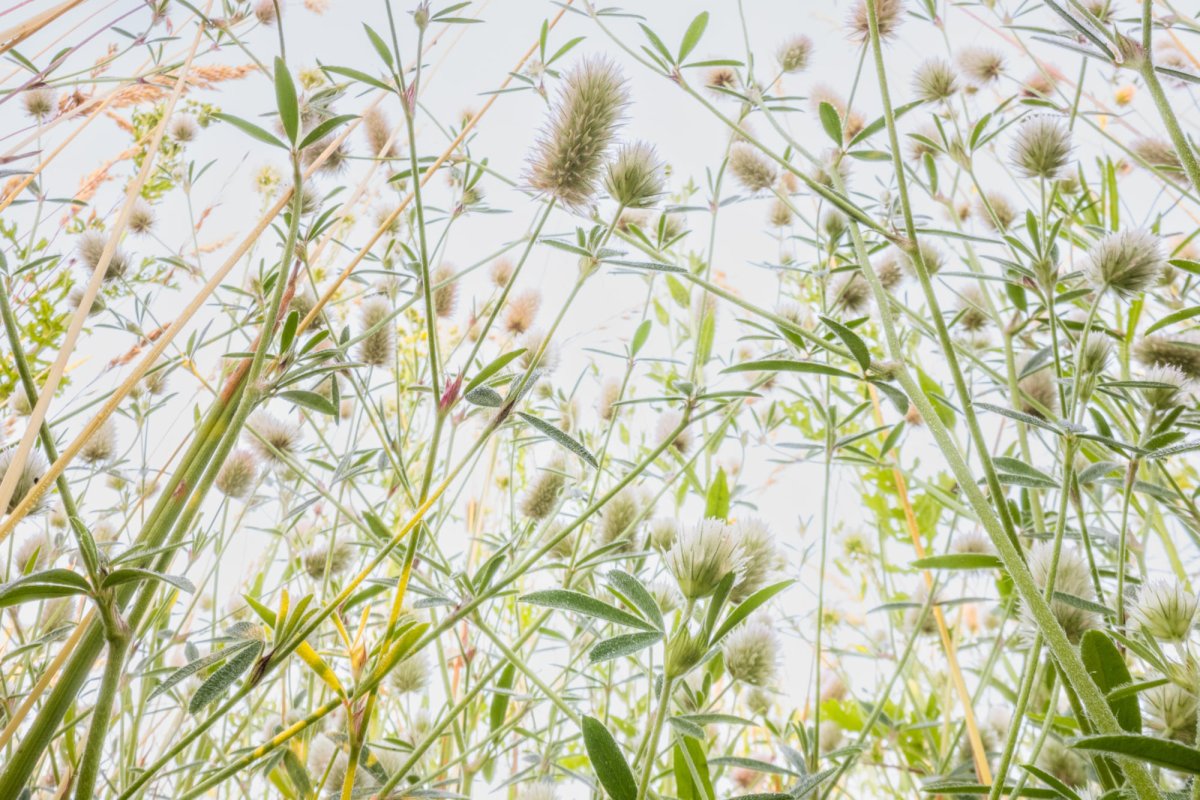
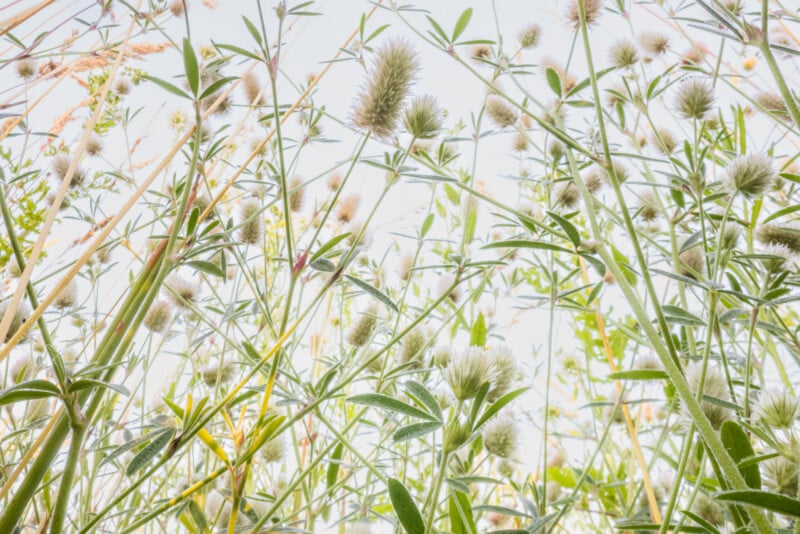 This photo of a group of Hare’s-foot clover (Trifolium arvense) is a favourite image from my new book project Flowerscapes, A Bug’s Eye Perspective.
I have wondered for many years what you would see if you were a tiny ant looking up when walking through a flower field, or a ladybug that has just landed on a flower stem.
How fantastic would it be to photograph flowers from an insect’s perspective! Until recently, this was only a dream. But when a long, narrow wide-angle macro lens that can rotate 360 degrees (the Laowa periprobe) was released, I suddenly saw an opportunity to turn that dream into reality. I felt as though I‘d received the key that granted access to a wondrous secret world; I felt very privileged! This marked the beginning of a journey of discovery through countless flower fields and other places where flowers grow such as verges, forests, dunes and parks, mostly in the Netherlands and sometimes just over the border in Germany or Belgium. Thanks to the continually surprising perspectives, I became captivated by flowers and marvelled at their beauty and strength.
The photo was taken in a field of flowers on the outskirts of the city in my then-hometown, Harderwijk, in the Netherlands. In terms of a nature experience, this location is not among my favorite spots. It’s right next to a highway and on either side there’s a busy road where people drive to work or children cycle to school in the morning (my favorite time to photograph). The advantage of this location was that it was only a 10-minute walk from my house. This meant I could go there quickly if conditions looked good. I visited it regularly for the project.
Organized Chaos
I am happy with this photo because I managed to capture the chaos of a field of flowers in a good way. One of the major challenges of the project was how to organize the chaos to be visually appealing and give the viewer the feeling of being in a flower field.
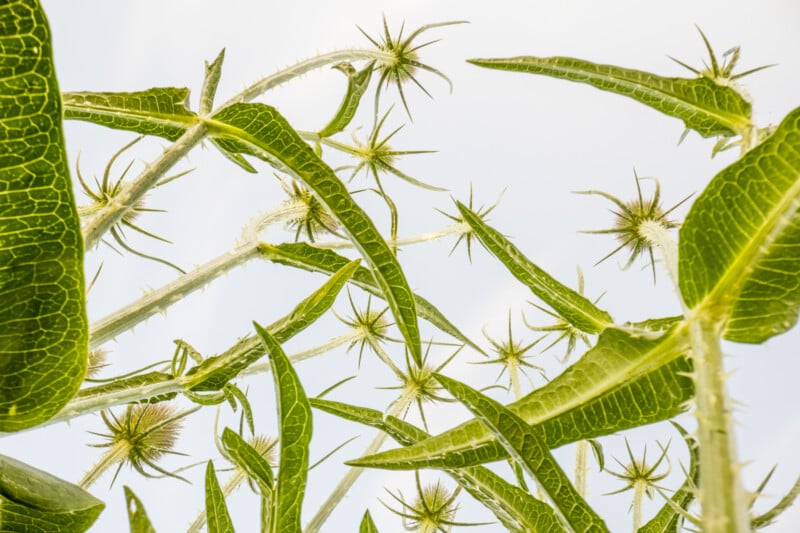
One element in photographing flowers from an insect’s perspective is that there must be enough space between the flowers. This was not a problem with this species. Additionally, it helps if you can include one or multiple focus points in the image such as places where the eye can settle for a moment. In my opinion, this is the hare’s-foot clover positioned centrally at the top of the image. It is sharply focused yet separated from the background and surroundings.
I try to distribute the stems, leaves and flowers as evenly as possible across the frame. To achieve even lighting and a soft atmosphere, I prefer to photograph in the shade or on cloudy days. This photo was taken early in the morning, although the sun was already up. The hare’s-foot clover was in the shadow of a large tree. Initially, I was annoyed that I hadn’t succeeded in keeping the sun completely out of the frame. But in hindsight I was glad because it adds subtle colour accents.
Finally, it’s important to avoid distracting elements in the composition, as they can ruin the image. Choosing young, newly sprouted plants helps, as they are usually still intact.
Technique
All the photos for my Flowerscapes project, including this one, were taken with a Laowa PeriProbe lens – a tube-shaped macro wide-angle lens with the lens opening on the side of the tube. Because you can rotate the tube 360 degrees, it works like a kind of periscope.
This makes it possible to place the lens on the ground and photograph straight upwards. That feature makes the lens unique and even groundbreaking. Additionally, I find the combination of a 24mm wide-angle (85-degree field of view) and a macro magnification of 2:1 very attractive. The minimum focusing distance from the lens is only 2cm!
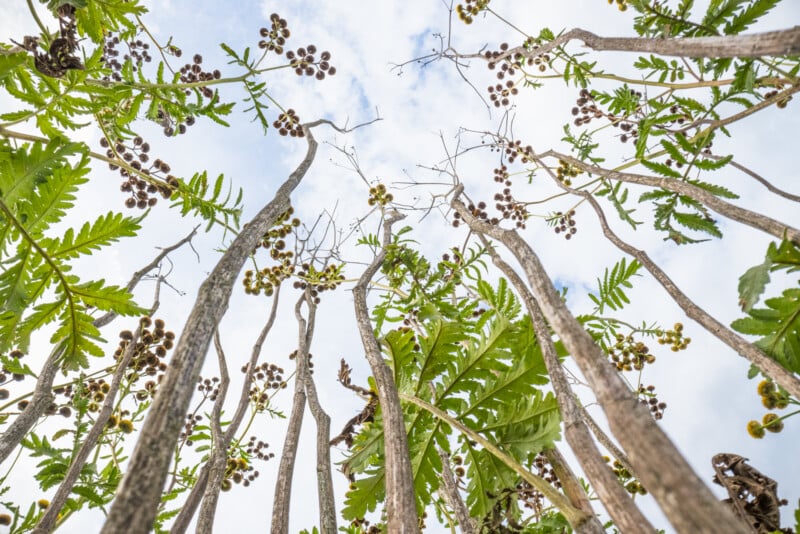
The lens is intended primarily for filmmakers. It is not inexpensive and it’s not easy to use. For example, the image appears upside down in the viewfinder and everything must be set manually. You need a lot of light because the minimum aperture is f/14. I was willing to invest in all this when I discovered that I could create images of flowers and insects that had previously been impossible.
Despite its hefty price, I bought the lens immediately, feeling that it offered the potential to produce unique images. That is always a great bonus in this age of image overload, when many photographers lament that everything has already been photographed. One of my motivations as a photographer is to show that this is not the case. But it’s not just a toy. New perspectives in photos are extremely helpful to draw attention to your subject – in this case, wildflowers in our environment which are under severe pressure.
In general, working with a wide-angle macro lens presents several important challenges. One of these is that you have to set everything manually. This applies not only to focusing but also to choosing the aperture.
Another issue with the lens is that the depth of field is quite limited, especially when you get very close to your subject. This is usually what you want in this type of photography. Stopping down the aperture to, for example, f/16 or f/22 helps somewhat. Applying focus may be a challenge because the software quickly becomes overwhelmed. You can simply accept the limited depth of field. This is generally not a big problem. In my experience, it’s not always necessary for the trees in the background to be completely sharp; it often works fine if they seem sharp or if the contours at least are clearly visible.
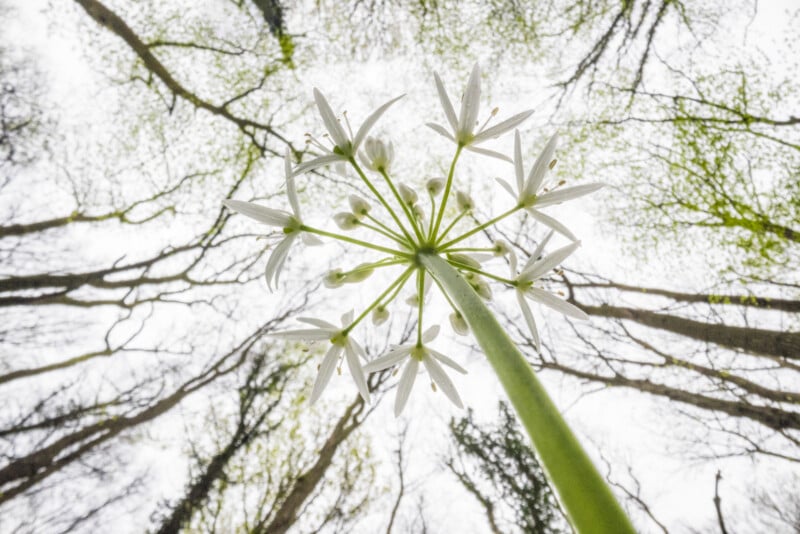
Due to the minimum aperture of the PeriProbe being as high as F/14 – which, given the construction of the lens, is not unreasonable – working with this lens presents some additional challenges. You need strong light to be able to photograph. Although there is an LED ring light around the lens opening, powered via the USB-C port on the lens, I prefer working with pure natural light.
This means I always work from a tripod, or if that’s not low enough, from a bean bag. The flip-out screen on my Canon R5 is indispensable for this. I worked with a remote shutter release or self-timer for this project to prevent motion blur caused by pressing the shutter button. Not only camera vibrations but also movement in the subject (the flowers) can cause blurriness so I sometimes had to increase the ISO to get shutter speeds short enough for sharp images. I used ISO values between 1000 and 5000.
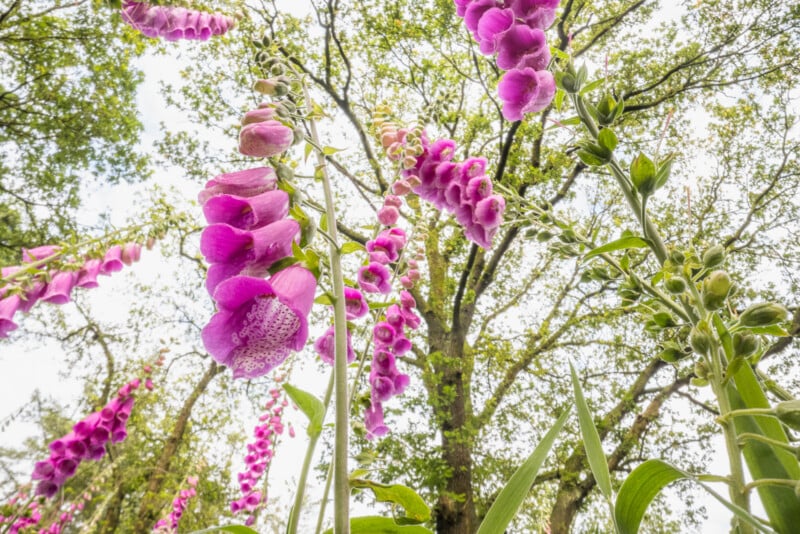
This is quite unusual for plant photography but it was the only way to get sharp images with natural light. And with modern cameras, the images at these high ISO values are surprisingly usable, especially if you run them through noise-reduction programs such as those included in Lightroom or in specialized programs such as Topaz Denoise or Nik Dfine.
The article is courtesy of ELEMENTS Magazine. The ELEMENTS is the monthly magazine dedicated to elegant landscape photography, insightful editorials and fluid, clean design. Inside you will find an exclusive and in-depth articles and imagery by the best landscape photographers in the world such as Charles Cramer, Christopher Burkett, Hans Strand, Rachael Talibart, Christian Fletcher, Charlie Waite, and Steven Friedman, to name a few. Use the PETAPIXEL10 code for a 10% discount off the annual subscription.
About the Author: Theo Bosboom is a passionate photographer from Netherlands specializing in nature and landscape. In 2023, he turned his back on a successful legal career to pursue his dream of being a fulltime professional photographer. Since then, he has never looked back. The photobook “Flowerscapes, A Bug’s Eye Perpective” is available at his website.
What's Your Reaction?
 Like
0
Like
0
 Dislike
0
Dislike
0
 Love
0
Love
0
 Funny
0
Funny
0
 Wow
0
Wow
0
 Sad
0
Sad
0
 Angry
0
Angry
0






Comments (0)