

Hasselblad Files Now Open Natively in Capture One
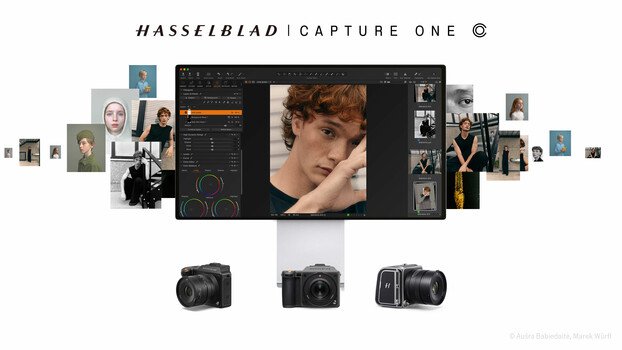
For years, the workflow gap between Hasselblad and Capture One was one of those quietly frustrating facts of professional life. If you shot medium format on a Hasselblad but preferred to edit in Capture One, you were stuck converting your raw files first, and every conversion chipped away at the color fidelity and editing latitude that were the whole point of shooting Hasselblad in the first place. That gap is now closed.
Hasselblad and Capture One have announced a partnership bringing native support for Hasselblad medium format raw files to Capture One. Starting today, Thursday, July 2, photographers can import, organize, and develop their Hasselblad .3FR files directly in the software, using the full toolset of layers, masks, color editing, and precision adjustments that Capture One users already rely on for the rest of their work. No conversion step, no workarounds.
The support arrives with three of Hasselblad's 100-megapixel models covered from day one: the X2D II 100C, the X2D 100C, and the CFV 100C digital back. Tethered capture, the feature that connects a Hasselblad body directly to Capture One for live on-set shooting, is planned to follow later in 2026, though Capture One has not yet confirmed exact timing.
Why It Matters
Native Hasselblad support has been near the top of Capture One's most-requested features for years, raised repeatedly across community forums, feature-request boards, and social channels. Photographers who owned both a Hasselblad and a Capture One license were essentially maintaining two color pipelines: shoot in one, convert, then edit in another and hope the translation held up.
What makes this integration worth paying attention to is that Capture One built it specifically for Hasselblad rather than leaning on generic profiles. Dedicated color profiles were created for each of the three supported models, so files render with the same true-to-life color Capture One is known for. On top of that, dedicated lens profiles for Hasselblad XCD lenses handle distortion, chromatic aberration, and light falloff. If you have spent any time fighting a generic profile that almost, but not quite, corrects a lens, you understand why bespoke profiling is the difference between usable and excellent.
Rafael Orta, CEO of Capture One, framed the partnership as delivering exactly what photographers had been asking for over the years, describing it as a collaboration the community had wanted for a long time. From Hasselblad's side, Global Marketing Manager Bronius Rudnickas positioned the move as making Hasselblad technology accessible to a wider audience by pairing it with best-in-class editing tools.
What the Three Cameras Have in Common
All three supported models are built around a 100-megapixel medium format BSI CMOS sensor measuring 43.8 by 32.9 mm, with 16-bit color depth. That 16-bit depth translates to roughly 281 trillion possible colors, and it is paired with the Hasselblad Natural Color Solution, the company's color management system engineered to reproduce skin tones and tonal transitions the way the eye actually perceives them. This is precisely the kind of data that suffers most under a lossy conversion, which is why native handling is more than a convenience here.
The two X2D bodies are the flagship mirrorless line. The X2D II 100C, released in 2025, is the newer of the pair and brings meaningful upgrades over its predecessor:
- First continuous autofocus system in the Hasselblad X range, backed by an improved 425-zone phase-detect array and a LiDAR unit
- 10 stops of in-body image stabilization, class-leading for the format
- Base ISO 50
- 15.3 stops of dynamic range
- End-to-end HDR capture workflow, a first for medium format
The CFV 100C is the outlier of the three and, arguably, the most interesting inclusion. It is a modular digital back rather than a fixed-body camera. It mounts on the compact 907X body for use with XCD lenses, but it also attaches to classic Hasselblad V System film cameras from the 500 and 200 series, as well as to technical and view cameras. In other words, it lets a decades-old Hasselblad film body capture 100-megapixel digital images, and its backside-illuminated sensor largely eliminates the magenta color cast that plagued earlier backs on shift movements. For photographers running those systems, having native Capture One support for that back closes a workflow gap that was even more painful than the one facing X2D shooters.
Availability
Native Hasselblad raw support is live today in Capture One desktop version 16.8.3 and Capture One mobile version 3.3.4, covering all three models. Tethered capture is planned for later this year, with timing still to be confirmed. Capture One is offering a free 7-day trial tied to the launch.
For context on scale, the addition places Hasselblad alongside the more than 550 cameras and 700 lens profiles Capture One already supports, though the company's own current documentation now lists over 600 camera models. Both companies are headquartered in Scandinavia, Capture One in Copenhagen and Hasselblad in Gothenburg, which lends the partnership a certain regional symmetry, if you are inclined to read into that sort of thing.
The practical takeaway is simpler. If you shoot the X2D II 100C, the X2D 100C, or the CFV 100C and you have wanted to keep everything inside Capture One, the compromise you have been living with is gone as of this week.
What's Your Reaction?
 Like
0
Like
0
 Dislike
0
Dislike
0
 Love
0
Love
0
 Funny
0
Funny
0
 Wow
0
Wow
0
 Sad
0
Sad
0
 Angry
0
Angry
0









Comments (0)