

Murder, Movies, and Horses: The Strange Life of the Man Who Made Photographs Move
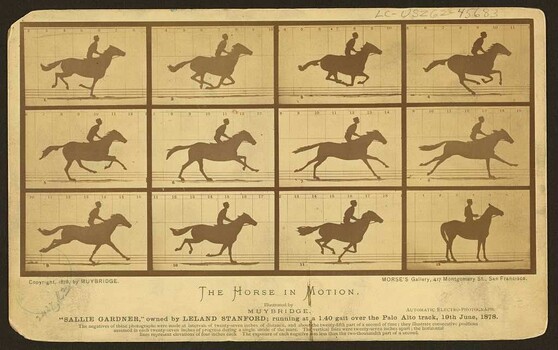
On June 19, 1878, a thoroughbred named Sallie Gardner ran down a track in Palo Alto and broke twelve threads stretched across her path with her chest. Each thread fired a camera. When the plates came out of the darkroom, they answered a question that painters, sculptors, and horsemen had argued about for centuries.
The question was simple. When a horse gallops at full speed, does it ever have all four hooves off the ground at the same time? You would think that after thousands of years of living alongside horses, someone would have settled this by eye. But the legs of a galloping horse move far too fast for human vision to freeze, and the answer had real consequences for anyone who drew or painted them. The man who finally proved it also, almost as a side effect, helped set in motion the technology that would become the movies.
The Question That Would Not Go Away
The popular version of this story is that former California governor Leland Stanford made a $25,000 bet with a friend and hired a photographer to win it. It is a great line, and you will see it repeated everywhere. It is also almost certainly false. The curator Phillip Prodger, who has done more archival work on Muybridge than most, has stated plainly that there are no primary accounts of any such bet and that he believes the story is apocryphal. What is documented is that Stanford was a serious horseman with a genuine interest in how his animals moved, and that he had the money to fund an answer.
Stanford believed in something called "unsupported transit," the idea that a running horse lifts entirely off the earth at one phase of its stride. Plenty of people disagreed. The problem was that no one could see the moment clearly enough to prove anything, and the art of the day was not much help. For generations, painters had drawn the galloping horse in the "rocking horse" pose, front legs thrown forward and hind legs kicked straight back, all four feet in the air but stretched out at the extremes of the stride. It looked fast. It looked dramatic. It turned out to be wrong.
Stanford hired Eadweard Muybridge, an English-born photographer working in San Francisco who had already made his name with enormous, technically demanding landscape work in Yosemite. Muybridge made an early attempt with a horse named Occident around 1872 and 1873 near Sacramento, but wet-plate chemistry at the time was too slow and the results were blurry shadows. By 1877 he had a single, much sharper picture of Occident that appeared to show all four feet off the ground at once, though it was one heavily retouched frame and plenty of people doubted it. The rigorous proof, a whole sequence of images rather than a lone contested one, came the next summer.
Twelve Cameras and a Row of Threads
Here is where Muybridge stopped being a landscape photographer and became an engineer. A single camera could not do the job, because the whole point was to capture a sequence of instants, not one frozen moment. So he built a battery of cameras and let the horse take its own picture.
Along one side of the Palo Alto track, Muybridge and Stanford's crew constructed a long shed and lined up twelve cameras inside it, all aimed across the track at a whitewashed backdrop marked with vertical lines for measurement. Across the running surface, at roughly the height of a horse's chest, he stretched fine threads. Each thread was tied to the shutter release of one camera. As the horse ran the line, her body snapped the threads one after another, and each break tripped a shutter at the exact instant she reached it. The horse was the trigger. No human reflex was fast enough to do the timing, so Muybridge took the human out of the loop.
The shutters themselves were the other half of the trick. Muybridge designed a spring-driven mechanism that he claimed exposed each plate for as little as 1/1,000 second. That number is remarkable for 1878, when a typical exposure was measured in seconds, and it is the reason the legs came out sharp instead of smeared. He had to push his plates and his chemistry to their limits to get any image at all at that speed, and part of what impressed his contemporaries was simply that a usable negative existed.
He ran the experiment on more than one horse. On June 15, a trotting horse named Abe Edgington pulled a sulky through the rig, and those frames already caught the moment of suspension. Four days later, on June 19, the thoroughbred Sallie Gardner ran the same gauntlet at a full gallop. Her sequence is the one everyone remembers, and it put the gallop itself beyond dispute, even though the airborne answer had been emerging in Muybridge's plates since the retouched Occident frame the year before.
What the Pictures Showed
Stanford was right, and so was almost no painter who had ever tried. At full gallop, a horse really does get all four feet clear of the ground at the same time. But it does not happen where everyone assumed. The airborne moment is not the dramatic, splayed-out pose with legs reaching front and back. It happens when the legs are gathered underneath the body, folded up close together in the middle of the stride, in a posture that looks almost nothing like the classic racing print. The horse is essentially a coiled spring at the instant it flies, not an extended one.
That single finding did two things at once. It gave scientists a tool, a way to freeze and study animal locomotion frame by frame, which Muybridge would spend the rest of his career expanding into thousands of studies of humans and animals in motion. And it embarrassed a whole tradition of art. Once the photographs circulated, the old rocking-horse gallop started to look like what it was, a guess. Artists had to decide whether to keep painting a lie that looked good or start painting an awkward truth that no one had ever noticed with the naked eye.
Stop and consider how odd that really is. People had been watching horses run for as long as there had been horses and people. The information was there the whole time, moving past every set of eyes at the racetrack. It simply moved too fast to register, and it took a machine to slow the world down enough for a human to see it.
From a Spinning Disk to the Movies
Muybridge could have stopped at proving a point about horses. Instead he asked the obvious next question. If he had a row of still pictures showing every stage of the stride, what would happen if he made them move again?
In 1879 he built a device he called the zoopraxiscope. It was a large glass disk, around 16 inches across, painted or printed with figures traced from his motion sequences. He spun the disk in front of a lamp and a lens, and a second slotted disk turning the opposite way acted as a shutter, flashing each image for an instant so the eye blended them into continuous movement. Projected onto a screen, a painted horse from his Palo Alto plates appeared to gallop across the wall. He toured lecture halls with it and, in effect, showed audiences some of the earliest projected moving pictures more than fifteen years before the Lumiere brothers held their famous Paris screening.
The zoopraxiscope was a dead end as a product. Because his photographs could not yet be projected directly as continuous motion, the images on the disk had to be redrawn by hand, and Muybridge even stretched the figures to correct for distortion in the spinning glass. It was closer to sophisticated animation than to film as you know it. But the core idea, the one that mattered, was all there. Break a motion into a sequence of instants, then play the instants back fast enough to rebuild the motion. That is the principle underneath every frame you have ever watched, from a nickelodeon reel to whatever is on your phone right now. Thomas Edison met Muybridge and saw the zoopraxiscope, and while practical cinema would still need flexible film and the work of many other inventors, the line from that meeting toward the kinetoscope is a real one. The bet, real or not, had produced the seed of a whole art form.
The connective tissue was always the shutter. Muybridge won by making an exposure short enough to freeze a hoof, and every leap in motion photography since has been another version of that same fight against time. You can feel the direct lineage in a modern global-shutter body like the Sony a9 III, which reads an entire frame in one instant and can fire off images faster than Muybridge could have dreamed. He was solving in a wooden shed with threads and springs the exact problem your camera solves in silicon.
The Man Behind the Camera
You cannot tell this story honestly without the part that has nothing to do with horses. Three years before the Palo Alto experiment, Muybridge was tried for murder.
In October 1874, he learned that his young wife had likely been having an affair with a man named Harry Larkyns, and that the child Muybridge believed was his son may have been Larkyns' instead. Muybridge tracked Larkyns to the Yellow Jacket Mine near Calistoga and, by most accounts, announced some version of "Good evening, Major, my name is Muybridge and here's the answer to the message you sent my wife" before shooting him dead in front of witnesses. He did not run. He admitted the killing openly. His defense attorney first tried an insanity argument, pointing to a severe stagecoach accident in 1860 that had left Muybridge with a head injury and, by many accounts, a changed and erratic personality afterward.
The jury did not buy the insanity claim, and it did not much care about the judge's instructions either. In February 1875, an all-male Napa jury acquitted him on the grounds of justifiable homicide, reasoning, in essence, that a man in his position would be expected to do exactly what he did. It was not the law, and the jurors more or less said so. Muybridge walked free, left the country for a while to photograph in Central America, and came back to do the work that made him immortal.
It is a deeply uncomfortable biography, and there is no need to dress it up as a colorful eccentricity. A man got away with killing another man. That same man, a few years later, patiently strung threads across a racetrack and gave the world its first clear look at how a body moves through time. Both of those things are true, and the second does not cancel the first. What the horse pictures earned him was not redemption. It was a place at the very start of the medium you work in, the moment photography stopped being about holding a single instant still and started being about putting the instants back in motion.
Lead image — Eadweard Muybridge, "The Horse in Motion," 1878, the 12-frame sequence of Sallie Gardner at a gallop. In the public domain and held by the Library of Congress. Source.
What's Your Reaction?
 Like
0
Like
0
 Dislike
0
Dislike
0
 Love
0
Love
0
 Funny
0
Funny
0
 Wow
0
Wow
0
 Sad
0
Sad
0
 Angry
0
Angry
0




_(13624716983).jpg)


Comments (0)