

How an Unplanned Photo Became Legendary: 'Earthrise' Was Almost Never Taken
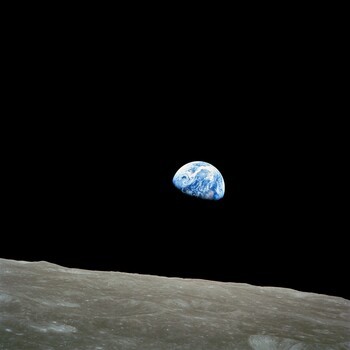
The most influential environmental photograph ever taken was not on anyone's shot list. It happened because a rolling spacecraft swung a blue planet into view over a gray horizon, and Bill Anders had about a minute to find color film before the moment was gone. When he first raised the camera, his commander told him to stop.
You have almost certainly seen the frame. Earth hangs half-lit above a barren lunar surface, small and unmistakably fragile against black space. It is one of the most reproduced images in history, and the standard version of how it came to be gets a lot wrong. The truth is messier, more rushed, and more human than the tidy legend that grew up around it.
A Mission That Was Never Supposed to Land
Apollo 8 launched on December 21, 1968. Aboard were Frank Borman in the commander's seat, Jim Lovell flying as command module pilot, and Anders holding the lunar module pilot title, even though the flight carried no lunar module at all. The mission was a bold, somewhat improvised leap: NASA moved up the plan to send a crew all the way to the Moon and back without any lander, partly out of concern that the Soviets were close to their own circumlunar shot.
The crew became the first humans to leave low Earth orbit and travel to another world. They looped the Moon ten times over about twenty hours, scouting future landing sites and running the navigation and engine burns that a real landing would later depend on. Anders' job was largely photographic. He was tasked with documenting the lunar surface in detail, and the flight plan mapped out which craters and which passes he was supposed to shoot.
Photographing Earth during those lunar passes was not part of that plan. Earth photography was a broader Apollo 8 objective, but in orbit around the Moon the astronauts were pointed at the surface, both literally and in terms of their assignments. For the first three orbits, the spacecraft's orientation kept the lunar surface filling the small windows, and Earth stayed out of the frame entirely. That was by design. The Moon was the target, and every checklist item pushed the crew's attention downward, toward the cratered ground sliding past below them.
"Don't Take That, It's Not Scheduled'
Everything changed on the fourth orbit. Borman rolled the spacecraft to a new attitude, and as the capsule turned, the Moon's horizon dropped and Earth climbed into view through the window. Nobody had staged it. The crew had simply reoriented, and the geometry did the rest.
Anders saw it first. The mission audio tape captured his reaction almost exactly as you would expect from someone watching his home planet rise over an alien landscape. "Oh my God! Look at that picture over there!" he said. "There's the Earth coming up. Wow, that's pretty." He grabbed the camera he already had in hand, loaded with black-and-white film, and fired off a monochrome frame.
Then came the line that makes the whole story. Borman, half joking, told him to knock it off. "Hey, don't take that, it's not scheduled," the commander said. It was a pilot's reflex, the instinct of a man running a mission by the book on a flight where deviations could kill you. Anders ignored it, which is the correct instinct for a photographer, and immediately started hunting for the right film.
"You got a color film, Jim?" he asked. "Hand me that roll of color quick, would you." Lovell scrambled for a magazine of color film while the scene drifted. By some accounts the crew fumbled for the better part of a minute before the color roll was loaded and the camera was ready. Earth was still there, and Anders managed to squeeze off two color exposures before the view slid out of the window. Lovell's voice on the tape says it plainly: "Oh man, that's great."
For years the credit went to the wrong man. Popular accounts, and even some official ones, said Borman took the picture, or at least the first black-and-white frame. He did not. As the Smithsonian and NASA's own reconstruction of the onboard tape and film magazines later confirmed, Anders shot all of them, the monochrome frame and both color frames. The commander who said "don't take that" was not the one holding the camera.
The Frame Itself
The camera was a Hasselblad 500 EL, a Swedish medium-format body fitted with an electric drive so the crew could advance film in bulky pressure gloves. It had no reflex viewfinder. Instead it carried a simple sighting ring, so Anders was essentially aiming, not composing through the lens. The lens on the camera at that moment was a 250mm, which he had been using for tight shots of the lunar surface rather than anything wide.
The film was a custom 70mm color reversal stock, a thin-base Ektachrome variant (rated around ASA 64) developed by Kodak specifically for the mission's film magazines. The exposure that produced the color Earthrise was made at 1/250 second at f/11. Lovell can be heard reading those settings on the tape, part of the quick back-and-forth as the crew tried to nail the shot before it disappeared.
One last detail is worth keeping in mind. The version you have seen on posters and stamps is rotated. In the raw frame, the lunar horizon runs roughly vertical, because of how the spacecraft was oriented when Anders shot it, with Earth off to the side rather than directly overhead. NASA turned the image so the horizon sits at the bottom and Earth appears to rise, which matches how we instinctively read a landscape. The picture that launched a movement is, in a small way, a rotation of what the crew actually saw.
None of that diminishes it. A 250mm optic, a fixed sighting ring, a body built for a gloved hand, and a stock that no longer exists in that form combined for a frame that was equal parts preparation and luck. If you want to shoot the same emulsion family today, Kodak still makes a color reversal film under the Ektachrome name, and Hasselblad still builds cameras, though the modern Hasselblad lineup is a long way from a 1968 lunar body.
The Photograph That Rewired How We See Ourselves
Anders had gone to the Moon and come back with the definitive portrait of Earth. His own summary of the trip became almost as famous as the picture. "We came all this way to explore the Moon, and the most important thing is that we discovered the Earth," he said. That is not a throwaway line. Before Apollo 8, no human being had ever seen the whole planet float free in space with their own eyes.
The image moved fast. It ran in newspapers and magazines within days, reached the cover of the Whole Earth Catalog in 1969, and appeared on a United States postage stamp issued that May. The day after Anders took the frame, and before the crew had even splashed down, poet Archibald MacLeish published a front-page New York Times essay about riders on the Earth together. The first Earth Day followed in 1970, and Earthrise became one of its emblems, a single frame arguing that the planet was small, finite, and worth protecting.
The photographer Galen Rowell called it "the most influential environmental photograph ever taken," and the label stuck because it is hard to argue with. The picture did not add a single fact about ecology. What it altered was the vantage point from which we understood ourselves. Seen from a quarter million miles away, national borders vanish, the whole planet hangs small against the black, and it looks exactly as vulnerable as it is. That perspective shift did work that no chart or speech could.
Anders spent the rest of his life as the man who took it. He flew no more space missions, moved into government and industry, and kept flying vintage aircraft for pleasure. On June 7, 2024, at 90, he was piloting a Beechcraft T-34 Mentor alone when it crashed into the waters off the San Juan Islands in Washington State. The astronaut who almost did not get the shot, and who was told mid-scramble that it was not scheduled, left behind a frame that outran the mission it was attached to.
Lead image — Image: NASA/Bill Anders, public domain. Source.
What's Your Reaction?
 Like
0
Like
0
 Dislike
0
Dislike
0
 Love
0
Love
0
 Funny
0
Funny
0
 Wow
0
Wow
0
 Sad
0
Sad
0
 Angry
0
Angry
0






Comments (0)