

How Can 1980’s ‘The Return of the King’ Spoil Everything — and Ruin Nothing?

On Friday nights, IndieWire After Dark honors fringe cinema in the streaming age with midnight movies from any moment in film history.
First, the BAIT: a weird genre pick, and why we’re exploring its specific niche right now. Then, the BITE: a spoiler-filled answer to the all-important question, “Is this old cult film actually worth recommending?”
Note: This is part two of IndieWire After Dark‘s three-part animated “Lord of the Rings” series! Have you watched 1977’s “The Hobbit” yet?
The Bait: A Once and Future Sequel
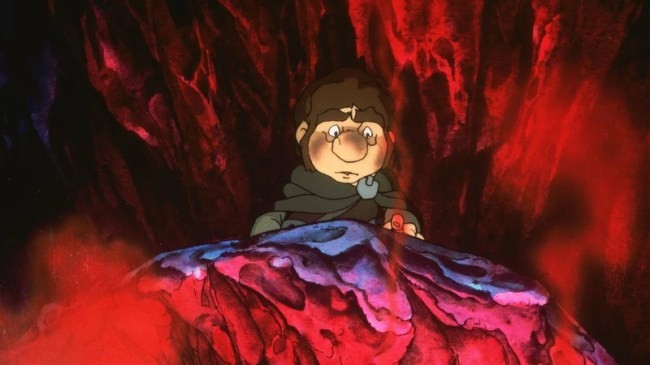
A fascinating case study for the perils of skipping straight to the good part, 1980’s Rankin/Bass musical/fantasy/animated psychedelia TV movie “The Return of the King” doesn’t even cover the whole of the final book in J.R.R. Tolkien’s “The Lord of the Rings” series. Those who’ve seen the Peter Jackson films will recognize the Battle of Pelennor Fields and Frodo and Sam’s long march to Mount Doom on offer here. Plus, signature some Rankin/Bass folk interludes that have a lot less clarity (or indeed coherence) than the ones in their 1977 telling of “The Hobbit.”


If ever there’s been a “LOTR” adaptation to be held lightly — split into eighths like a pot brownie and nibbled on rather than devoured — it is this one. Which is not to say “Return of the King” doesn’t have its charms. The animation style by Studio Ghibli forerunner Topcraft is a fascinating melange of medievalisms and Art Nouveau: an almost storybook way of rendering this world that can’t help but feel rare and beautiful in this, our collapsing Age of “live-action” remakes and Minions spin-offs. But the double-edged sword of Jackson’s films’ staying power is that the aesthetic of them has so imprinted onto “serious” epics and high fantasy stories, from “Game of Thrones” to “The Odyssey,” that it’s easy to forget other interpretations of Mordor are possible.
“The Return of the King” is very much another interpretation, and as a means of keeping After Dark’s revisitation of the IP’s animated era ongoing? It’s worth preserving for its potential.
As with “The Hobbit,” the Rankin/Bass monsters are much less humanoid and more wrinkly wee beasties — both to their benefit and to ours. The one true bop among the musical interludes absolutely has to be the all-orc banger, “Where’s there’s a whip, there’s a way.” And a lot of the sound effects and voice filtering, especially for the Lord of the Nazgul (John Stephenson), are more sci-fi than fantasy coded, which has a fascinating effect. There’s a rendering of Sauron’s Eye here that’s unhinged and almost unmoored from reality in the best way imaginable. In that sense, it’s energizing to see a fantasy story be this openly fantastical.
Unfortunately, “The Return of the King” is also spectacularly uninterested in coherent exposition, tying itself into a plate of pretzel knots just to set the stage. It starts with Bilbo and Frodo Baggins (both Orson Bean, reporting again for duty after voicing Bilbo in “The Hobbit”) along with their friend Gandalf the wizard (John Huston; yes, that John Huston), and Frodo’s faithful servant Samwise (Roddy McDowell; yes, that Roddy McDowell) sitting around in Rivendell telling old, forgetful Bilbo about their adventures getting rid of his old ring. But also there’s a balladeer who starts singing about the quest of the Fellowship of the Ring? And also there’s a voiceover?
There’s a lot going on — clearly too much to pronounce any of Tolkien’s placenames correctly, so just let go of that now, nerds, lest ye despair. No doubt Romeo Muller had legitimate concerns about losing people over the ABC commercial breaks. But man, the first like 20 minutes of this movie are rough going… although, probably not as rough going as poor Sam’s attempt to break into Cirith Ungol, where Frodo has been taken captive when our tale within a tale begins.
If I did not know the books well enough to catch when characters are just straight up quoting them verbatim, then I am not sure what I would make of, say, the way that this movie chooses to handle the madness the One Ring can induce — or the introduction of Denethor (William Conrad) only to have him order his own fiery death (but offscreen) like… five minutes later. I’m not sure I’d feel much for King Theoden (Don Messick), who just kinda rides in on a horse only to be bucked off it and die. Meanwhile, Aragorn (Theodore Bikel) is kinda big and buff and beardy, and that’s it.
But for worse and, at times, even for better, the main legacy of “The Return of the King” is its incompleteness. It’s often mistaken for the sequel to the 1978 Ralph Bakshi “The Lord of the Rings,” which adapts the first two parts of Tolkien’s epic, “The Fellowship of the Ring” and “The Two Towers.” Bakshi and Rankin/Bass developed the projects separately, of course. Bakshi’s vision is different, and we’ll be exploring that movie next week. But once Warner Brothers had the rights to both, it started packaging both films and “The Hobbit” as a trilogy of sorts. Still, “The Return of the King” feels like its own discrete thing. And it does so, perhaps, in spite of itself.
Given the working title here was once “Frodo, The Hobbit II,” the Rankin/Bass team clearly wanted to double down on what had already worked for them. But the 1980 special is also darker, more bittersweet, and less fully formed — seemingly stuck in an eternal search for an origin, for a counterpart, for ground on which to build. Even then, it’s always satisfying to see the Dark Tower crumble, however unstable its base. —Sarah Shachat
The Bite: Bilbo > Frodo (or, Damning by Faint Wikipedia Page)
When Sarah and I watched 1977’s “The Hobbit” a few weeks back, I vowed the first Rankin/Bass affair would not be my last. Still, catapulting into a time jump that had the audacity to hand-wave a huge part of Tolkien’s plot — and make me envision America’s sweetheart Elijah Wood with a mere nine fingers? That was harrowing. Even so, I pressed on.
It’s funny. Having grown up in the 2000s, you’d think the actual story of “The Lord of the Rings” would have seeped into my life more than it has. But before now, my understanding of the live-action films was almost entirely rooted in the fame of their director, his millennial cast, and eventually the cultural event that was Martin Freeman’s portrayal of Bilbo Baggins.
By all accounts, if I had experienced this story through the evolution New Line intended, then I would have met Frodo before Bilbo. That chronology worked explosively well for those who saw Jackson’s rendition unfold at the box office. And yet, for me, I question whether the repertory journey would have been half as compelling if I’d encountered the characters in that order.
I’ll admit, it doesn’t seem like Frodo has put his best foot forward here, and as a diehard fan of “Come to Daddy,” “Eternal Sunshine of the Spotless Mind,” and “Sin City,” I’m confident Wood will get a lot farther impressing me in Jackson’s movies. But approaching the hero’s journey from opposite angles, Frodo and Bilbo seem written to connect with two fundamentally different types of people. While the Frodos among us are defined by the burdens we agree to carry, the Bilbos must first be convinced there’s something worth leaving home to find.
Perhaps, I was once a Frodo. But these days, I’m a Bilbo, through and through. And somewhat paradoxically identifying more with the character I’ve also seen at the older, prequel hero reinvigorated parts of me that I wish had been just a bit more hopeful when I was younger.
For years, I’ve suspected my life would be fundamentally better if I had been a teenager in the ’80s. (I find the golden era of slashers particularly appealing.) And thanks to Rankin/Bass, I finally got a taste of that experience. Sitting helplessly before an epic fantasy already in progress — desperately trying to determine which of several interchangeable little men was now carrying the weight of the world and why — I got to properly stumble into a narrative for the first time in many years.
That might sound like I watched “The Return of the King” incorrectly, but because of our good pal Sarah, you and I both know I didn’t. Jumping directly from Bilbo’s first adventure to the final movement of Frodo’s quest is how many audiences go to experience this story originally. Plenty of viewers, particularly children, watched Bilbo return from the Lonely Mountain in 1977. Then, they tuned in three years later, and discovered that his funny little invisibility ring had nearly brought about the apocalypse… and cost some guy they’d never met his finger.
Effectively going “out” the “in,” the 1980 follow-up film seems like an objectively misguided approach to the structure Tolkien’s story. But it’s also strangely freeing.
By meeting Bilbo first, your curiosity about this storytelling universe gets teased out gradually. And in turn, your emotional connection to its most potent themes gets stronger as you head deeper into the darkness — reminded that every step you’ve taken was done so with curatorial courage and purpose, ring or no ring. Sure, “Return of the King” is the lesser of the two Rankin/Bass movies. But enjoying it anyway made me want to explore Tolkien more, not less. That’s a testament to his literary prowess and a reminder that he did write the books this way.
Watching the Academy Award-winning aughts movies has felt like a daunting task for me until now, partly because Jackson’s work is so legendary that it has felt shameful to not have seen it up to this point. After 1980’s “The Return of the King,” I know a lot more than I once did. Yes, Frodo loses a finger. Gollum and the Ring also fall into Mount Doom, while Sauron is defeated, Aragorn goes on to rule, and Éowyn, disguised as a male warrior, kills the Witch-king of Angmar. (Someone please tell me that’s Cate Blachett’s character. Please!)
But exiting Middle-earth beside cartoon Frodo, there’s a sense that this 98-minute musical adaptation is truly just the beginning. Arriving between “Lord of the Rings” eras, 1992’s “Cool World” is the sleazy masterpiece — about a horny pinup drawing and the cop who wants to arrest her for having sex with a human (uh, sure!) — that introduced me to Ralph Bakshi. It’s also the deep-cute genre recommendation that started this column in the summer of 2023.
Next week, we’ll see how his sensibilities do filling in some of the gaps Rankin/Bass left behind. No matter what, it probably won’t beat the joy I got reading this line from the 1980 version’s Wikipedia page: “Both critics and fans gave ‘The Return of the King’ an indifferent reception.” Accurate? Who knows. But it is incredible. And not all those who shrug are lost. —Alison Foreman
Read more installments of After Dark, IndieWire’s midnight movie club:
- ‘Butcher, Baker, Nightmare Maker’ Is the Cult Slasher Every Horror Fan Should Have on Tap
- ‘Evil Dead Burn’ Just Made Sam Raimi’s ‘Army of Darkness’ Essential Viewing Again
- 1997’s ‘The Postman’ Will Restore Your Faith in Other People on America’s 250th Birthday
- FIFA Can’t Beat Michael Caine Challenging Literal Nazis to Soccer in 1981’s ‘Victory’
- You Won’t Stop Quoting Steven Seagal Once You See 1996’s ‘The Glimmer Man’
What's Your Reaction?
 Like
0
Like
0
 Dislike
0
Dislike
0
 Love
0
Love
0
 Funny
0
Funny
0
 Wow
0
Wow
0
 Sad
0
Sad
0
 Angry
0
Angry
0






Comments (0)