

How Netflix’s ‘Little House on the Prairie’ Reboot Reframes Its Iconic Story Through Indigenous Eyes
[Editor’s note: The following interview contains some spoilers for the first season of “Little House on the Prairie.”]
In developing her new Netflix adaptation of “Little House on the Prairie,” showrunner Rebecca Sonnenshine knew from the outset that she wanted to expand the narrative beyond the scope of Laura Ingalls Wilder’s classic children’s novels. Her vision for the first season finally introduces a long-overdue perspective, paralleling the Ingalls family’s illegal settlement in Kansas with the Osage Nation’s fight to remain on their own land in the 19th century.
In this retelling, the Ingalls — patriarch Charles (Luke Bracey), matriarch Caroline (Crosby Fitzgerald), and sisters Laura (Alice Halsey) and Mary (Skywalker Hughes) — are forever changed by their bond with a neighboring Osage family, the Mitchells, whose young daughter, Good Eagle (Wren Zhawenim Gotts), becomes Laura’s best friend. Over the course of eight episodes, the families are left to grapple with the largely unspoken tension between white settlers and Osage citizens, leading to difficult conversations about land rights.


“The reason to tell this story in 2026 is that we get the opportunity to tell the Osage point of view,” Sonnenshine told IndieWire. “They’re in the book, but we see them from afar. We never get to know them; we don’t get to characterize them. This [show] gives us the opportunity to portray them as parents and children and brothers and sisters. The most exciting thing about this season is that we get to see two families trying to figure out what the best future is in this country for them.”
Sonnenshine’s more inclusive reboot rights one of the major wrongs of Ingalls Wilder’s “Little House” books and past screen adaptations — including the beloved NBC series that ran from 1974–83 — which scholars and Indigenous groups have increasingly criticized for their racist, dehumanizing depiction of Native Americans. In 2018, the American Library Association stripped Ingalls Wilder’s name from one of its most prestigious awards, citing her works’ “dated cultural attitudes toward Indigenous people and people of color that contradict modern acceptance, celebration, and understanding of diverse communities.”
Although the U.S. Bureau of Indian Affairs has now given federal recognition to 575 tribes, these communities are seldom afforded the opportunity to tell their own stories onscreen. Addressing this gap early on, Sonnenshine recruited Osage Nation citizens to shape the narrative: P. Carter Kristensen wrote Episode 4, while University of Kansas professor Robert Warrior guided the historical framework of the Osage Diminished Reserve.
The production later enlisted Julie O’Keefe, who previously worked on Martin Scorsese’s “Killers of the Flower Moon” and the Netflix western “American Primeval,” to act as the show’s on-set cultural consultant.
 Wren Zhawenim Gotts as Good Eagle and Meegwun Fairbrother as Mitchell in ‘Little House on the Prairie’ERIC ZACHANOWICH/NETFLIX
Having grown up on the Osage reservation in northeastern Oklahoma, O’Keefe was able to fast-track the standard consultation period required for her scripted projects. Relying heavily on the collections at the Osage Museum, she recruited artisans from within her community to help the props department source or create more than 3,000 cultural items for the show. “I’m always wanting to achieve a feeling of a community project from any nation that I work with,” O’Keefe said. “That way, they get to see their work, and they get to understand the story and how it’s being told.”
That steadfast commitment to cultural authenticity came as a great relief to the Indigenous actors — including Meegwun Fairbrother, who plays patriarch William Mitchell. Despite feeling some trepidation about what a new “Little House” story would entail for Indigenous storylines, he was pleasantly surprised to find himself auditioning for a mixed-blood character, noting that these perspectives “generally aren’t told as much” in historical dramas.
As a mixed-blood Ojibwe citizen from Treaty 3 territory in northwestern Ontario, Fairbrother easily drew parallels between the forced displacement of the Osage — once considered among the most powerful Indigenous groups in North America — and the painful history of residential schools in Canada.
“I had to bring my own experience and find the universal truths across all Nations, but then to get specific, it was all about the language for me,” Fairbrother said, crediting Osage language consultant Talee Redcorn for shaping his approach to playing Mitchell. “The best way to honor a Nation is to know their language, and then you understand them as a people.”
 Wren Zhawenim Gotts as Good Eagle and Alice Halsey as Laura Ingalls in ‘Little House on the Prairie’ERIC ZACHANOWICH/NETFLIX
Fairbrother, who grew up with Ojibwe and Cree language systems, had only a few weeks to study Osage before playing a man who serves as the translator — and, by extension, the cultural bridge — between his tribe and the English-speaking settlers. While the white crew members were easily amazed by his quick mastery, Fairbrother was more concerned about trying to impress the actual speakers of the critically endangered language.
“We realized that we achieved that goal when all the Osage chiefs came to set and I was speaking Osage in front of them, and they would come up to me and ask me if I was a speaker,” he said, calling those interactions “the biggest compliment.”
Long before the Ingalls family arrived in Kansas, the Osage people bore the brunt of white settlers recklessly seizing their land without consultation. “One of the things that was revealed to me in my research was that there was actually a lot of cross-cultural sharing between the Osage and the missionaries that originally came into that area,” Fairbrother said. “The Osage were genuinely interested in Christianity, in the Bible, and all the things that these missionaries were sharing with them.”
“But there was one aspect that they just did not agree on,” which was the missionaries’ belief that they “have dominion over the land,” Fairbrother continued. “The Osage were like, ‘No, that’s wrong. We look after the land. We protect the land. We live with the land. We share the land.’”
Because Charles is “the first person who really shows empathy in that whole white world to the Osage,” Mitchell gradually “starts to open up to sharing that idea of reciprocity and helping each other,” Fairbrother said. The two men certainly share more in common than their wives, Caroline and White Sun (Alyssa Wapanatâhk), who are initially highly suspicious of each other.
 Meegwun Fairbrother as Mitchell and Wren Zhawenim Gotts as Good Eagle in ‘Little House on the Prairie’ERIC ZACHANOWICH/NETFLIX
Caroline’s deep-seated anxiety about the Osage reaches a fever pitch in Episode 3, when tribe members — including White Sun’s younger brother, Little Puma (Xander Cole) — break into the Ingalls’ newly finished house to reclaim belongings as payback for the family squatting on reservation land. “The thing that we tried to portray with Caroline is that [her attitudes] were all coming from a place of fear,” Sonnenshine said.
Yet, in a surprising departure from the real-life Caroline’s historical hatred of Native Americans, this version of the character ultimately befriends White Sun and teaches Good Eagle.
Sonnenshine attributes this transformation to a shared maternal bond. “Caroline and White Sun are both married to very open-hearted men who have interesting ideas about changing their future or looking ahead to create this new life for themselves,” she said. “Once you get to know people … it’s not just an idea of another culture, but actually a one-on-one conversation about small things.”
Stepping back from these intimate, personal breakthroughs, the series’ broader conflict over land ownership comes to a head in the penultimate episode, which was penned by Cherokee writer Tom Hanada and helmed by Navajo filmmaker Sydney Freeland. Titled “A Softer Note in the Sound of the Wind,” Episode 7 dramatizes a tribal council meeting that led to the signing of the Drum Creek Treaty of 1870, which moved all Osage out of Kansas into modern-day Oklahoma.
“In a lot of ways, ‘Little House on the Prairie’ is a hopeful show,” Fairbrother said. “But bringing this show to a new generation, I don’t think you can, I don’t want to say whitewash, but I don’t think you can cover up what happened historically and tell a hopeful story. It has to be almost bittersweet.”
The inspiration for that meeting came from the “Little House” novel. “There’s a chapter called ‘Indian Jamboree,’ and we were like, ‘What was this? What could it have been?,’” Sonnenshine recalled. After uncovering the history behind it, the team looked for a way to weave the fictional characters into the real event. “Robert said, ‘Oh, yeah, there would be white settlers there that were also interested in what would happen [to the land].’ So I’m like, ‘Perfect. Then we can put our character [Charles] into this situation.’”
 Tahlee Redcorn as Governor Joe and Meegwun Fairbrother as Mitchell in in ‘Little House on the Prairie’ERIC ZACHANOWICH/NETFLIX
To make the historic meeting feel as authentic as possible, O’Keefe and the creative team relied on archival research from the Osage Museum, as well as rare 1870s photographs sourced from the U.S. Department of the Interior. Beyond weaving the pivotal Osage leader Governor Joe into the script, the production team constructed an entire Osage village, alongside the specific lodge where the meeting took place.
When members of the Osage Nation arrived on set, they were “gobsmacked” by the attention to detail. “They tried on their costumes, and they couldn’t believe them,” recalled O’Keefe, who cast actual tribal citizens — including the seven chiefs featured in the historic meeting scene. “I was using men from our tribe to really help each one of the team members dig down into that time period and have something truly authentic come out of it.”
For Sonnenshine, the goal was to immerse both the characters and the viewers in the harsh realities of the forced removal process. The showrunner noted that while the Osage ultimately lacked a true choice, the series emphasizes their agency in trying to make the best of an impossible situation.
“What’s really interesting and beautiful about the Osage story is that they decided not to break apart, not to spread their land amongst each other individually. They kept it as a whole, and they also didn’t give away the rights to their minerals and resources,” Fairbrother said, noting that retaining those rights has allowed the nation to preserve its culture to this day. This strategic refusal is a major plot point in the episode, reflecting a history that led the New York Times to report in 1921 that the Osage had the greatest per capita wealth in the world.
In the show, after the governor abruptly decides that he cannot in good conscience sign the treaty due to the obligations he feels toward his ancestors, Mitchell is able to bring both sides back to the negotiating table. In the end, “Mitchell was able to negotiate this really complex and tough deal to move his whole people across the land to save them,” Fairbrother said, “even though it looks maybe like it’s a bit of a betrayal.”
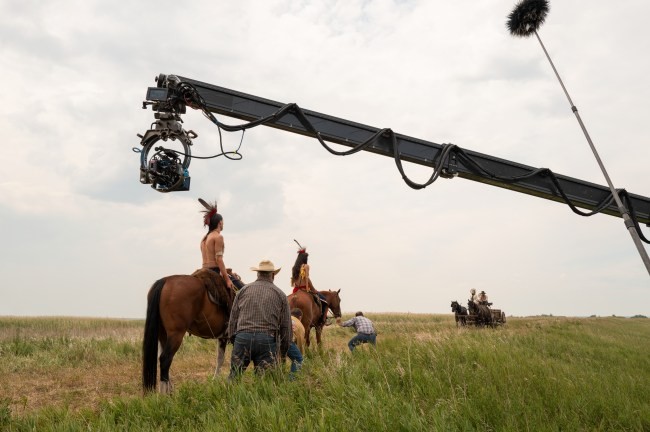
 Behind the scenes with Rebecca Amzallag as Lacey, Luke Bracey as Charles Ingalls, Meegwun Fairbrother as Mitchell, and Xander Cole as Little Puma in ‘Little House on the Prairie’ERIC ZACHANOWICH/NETFLIX
Mitchell relays that sentiment in a later conversation with Charles, who apologizes for believing the federal government was giving the Osage a fair deal. “Charles is saying, ‘I was believing a story that I was being fed, and I see now from going through this [ordeal] that it was a myth, and that what is happening here is not right. I’m sorry for that.’ I think that [scene] was important to, for one thing, explain how [settlers] got themselves into these situations,” Sonnenshine said. “I don’t think that everybody was like, ‘We’re going to go in and steal land!’ They had flyers that said, ‘Free land!’ They didn’t know exactly what’s happening, but they wanted to believe that that was the truth.”
After the Ingalls spent most of their time in Kansas wondering whether they would be able to stay on the land where they built their “little house,” the end result leaves the family feeling deeply conflicted. “That’s why we end [Episode 7] with Charles and Laura listening to this song,” Sonnenshine added of the Osage’s haunting song of mourning, which is heard the morning after the deal is signed. “We just sit there as they listen and absorb what all their hopes and dreams have resulted in.”
In the wake of the treaty ratification, Mitchell and White Sun must decide whether they will stay behind to maintain their homestead or leave with the rest of their community. In the end, after a fire nearly engulfs the town, they come to the difficult decision to leave — but it’s not without heartache. “White Sun and Mitchell’s daughter [Julia] died and is buried on the land, and White Sun is like, ‘If we leave, we’re going to be leaving a part of ourselves here in the ground, because that’s who we are,’” Fairbrother explained. “‘So that’s why it’s such a hard choice for us to leave. But in order to survive, we have to move on.’ That was just the truth of what happened at those times.”
By the end of the finale, the Ingalls leave for Walnut Grove, Minnesota, with the charmingly gruff Mr. Edwards (Warren Christie), while the Mitchells relocate to the new “Indian Territory” in Oklahoma. When asked whether the Mitchells could reappear in the Ingalls’ lives in another town, Sonnenshine said that while “anything is possible” in future seasons, the writers “are trying to remain true to the spirit of what would’ve really happened, which is the Mitchells went their way and the Ingalls went theirs.”
 Alice Halsey as Laura Ingalls and Luke Bracey as Charles Ingalls in ‘Little House on the Prairie’Courtesy of Eric Zachanowich / Netflix
“That doesn’t mean [it’s] the last we’ll see of them, because, obviously, they’re incredibly interesting characters and everybody will fall in love with them,” she clarified. “All through Episode 8, Good Eagle and Laura are talking about how they’re going to write this book together. They’re going to make a book of letters, so we do have plans to follow through on that relationship.”
For now, Fairbrother — who previously parlayed his onscreen roles in Canadian series “Burden of Truth” and “SkyMed” into writing positions — is focused on taking a more active role in telling Indigenous stories, which he hinted could include returning to work on “Little House” behind the camera. “I’m wanting to work in more of the directing side as well,” he said, “so I am going to stay connected to the show in different ways.”
Going forward, Sonnenshine confirmed, the writers intend to continue exploring the lived experiences of other Native Americans who cross paths with the central family. “The Ingalls move around a lot; the books are [about] them moving around,” she said. “Every inch of this land that we are all living on right now was inhabited by Indigenous peoples. So, of course, anywhere they go, there is a story to be told about the Indigenous peoples who lived there.”
The first season of “Little House on the Prairie” is now streaming on Netflix. It has already been renewed for a second season.
What's Your Reaction?
 Like
0
Like
0
 Dislike
0
Dislike
0
 Love
0
Love
0
 Funny
0
Funny
0
 Wow
0
Wow
0
 Sad
0
Sad
0
 Angry
0
Angry
0











Comments (0)