

How Sharp Is the Thypoch Simera 75mm f/1.4 Wide Open?
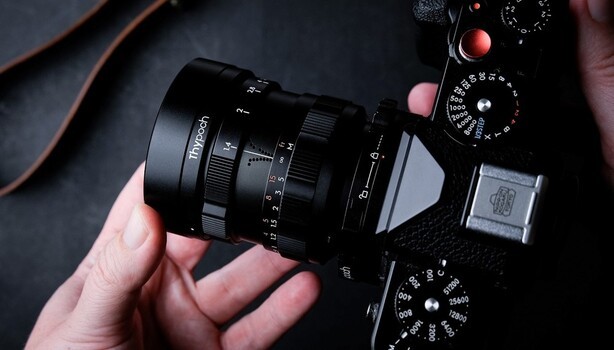
A 75mm f/1.4 is a short telephoto that isolates a subject without forcing you to back across the room, and the Thypoch Simera 75mm f/1.4 brings that focal length to Leica M mount in an all-metal body. Because it's a manual focus rangefinder lens, plenty of people will adapt it to mirrorless cameras, which raises fair questions about how much performance survives the trip.
Andrei Dima mounts the Thypoch Simera 75mm f/1.4 on a Nikon Zf and on Fujifilm X-series bodies to see where the glass starts to struggle. The barrel, mount, focus ring, and aperture ring are all metal, and the focus ring turns smoothly with enough throw to land focus at f/1.4 without much fuss. The aperture ring clicks by default, though a switch lets you de-click it for video. There's no weather-sealing and no gasket at the mount, and Dima points out small openings near the focus scale where water could get in, so rain calls for some care. Focus breathing is also visible. That makes focus pulls tricky, even though the rendering itself suits video well.
On the Zf's 24-megapixel sensor, the center is sharp from f/1.4, with plenty of detail and strong micro contrast. Dima calls it the best-performing Simera lens he has tested wide open, which is a notable claim given how many fast manual lenses soften up at their widest setting. The corners lag behind at first, and he suspects the adapter may play a part. By f/4, the frame is sharp from corner to corner. Color makes the strongest impression, with a slightly vintage look and rich contrast that fits the Zf's retro design. Chromatic aberration and vignetting both appear wide open, and Dima shows how quickly each one fades as you stop down.
Leica M mount has a flange distance of 27.8 mm, while Nikon Z sits at 16 mm, so an M-to-Z adapter is a simple tube with no glass inside. That short, clean conversion is why M-mount lenses have become such a popular way to get manual focus character on mirrorless bodies. Brands like Thypoch, TTArtisan, 7Artisans, and Light Lens Lab now design M-mount glass with both Leica shooters and adapters in mind. One technical detail helps explain edge performance: Leica's digital sensors use thin cover glass tuned for rangefinder lenses, while most mirrorless cameras have thicker sensor stacks. Light striking the edge of the frame at a steep angle passes through more of that glass, which can soften corners. Wide angle M lenses tend to feel this more than short telephotos, because their light reaches the corners at sharper angles. On the Zf specifically, a few settings make adapted lenses much easier to live with. You can enter the focal length in the non-CPU lens data menu so the in-body stabilization corrects properly for a 75mm, and focus peaking combined with magnified view makes hitting critical focus at f/1.4 far more reliable than relying on the focus scale alone.
The Fujifilm results tell a different story. On an APS-C sensor, the 75mm frames like roughly a 112mm lens on full frame, which turns it into a tight portrait or detail lens. At f/1.4, the image holds good detail and contrast but looks slightly soft, and you need f/2 to match what the Zf delivers wide open. From there, the two systems perform about the same. Chromatic aberration is more pronounced on the smaller format, which is something to plan for if you shoot backlit subjects or high-contrast edges. Beyond sharpness, Dima tests the 16-blade aperture for sunstars, looks at how the bokeh transitions from in focus to out of focus, checks how flare behaves wide open, and puts the 60 cm minimum focus distance to work, which is close for a 75mm M-mount lens.
The sample photos and footage in the video above show how that rendering holds up on both cameras.
What's Your Reaction?
 Like
0
Like
0
 Dislike
0
Dislike
0
 Love
0
Love
0
 Funny
0
Funny
0
 Wow
0
Wow
0
 Sad
0
Sad
0
 Angry
0
Angry
0








Comments (0)